Science Explorer Back to mapMap
Discussion
University · Douala · Cameroon

Institut Universitaire de la Côte

In research, Institut Universitaire de la Côte stands highest in Social Sciences (#8,832 of 14,833 worldwide), over all time.

World rank, all time
#25,640
of 34,923
Rank in Cameroon
#23
of 34
Research works
269
▼ 79% vs 2018-21
Citations
276
1.0 per fractional work
Top-10% rate
10.0%
all institutions 10.0%
vs its own fields
0.96×
1.00× is exactly expected
Open access
94%
world 40%
International
10%
world 18%
Institut Universitaire de la Côte

What is Institut Universitaire de la Côte known for in research?

The fields where it stands highest, over all time, ranked among every institution above the floor in each field.

FieldWorld rankWhere that sitsTop-10% rateWorks
Social SciencesDomain #8,832 of 14,833 9.5%207

Each strip is that field's whole ranked pool, with the notch where Institut Universitaire de la Côte sits in it, in the colour of the band that rank falls in. The track under the rate is the rate itself: it carries no average mark, because the average differs by field (from about 6% in Dentistry to 21% in Economics).

Which fields of science does Institut Universitaire de la Côte work in?

In 2022-now, 42% of research at Institut Universitaire de la Côte is in Physical Sciences, 35% in Social Sciences. Its largest fields are Engineering (24%), Medicine (13%), Social Sciences (10%). It does 1.3× the world's share of Social Sciences.

Physical Sciences: 9 fractional works · 42.4% of its workEngineering: 5 fractional works · 24.1% of its workCivil and Structural Engineering: 1 fractional works · 5.8% of its workControl and Systems Engineering: 1 fractional works · 5.0% of its workElectrical and Electronic Engineering: 1 fractional works · 4.4% of its workSafety, Risk, Reliability and Quality: 1 fractional works · 2.4% of its workBuilding and Construction: 0 fractional works · 1.6% of its workMechanical Engineering: 0 fractional works · 1.6% of its workBiomedical Engineering: 0 fractional works · 1.4% of its workOcean Engineering: 0 fractional works · 1.2% of its workAutomotive Engineering: 0 fractional works · 0.8% of its workComputer Science: 1 fractional works · 6.2% of its workArtificial Intelligence: 1 fractional works · 2.7% of its workComputer Networks and Communications: 1 fractional works · 2.7% of its workInformation Systems: 0 fractional works · 0.5% of its workComputer Vision and Pattern Recognition: 0 fractional works · 0.3% of its workEnvironmental Science: 1 fractional works · 5.6% of its workEnvironmental Engineering: 1 fractional works · 3.0% of its workHealth, Toxicology and Mutagenesis: 0 fractional works · 0.8% of its workWater Science and Technology: 0 fractional works · 0.8% of its workEcology: 0 fractional works · 0.4% of its workManagement, Monitoring, Policy and Law: 0 fractional works · 0.3% of its workSmaller subfields together: 0 fractional works · 0.3% of its workPhysics and Astronomy: 0 fractional works · 2.4% of its workStatistical and Nonlinear Physics: 0 fractional works · 2.4% of its workMaterials Science: 0 fractional works · 1.8% of its workPolymers and Plastics: 0 fractional works · 1.1% of its workMaterials Chemistry: 0 fractional works · 0.7% of its workSmaller subfields together: 0 fractional works · 0.0% of its workEarth and Planetary Sciences: 0 fractional works · 1.6% of its workAtmospheric Science: 0 fractional works · 0.8% of its workGeophysics: 0 fractional works · 0.5% of its workGeochemistry and Petrology: 0 fractional works · 0.3% of its workChemistry: 0 fractional works · 0.7% of its workOrganic Chemistry: 0 fractional works · 0.5% of its workSmaller subfields together: 0 fractional works · 0.1% of its workSocial Sciences: 7 fractional works · 34.6% of its workSocial Sciences: 2 fractional works · 9.6% of its workSociology and Political Science: 0 fractional works · 2.0% of its workAnthropology: 0 fractional works · 1.9% of its workSafety Research: 0 fractional works · 1.7% of its workDemography: 0 fractional works · 1.6% of its workTransportation: 0 fractional works · 0.8% of its workEducation: 0 fractional works · 0.5% of its workGeography, Planning and Development: 0 fractional works · 0.4% of its workCultural Studies: 0 fractional works · 0.3% of its workGender Studies: 0 fractional works · 0.2% of its workHealth: 0 fractional works · 0.2% of its workArts and Humanities: 2 fractional works · 7.6% of its workClassics: 1 fractional works · 4.7% of its workHistory: 0 fractional works · 2.4% of its workArcheology: 0 fractional works · 0.3% of its workConservation: 0 fractional works · 0.3% of its workDecision Sciences: 1 fractional works · 5.3% of its workManagement Science and Operations Research: 1 fractional works · 3.7% of its workInformation Systems and Management: 0 fractional works · 1.6% of its workEconomics, Econometrics and Finance: 1 fractional works · 5.3% of its workEconomics and Econometrics: 1 fractional works · 4.7% of its workFinance: 0 fractional works · 0.5% of its workBusiness, Management and Accounting: 1 fractional works · 5.1% of its workMarketing: 1 fractional works · 3.2% of its workStrategy and Management: 0 fractional works · 1.6% of its workBusiness and International Management: 0 fractional works · 0.3% of its workPsychology: 0 fractional works · 1.8% of its workSocial Psychology: 0 fractional works · 1.6% of its workClinical Psychology: 0 fractional works · 0.2% of its workHealth Sciences: 3 fractional works · 14.6% of its workMedicine: 3 fractional works · 13.4% of its workInfectious Diseases: 1 fractional works · 3.2% of its workEndocrinology, Diabetes and Metabolism: 1 fractional works · 3.2% of its workEpidemiology: 0 fractional works · 1.3% of its workPublic Health, Environmental and Occupational Health: 0 fractional works · 1.1% of its workSurgery: 0 fractional works · 1.0% of its workEmergency Medicine: 0 fractional works · 0.9% of its workBiochemistry: 0 fractional works · 0.8% of its workCardiology and Cardiovascular Medicine: 0 fractional works · 0.8% of its workHepatology: 0 fractional works · 0.4% of its workNephrology: 0 fractional works · 0.4% of its workSmaller subfields together: 0 fractional works · 0.3% of its workHealth Professions: 0 fractional works · 1.1% of its workGeneral Health Professions: 0 fractional works · 0.7% of its workHealth Information Management: 0 fractional works · 0.3% of its workSmaller subfields together: 0 fractional works · 0.1% of its workNursing: 0 fractional works · 0.1% of its workLife Sciences: 2 fractional works · 8.4% of its workAgricultural and Biological Sciences: 1 fractional works · 5.5% of its workPlant Science: 1 fractional works · 3.3% of its workFood Science: 0 fractional works · 1.9% of its workEcology, Evolution, Behavior and Systematics: 0 fractional works · 0.2% of its workBiochemistry, Genetics and Molecular Biology: 0 fractional works · 1.9% of its workMolecular Biology: 0 fractional works · 0.9% of its workBiotechnology: 0 fractional works · 0.8% of its workSmaller subfields together: 0 fractional works · 0.2% of its workImmunology and Microbiology: 0 fractional works · 0.9% of its workVirology: 0 fractional works · 0.7% of its workSmaller subfields together: 0 fractional works · 0.2% of its workNeuroscience: 0 fractional works · 0.2% of its workALL ITS WORKInstitutUniversitaire de…21fractional works, 2022-now
Life Sciences8%Physical Sciences42%Health Sciences15%Social Sciences35%

Each ring splits the one inside it: the four domains of science, their fields, their subfields. Size is fractional works in 2022-now. Every slice is a page; the interactive view zooms down to single topics and colours each by how much more of it this institution does than the world.

Its 4 domains and 20 fields, with their numbers
    1. Engineering524.1%
    2. Computer Science16.2%
    3. Environmental Science15.6%
    4. Physics and Astronomy02.4%
    5. Materials Science01.8%
    6. Earth and Planetary Sciences01.6%
    7. Chemistry00.7%
    1. Social Sciences29.6%
    2. Arts and Humanities27.6%
    3. Decision Sciences15.3%
    4. Economics, Econometrics and Finance15.3%
    5. Business, Management and Accounting15.1%
    6. Psychology01.8%
    1. Medicine313.4%
    2. Health Professions01.1%
    3. Nursing00.1%
    1. Agricultural and Biological Sciences15.5%
    2. Biochemistry, Genetics and Molecular Biology01.9%
    3. Immunology and Microbiology00.9%
    4. Neuroscience00.2%
All of science, and how each field's share has moved since 1950: the Science domain explorer

Field profile

Location quotient across every field it publishes in: outside the ring is more than an institution of this size would be expected to publish, inside it is less.

Agricultural and Biological Sciences: 1.14× its world share, 1 worksAgricultural and Bio…Biochemistry, Genetics and Molecular Biology: 0.35× its world share, 0 worksBiochemistry, Geneti…Immunology and Microbiology: 0.83× its world share, 0 worksImmunology and Micro…Neuroscience: 0.11× its world share, 0 worksNeuroscienceChemistry: 0.43× its world share, 0 worksChemistryComputer Science: 0.79× its world share, 1 worksComputer ScienceEarth and Planetary Sciences: 1.01× its world share, 0 worksEarth and Planetary …Engineering: 1.61× its world share, 5 worksEngineeringEnvironmental Science: 1.14× its world share, 1 worksEnvironmental ScienceMaterials Science: 0.52× its world share, 0 worksMaterials SciencePhysics and Astronomy: 1.07× its world share, 0 worksPhysics and AstronomyHealth Professions: 0.44× its world share, 0 worksHealth ProfessionsMedicine: 0.70× its world share, 3 worksMedicineNursing: 0.27× its world share, 0 worksNursingArts and Humanities: 2.65× its world share, 2 worksArts and HumanitiesBusiness, Management and Accounting: 1.57× its world share, 1 worksBusiness, Management…Decision Sciences: 5.45× its world share, 1 worksDecision SciencesEconomics, Econometrics and Finance: 2.47× its world share, 1 worksEconomics, Econometr…Psychology: 0.59× its world share, 0 worksPsychologySocial Sciences: 0.76× its world share, 2 worksSocial Sciences1×world share
more than its size predictsabout as predictedless

Rings at 0.5×, 1× and 2×. Widest outward: Decision Sciences, 5.5×. Every wedge is a field page.

All 20 fields, with their numbers
  1. Decision Sciences5.45×1 works
  2. Arts and Humanities2.65×2 works
  3. Economics, Econometrics and Finance2.47×1 works
  4. Engineering1.61×5 works
  5. Business, Management and Accounting1.57×1 works
  6. Agricultural and Biological Sciences1.14×1 works
  7. Environmental Science1.14×1 works
  8. Physics and Astronomy1.07×0 works
  9. Earth and Planetary Sciences1.01×0 works
  10. Immunology and Microbiology0.83×0 works
  11. Computer Science0.79×1 works
  12. Social Sciences0.76×2 works
  13. Medicine0.70×3 works
  14. Psychology0.59×0 works
  15. Materials Science0.52×0 works
  16. Health Professions0.44×0 works
  17. Chemistry0.43×0 works
  18. Biochemistry, Genetics and Molecular Biology0.35×0 works
  19. Nursing0.27×0 works
  20. Neuroscience0.11×0 works

What are the most cited papers from Institut Universitaire de la Côte?

The most cited paper from Institut Universitaire de la Côte is "Detection of oil slick signatures in SAR images by fusion of hysteresis thresholding responses" (Thomas Kanaa, Emmanuel Tonyé, Grégoire Mercier et al., 2004), with 49 citations. Next come "Lactuca capensis reverses memory deficits in Aβ1‐42‐induced an animal model of Alzheimer's disease" (41) and "Quantum correlations dynamics and decoherence of a three-qubit system subject to classical environmental noise" (40).

Most cited papers
#PaperReleasedCitations
1 Detection of oil slick signatures in SAR images by fusion of hysteresis thresholding responses Thomas Kanaa, Emmanuel Tonyé, Grégoire Mercier et al. Conference paper 30 Jun 2004 49
2 Lactuca capensis reverses memory deficits in Aβ1‐42‐induced an animal model of Alzheimer's disease Paula Alexandra Postu, Jaurès A. K. Noumedem, Oana Cioancă et al. · Journal of Cellular and Molecular Medicine Open access 16 Aug 2017 41
3 Quantum correlations dynamics and decoherence of a three-qubit system subject to classical environmental noise Martin Tchoffo, Lionel Tenemeza Kenfack, Georges Collince Fouokeng et al. · The European Physical Journal Plus Oct 2016 40
4 Determinants of burnout syndrome among nursing students in Cameroon: cross-sectional study Tsi N. Njim, Clarence Mvalo Mbanga, Dave Mouemba et al. · BMC Research Notes Open access 9 Jul 2018 39
5 Experimental determination and modelling of water desorption isotherms of tropical woods: afzelia, ebony, iroko, moabi and obeche Yves Jannot, Abraham Kanmogne, André Talla et al. · European Journal of Wood and Wood Products 10 Nov 2005 39
All 63 most cited papers, with filters and sorting

Which research topics does Institut Universitaire de la Côte publish most on?

By volume in 2022-now: Byzantine Studies and History, Geotechnical and construction materials studies, Impact of AI and Big Data on Business and Society and Energy Load and Power Forecasting.

  1. 1 Byzantine Studies and History Classics 1 works
  2. 2 Geotechnical and construction materials studies Civil and Structural Engineering 1 works
  3. 3 Impact of AI and Big Data on Business and Society Management Science and Operations Research 1 works
  4. 4 Energy Load and Power Forecasting Electrical and Electronic Engineering 0 works
  5. 5 French Historical and Cultural Studies History 0 works
  6. 6 Hydrological Forecasting Using AI Environmental Engineering 0 works
  7. 7 Fault Detection and Control Systems Control and Systems Engineering 0 works
  8. 8 Philippine History and Culture Anthropology 0 works
  9. 9 Machine Fault Diagnosis Techniques Control and Systems Engineering 0 works
  10. 10 Diaspora, migration, transnational identity Demography 0 works

How open and international is its research?

Against the world's own shares: the tick on each track. Both are shares of its output, so they sit on one scale and can be read against each other as well as against the world.

openly available94.2%not open5.8%

World: 40% of research is openly available.

with international co-authors10.4%domestic only89.6%

World: 18% is written across borders.

How has Institut Universitaire de la Côte's research output changed?

Output in 2022-2025 was 79% lower than in 2018-2021.

still counting1990200020102020
grewheldshrank

The same series as a ribbon: one cell per year, darker for more. The line above answers how much; this answers when.

Its share of all research

Growing output can still be a shrinking share: all of science grows. This is Institut Universitaire de la Côte as a percentage of every work published that year, 0.000063% in 2024.

still counting0.00050%0.0010%0.0015%Institut Universitaire de la Côte0.00014% in 20251990200020102020

Fractional works of Institut Universitaire de la Côte over all fractional works that year. How the balance of science has shifted.

How much of it reaches the world top 10%

Year by year, against all institutions in the same year.

5%10%all institutions10.0% in 2019Institut Universitaire de la Côte8.3% in 2019

Of each year's output, the share that reached the world's 10% most cited for its field and year. Peak 9.8% in 2012.

Other research institutions in Douala

All research institutions in Douala

Share Institut Universitaire de la Côte's ranking
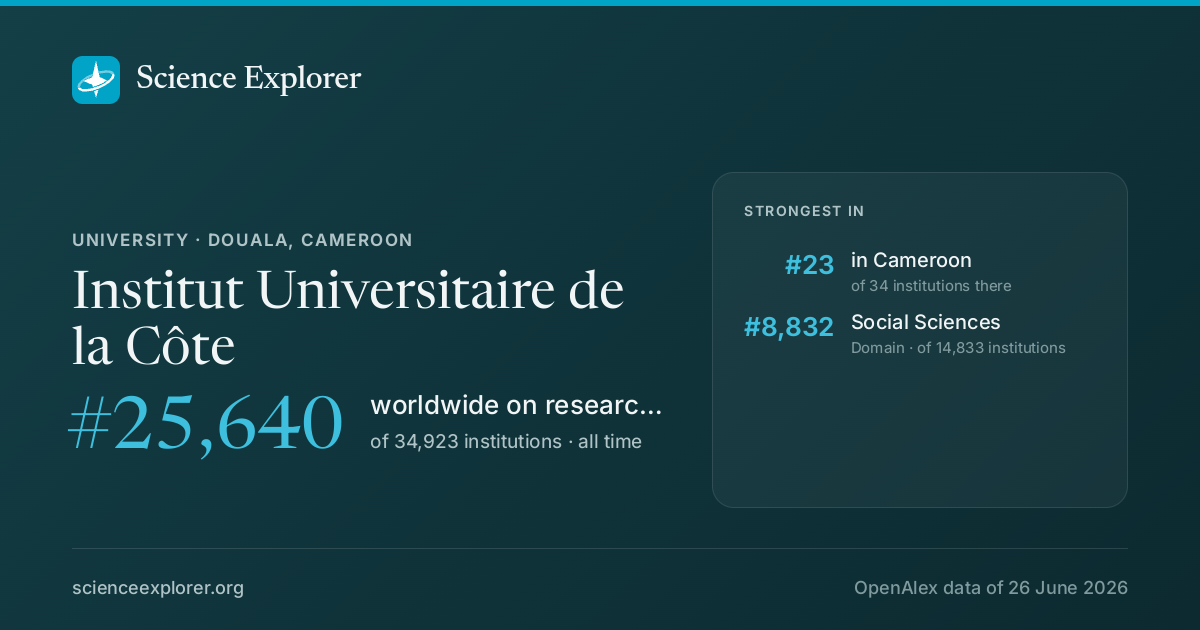
Institut Universitaire de la Côte on Science Explorer

A card with Institut Universitaire de la Côte's standing and the fields it leads in, for a post or a slide. A link to this page previews as the same card.

Download the card

1200 × 630 PNG, sized for social posts, drawn from the latest snapshot.

Badges for a website1Each links back here and updates with every snapshot

Research measures only: rankings here say nothing about teaching, admissions or student experience. Comparable institutions and collaboration partners have tabs of their own, above.

Discussion

Ask a question or share a note about Institut Universitaire de la Côte. Posts are plain text and can be reported.