Noritake (Japan)
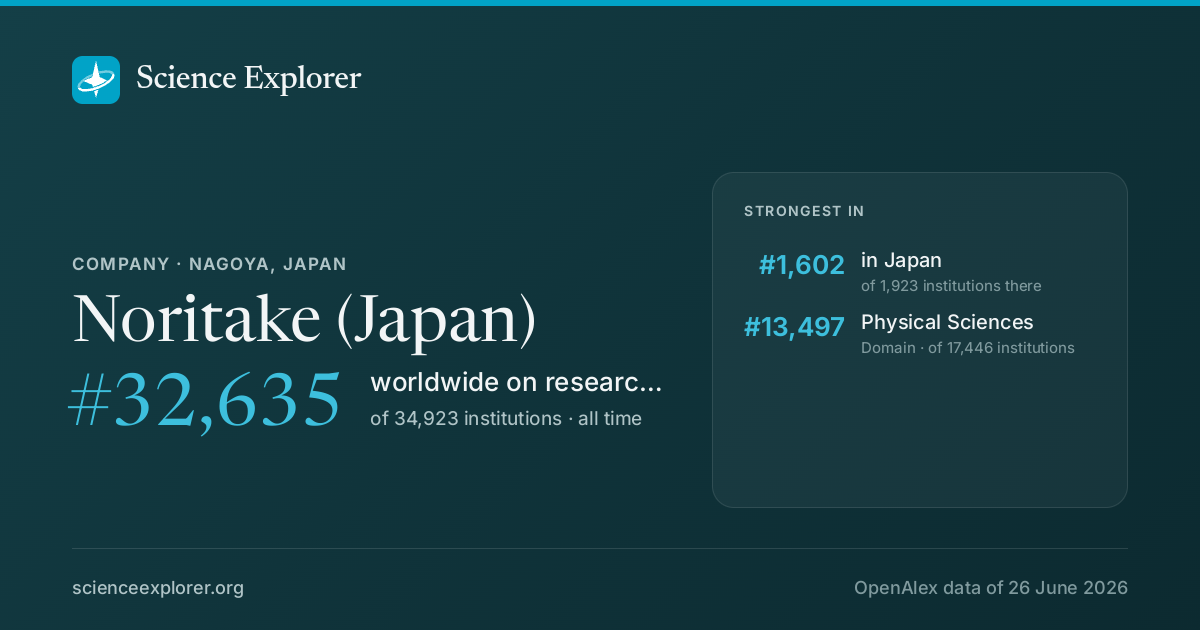
In research, Noritake (Japan) stands highest in Physical Sciences (#13,497 of 17,446 worldwide), over all time.
- World rank, all time
- #32,635 of 34,923
- Rank in Japan
- #1,602 of 1,923
- Research works
- 188 ▼ 25% vs 2018-21
- Citations
- 3.7k 19.9 per fractional work
- Top-10% rate
- 3.3% all institutions 10.0%
- vs its own fields
- 0.92× 1.00× is exactly expected
- Open access
- 44% world 40%
- International
- 18% world 18%
What is Noritake (Japan) known for in research?
The fields where it stands highest, over all time, ranked among every institution above the floor in each field.
| Field | World rank | Where that sits | Top-10% rate | Works |
|---|---|---|---|---|
| Physical SciencesDomain | #13,497 of 17,446 | 5.6% | 172 |
Each strip is that field's whole ranked pool, with the notch where Noritake (Japan) sits in it, in the colour of the band that rank falls in. The track under the rate is the rate itself: it carries no average mark, because the average differs by field (from about 6% in Dentistry to 21% in Economics).
Which fields of science does Noritake (Japan) work in?
In all years, 91% of research at Noritake (Japan) is in Physical Sciences, 4% in Life Sciences. Its largest fields are Engineering (40%), Materials Science (29%), Energy (6%). It does 2.2× the world's share of Physical Sciences.
Each ring splits the one inside it: the four domains of science, their fields, their subfields. Size is fractional works in all years. Every slice is a page; the interactive view zooms down to single topics and colours each by how much more of it this institution does than the world.
Its 4 domains and 24 fields, with their numbers
- Physical Sciences17291.5%
- Engineering7640.4%
- Materials Science5529.4%
- Energy126.3%
- Chemistry105.6%
- Earth and Planetary Sciences42.4%
- Chemical Engineering42.4%
- Environmental Science42.3%
- Physics and Astronomy42.1%
- Computer Science10.4%
- Mathematics00.1%
- Life Sciences73.6%
- Health Sciences52.7%
- Social Sciences42.2%
Field profile
Location quotient across every field it publishes in: outside the ring is more than an institution of this size would be expected to publish, inside it is less.
Rings at 0.5×, 1× and 2×. Widest outward: Energy, 17.4×. Every wedge is a field page.
All 14 fields, with their numbers
- Energy17.36×2 works
- Materials Science5.04×3 works
- Chemistry3.38×1 works
- Chemical Engineering3.25×0 works
- Dentistry2.34×0 works
- Engineering2.14×5 works
- Environmental Science1.70×1 works
- Agricultural and Biological Sciences1.50×1 works
- Nursing0.58×0 works
- Psychology0.37×0 works
- Social Sciences0.34×1 works
- Physics and Astronomy0.26×0 works
- Biochemistry, Genetics and Molecular Biology0.25×0 works
- Medicine0.19×0 works
- Energy 17.4×
- Materials Science 5.0×
- Chemistry 3.4×
- Chemical Engineering 3.2×
- Dentistry 2.3×
- Engineering 2.1×
- Environmental Science 1.7×
- Agricultural and Biological Sciences 1.5×
- Nursing 0.6×
- Psychology 0.4×
- Social Sciences 0.3×
- Physics and Astronomy 0.3×
- Biochemistry, Genetics and Molecular Biology 0.2×
- Medicine 0.2×
Who are the top researchers at Noritake (Japan)?
Ranked on the quality score, Balagopal Narayanan Nair, Koji Inukai and Yosuke Takahashi lead among researchers whose main affiliation is Noritake (Japan).
- 1
Balagopal Narayanan Nair
 Japan · #2,258,169 worldwide
2.7k citations · 80 works
- 2
Koji Inukai
Japan · #2,365,469 worldwide
1.1k citations · 39 works
- 3
Yosuke Takahashi
Japan · #2,575,029 worldwide
1.6k citations · 98 works
- 4
Yasushi Yoshino
Japan · #2,778,693 worldwide
692 citations · 25 works
- 5
Sumihito Sago
Japan · #3,144,915 worldwide
526 citations · 19 works
- 6
Misao Iwata
Japan · #3,686,566 worldwide
295 citations · 26 works
- 7
Gopinathan M. Anilkumar
Japan · #3,795,171 worldwide
2.5k citations · 102 works
- 8
Keita Miyajima
Japan · #3,923,634 worldwide
189 citations · 19 works
- 9
Hiroyuki Kurachi
Japan · #4,702,540 worldwide
407 citations · 33 works
- 10
Tsuyoshi Maesoba
Japan · #4,843,377 worldwide
148 citations · 17 works
Which keywords describe research at Noritake (Japan)?
By fractional works in all years, weighted toward what it does more of than the world: Nanoparticles, Nanomaterials, Sintering, Composite Materials, Catalysis, Spark Plasma Sintering, Energy Storage and Water Splitting.
- Hydrogen Evolution
- Inorganic Pigments
- Fuel Cells
- Oxidation
- Proton Exchange Membranes
- Energy Conversion
- Optical Properties
- Solid Oxide Fuel Cells
- Characterization
- Nanocrystalline Ceramics
- Material Properties
- Metal-Organic Frameworks
- Solar Cells
- Nanostructures
- Synthesis
- Ceramic Materials
- Water Splitting
- Spark Plasma Sintering
- Composite Materials
- Nanomaterials
- Nanoparticles
- Sintering
- Catalysis
- Energy Storage
- Materials
- Nanocomposites
- Oxidation Resistance
- Mechanical Properties
- Graphene
- Cathode Materials
- High-Temperature Applications
- Microstructure
- Tool Wear
- Electrocatalysis
- Crystal Structure
- Polymer Electrolyte Membranes
- Catalysts
- Ceria
- Gold
- Reflectance Properties
Size is fractional works in all years in the topics tagged with each word; colour is the word's share of this institution's work against its share of the world's. The 40 words are chosen for being large and distinctive. Each links to the topic it comes from most.
All 40 words, with their numbers
- Nanoparticles19▲ 7.6×19 topics
- Nanomaterials15▲ 9.9×13 topics
- Sintering12▲ 43×5 topics
- Composite Materials11▲ 26×5 topics
- Catalysis11▲ 7.1×18 topics
- Spark Plasma Sintering10▲ 48×2 topics
- Energy Storage10▲ 14×7 topics
- Water Splitting10▲ 21×4 topics
- Materials10▲ 30×6 topics
- Ceramic Materials9▲ 46×3 topics
- Nanocomposites9▲ 6.2×14 topics
- Synthesis9▲ 8.1×5 topics
- Oxidation Resistance8▲ 31×3 topics
- Nanostructures8▲ 9.1×12 topics
- Mechanical Properties8▲ 4.6×11 topics
- Solar Cells8▲ 14×6 topics
- Graphene8▲ 8.2×7 topics
- Metal-Organic Frameworks8▲ 15×6 topics
- Cathode Materials7▲ 18×3 topics
- Material Properties7▲ 30×2 topics
- High-Temperature Applications7▲ 61×1 topic
- Nanocrystalline Ceramics7▲ 61×1 topic
- Microstructure7▲ 7.1×7 topics
- Characterization6▲ 23×3 topics
- Tool Wear6▲ 25×3 topics
- Solid Oxide Fuel Cells6▲ 114×2 topics
- Electrocatalysis6▲ 18×4 topics
- Optical Properties6▲ 28×3 topics
- Crystal Structure6▲ 13×3 topics
- Energy Conversion6▲ 20×3 topics
- Polymer Electrolyte Membranes6▲ 48×1 topic
- Proton Exchange Membranes6▲ 48×1 topic
- Catalysts6▲ 24×3 topics
- Oxidation6▲ 14×2 topics
- Ceria5▲ 24×1 topic
- Fuel Cells5▲ 21×2 topics
- Gold5▲ 24×1 topic
- Inorganic Pigments5▲ 174×1 topic
- Reflectance Properties5▲ 174×1 topic
- Hydrogen Evolution5▲ 33×1 topic
Which research topics does Noritake (Japan) publish most on?
By volume in 2022-now: Fuel Cells and Related Materials, Electrocatalysts for Energy Conversion, Advanced battery technologies research and Agricultural and Food Sciences.
Area is fractional works; colour is the subfield each topic belongs to.
- 1 Fuel Cells and Related Materials Electrical and Electronic Engineering 2 works
- 2 Electrocatalysts for Energy Conversion Renewable Energy, Sustainability and the Environment 2 works
- 3 Advanced battery technologies research Electrical and Electronic Engineering 1 works
- 4 Agricultural and Food Sciences Forestry 1 works
- 5 Hybrid Renewable Energy Systems Energy Engineering and Power Technology 1 works
- 6 Conducting polymers and applications Polymers and Plastics 0 works
- 7 Membrane-based Ion Separation Techniques Biomedical Engineering 0 works
- 8 Copper Interconnects and Reliability Electronic, Optical and Magnetic Materials 0 works
- 9 Korean Urban and Social Studies Management, Monitoring, Policy and Law 0 works
- 10 Analytical chemistry methods development Analytical Chemistry 0 works
How open and international is its research?
Against the world's own shares: the tick on each track. Both are shares of its output, so they sit on one scale and can be read against each other as well as against the world.
World: 40% of research is openly available.
World: 18% is written across borders.
How has Noritake (Japan)'s research output changed?
Output in 2022-2025 was 25% lower than in 2018-2021.
The same series as a ribbon: one cell per year, darker for more. The line above answers how much; this answers when.
Its share of all research
Growing output can still be a shrinking share: all of science grows. This is Noritake (Japan) as a percentage of every work published that year, 0.000038% in 2024.
Fractional works of Noritake (Japan) over all fractional works that year. How the balance of science has shifted.
Other research institutions in Nagoya
- Nagoya University
- Nagoya Institute of Technology
- Nagoya City University
- Meijo University
- Aichi Cancer Center
- Toyota Technological Institute
- Aichi Gakuin University
- Chukyo University
Share Noritake (Japan)'s ranking
Badges for a website1Each links back here and updates with every snapshot

Research measures only: rankings here say nothing about teaching, admissions or student experience. Comparable institutions and collaboration partners have tabs of their own, above.
Discussion
Ask a question or share a note about Noritake (Japan). Posts are plain text and can be reported.