Science Explorer Back to mapMap
Discussion
Company · São Carlos · Brazil

Opto Eletrônica (Brazil)

In research, Opto Eletrônica (Brazil) stands highest in Physical Sciences (#15,189 of 17,446 worldwide), over all time.

World rank, all time
#29,253
of 34,923
Rank in Brazil
#780
of 834
Research works
197
◆ 1% vs 2018-21
Citations
1.1k
5.7 per fractional work
Top-10% rate
8.6%
all institutions 10.0%
vs its own fields
0.84×
1.00× is exactly expected
Open access
40%
world 40%
International
32%
world 18%

What is Opto Eletrônica (Brazil) known for in research?

The fields where it stands highest, over all time, ranked among every institution above the floor in each field.

FieldWorld rankWhere that sitsTop-10% rateWorks
Physical SciencesDomain #15,189 of 17,446 5.5%139

Each strip is that field's whole ranked pool, with the notch where Opto Eletrônica (Brazil) sits in it, in the colour of the band that rank falls in. The track under the rate is the rate itself: it carries no average mark, because the average differs by field (from about 6% in Dentistry to 21% in Economics).

Which fields of science does Opto Eletrônica (Brazil) work in?

In 2022-now, 53% of research at Opto Eletrônica (Brazil) is in Physical Sciences, 24% in Social Sciences. Its largest fields are Engineering (26%), Social Sciences (19%), Medicine (9%). It does 1.3× the world's share of Physical Sciences.

Physical Sciences: 15 fractional works · 52.7% of its workEngineering: 7 fractional works · 25.8% of its workElectrical and Electronic Engineering: 4 fractional works · 14.2% of its workMechanical Engineering: 1 fractional works · 4.9% of its workMechanics of Materials: 1 fractional works · 2.6% of its workBiomedical Engineering: 1 fractional works · 2.2% of its workOcean Engineering: 0 fractional works · 1.2% of its workComputational Mechanics: 0 fractional works · 0.6% of its workMaterials Science: 2 fractional works · 8.3% of its workMaterials Chemistry: 2 fractional works · 6.1% of its workBiomaterials: 0 fractional works · 1.2% of its workSurfaces, Coatings and Films: 0 fractional works · 0.6% of its workPolymers and Plastics: 0 fractional works · 0.4% of its workPhysics and Astronomy: 2 fractional works · 6.9% of its workAtomic and Molecular Physics, and Optics: 2 fractional works · 6.3% of its workStatistical and Nonlinear Physics: 0 fractional works · 0.3% of its workAstronomy and Astrophysics: 0 fractional works · 0.3% of its workComputer Science: 2 fractional works · 6.3% of its workInformation Systems: 1 fractional works · 3.6% of its workArtificial Intelligence: 1 fractional works · 2.5% of its workComputer Vision and Pattern Recognition: 0 fractional works · 0.3% of its workEnvironmental Science: 1 fractional works · 3.7% of its workManagement, Monitoring, Policy and Law: 0 fractional works · 1.8% of its workNature and Landscape Conservation: 0 fractional works · 0.9% of its workHealth, Toxicology and Mutagenesis: 0 fractional works · 0.4% of its workWater Science and Technology: 0 fractional works · 0.4% of its workEnvironmental Engineering: 0 fractional works · 0.3% of its workChemistry: 0 fractional works · 0.8% of its workInorganic Chemistry: 0 fractional works · 0.6% of its workSpectroscopy: 0 fractional works · 0.3% of its workEnergy: 0 fractional works · 0.6% of its workRenewable Energy, Sustainability and the Environment: 0 fractional works · 0.6% of its workChemical Engineering: 0 fractional works · 0.3% of its workBioengineering: 0 fractional works · 0.3% of its workSocial Sciences: 7 fractional works · 23.9% of its workSocial Sciences: 5 fractional works · 18.6% of its workSociology and Political Science: 2 fractional works · 8.0% of its workEducation: 1 fractional works · 4.9% of its workLaw: 0 fractional works · 1.5% of its workPolitical Science and International Relations: 0 fractional works · 1.3% of its workDemography: 0 fractional works · 0.6% of its workAnthropology: 0 fractional works · 0.5% of its workGeography, Planning and Development: 0 fractional works · 0.4% of its workHealth: 0 fractional works · 0.4% of its workTransportation: 0 fractional works · 0.4% of its workCommunication: 0 fractional works · 0.3% of its workUrban Studies: 0 fractional works · 0.3% of its workSmaller subfields together: 0 fractional works · 0.1% of its workArts and Humanities: 1 fractional works · 2.0% of its workPhilosophy: 0 fractional works · 1.2% of its workHistory and Philosophy of Science: 0 fractional works · 0.4% of its workLanguage and Linguistics: 0 fractional works · 0.4% of its workSmaller subfields together: 0 fractional works · 0.0% of its workBusiness, Management and Accounting: 0 fractional works · 1.1% of its workMarketing: 0 fractional works · 0.8% of its workStrategy and Management: 0 fractional works · 0.3% of its workSmaller subfields together: 0 fractional works · 0.0% of its workEconomics, Econometrics and Finance: 0 fractional works · 1.1% of its workEconomics and Econometrics: 0 fractional works · 0.8% of its workGeneral Economics, Econometrics and Finance: 0 fractional works · 0.3% of its workSmaller subfields together: 0 fractional works · 0.0% of its workDecision Sciences: 0 fractional works · 1.1% of its workInformation Systems and Management: 0 fractional works · 1.1% of its workHealth Sciences: 5 fractional works · 17.0% of its workMedicine: 3 fractional works · 9.4% of its workRadiology, Nuclear Medicine and Imaging: 1 fractional works · 2.4% of its workPulmonary and Respiratory Medicine: 0 fractional works · 1.8% of its workPublic Health, Environmental and Occupational Health: 0 fractional works · 1.4% of its workOphthalmology: 0 fractional works · 1.2% of its workAnesthesiology and Pain Medicine: 0 fractional works · 1.2% of its workNeurology: 0 fractional works · 0.6% of its workEmergency Medicine: 0 fractional works · 0.4% of its workEpidemiology: 0 fractional works · 0.4% of its workHealth Professions: 2 fractional works · 7.4% of its workGeneral Health Professions: 2 fractional works · 6.8% of its workEmergency Medical Services: 0 fractional works · 0.6% of its workDentistry: 0 fractional works · 0.2% of its workLife Sciences: 2 fractional works · 6.5% of its workBiochemistry, Genetics and Molecular Biology: 1 fractional works · 4.3% of its workMolecular Biology: 1 fractional works · 2.1% of its workBiophysics: 0 fractional works · 1.2% of its workBiotechnology: 0 fractional works · 0.6% of its workGenetics: 0 fractional works · 0.3% of its workSmaller subfields together: 0 fractional works · 0.1% of its workNeuroscience: 0 fractional works · 1.8% of its workCellular and Molecular Neuroscience: 0 fractional works · 0.9% of its workCognitive Neuroscience: 0 fractional works · 0.9% of its workAgricultural and Biological Sciences: 0 fractional works · 0.3% of its workForestry: 0 fractional works · 0.3% of its workImmunology and Microbiology: 0 fractional works · 0.1% of its workALL ITS WORKOpto Eletrônica(Brazil)28fractional works, 2022-now
Life Sciences6%Physical Sciences53%Health Sciences17%Social Sciences24%

Each ring splits the one inside it: the four domains of science, their fields, their subfields. Size is fractional works in 2022-now. Every slice is a page; the interactive view zooms down to single topics and colours each by how much more of it this institution does than the world.

Its 4 domains and 20 fields, with their numbers
    1. Engineering725.8%
    2. Materials Science28.3%
    3. Physics and Astronomy26.9%
    4. Computer Science26.3%
    5. Environmental Science13.7%
    6. Chemistry00.8%
    7. Energy00.6%
    8. Chemical Engineering00.3%
    1. Social Sciences518.6%
    2. Arts and Humanities12.0%
    3. Business, Management and Accounting01.1%
    4. Economics, Econometrics and Finance01.1%
    5. Decision Sciences01.1%
    1. Medicine39.4%
    2. Health Professions27.4%
    3. Dentistry00.2%
    1. Biochemistry, Genetics and Molecular Biology14.3%
    2. Neuroscience01.8%
    3. Agricultural and Biological Sciences00.3%
    4. Immunology and Microbiology00.1%
All of science, and how each field's share has moved since 1950: the Science domain explorer

Field profile

Location quotient across every field it publishes in: outside the ring is more than an institution of this size would be expected to publish, inside it is less.

Agricultural and Biological Sciences: 0.05× its world share, 0 worksAgricultural and Bio…Biochemistry, Genetics and Molecular Biology: 0.80× its world share, 1 worksBiochemistry, Geneti…Immunology and Microbiology: 0.15× its world share, 0 worksImmunology and Micro…Neuroscience: 1.11× its world share, 0 worksNeuroscienceChemical Engineering: 0.68× its world share, 0 worksChemical EngineeringChemistry: 0.53× its world share, 0 worksChemistryComputer Science: 0.81× its world share, 2 worksComputer ScienceEnergy: 0.65× its world share, 0 worksEnergyEngineering: 1.72× its world share, 7 worksEngineeringEnvironmental Science: 0.75× its world share, 1 worksEnvironmental ScienceMaterials Science: 2.38× its world share, 2 worksMaterials SciencePhysics and Astronomy: 3.07× its world share, 2 worksPhysics and AstronomyDentistry: 0.41× its world share, 0 worksDentistryHealth Professions: 2.81× its world share, 2 worksHealth ProfessionsMedicine: 0.49× its world share, 3 worksMedicineArts and Humanities: 0.69× its world share, 1 worksArts and HumanitiesBusiness, Management and Accounting: 0.34× its world share, 0 worksBusiness, Management…Decision Sciences: 1.13× its world share, 0 worksDecision SciencesEconomics, Econometrics and Finance: 0.51× its world share, 0 worksEconomics, Econometr…Social Sciences: 1.47× its world share, 5 worksSocial Sciences1×world share
more than its size predictsabout as predictedless

Rings at 0.5×, 1× and 2×. Widest outward: Physics and Astronomy, 3.1×. Every wedge is a field page.

All 20 fields, with their numbers
  1. Physics and Astronomy3.07×2 works
  2. Health Professions2.81×2 works
  3. Materials Science2.38×2 works
  4. Engineering1.72×7 works
  5. Social Sciences1.47×5 works
  6. Decision Sciences1.13×0 works
  7. Neuroscience1.11×0 works
  8. Computer Science0.81×2 works
  9. Biochemistry, Genetics and Molecular Biology0.80×1 works
  10. Environmental Science0.75×1 works
  11. Arts and Humanities0.69×1 works
  12. Chemical Engineering0.68×0 works
  13. Energy0.65×0 works
  14. Chemistry0.53×0 works
  15. Economics, Econometrics and Finance0.51×0 works
  16. Medicine0.49×3 works
  17. Dentistry0.41×0 works
  18. Business, Management and Accounting0.34×0 works
  19. Immunology and Microbiology0.15×0 works
  20. Agricultural and Biological Sciences0.05×0 works

Who are the top researchers at Opto Eletrônica (Brazil)?

Ranked on the quality score, Lucimara C. N. Scaduto, Giuliano Rossi and Mário Antonio Stefani lead among researchers whose main affiliation is Opto Eletrônica (Brazil).

  1. 1 Lucimara C. N. Scaduto Brazil · #4,470,239 worldwide 27 citations · 18 works
  2. 2 Giuliano Rossi Brazil · #4,933,194 worldwide 3.2k citations · 34 works
  3. 3 Mário Antonio Stefani Brazil · #6,027,962 worldwide 54 citations · 50 works
All ranked researchers at Opto Eletrônica (Brazil)

What are the most cited papers from Opto Eletrônica (Brazil)?

The most cited paper from Opto Eletrônica (Brazil) is "Multiple-Loop H-Infinity Control Design for Uninterruptible Power Supplies" (G. Willmann, Daniel Coutinho, L.F.A. Pereira et al., 2007), with 188 citations. Next come "Photothermal therapy of melanoma tumor using multiwalled carbon nanotubes" (167) and "Rapid multiexcitation fluorescence spectroscopy system for in vivo tissue diagnosis" (121).

Most cited papers
#PaperReleasedCitations
1 Multiple-Loop H-Infinity Control Design for Uninterruptible Power Supplies G. Willmann, Daniel Coutinho, L.F.A. Pereira et al. · IEEE Industrial Electronics Magazine 3 May 2007 188
2 Photothermal therapy of melanoma tumor using multiwalled carbon nanotubes Zahra Sobhani, Mohammad Ali Behnam, Farzin Emami et al. · International Journal of Nanomedicine Open access Jun 2017 167
3 Rapid multiexcitation fluorescence spectroscopy system for in vivo tissue diagnosis Renato Amaro Zângaro, Landulfo Silveira, Ramasamy Manoharan et al. · Applied Optics Sep 1996 121
4 Metallic ruthenium-based nanomaterials for electrocatalytic and photocatalytic hydrogen evolution Sumei Han, Qinbai Yun, Siyang Tu et al. · Journal of Materials Chemistry A 2019 119
5 Synthesis of Regioisomerically Pure 1,7-Dibromoperylene-3,4,9,10-tetracarboxylic Acid Derivatives Sanchita Sengupta, Rajeev K. Dubey, Rob W. M. Hoek et al. · The Journal of Organic Chemistry Jul 2014 102
All 60 most cited papers, with filters and sorting

Which keywords describe research at Opto Eletrônica (Brazil)?

By fractional works in 2022-now, weighted toward what it does more of than the world: Nonlinear Optics, Healthcare, Fiber Lasers, Qualitative Research, Public Health, Social Management, Solidarity Economy and Social Determinants.

▲ more of its work than of the world's◆ about the world's share▼ less than the world's

Size is fractional works in 2022-now in the topics tagged with each word; colour is the word's share of this institution's work against its share of the world's. The 13 words are chosen for being large and distinctive. Each links to the topic it comes from most.

All 13 words, with their numbers
  1. Nonlinear Optics2▲ 68×3 topics
  2. Healthcare2▲ 5.5×7 topics
  3. Public Health2▲ 3.9×5 topics
  4. Fiber Lasers1▲ 52×2 topics
  5. Qualitative Research1▲ 5.8×4 topics
  6. Educational Technology1▲ 3.8×6 topics
  7. Renewable Energy1▲ 2.7×5 topics
  8. Social Determinants1▲ 18×2 topics
  9. Social Management1▲ 157×1 topic
  10. Solidarity Economy1▲ 67×1 topic
  11. Child Health1▲ 64×1 topic
  12. Frequency Conversion1▲ 86×2 topics
  13. Maternal Health1▲ 14×1 topic

Which research topics does Opto Eletrônica (Brazil) publish most on?

By volume in 2022-now: Social and Economic Solidarity, Maternal and Neonatal Healthcare, Advanced Fiber Laser Technologies and Laser-Matter Interactions and Applications.

  1. 1 Social and Economic Solidarity Sociology and Political Science 1 works
  2. 2 Maternal and Neonatal Healthcare General Health Professions 1 works
  3. 3 Advanced Fiber Laser Technologies Atomic and Molecular Physics, and Optics 1 works
  4. 4 Laser-Matter Interactions and Applications Atomic and Molecular Physics, and Optics 1 works
  5. 5 Healthcare during COVID-19 Pandemic Information Systems 1 works
  6. 6 Environmental Sustainability and Education Management, Monitoring, Policy and Law 0 works
  7. 7 Solid State Laser Technologies Electrical and Electronic Engineering 0 works
  8. 8 Optical Network Technologies Electrical and Electronic Engineering 0 works
  9. 9 Biliary and Gastrointestinal Fistulas Pulmonary and Respiratory Medicine 0 works
  10. 10 Laser Design and Applications Electrical and Electronic Engineering 0 works

How open and international is its research?

Against the world's own shares: the tick on each track. Both are shares of its output, so they sit on one scale and can be read against each other as well as against the world.

openly available40.0%not open60.0%

World: 40% of research is openly available.

with international co-authors32.5%domestic only67.5%

World: 18% is written across borders.

How has Opto Eletrônica (Brazil)'s research output changed?

Output in 2022-2025 was 1% lower than in 2018-2021.

still counting1990200020102020
grewheldshrank

The same series as a ribbon: one cell per year, darker for more. The line above answers how much; this answers when.

Its share of all research

Growing output can still be a shrinking share: all of science grows. This is Opto Eletrônica (Brazil) as a percentage of every work published that year, 0.00010% in 2024.

still counting0.00025%0.00050%0.00075%Opto Eletrônica (Brazil)0.000097% in 20251990200020102020

Fractional works of Opto Eletrônica (Brazil) over all fractional works that year. How the balance of science has shifted.

Other research institutions in São Carlos

All research institutions in São Carlos

Share Opto Eletrônica (Brazil)'s ranking
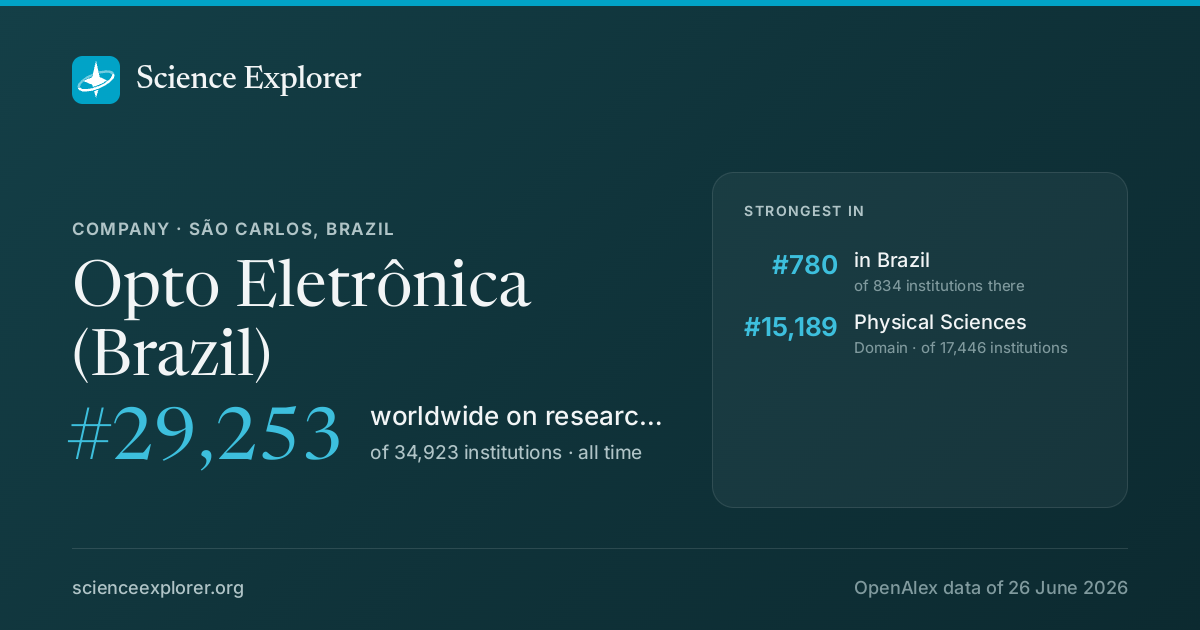
Opto Eletrônica (Brazil) on Science Explorer

A card with Opto Eletrônica (Brazil)'s standing and the fields it leads in, for a post or a slide. A link to this page previews as the same card.

Download the card

1200 × 630 PNG, sized for social posts, drawn from the latest snapshot.

Badges for a website1Each links back here and updates with every snapshot

Research measures only: rankings here say nothing about teaching, admissions or student experience. Comparable institutions and collaboration partners have tabs of their own, above.

Discussion

Ask a question or share a note about Opto Eletrônica (Brazil). Posts are plain text and can be reported.