Sandvik (Sweden)
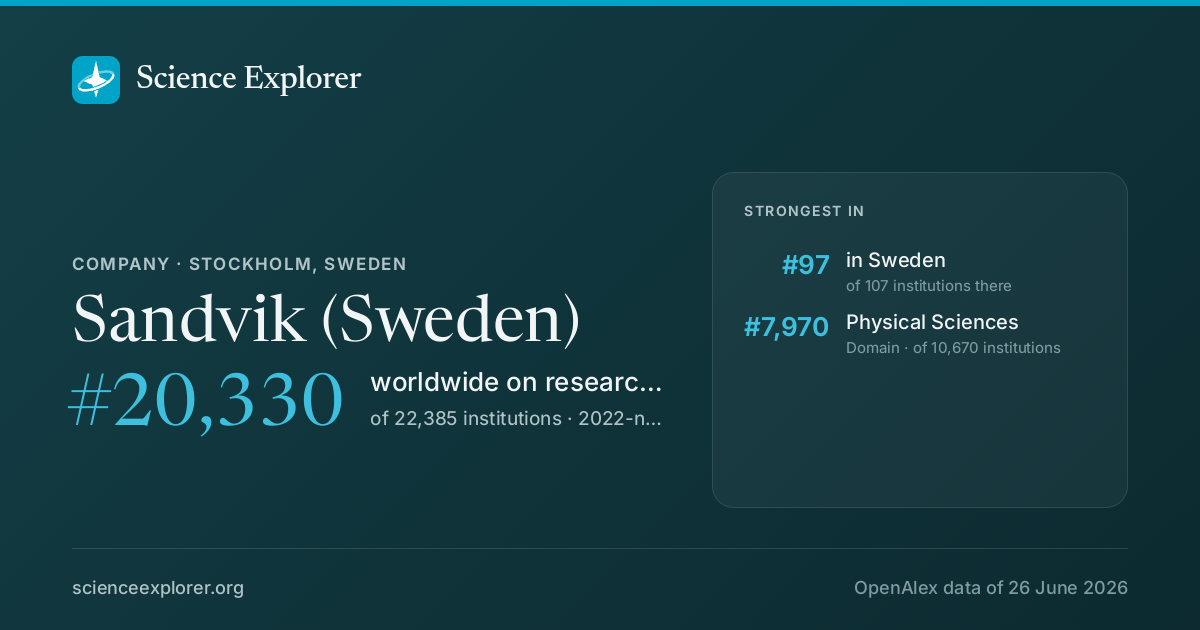
In research, Sandvik (Sweden) stands highest in Physical Sciences (#7,970 of 10,670 worldwide), 2022-now. Relative to its size it is most specialised in Mechanical Engineering (Mechanical Engineering is 17.9× its share of world research).
- World rank, 2022-now
- #20,330 of 22,385 · #10,310 all time
- Rank in Sweden
- #97 of 107
- Research works
- 834 ▼ 29% vs 2018-21
- Citations
- 17k 20.7 per fractional work
- Top-10% rate
- 8.2% all institutions 10.0%
- vs its own fields
- 0.99× 1.00× is exactly expected
- Open access
- 27% world 40%
- International
- 25% world 18%
What is Sandvik (Sweden) known for in research?
The fields where it stands highest, 2022-now, ranked among every institution above the floor in each field.
| Field | World rank | Where that sits | Top-10% rate | Works | All time |
|---|---|---|---|---|---|
| Physical SciencesDomain | #7,970 of 10,670 | 8.3% | 88 | #4352 |
Each strip is that field's whole ranked pool, with the notch where Sandvik (Sweden) sits in it, in the colour of the band that rank falls in. The track under the rate is the rate itself: it carries no average mark, because the average differs by field (from about 6% in Dentistry to 21% in Economics).
Which fields of science does Sandvik (Sweden) work in?
In 2022-now, 92% of research at Sandvik (Sweden) is in Physical Sciences, 4% in Health Sciences. Its largest fields are Engineering (61%), Materials Science (16%), Chemistry (11%). It does 2.3× the world's share of Physical Sciences.
Each ring splits the one inside it: the four domains of science, their fields, their subfields. Size is fractional works in 2022-now. Every slice is a page; the interactive view zooms down to single topics and colours each by how much more of it this institution does than the world.
Its 4 domains and 21 fields, with their numbers
- Physical Sciences9592.4%
- Engineering6260.7%
- Materials Science1616.0%
- Chemistry1211.2%
- Environmental Science22.0%
- Energy11.0%
- Computer Science10.7%
- Earth and Planetary Sciences00.4%
- Physics and Astronomy00.3%
- Chemical Engineering00.1%
- Health Sciences43.5%
- Medicine32.8%
- Health Professions10.7%
- Nursing00.1%
- Social Sciences43.4%
- Life Sciences10.7%
What does Sandvik (Sweden) specialise in?
Where its research is concentrated relative to its size: Mechanical Engineering takes 17.9× the share of its output that it takes of world research.
- Mechanical EngineeringSubfield · 33.9 works18×
Location quotient, a volume reading rather than an impact one. It surfaces small, lopsided specialities.
Field profile
Location quotient across every field it publishes in: outside the ring is more than an institution of this size would be expected to publish, inside it is less.
Rings at 0.5×, 1× and 2×. Widest outward: Chemistry, 7.1×. Every wedge is a field page.
All 21 fields, with their numbers
- Chemistry7.14×12 works
- Materials Science4.59×16 works
- Engineering4.05×62 works
- Energy1.10×1 works
- Environmental Science0.40×2 works
- Decision Sciences0.34×0 works
- Business, Management and Accounting0.29×1 works
- Health Professions0.26×1 works
- Earth and Planetary Sciences0.25×0 works
- Chemical Engineering0.19×0 works
- Psychology0.16×0 works
- Medicine0.14×3 works
- Physics and Astronomy0.12×0 works
- Nursing0.11×0 works
- Social Sciences0.11×1 works
- Computer Science0.09×1 works
- Economics, Econometrics and Finance0.09×0 works
- Agricultural and Biological Sciences0.08×0 works
- Immunology and Microbiology0.08×0 works
- Biochemistry, Genetics and Molecular Biology0.05×0 works
- Arts and Humanities0.03×0 works
- Chemistry 7.1×
- Materials Science 4.6×
- Engineering 4.0×
- Energy 1.1×
- Environmental Science 0.4×
- Decision Sciences 0.3×
- Business, Management and Accounting 0.3×
- Health Professions 0.3×
- Earth and Planetary Sciences 0.2×
- Chemical Engineering 0.2×
- Psychology 0.2×
- Medicine 0.1×
- Physics and Astronomy 0.1×
- Nursing 0.1×
- Social Sciences 0.1×
- Computer Science 0.1×
- Economics, Econometrics and Finance 0.1×
- Agricultural and Biological Sciences 0.1×
- Immunology and Microbiology 0.1×
- Biochemistry, Genetics and Molecular Biology 0.1×
- Arts and Humanities 0.0×
Who are the top researchers at Sandvik (Sweden)?
Ranked on the quality score, Sten Andersson, Björn Uhrenius and Josefin Eidhagen lead among researchers whose main affiliation is Sandvik (Sweden).
- 1
Sten Andersson
 Sweden · #557,466 worldwide
6.9k citations · 198 works
- 2
Björn Uhrenius
Sweden · #940,926 worldwide
940 citations · 33 works
- 3
Josefin Eidhagen
Sweden · #1,489,921 worldwide
284 citations · 23 works
- 4
Jan-Olof Nilsson
Sweden · #1,519,054 worldwide
1.1k citations · 60 works
- 5
A. Wilson
Sweden · #1,652,754 worldwide
748 citations · 19 works
- 6
Jose Luis Garcia
Sweden · #2,041,058 worldwide
3.6k citations · 122 works
- 7
M. Collin
Sweden · #2,409,635 worldwide
558 citations · 18 works
- 8
T. Thorvaldsson
Sweden · #2,511,281 worldwide
558 citations · 19 works
- 9
Eleonora Bettini
Sweden · #2,512,468 worldwide
598 citations · 24 works
- 10
Ingrid Reineck
Sweden · #2,531,652 worldwide
682 citations · 25 works
Which keywords describe research at Sandvik (Sweden)?
By fractional works in 2022-now, weighted toward what it does more of than the world: Mechanical Properties, Microstructure, Partially Ordered Sets, Periodic Table, Sintering, Spark Plasma Sintering, Process Parameters and Additive Manufacturing.
- Taguchi Method
- Optimization
- Cryogenic Treatment
- Molecular Dynamics Simulation
- Machining
- High-Entropy Alloys
- Stainless Steels
- Grain Boundary Engineering
- Nanoindentation
- X-ray Photoelectron Spectroscopy
- Selective Laser Melting
- Nanocomposites
- Numerical Simulation
- Hydrogen Embrittlement
- Metal Powders
- Cemented Carbides
- Additive Manufacturing
- Spark Plasma Sintering
- Periodic Table
- Microstructure
- Mechanical Properties
- Partially Ordered Sets
- Sintering
- Process Parameters
- Tool Wear
- Nanostructured Materials
- Material Characterization
- Composite Materials
- Phase Stability
- Metallic Components
- Thin Films
- Coatings
- Corrosion Behavior
- Passive Films
- Surface Roughness
- Multi-Component Alloys
- Surface Integrity
- Wear Resistance
- Tool Steels
- Heat Transfer
Size is fractional works in 2022-now in the topics tagged with each word; colour is the word's share of this institution's work against its share of the world's. The 40 words are chosen for being large and distinctive. Each links to the topic it comes from most.
All 40 words, with their numbers
- Mechanical Properties31▲ 31×15 topics
- Microstructure23▲ 42×10 topics
- Partially Ordered Sets11▲ 1128×1 topic
- Periodic Table11▲ 801×1 topic
- Sintering9▲ 71×3 topics
- Spark Plasma Sintering8▲ 74×2 topics
- Process Parameters7▲ 68×3 topics
- Additive Manufacturing7▲ 21×3 topics
- Tool Wear7▲ 51×3 topics
- Cemented Carbides6▲ 121×1 topic
- Nanostructured Materials6▲ 37×1 topic
- Metal Powders6▲ 84×2 topics
- Material Characterization6▲ 47×3 topics
- Hydrogen Embrittlement5▲ 61×3 topics
- Composite Materials5▲ 23×3 topics
- Numerical Simulation5▲ 16×5 topics
- Phase Stability5▲ 67×2 topics
- Nanocomposites5▲ 5.7×3 topics
- Metallic Components5▲ 66×1 topic
- Selective Laser Melting5▲ 66×1 topic
- Thin Films5▲ 23×2 topics
- X-ray Photoelectron Spectroscopy5▲ 60×2 topics
- Coatings4▲ 74×1 topic
- Nanoindentation4▲ 77×1 topic
- Corrosion Behavior4▲ 52×2 topics
- Grain Boundary Engineering4▲ 63×2 topics
- Passive Films4▲ 116×1 topic
- Stainless Steels4▲ 116×1 topic
- Surface Roughness4▲ 29×2 topics
- High-Entropy Alloys4▲ 76×1 topic
- Multi-Component Alloys4▲ 76×1 topic
- Machining4▲ 68×1 topic
- Surface Integrity4▲ 68×1 topic
- Molecular Dynamics Simulation4▲ 31×3 topics
- Wear Resistance4▲ 89×2 topics
- Cryogenic Treatment3▲ 119×1 topic
- Tool Steels3▲ 119×1 topic
- Optimization3▲ 7.2×4 topics
- Heat Transfer3▲ 6.2×4 topics
- Taguchi Method3▲ 59×2 topics
Which research topics does Sandvik (Sweden) publish most on?
By volume in 2022-now: History and advancements in chemistry, Advanced materials and composites, Additive Manufacturing Materials and Processes and Metal and Thin Film Mechanics.
Area is fractional works; colour is the subfield each topic belongs to.
- 1 History and advancements in chemistry Physical and Theoretical Chemistry 11 works
- 2 Advanced materials and composites Mechanical Engineering 6 works
- 3 Additive Manufacturing Materials and Processes Mechanical Engineering 5 works
- 4 Metal and Thin Film Mechanics Mechanics of Materials 4 works
- 5 Hydrogen embrittlement and corrosion behaviors in metals Metals and Alloys 4 works
- 6 High Entropy Alloys Studies Mechanical Engineering 4 works
- 7 Advanced machining processes and optimization Mechanical Engineering 4 works
- 8 Metal Alloys Wear and Properties Materials Chemistry 3 works
- 9 Welding Techniques and Residual Stresses Mechanical Engineering 2 works
- 10 Microstructure and Mechanical Properties of Steels Mechanical Engineering 2 works
How open and international is its research?
Against the world's own shares: the tick on each track. Both are shares of its output, so they sit on one scale and can be read against each other as well as against the world.
World: 40% of research is openly available.
World: 18% is written across borders.
How has Sandvik (Sweden)'s research output changed?
Output in 2022-2025 was 29% lower than in 2018-2021.
The same series as a ribbon: one cell per year, darker for more. The line above answers how much; this answers when.
Its share of all research
Growing output can still be a shrinking share: all of science grows. This is Sandvik (Sweden) as a percentage of every work published that year, 0.00047% in 2024.
Fractional works of Sandvik (Sweden) over all fractional works that year. How the balance of science has shifted.
How much of it reaches the world top 10%
Year by year, against all institutions in the same year.
Of each year's output, the share that reached the world's 10% most cited for its field and year. Peak 13.9% in 1996.
Other research institutions in Stockholm
- Karolinska Institutet
- KTH Royal Institute of Technology
- Stockholm University
- Swedish Institute
- Stockholm School of Economics
- Science for Life Laboratory
- Swedish Defence Research Agency
- Stockholm South General Hospital
Share Sandvik (Sweden)'s ranking
Badges for a website1Each links back here and updates with every snapshot

Research measures only: rankings here say nothing about teaching, admissions or student experience. Comparable institutions and collaboration partners have tabs of their own, above.
Discussion
Ask a question or share a note about Sandvik (Sweden). Posts are plain text and can be reported.