- World rank, all time
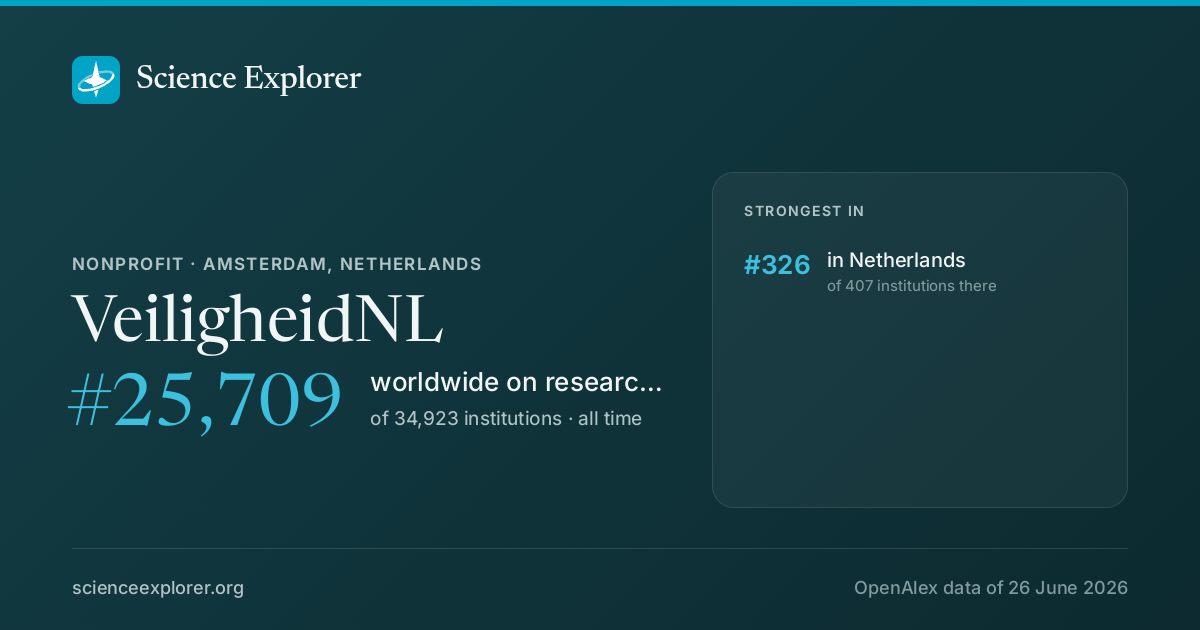
- #25,709 of 34,923
- Rank in Netherlands
- #326 of 407
- Research works
- 145 ▼ 11% vs 2018-21
- Citations
- 2.5k 16.9 per fractional work
- Top-10% rate
- 10.4% all institutions 10.0%
- vs its own fields
- 1.09× 1.00× is exactly expected
- Open access
- 47% world 40%
- International
- 17% world 18%
Which fields of science does VeiligheidNL work in?
In 2022-now, 64% of research at VeiligheidNL is in Health Sciences, 17% in Social Sciences. Its largest fields are Medicine (50%), Health Professions (15%), Social Sciences (9%). It does 2.2× the world's share of Health Sciences.
Each ring splits the one inside it: the four domains of science, their fields, their subfields. Size is fractional works in 2022-now. Every slice is a page; the interactive view zooms down to single topics and colours each by how much more of it this institution does than the world.
Its 4 domains and 15 fields, with their numbers
- Health Sciences1764.5%
- Medicine1349.8%
- Health Professions414.6%
- Social Sciences416.8%
- Physical Sciences312.6%
- Energy15.1%
- Computer Science13.3%
- Engineering12.1%
- Materials Science01.3%
- Physics and Astronomy00.4%
- Mathematics00.3%
- Life Sciences26.2%
Field profile
Location quotient across every field it publishes in: outside the ring is more than an institution of this size would be expected to publish, inside it is less.
Rings at 0.5×, 1× and 2×. Widest outward: Energy, 5.6×. Every wedge is a field page.
All 15 fields, with their numbers
- Energy5.59×1 works
- Health Professions5.54×4 works
- Medicine2.59×13 works
- Neuroscience1.98×1 works
- Psychology1.46×1 works
- Economics, Econometrics and Finance1.20×1 works
- Social Sciences0.72×2 works
- Computer Science0.43×1 works
- Materials Science0.37×0 works
- Biochemistry, Genetics and Molecular Biology0.32×0 works
- Agricultural and Biological Sciences0.27×0 works
- Mathematics0.27×0 works
- Business, Management and Accounting0.20×0 works
- Physics and Astronomy0.19×0 works
- Engineering0.14×1 works
- Energy 5.6×
- Health Professions 5.5×
- Medicine 2.6×
- Neuroscience 2.0×
- Psychology 1.5×
- Economics, Econometrics and Finance 1.2×
- Social Sciences 0.7×
- Computer Science 0.4×
- Materials Science 0.4×
- Biochemistry, Genetics and Molecular Biology 0.3×
- Agricultural and Biological Sciences 0.3×
- Mathematics 0.3×
- Business, Management and Accounting 0.2×
- Physics and Astronomy 0.2×
- Engineering 0.1×
Who are the top researchers at VeiligheidNL?
Ranked on the quality score, Martien J. M. Panneman, Saakje Mulder and Anneke Bloemhoff lead among researchers whose main affiliation is VeiligheidNL.
- 1
Martien J. M. Panneman
 Netherlands · #578,541 worldwide
3k citations · 75 works
- 2
Saakje Mulder
Netherlands · #1,051,766 worldwide
1.5k citations · 36 works
- 3
Anneke Bloemhoff
Netherlands · #2,096,572 worldwide
407 citations · 34 works
- 4
Ingrid Vriend
Netherlands · #2,179,645 worldwide
529 citations · 31 works
- 5
Ellen J. Kemler
Netherlands · #2,862,673 worldwide
654 citations · 48 works
- 6
Paul den Hertog
Netherlands · #3,440,633 worldwide
334 citations · 21 works
- 7
Huib Valkenberg
Netherlands · #3,686,229 worldwide
187 citations · 34 works
- 8
Bart Goeminne
Netherlands · #3,709,832 worldwide
23 citations · 19 works
- 9
Wim Rogmans
Netherlands · #6,082,036 worldwide
155 citations · 55 works
Which keywords describe research at VeiligheidNL?
By fractional works in 2022-now, weighted toward what it does more of than the world: Epidemiology, Injury Prevention, Physical Performance, Rehabilitation, Risk Factors, Socioeconomic Factors, Global Burden and Mortality.
- Water Scarcity
- COVID-19
- Prehospital Care
- Injury Severity
- Sports Injury
- Muscle Injuries
- ICF Model
- Public Health
- Mental Health
- Unintentional Injuries
- Fall Risk
- Mortality
- Socioeconomic Factors
- Rehabilitation
- Injury Prevention
- Epidemiology
- Physical Performance
- Risk Factors
- Global Burden
- Child Injury
- Gait Speed
- Athletic Training
- Prevention
- Cerebral Palsy
- Quality of Life
- Quality Improvement
- Elderly Patients
- Oxidative Stress
- Trauma Center
- Solar Desalination
Size is fractional works in 2022-now in the topics tagged with each word; colour is the word's share of this institution's work against its share of the world's. The 30 words are chosen for being large and distinctive. Each links to the topic it comes from most.
All 30 words, with their numbers
- Epidemiology6▲ 5.5×14 topics
- Injury Prevention3▲ 95×2 topics
- Physical Performance2▲ 90×2 topics
- Rehabilitation2▲ 21×4 topics
- Risk Factors2▲ 7.6×6 topics
- Socioeconomic Factors2▲ 65×2 topics
- Global Burden2▲ 14×4 topics
- Mortality2▲ 13×2 topics
- Child Injury2▲ 240×1 topic
- Fall Risk2▲ 142×1 topic
- Gait Speed2▲ 142×1 topic
- Unintentional Injuries2▲ 240×1 topic
- Athletic Training2▲ 69×2 topics
- Mental Health2▲ 4.3×6 topics
- Prevention2▲ 15×2 topics
- Public Health2▲ 3.9×5 topics
- Cerebral Palsy1▲ 73×1 topic
- ICF Model1▲ 130×1 topic
- Quality of Life1▲ 3.7×5 topics
- Muscle Injuries1▲ 77×1 topic
- Quality Improvement1▲ 27×2 topics
- Sports Injury1▲ 77×1 topic
- Elderly Patients1▲ 28×2 topics
- Injury Severity1▲ 59×2 topics
- Oxidative Stress1▲ 2.8×8 topics
- Prehospital Care1▲ 110×1 topic
- Trauma Center1▲ 110×1 topic
- COVID-191▲ 3.0×3 topics
- Solar Desalination1▲ 107×1 topic
- Water Scarcity1▲ 48×1 topic
Which research topics does VeiligheidNL publish most on?
By volume in 2022-now: Balance, Gait, and Falls Prevention, Injury Epidemiology and Prevention, Cerebral Palsy and Movement Disorders and Sports injuries and prevention.
Area is fractional works; colour is the subfield each topic belongs to.
- 1 Balance, Gait, and Falls Prevention Physical Therapy, Sports Therapy and Rehabilitation 2 works
- 2 Injury Epidemiology and Prevention Public Health, Environmental and Occupational Health 2 works
- 3 Cerebral Palsy and Movement Disorders Psychiatry and Mental health 1 works
- 4 Sports injuries and prevention Orthopedics and Sports Medicine 1 works
- 5 Trauma and Emergency Care Studies Emergency Medicine 1 works
- 6 Solar-Powered Water Purification Methods Renewable Energy, Sustainability and the Environment 1 works
- 7 Data-Driven Disease Surveillance Epidemiology 1 works
- 8 Hip and Femur Fractures Surgery 1 works
- 9 Frailty in Older Adults Geriatrics and Gerontology 1 works
- 10 Knee injuries and reconstruction techniques Surgery 1 works
How open and international is its research?
Against the world's own shares: the tick on each track. Both are shares of its output, so they sit on one scale and can be read against each other as well as against the world.
World: 40% of research is openly available.
World: 18% is written across borders.
How has VeiligheidNL's research output changed?
Output in 2022-2025 was 11% lower than in 2018-2021.
The same series as a ribbon: one cell per year, darker for more. The line above answers how much; this answers when.
Its share of all research
Growing output can still be a shrinking share: all of science grows. This is VeiligheidNL as a percentage of every work published that year, 0.000057% in 2024.
Fractional works of VeiligheidNL over all fractional works that year. How the balance of science has shifted.
Other research institutions in Amsterdam
- University of Amsterdam
- Vrije Universiteit Amsterdam
- Philips (Netherlands)
- Amsterdam UMC Location University of Amsterdam
- Royal Netherlands Academy of Arts and Sciences
- Amsterdam University Medical Centers
- Centrum Wiskunde & Informatica
- Institute for Atomic and Molecular Physics


Share VeiligheidNL's ranking
Badges for a website1Each links back here and updates with every snapshot

Research measures only: rankings here say nothing about teaching, admissions or student experience. Comparable institutions and collaboration partners have tabs of their own, above.
Discussion
Ask a question or share a note about VeiligheidNL. Keep it to the research: no personal attacks, advertising or links. Any reader can report a post, which collapses it for everyone until it is opened.