Centrum Wiskunde & Informatica
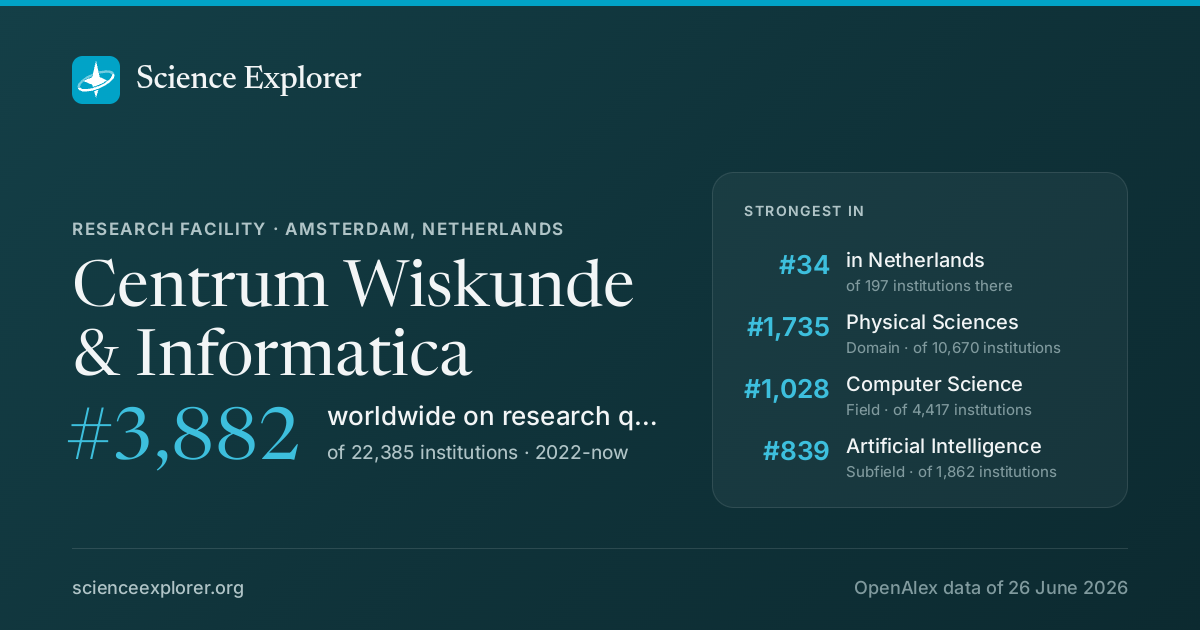
In research, Centrum Wiskunde & Informatica stands highest in Physical Sciences (#1,735 of 10,670 worldwide), Computer Science (#1,028 of 4,417 worldwide) and Artificial Intelligence (#839 of 1,862 worldwide), 2022-now. Relative to its size it is most specialised in Computational Theory and Mathematics (Computational Theory and Mathematics is 16.2× its share of world research).
- World rank, 2022-now
- #3,882 of 22,385 · #1,927 all time
- Rank in Netherlands
- #34 of 197
- Research works
- 5.5k ▼ 20% vs 2018-21
- Citations
- 146k 26.6 per fractional work
- Top-10% rate
- 11.5% all institutions 10.0%
- vs its own fields
- 1.09× 1.00× is exactly expected
- Open access
- 60% world 40%
- International
- 33% world 18%
What is Centrum Wiskunde & Informatica known for in research?
The fields where it stands highest, 2022-now, ranked among every institution above the floor in each field.
| Field | World rank | Where that sits | Top-10% rate | Works | All time |
|---|---|---|---|---|---|
| Physical SciencesDomain | #1,735 of 10,670 | 11.9% | 318 | #1359 | |
| Computer ScienceField | #1,028 of 4,417 | 11.7% | 186 | #471 | |
| Artificial IntelligenceSubfield | #839 of 1,862 | 10.9% | 84 | #421 | |
| Social SciencesDomain | #6,892 of 9,585 | 12.6% | 63 | #3008 |
Each strip is that field's whole ranked pool, with the notch where Centrum Wiskunde & Informatica sits in it, in the colour of the band that rank falls in. The track under the rate is the rate itself: it carries no average mark, because the average differs by field (from about 6% in Dentistry to 21% in Economics).
Which of those standings moved
The same fields on both windows: where it stood over the whole record, and where it stands in 2022-now. The distance is the story, and it is the one thing the two rank columns above cannot show.
- Physical Sciences#1,359 #1,735
- Computer Science#471 #1,028
- Artificial Intelligence#421 #839
- Social Sciences#3,008 #6,892
A dot further right is a better standing. Fields it was not ranked in over the whole record are left out.
Which fields of science does Centrum Wiskunde & Informatica work in?
In 2022-now, 74% of research at Centrum Wiskunde & Informatica is in Physical Sciences, 15% in Social Sciences. Its largest fields are Computer Science (43%), Engineering (14%), Mathematics (7%). It does 1.9× the world's share of Physical Sciences.
Each ring splits the one inside it: the four domains of science, their fields, their subfields. Size is fractional works in 2022-now. Every slice is a page; the interactive view zooms down to single topics and colours each by how much more of it this institution does than the world.
Its 4 domains and 23 fields, with their numbers
- Physical Sciences34974.1%
- Computer Science20543.4%
- Engineering6513.7%
- Mathematics316.6%
- Physics and Astronomy234.8%
- Environmental Science91.8%
- Earth and Planetary Sciences71.6%
- Materials Science51.1%
- Chemistry30.5%
- Energy20.3%
- Chemical Engineering10.2%
- Social Sciences7215.2%
- Decision Sciences204.3%
- Social Sciences183.8%
- Psychology122.5%
- Economics, Econometrics and Finance81.8%
- Business, Management and Accounting81.6%
- Arts and Humanities61.2%
- Health Sciences275.7%
- Medicine234.9%
- Health Professions30.6%
- Dentistry00.1%
- Veterinary00.0%
- Life Sciences245.1%
What does Centrum Wiskunde & Informatica specialise in?
Where its research is concentrated relative to its size: Computational Theory and Mathematics takes 16.2× the share of its output that it takes of world research.
- Computational Theory and MathematicsSubfield · 32.6 works16×
Location quotient, a volume reading rather than an impact one. It surfaces small, lopsided specialities.
Field profile
Location quotient across every field it publishes in: outside the ring is more than an institution of this size would be expected to publish, inside it is less.
Rings at 0.5×, 1× and 2×. Widest outward: Computer Science, 5.6×. Every wedge is a field page.
All 23 fields, with their numbers
- Computer Science5.58×205 works
- Mathematics5.57×31 works
- Decision Sciences4.46×20 works
- Physics and Astronomy2.16×23 works
- Neuroscience1.14×9 works
- Earth and Planetary Sciences1.00×7 works
- Engineering0.92×65 works
- Economics, Econometrics and Finance0.84×8 works
- Psychology0.81×12 works
- Biochemistry, Genetics and Molecular Biology0.52×13 works
- Business, Management and Accounting0.51×8 works
- Chemical Engineering0.50×1 works
- Arts and Humanities0.42×6 works
- Environmental Science0.37×9 works
- Energy0.36×2 works
- Chemistry0.35×3 works
- Materials Science0.31×5 works
- Social Sciences0.30×18 works
- Medicine0.26×23 works
- Health Professions0.24×3 works
- Dentistry0.17×0 works
- Veterinary0.17×0 works
- Agricultural and Biological Sciences0.09×2 works
- Computer Science 5.6×
- Mathematics 5.6×
- Decision Sciences 4.5×
- Physics and Astronomy 2.2×
- Neuroscience 1.1×
- Earth and Planetary Sciences 1.0×
- Engineering 0.9×
- Economics, Econometrics and Finance 0.8×
- Psychology 0.8×
- Biochemistry, Genetics and Molecular Biology 0.5×
- Business, Management and Accounting 0.5×
- Chemical Engineering 0.5×
- Arts and Humanities 0.4×
- Environmental Science 0.4×
- Energy 0.4×
- Chemistry 0.3×
- Materials Science 0.3×
- Social Sciences 0.3×
- Medicine 0.3×
- Health Professions 0.2×
- Dentistry 0.2×
- Veterinary 0.2×
- Agricultural and Biological Sciences 0.1×
Who are the top researchers at Centrum Wiskunde & Informatica?
Ranked on the quality score, David Chaum, Léo Ducas and Christian Schaffner lead among researchers whose main affiliation is Centrum Wiskunde & Informatica.
- 1
David Chaum
 Netherlands · #93,639 worldwide
26k citations · 132 works
- 2
Léo Ducas
Netherlands · #119,697 worldwide
6.9k citations · 87 works
- 3
Christian Schaffner
Netherlands · #152,840 worldwide
6.4k citations · 111 works
- 4
Ronald Cramer
Netherlands · #163,956 worldwide
13k citations · 167 works
- 5
Peter A. Boncz
Netherlands · #166,347 worldwide
9.1k citations · 268 works
- 6
Stefan Manegold
Netherlands · #315,373 worldwide
4k citations · 172 works
- 7
Ronald de Wolf
Netherlands · #341,486 worldwide
8.1k citations · 200 works
- 8
Robert Špalek
Netherlands · #427,077 worldwide
1.6k citations · 39 works
- 9
Serge Fehr
Netherlands · #449,540 worldwide
3.6k citations · 136 works
- 10
Niels J. Nes
Netherlands · #451,283 worldwide
2.4k citations · 58 works
Which keywords describe research at Centrum Wiskunde & Informatica?
By fractional works in 2022-now, weighted toward what it does more of than the world: Deep Learning, Machine Learning, Approximation Algorithms, Model Checking, Neural Networks, Evolutionary Algorithms, Algorithmic Applications and Cryptanalysis.
- Presence
- Suffix Arrays
- Algorithms
- Quantum Computation
- Game Theory
- Quantum Simulation
- Entropy
- Particle Swarm Optimization
- Security Analysis
- Simulation
- Global Optimization
- Combinatorial Optimization
- Temporal Logic
- Convex Optimization
- Quantum Information
- Identity-Based Encryption
- Cryptanalysis
- Evolutionary Algorithms
- Approximation Algorithms
- Machine Learning
- Deep Learning
- Neural Networks
- Model Checking
- Algorithmic Applications
- Homomorphic Encryption
- Inverse Problems
- Complexity Theory
- Side-Channel Attacks
- Automata
- Graph Algorithms
- Multiobjective Optimization
- Cryptography
- Parallel Computing
- Embodiment
- Monte Carlo Simulation
- Entanglement
- Quantum Algorithms
- Agent-Based Modeling
- Compression
- Immersion
Size is fractional works in 2022-now in the topics tagged with each word; colour is the word's share of this institution's work against its share of the world's. The 40 words are chosen for being large and distinctive. Each links to the topic it comes from most.
All 40 words, with their numbers
- Deep Learning46▲ 2.8×55 topics
- Machine Learning44▲ 2.8×59 topics
- Neural Networks20▲ 2.8×21 topics
- Approximation Algorithms13▲ 39×5 topics
- Model Checking13▲ 59×3 topics
- Evolutionary Algorithms11▲ 22×4 topics
- Algorithmic Applications10▲ 61×2 topics
- Cryptanalysis9▲ 23×4 topics
- Homomorphic Encryption9▲ 42×1 topic
- Identity-Based Encryption9▲ 42×1 topic
- Inverse Problems9▲ 17×4 topics
- Quantum Information8▲ 15×3 topics
- Complexity Theory8▲ 29×3 topics
- Convex Optimization8▲ 20×5 topics
- Side-Channel Attacks8▲ 32×3 topics
- Temporal Logic8▲ 48×2 topics
- Automata8▲ 56×2 topics
- Combinatorial Optimization8▲ 109×1 topic
- Graph Algorithms8▲ 109×1 topic
- Global Optimization7▲ 29×2 topics
- Multiobjective Optimization7▲ 29×2 topics
- Simulation7▲ 6.0×6 topics
- Cryptography7▲ 13×3 topics
- Security Analysis7▲ 9.0×4 topics
- Parallel Computing7▲ 12×3 topics
- Particle Swarm Optimization7▲ 12×2 topics
- Embodiment7▲ 7.5×3 topics
- Entropy7▲ 52×2 topics
- Monte Carlo Simulation7▲ 7.0×6 topics
- Quantum Simulation6▲ 17×2 topics
- Entanglement6▲ 8.7×3 topics
- Game Theory6▲ 7.8×4 topics
- Quantum Algorithms6▲ 24×1 topic
- Quantum Computation6▲ 24×1 topic
- Agent-Based Modeling6▲ 9.7×5 topics
- Algorithms6▲ 64×2 topics
- Compression6▲ 52×1 topic
- Suffix Arrays6▲ 85×1 topic
- Immersion6▲ 18×1 topic
- Presence6▲ 18×1 topic
Which research topics does Centrum Wiskunde & Informatica publish most on?
By volume in 2022-now: Cryptography and Data Security, Complexity and Algorithms in Graphs, Quantum Computing Algorithms and Architecture and Algorithms and Data Compression.
Area is fractional works; colour is the subfield each topic belongs to.
- 1 Cryptography and Data Security Artificial Intelligence 9 works
- 2 Complexity and Algorithms in Graphs Computational Theory and Mathematics 8 works
- 3 Quantum Computing Algorithms and Architecture Artificial Intelligence 6 works
- 4 Algorithms and Data Compression Artificial Intelligence 6 works
- 5 Virtual Reality Applications and Impacts Human-Computer Interaction 6 works
- 6 Model Reduction and Neural Networks Statistical and Nonlinear Physics 6 works
- 7 Logic, programming, and type systems Artificial Intelligence 5 works
- 8 Formal Methods in Verification Computational Theory and Mathematics 5 works
- 9 Cryptographic Implementations and Security Artificial Intelligence 5 works
- 10 Medical Imaging Techniques and Applications Radiology, Nuclear Medicine and Imaging 4 works
How open and international is its research?
Against the world's own shares: the tick on each track. Both are shares of its output, so they sit on one scale and can be read against each other as well as against the world.
World: 40% of research is openly available.
World: 18% is written across borders.
How has Centrum Wiskunde & Informatica's research output changed?
Output in 2022-2025 was 20% lower than in 2018-2021.
The same series as a ribbon: one cell per year, darker for more. The line above answers how much; this answers when.
Its share of all research
Growing output can still be a shrinking share: all of science grows. This is Centrum Wiskunde & Informatica as a percentage of every work published that year, 0.0019% in 2024.
Fractional works of Centrum Wiskunde & Informatica over all fractional works that year. How the balance of science has shifted.
How much of it reaches the world top 10%
Year by year, against all institutions in the same year.
Of each year's output, the share that reached the world's 10% most cited for its field and year. Peak 17.3% in 2007.
Other research institutions in Amsterdam
- University of Amsterdam
- Vrije Universiteit Amsterdam
- Philips (Netherlands)
- Amsterdam UMC Location University of Amsterdam
- Royal Netherlands Academy of Arts and Sciences
- Amsterdam University Medical Centers
- Institute for Atomic and Molecular Physics
- Amsterdam University of Applied Sciences



Share Centrum Wiskunde & Informatica's ranking
Badges for a website1Each links back here and updates with every snapshot

Research measures only: rankings here say nothing about teaching, admissions or student experience. Comparable institutions and collaboration partners have tabs of their own, above.
Discussion
Ask a question or share a note about Centrum Wiskunde & Informatica. Posts are plain text and can be reported.