Science Explorer Back to mapMap
Discussion
Nonprofit · Dar es Salaam · Tanzania

African Malaria Network Trust

World rank, all time
#21,226
of 34,923
Rank in Tanzania
#36
of 56
Research works
168
▲ 58% vs 2018-21
Citations
4.6k
27.1 per fractional work
Top-10% rate
18.8%
all institutions 10.0%
vs its own fields
1.19×
1.00× is exactly expected
Open access
50%
world 40%
International
44%
world 18%

Which fields of science does African Malaria Network Trust work in?

In 2022-now, 61% of research at African Malaria Network Trust is in Health Sciences, 19% in Social Sciences. Its largest fields are Medicine (54%), Social Sciences (11%), Agricultural and Biological Sciences (8%). It does 2.1× the world's share of Health Sciences.

Health Sciences: 17 fractional works · 60.9% of its workMedicine: 15 fractional works · 54.3% of its workPublic Health, Environmental and Occupational Health: 9 fractional works · 32.6% of its workInfectious Diseases: 2 fractional works · 5.8% of its workPediatrics, Perinatology and Child Health: 1 fractional works · 4.7% of its workGenetics: 1 fractional works · 3.2% of its workHematology: 1 fractional works · 2.9% of its workEpidemiology: 0 fractional works · 1.7% of its workObstetrics and Gynecology: 0 fractional works · 0.5% of its workEndocrinology, Diabetes and Metabolism: 0 fractional works · 0.5% of its workPhysiology: 0 fractional works · 0.4% of its workAnesthesiology and Pain Medicine: 0 fractional works · 0.4% of its workPulmonary and Respiratory Medicine: 0 fractional works · 0.4% of its workRadiology, Nuclear Medicine and Imaging: 0 fractional works · 0.4% of its workDermatology: 0 fractional works · 0.2% of its workSmaller subfields together: 0 fractional works · 0.5% of its workHealth Professions: 2 fractional works · 5.6% of its workGeneral Health Professions: 1 fractional works · 3.9% of its workEmergency Medical Services: 0 fractional works · 1.1% of its workSpeech and Hearing: 0 fractional works · 0.4% of its workPhysical Therapy, Sports Therapy and Rehabilitation: 0 fractional works · 0.3% of its workDentistry: 0 fractional works · 0.6% of its workOral Surgery: 0 fractional works · 0.6% of its workNursing: 0 fractional works · 0.4% of its workNutrition and Dietetics: 0 fractional works · 0.4% of its workSocial Sciences: 5 fractional works · 19.3% of its workSocial Sciences: 3 fractional works · 10.6% of its workSociology and Political Science: 2 fractional works · 8.4% of its workEducation: 0 fractional works · 0.8% of its workPublic Administration: 0 fractional works · 0.6% of its workSmaller subfields together: 0 fractional works · 0.7% of its workBusiness, Management and Accounting: 1 fractional works · 2.6% of its workOrganizational Behavior and Human Resource Management: 1 fractional works · 2.0% of its workManagement of Technology and Innovation: 0 fractional works · 0.6% of its workArts and Humanities: 1 fractional works · 2.6% of its workReligious studies: 1 fractional works · 2.4% of its workSmaller subfields together: 0 fractional works · 0.2% of its workPsychology: 1 fractional works · 2.1% of its workDevelopmental and Educational Psychology: 0 fractional works · 1.8% of its workSmaller subfields together: 0 fractional works · 0.3% of its workDecision Sciences: 0 fractional works · 0.7% of its workInformation Systems and Management: 0 fractional works · 0.6% of its workSmaller subfields together: 0 fractional works · 0.1% of its workEconomics, Econometrics and Finance: 0 fractional works · 0.7% of its workEconomics and Econometrics: 0 fractional works · 0.4% of its workFinance: 0 fractional works · 0.4% of its workLife Sciences: 4 fractional works · 16.0% of its workAgricultural and Biological Sciences: 2 fractional works · 8.5% of its workPlant Science: 2 fractional works · 7.0% of its workGeneral Agricultural and Biological Sciences: 0 fractional works · 1.0% of its workAgronomy and Crop Science: 0 fractional works · 0.5% of its workSmaller subfields together: 0 fractional works · 0.1% of its workImmunology and Microbiology: 1 fractional works · 4.4% of its workParasitology: 1 fractional works · 3.4% of its workImmunology: 0 fractional works · 1.0% of its workBiochemistry, Genetics and Molecular Biology: 1 fractional works · 3.1% of its workMolecular Biology: 1 fractional works · 2.7% of its workCell Biology: 0 fractional works · 0.3% of its workSmaller subfields together: 0 fractional works · 0.1% of its workPhysical Sciences: 1 fractional works · 3.9% of its workEnvironmental Science: 1 fractional works · 2.6% of its workEcology: 0 fractional works · 0.7% of its workGlobal and Planetary Change: 0 fractional works · 0.5% of its workHealth, Toxicology and Mutagenesis: 0 fractional works · 0.5% of its workEnvironmental Engineering: 0 fractional works · 0.3% of its workWater Science and Technology: 0 fractional works · 0.3% of its workNature and Landscape Conservation: 0 fractional works · 0.2% of its workEngineering: 0 fractional works · 0.6% of its workBiomedical Engineering: 0 fractional works · 0.6% of its workMathematics: 0 fractional works · 0.4% of its workModeling and Simulation: 0 fractional works · 0.4% of its workComputer Science: 0 fractional works · 0.4% of its workComputer Vision and Pattern Recognition: 0 fractional works · 0.2% of its workSmaller subfields together: 0 fractional works · 0.1% of its workALL ITS WORKAfrican MalariaNetwork Trust28fractional works, 2022-now
Life Sciences16%Physical Sciences4%Health Sciences61%Social Sciences19%

Each ring splits the one inside it: the four domains of science, their fields, their subfields. Size is fractional works in 2022-now. Every slice is a page; the interactive view zooms down to single topics and colours each by how much more of it this institution does than the world.

Its 4 domains and 17 fields, with their numbers
    1. Medicine1554.3%
    2. Health Professions25.6%
    3. Dentistry00.6%
    4. Nursing00.4%
    1. Social Sciences310.6%
    2. Business, Management and Accounting12.6%
    3. Arts and Humanities12.6%
    4. Psychology12.1%
    5. Decision Sciences00.7%
    6. Economics, Econometrics and Finance00.7%
    1. Agricultural and Biological Sciences28.5%
    2. Immunology and Microbiology14.4%
    3. Biochemistry, Genetics and Molecular Biology13.1%
    1. Environmental Science12.6%
    2. Engineering00.6%
    3. Mathematics00.4%
    4. Computer Science00.4%
All of science, and how each field's share has moved since 1950: the Science domain explorer

Field profile

Location quotient across every field it publishes in: outside the ring is more than an institution of this size would be expected to publish, inside it is less.

Agricultural and Biological Sciences: 1.78× its world share, 2 worksAgricultural and Bio…Biochemistry, Genetics and Molecular Biology: 0.58× its world share, 1 worksBiochemistry, Geneti…Immunology and Microbiology: 4.37× its world share, 1 worksImmunology and Micro…Computer Science: 0.05× its world share, 0 worksComputer ScienceEngineering: 0.04× its world share, 0 worksEngineeringEnvironmental Science: 0.51× its world share, 1 worksEnvironmental ScienceMathematics: 0.33× its world share, 0 worksMathematicsDentistry: 1.22× its world share, 0 worksDentistryHealth Professions: 2.15× its world share, 2 worksHealth ProfessionsMedicine: 2.82× its world share, 15 worksMedicineNursing: 0.80× its world share, 0 worksNursingArts and Humanities: 0.88× its world share, 1 worksArts and HumanitiesBusiness, Management and Accounting: 0.81× its world share, 1 worksBusiness, Management…Decision Sciences: 0.75× its world share, 0 worksDecision SciencesEconomics, Econometrics and Finance: 0.32× its world share, 0 worksEconomics, Econometr…Psychology: 0.68× its world share, 1 worksPsychologySocial Sciences: 0.83× its world share, 3 worksSocial Sciences1×world share
more than its size predictsabout as predictedless

Rings at 0.5×, 1× and 2×. Widest outward: Immunology and Microbiology, 4.4×. Every wedge is a field page.

All 17 fields, with their numbers
  1. Immunology and Microbiology4.37×1 works
  2. Medicine2.82×15 works
  3. Health Professions2.15×2 works
  4. Agricultural and Biological Sciences1.78×2 works
  5. Dentistry1.22×0 works
  6. Arts and Humanities0.88×1 works
  7. Social Sciences0.83×3 works
  8. Business, Management and Accounting0.81×1 works
  9. Nursing0.80×0 works
  10. Decision Sciences0.75×0 works
  11. Psychology0.68×1 works
  12. Biochemistry, Genetics and Molecular Biology0.58×1 works
  13. Environmental Science0.51×1 works
  14. Mathematics0.33×0 works
  15. Economics, Econometrics and Finance0.32×0 works
  16. Computer Science0.05×0 works
  17. Engineering0.04×0 works

Who are the top researchers at African Malaria Network Trust?

Ranked on the quality score, Aceme Nyika, Wen L. Kilama and Joy Phumaphi lead among researchers whose main affiliation is African Malaria Network Trust.

  1. 1 Aceme Nyika Tanzania · #1,171,850 worldwide 875 citations · 33 works
  2. 2 Wen L. Kilama Tanzania · #1,874,491 worldwide 1.8k citations · 47 works
  3. 3 Joy Phumaphi Tanzania · #2,555,707 worldwide 311 citations · 19 works
  4. 4 J. Lelijveld Tanzania · #3,276,768 worldwide 240 citations · 19 works
  5. 5 C. Andresen Hubbard Tanzania · #3,449,624 worldwide 65 citations · 17 works
  6. 6 G. Pringle Tanzania · #4,527,955 worldwide 469 citations · 45 works
  7. 7 Sigsbert Patila Mkunde Tanzania · #4,901,947 worldwide 22 citations · 15 works
  8. 8 John N. Raybould Tanzania · #5,241,588 worldwide 256 citations · 29 works
All ranked researchers at African Malaria Network Trust

What are the most cited papers from African Malaria Network Trust?

The most cited paper from African Malaria Network Trust is "Rapid diagnostic tests compared with malaria microscopy for guiding outpatient treatment of febrile illness in Tanzania: randomised trial" (Hugh Reyburn, Hilda Mbakilwa, Rose Mwangi et al., 2007), with 440 citations. Next come "Malaria: current status of control, diagnosis, treatment, and a proposed agenda for research and development" (373) and "Amodiaquine alone, amodiaquine+sulfadoxine-pyrimethamine, amodiaquine+artesunate, and artemether-lumefantrine for outpatient treatment of malaria in Tanzanian children: a four-arm randomised effectiveness trial" (267).

Most cited papers
#PaperReleasedCitations
1 Rapid diagnostic tests compared with malaria microscopy for guiding outpatient treatment of febrile illness in Tanzania: randomised trial Hugh Reyburn, Hilda Mbakilwa, Rose Mwangi et al. · BMJ Open access 26 Jan 2007 440
2 Malaria: current status of control, diagnosis, treatment, and a proposed agenda for research and development Philippe Jean Guerin, Piero Olliaro, François Henry Nosten et al. · The Lancet Infectious Diseases Sep 2002 373
3 Amodiaquine alone, amodiaquine+sulfadoxine-pyrimethamine, amodiaquine+artesunate, and artemether-lumefantrine for outpatient treatment of malaria in Tanzanian children: a four-arm randomised effectiveness trial Theonest K. Mutabingwa, D Harries Anthony, Archie Heller et al. · The Lancet Apr 2005 267
4 Profiling humoral immune responses to P. falciparum infection with protein microarrays Denise L. Doolan, Yunxiang Mu, Berkay Unal et al. · PROTEOMICS Open access 20 Oct 2008 256
5 Exploring mechanisms of excess mortality with early fluid resuscitation: insightsfrom the FEAST trial for the FEAST trial group et al. · BMC Medicine Open access 14 Mar 2013 248
All 60 most cited papers, with filters and sorting

Which keywords describe research at African Malaria Network Trust?

By fractional works in 2022-now, weighted toward what it does more of than the world: Epidemiology, Vaccine Development, Insecticide Resistance, Global Burden, Artemisinin Resistance, Plasmodium falciparum, Vector Control and Arboviral Diseases.

▲ more of its work than of the world's◆ about the world's share▼ less than the world's

Size is fractional works in 2022-now in the topics tagged with each word; colour is the word's share of this institution's work against its share of the world's. The 18 words are chosen for being large and distinctive. Each links to the topic it comes from most.

All 18 words, with their numbers
  1. Epidemiology9▲ 8.4×7 topics
  2. Vaccine Development8▲ 112×2 topics
  3. Insecticide Resistance5▲ 213×4 topics
  4. Artemisinin Resistance4▲ 453×1 topic
  5. Global Burden4▲ 27×2 topics
  6. Plasmodium falciparum4▲ 453×1 topic
  7. Vector Control4▲ 121×3 topics
  8. Arboviral Diseases4▲ 216×1 topic
  9. Zika Virus4▲ 216×1 topic
  10. Pest Management2▲ 72×2 topics
  11. Botanical Insecticides2▲ 153×1 topic
  12. Essential Oils2▲ 53×1 topic
  13. Helminth Infections2▲ 141×2 topics
  14. Public Health2▲ 3.5×11 topics
  15. Human Rights1▲ 3.8×4 topics
  16. Maternal Mortality1▲ 17×2 topics
  17. Health Inequalities1▲ 29×2 topics
  18. Peacebuilding1▲ 52×2 topics

Which research topics does African Malaria Network Trust publish most on?

By volume in 2022-now: Malaria Research and Control, Mosquito-borne diseases and control, Insect Pest Control Strategies and Hemoglobinopathies and Related Disorders.

  1. 1 Malaria Research and Control Public Health, Environmental and Occupational Health 4 works
  2. 2 Mosquito-borne diseases and control Public Health, Environmental and Occupational Health 4 works
  3. 3 Insect Pest Control Strategies Plant Science 2 works
  4. 4 Hemoglobinopathies and Related Disorders Genetics 1 works
  5. 5 Global Maternal and Child Health Pediatrics, Perinatology and Child Health 1 works
  6. 6 Parasites and Host Interactions Parasitology 1 works
  7. 7 Peacebuilding and International Security Sociology and Political Science 1 works
  8. 8 Parasitic Diseases Research and Treatment Infectious Diseases 1 works
  9. 9 Political Conflict and Governance Sociology and Political Science 1 works
  10. 10 Iron Metabolism and Disorders Hematology 1 works

How open and international is its research?

Against the world's own shares: the tick on each track. Both are shares of its output, so they sit on one scale and can be read against each other as well as against the world.

openly available49.9%not open50.1%

World: 40% of research is openly available.

with international co-authors43.8%domestic only56.2%

World: 18% is written across borders.

How has African Malaria Network Trust's research output changed?

Output in 2022-2025 was 58% higher than in 2018-2021.

still counting1990200020102020
grewheldshrank

The same series as a ribbon: one cell per year, darker for more. The line above answers how much; this answers when.

Its share of all research

Growing output can still be a shrinking share: all of science grows. This is African Malaria Network Trust as a percentage of every work published that year, 0.000065% in 2024.

still counting0.00050%0.0010%0.0015%African Malaria Network Trust0.00015% in 202519801990200020102020

Fractional works of African Malaria Network Trust over all fractional works that year. How the balance of science has shifted.

Other research institutions in Dar es Salaam

All research institutions in Dar es Salaam

Share African Malaria Network Trust's ranking
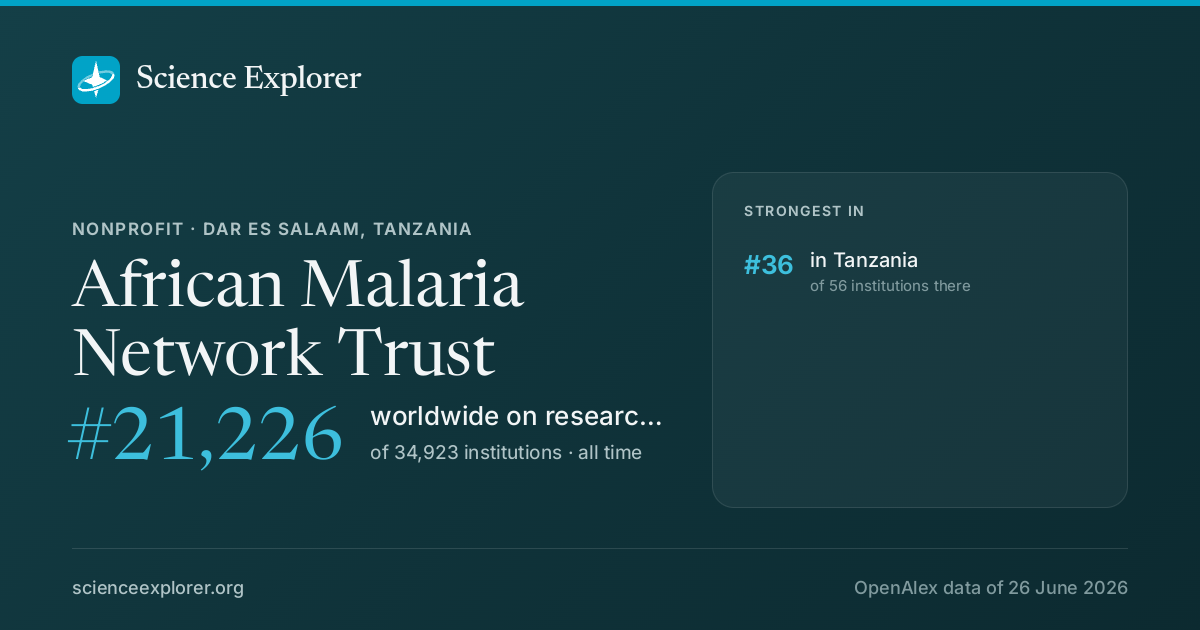
African Malaria Network Trust on Science Explorer

A card with African Malaria Network Trust's standing and the fields it leads in, for a post or a slide. A link to this page previews as the same card.

Download the card

1200 × 630 PNG, sized for social posts, drawn from the latest snapshot.

Badges for a website1Each links back here and updates with every snapshot

Research measures only: rankings here say nothing about teaching, admissions or student experience. Comparable institutions and collaboration partners have tabs of their own, above.

Discussion

Ask a question or share a note about African Malaria Network Trust. Posts are plain text and can be reported.