Beijing Satellite Navigation Center
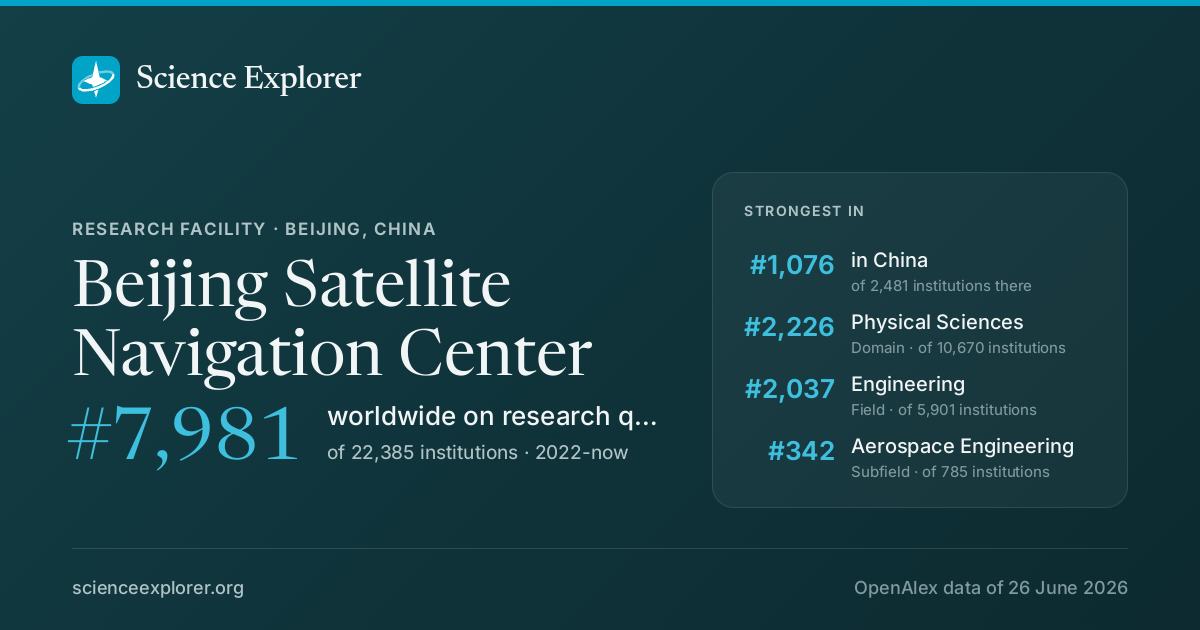
In research, Beijing Satellite Navigation Center stands highest in Physical Sciences (#2,226 of 10,670 worldwide), Engineering (#2,037 of 5,901 worldwide) and Aerospace Engineering (#342 of 785 worldwide), 2022-now. Relative to its size it is most specialised in Aerospace Engineering and Computer Networks and Communications (Aerospace Engineering is 25.8× its share of world research).
- World rank, 2022-now
- #7,981 of 22,385 · #9,085 all time
- Rank in China
- #1,076 of 2,481
- Research works
- 1.2k ▲ 41% vs 2018-21
- Citations
- 6.3k 5.2 per fractional work
- Top-10% rate
- 6.9% all institutions 10.0%
- vs its own fields
- 1.12× 1.00× is exactly expected
- Open access
- 25% world 40%
- International
- 6% world 18%
What is Beijing Satellite Navigation Center known for in research?
The fields where it stands highest, 2022-now, ranked among every institution above the floor in each field.
| Field | World rank | Where that sits | Top-10% rate | Works | All time |
|---|---|---|---|---|---|
| Physical SciencesDomain | #2,226 of 10,670 | 6.9% | 384 | #3250 | |
| EngineeringField | #2,037 of 5,901 | 6.6% | 255 | #3025 | |
| Aerospace EngineeringSubfield | #342 of 785 | 7.6% | 122 | #582 | |
| Computer ScienceField | #2,485 of 4,417 | 7.5% | 77 | #3292 |
Each strip is that field's whole ranked pool, with the notch where Beijing Satellite Navigation Center sits in it, in the colour of the band that rank falls in. The track under the rate is the rate itself: it carries no average mark, because the average differs by field (from about 6% in Dentistry to 21% in Economics).
Which of those standings moved
The same fields on both windows: where it stood over the whole record, and where it stands in 2022-now. The distance is the story, and it is the one thing the two rank columns above cannot show.
- Physical Sciences#3,250 #2,226
- Engineering#3,025 #2,037
- Aerospace Engineering#582 #342
- Computer Science#3,292 #2,485
A dot further right is a better standing. Fields it was not ranked in over the whole record are left out.
Which fields of science does Beijing Satellite Navigation Center work in?
In 2022-now, 96% of research at Beijing Satellite Navigation Center is in Physical Sciences, 2% in Social Sciences. Its largest fields are Engineering (64%), Computer Science (19%), Physics and Astronomy (6%). It does 2.5× the world's share of Physical Sciences.
Each ring splits the one inside it: the four domains of science, their fields, their subfields. Size is fractional works in 2022-now. Every slice is a page; the interactive view zooms down to single topics and colours each by how much more of it this institution does than the world.
Its 4 domains and 21 fields, with their numbers
- Physical Sciences43096.5%
- Engineering28563.9%
- Computer Science8519.1%
- Physics and Astronomy276.1%
- Earth and Planetary Sciences163.5%
- Environmental Science92.0%
- Materials Science51.2%
- Mathematics10.3%
- Chemistry10.1%
- Energy00.1%
- Chemical Engineering00.0%
- Social Sciences92.1%
- Health Sciences40.9%
- Medicine40.9%
- Health Professions00.0%
- Life Sciences20.5%
What does Beijing Satellite Navigation Center specialise in?
Where its research is concentrated relative to its size: Aerospace Engineering takes 25.8× the share of its output that it takes of world research.
- Aerospace EngineeringSubfield · 134.2 works26×
- Computer Networks and CommunicationsSubfield · 25.6 works6.4×
Location quotient, a volume reading rather than an impact one. It surfaces small, lopsided specialities.
Field profile
Location quotient across every field it publishes in: outside the ring is more than an institution of this size would be expected to publish, inside it is less.
Rings at 0.5×, 1× and 2×. Widest outward: Engineering, 4.3×. Every wedge is a field page.
All 21 fields, with their numbers
- Engineering4.26×285 works
- Physics and Astronomy2.73×27 works
- Computer Science2.46×85 works
- Earth and Planetary Sciences2.25×16 works
- Decision Sciences0.75×3 works
- Environmental Science0.41×9 works
- Materials Science0.33×5 works
- Mathematics0.27×1 works
- Chemical Engineering0.14×0 works
- Business, Management and Accounting0.14×2 works
- Energy0.10×0 works
- Chemistry0.08×0 works
- Neuroscience0.06×0 works
- Social Sciences0.06×3 works
- Agricultural and Biological Sciences0.05×1 works
- Medicine0.05×4 works
- Psychology0.04×1 works
- Biochemistry, Genetics and Molecular Biology0.03×1 works
- Economics, Econometrics and Finance0.02×0 works
- Immunology and Microbiology0.01×0 works
- Health Professions0.01×0 works
- Engineering 4.3×
- Physics and Astronomy 2.7×
- Computer Science 2.5×
- Earth and Planetary Sciences 2.2×
- Decision Sciences 0.8×
- Environmental Science 0.4×
- Materials Science 0.3×
- Mathematics 0.3×
- Chemical Engineering 0.1×
- Business, Management and Accounting 0.1×
- Energy 0.1×
- Chemistry 0.1×
- Neuroscience 0.1×
- Social Sciences 0.1×
- Agricultural and Biological Sciences 0.1×
- Medicine 0.1×
- Psychology 0.0×
- Biochemistry, Genetics and Molecular Biology 0.0×
- Economics, Econometrics and Finance 0.0×
- Immunology and Microbiology 0.0×
- Health Professions 0.0×
Who are the top researchers at Beijing Satellite Navigation Center?
Ranked on the quality score, Junyi Xu, Haibo He and Boyuan Wang lead among researchers whose main affiliation is Beijing Satellite Navigation Center.
- 1
Junyi Xu
 China · #1,344,522 worldwide
1.1k citations · 20 works
- 2
Haibo He
China · #1,390,136 worldwide
1k citations · 19 works
- 3
Boyuan Wang
China · #1,640,903 worldwide
949 citations · 77 works
- 4
Yufei Yang
China · #2,122,477 worldwide
1.5k citations · 37 works
- 5
He Zhao
China · #2,135,218 worldwide
197 citations · 30 works
- 6
Rui Guo
China · #2,490,325 worldwide
2.8k citations · 375 works
- 7
Hairong Guo
China · #2,673,191 worldwide
1.1k citations · 45 works
- 8
Maochun Wang
China · #2,995,205 worldwide
200 citations · 19 works
- 9
Xingli Gan
China · #3,131,174 worldwide
817 citations · 61 works
- 10
Xianglei Wang
China · #3,339,827 worldwide
523 citations · 34 works
Which keywords describe research at Beijing Satellite Navigation Center?
By fractional works in 2022-now, weighted toward what it does more of than the world: Orbit Determination, Global Navigation Satellite Systems, GNSS, Sensor Fusion, Deep Learning, Wireless Sensor Networks, Physical Layer Security and Cognitive Radio.
- MIMO Radar
- groundwater depletion
- Collision Avoidance
- Atomic Clocks
- Robotics
- Signal Processing
- Space Debris
- small satellite
- CubeSat
- Hydrological Modeling
- Indoor Localization
- Convolutional Neural Networks
- Kalman Filtering
- Magnetic Sensing
- Neural Networks
- LEO Satellite Constellation
- Cognitive Radio
- Wireless Sensor Networks
- Global Navigation Satellite Systems
- Deep Learning
- Orbit Determination
- GNSS
- Sensor Fusion
- Physical Layer Security
- IoT Applications
- Satellite Communications
- MEMS Sensors
- Inertial Navigation Systems
- Remote Sensing
- Inertial Sensors
- RF-Based Positioning
- Thermal Analysis
- Pose Estimation
- On-Orbit Servicing
- Resource Allocation
- Geodesy
- Sea Level Rise
- Optical Clocks
- GRACE
- Wireless Communications
Size is fractional works in 2022-now in the topics tagged with each word; colour is the word's share of this institution's work against its share of the world's. The 40 words are chosen for being large and distinctive. Each links to the topic it comes from most.
All 40 words, with their numbers
- Orbit Determination40▲ 200×2 topics
- Deep Learning40▲ 2.6×61 topics
- GNSS29▲ 297×1 topic
- Global Navigation Satellite Systems29▲ 249×1 topic
- Sensor Fusion23▲ 49×3 topics
- Wireless Sensor Networks22▲ 11×13 topics
- Physical Layer Security20▲ 106×2 topics
- Cognitive Radio20▲ 129×2 topics
- IoT Applications20▲ 123×2 topics
- LEO Satellite Constellation20▲ 156×1 topic
- Satellite Communications20▲ 156×1 topic
- Neural Networks17▲ 2.5×24 topics
- MEMS Sensors17▲ 127×2 topics
- Magnetic Sensing17▲ 62×2 topics
- Inertial Navigation Systems16▲ 143×1 topic
- Kalman Filtering16▲ 143×1 topic
- Remote Sensing16▲ 3.0×23 topics
- Convolutional Neural Networks13▲ 3.9×12 topics
- Inertial Sensors12▲ 42×2 topics
- Indoor Localization12▲ 62×1 topic
- RF-Based Positioning12▲ 62×1 topic
- Hydrological Modeling12▲ 11×5 topics
- Thermal Analysis11▲ 20×2 topics
- CubeSat11▲ 137×1 topic
- Pose Estimation11▲ 22×2 topics
- small satellite11▲ 137×1 topic
- On-Orbit Servicing11▲ 108×1 topic
- Space Debris11▲ 108×1 topic
- Resource Allocation10▲ 13×8 topics
- Signal Processing10▲ 16×4 topics
- Geodesy10▲ 144×2 topics
- Robotics10▲ 8.7×4 topics
- Sea Level Rise9▲ 17×3 topics
- Atomic Clocks9▲ 230×1 topic
- Optical Clocks9▲ 230×1 topic
- Collision Avoidance9▲ 11×4 topics
- GRACE9▲ 42×1 topic
- groundwater depletion9▲ 42×1 topic
- Wireless Communications8▲ 11×5 topics
- MIMO Radar8▲ 54×2 topics
Which research topics does Beijing Satellite Navigation Center publish most on?
By volume in 2022-now: GNSS positioning and interference, Satellite Communication Systems, Inertial Sensor and Navigation and Indoor and Outdoor Localization Technologies.
Area is fractional works; colour is the subfield each topic belongs to.
- 1 GNSS positioning and interference Aerospace Engineering 29 works
- 2 Satellite Communication Systems Aerospace Engineering 20 works
- 3 Inertial Sensor and Navigation Aerospace Engineering 16 works
- 4 Indoor and Outdoor Localization Technologies Electrical and Electronic Engineering 12 works
- 5 Spacecraft Design and Technology Aerospace Engineering 11 works
- 6 Space Satellite Systems and Control Aerospace Engineering 11 works
- 7 Advanced Frequency and Time Standards Atomic and Molecular Physics, and Optics 9 works
- 8 Geophysics and Gravity Measurements Oceanography 9 works
- 9 Ionosphere and magnetosphere dynamics Astronomy and Astrophysics 7 works
- 10 Robotics and Sensor-Based Localization Aerospace Engineering 7 works
How open and international is its research?
Against the world's own shares: the tick on each track. Both are shares of its output, so they sit on one scale and can be read against each other as well as against the world.
World: 40% of research is openly available.
World: 18% is written across borders.
How has Beijing Satellite Navigation Center's research output changed?
Output in 2022-2025 was 41% higher than in 2018-2021.
The same series as a ribbon: one cell per year, darker for more. The line above answers how much; this answers when.
Its share of all research
Growing output can still be a shrinking share: all of science grows. This is Beijing Satellite Navigation Center as a percentage of every work published that year, 0.0018% in 2024.
Fractional works of Beijing Satellite Navigation Center over all fractional works that year. How the balance of science has shifted.
How much of it reaches the world top 10%
Year by year, against all institutions in the same year.
Of each year's output, the share that reached the world's 10% most cited for its field and year. Peak 10.2% in 2024.
Other research institutions in Beijing
- Chinese Academy of Sciences
- Tsinghua University
- Peking University
- Chinese Academy of Agricultural Sciences
- University of Chinese Academy of Sciences
- Beihang University
- Beijing Institute of Technology
- Capital Medical University

Share Beijing Satellite Navigation Center's ranking
Badges for a website1Each links back here and updates with every snapshot

Research measures only: rankings here say nothing about teaching, admissions or student experience. Comparable institutions and collaboration partners have tabs of their own, above.
Discussion
Ask a question or share a note about Beijing Satellite Navigation Center. Keep it to the research: no personal attacks, advertising or links. Any reader can report a post, which collapses it for everyone until it is opened.