China Meteorological Administration
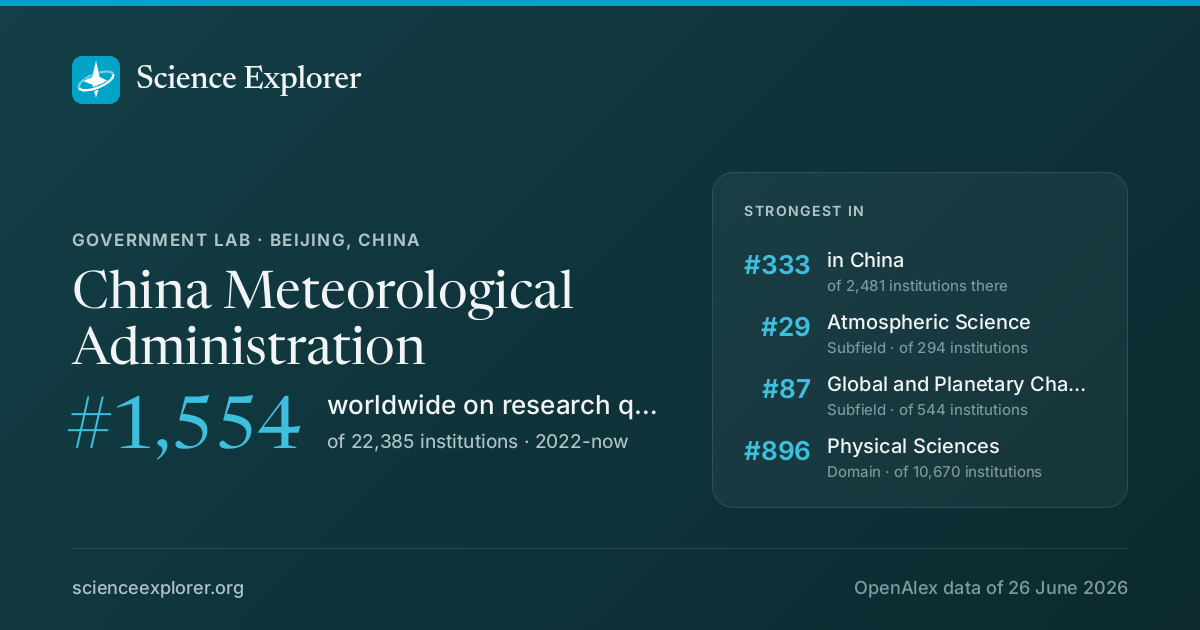
In research, China Meteorological Administration stands highest in Physical Sciences (#896 of 10,670 worldwide), Atmospheric Science (#29 of 294 worldwide) and Environmental Science (#341 of 3,334 worldwide), 2022-now. Relative to its size it is most specialised in Atmospheric Science, Global and Planetary Change and Earth and Planetary Sciences (Atmospheric Science is 75.4× its share of world research).
- World rank, 2022-now
- #1,554 of 22,385 · #1,564 all time
- Rank in China
- #333 of 2,481
- Research works
- 11k ▲ 56% vs 2018-21
- Citations
- 150k 14.3 per fractional work
- Top-10% rate
- 8.5% all institutions 10.0%
- vs its own fields
- 0.82× 1.00× is exactly expected
- Open access
- 35% world 40%
- International
- 14% world 18%
What is China Meteorological Administration known for in research?
The fields where it stands highest, 2022-now, ranked among every institution above the floor in each field.
| Field | World rank | Where that sits | Top-10% rate | Works | All time |
|---|---|---|---|---|---|
| Physical SciencesDomain | #896 of 10,670 | 7.9% | 2,449 | #1052 | |
| Atmospheric ScienceSubfield | #29 of 294 | 7.6% | 889 | #65 | |
| Environmental ScienceField | #341 of 3,334 | 7.9% | 1,034 | #355 | |
| Earth and Planetary SciencesField | #166 of 1,088 | 7.6% | 1,035 | #220 | |
| Global and Planetary ChangeSubfield | #87 of 544 | 6.5% | 618 | #107 | |
| Agricultural and Biological SciencesField | #646 of 3,157 | 12.9% | 105 | #896 | |
| EngineeringField | #1,381 of 5,901 | 9.3% | 203 | #1159 | |
| Life SciencesDomain | #1,968 of 6,403 | 12.2% | 128 | #2858 | |
| Environmental EngineeringSubfield | #116 of 336 | 9.6% | 175 | #210 | |
| Computer ScienceField | #1,590 of 4,417 | 6.3% | 82 | #2230 |
Each strip is that field's whole ranked pool, with the notch where China Meteorological Administration sits in it, in the colour of the band that rank falls in. The track under the rate is the rate itself: it carries no average mark, because the average differs by field (from about 6% in Dentistry to 21% in Economics).
Which of those standings moved
The same fields on both windows: where it stood over the whole record, and where it stands in 2022-now. The distance is the story, and it is the one thing the two rank columns above cannot show.
- Physical Sciences#1,052 #896
- Atmospheric Science#65 #29
- Environmental Science#355 #341
- Earth and Planetary Sciences#220 #166
- Global and Planetary Change#107 #87
- Agricultural and Biological Sciences#896 #646
- Engineering#1,159 #1,381
- Life Sciences#2,858 #1,968
- Environmental Engineering#210 #116
- Computer Science#2,230 #1,590
A dot further right is a better standing. Fields it was not ranked in over the whole record are left out.
Which fields of science does China Meteorological Administration work in?
In 2022-now, 92% of research at China Meteorological Administration is in Physical Sciences, 5% in Life Sciences. Its largest fields are Earth and Planetary Sciences (39%), Environmental Science (38%), Engineering (8%). It does 2.4× the world's share of Physical Sciences.
Each ring splits the one inside it: the four domains of science, their fields, their subfields. Size is fractional works in 2022-now. Every slice is a page; the interactive view zooms down to single topics and colours each by how much more of it this institution does than the world.
Its 4 domains and 26 fields, with their numbers
- Physical Sciences2,92792.0%
- Earth and Planetary Sciences1,23838.9%
- Environmental Science1,22338.4%
- Engineering2517.9%
- Computer Science983.1%
- Physics and Astronomy672.1%
- Materials Science180.6%
- Chemistry130.4%
- Energy120.4%
- Mathematics40.1%
- Chemical Engineering30.1%
- Life Sciences1534.8%
- Social Sciences642.0%
- Health Sciences391.2%
- Medicine300.9%
- Health Professions70.2%
- Nursing20.1%
- Veterinary10.0%
- Dentistry00.0%
What does China Meteorological Administration specialise in?
Where its research is concentrated relative to its size: Atmospheric Science takes 75.4× the share of its output that it takes of world research.
- Atmospheric ScienceSubfield · 1,060.5 works75×
- Global and Planetary ChangeSubfield · 733.0 works30×
- Earth and Planetary SciencesField · 1,237.7 works25×
- OceanographySubfield · 116.2 works13×
- Environmental EngineeringSubfield · 207.6 works12×
- Environmental ScienceField · 1,223.0 works7.7×
- Earth-Surface ProcessesSubfield · 26.5 works7.0×
- Health, Toxicology and MutagenesisSubfield · 98.2 works5.8×
Location quotient, a volume reading rather than an impact one. It surfaces small, lopsided specialities.
Field profile
Location quotient across every field it publishes in: outside the ring is more than an institution of this size would be expected to publish, inside it is less.
Rings at 0.5×, 1× and 2×. Widest outward: Earth and Planetary Sciences, 24.8×. Every wedge is a field page.
All 26 fields, with their numbers
- Earth and Planetary Sciences24.79×1,238 works
- Environmental Science7.73×1,223 works
- Physics and Astronomy0.94×67 works
- Agricultural and Biological Sciences0.83×126 works
- Engineering0.53×251 works
- Energy0.42×12 works
- Computer Science0.40×98 works
- Chemistry0.26×13 works
- Chemical Engineering0.25×3 works
- Decision Sciences0.25×8 works
- Economics, Econometrics and Finance0.18×12 works
- Materials Science0.17×18 works
- Biochemistry, Genetics and Molecular Biology0.14×23 works
- Veterinary0.13×1 works
- Nursing0.12×2 works
- Mathematics0.11×4 works
- Health Professions0.08×7 works
- Social Sciences0.08×33 works
- Psychology0.06×5 works
- Immunology and Microbiology0.05×2 works
- Medicine0.05×30 works
- Neuroscience0.04×2 works
- Pharmacology, Toxicology and Pharmaceutics0.04×0 works
- Business, Management and Accounting0.04×4 works
- Arts and Humanities0.02×2 works
- Dentistry0.01×0 works
- Earth and Planetary Sciences 24.8×
- Environmental Science 7.7×
- Physics and Astronomy 0.9×
- Agricultural and Biological Sciences 0.8×
- Engineering 0.5×
- Energy 0.4×
- Computer Science 0.4×
- Chemistry 0.3×
- Chemical Engineering 0.2×
- Decision Sciences 0.2×
- Economics, Econometrics and Finance 0.2×
- Materials Science 0.2×
- Biochemistry, Genetics and Molecular Biology 0.1×
- Veterinary 0.1×
- Nursing 0.1×
- Mathematics 0.1×
- Health Professions 0.1×
- Social Sciences 0.1×
- Psychology 0.1×
- Immunology and Microbiology 0.1×
- Medicine 0.1×
- Neuroscience 0.0×
- Pharmacology, Toxicology and Pharmaceutics 0.0×
- Business, Management and Accounting 0.0×
- Arts and Humanities 0.0×
- Dentistry 0.0×
Who are the top researchers at China Meteorological Administration?
Ranked on the quality score, Ying Sun, Buda Su and Tongwen Wu lead among researchers whose main affiliation is China Meteorological Administration.
- 1
Ying Sun
 China · #81,469 worldwide
10k citations · 138 works
- 2
Buda Su
China · #88,503 worldwide
9.7k citations · 193 works
- 3
Tongwen Wu
China · #167,553 worldwide
13k citations · 257 works
- 4
Guoyu Ren
China · #182,821 worldwide
12k citations · 266 works
- 5
Ying Xu
China · #211,307 worldwide
7.4k citations · 151 works
- 6
Shiguang Miao
China · #211,472 worldwide
8.7k citations · 194 works
- 7
Xuejie Gao
China · #246,809 worldwide
9.1k citations · 112 works
- 8
Yihui Ding
China · #257,640 worldwide
24k citations · 334 works
- 9
Jianqing Zhai
China · #260,945 worldwide
3.2k citations · 44 works
- 10
Min Min
China · #286,605 worldwide
6.7k citations · 285 works
Which keywords describe research at China Meteorological Administration?
By fractional works in 2022-now, weighted toward what it does more of than the world: Climate Change, Global Warming, Remote Sensing, Hydrological Cycle, Data Assimilation, Ocean Circulation, Boundary Layer and Probabilistic Forecasting.
- Drought
- Land Use Change
- Rainfall
- Spatial Interpolation
- Black Carbon
- Chemical Composition
- Atmospheric Dust
- Ice Nucleation
- Validation
- Hurricanes
- Tropical Cyclones
- Hydrological Modeling
- Air Quality
- Climate Modeling
- Extreme Events
- Convective Parameterization
- Probabilistic Forecasting
- Ocean Circulation
- Hydrological Cycle
- Global Warming
- Climate Change
- Remote Sensing
- Data Assimilation
- Boundary Layer
- Ensemble Kalman Filter
- Mesoscale Modeling
- Greenhouse Gas Emissions
- Precipitation Extremes
- Sea Level Rise
- Satellite Observations
- Climate
- Storm Surge
- Hydrology
- Aerosols
- Radiative Forcing
- Atmospheric Aerosols
- Precipitation
- Estimation
- Satellite
- Particulate Matter
Size is fractional works in 2022-now in the topics tagged with each word; colour is the word's share of this institution's work against its share of the world's. The 40 words are chosen for being large and distinctive. Each links to the topic it comes from most.
All 40 words, with their numbers
- Climate Change1,138▲ 13×82 topics
- Global Warming613▲ 45×12 topics
- Remote Sensing596▲ 15×38 topics
- Hydrological Cycle482▲ 149×2 topics
- Data Assimilation450▲ 86×4 topics
- Ocean Circulation421▲ 96×3 topics
- Boundary Layer403▲ 100×3 topics
- Probabilistic Forecasting387▲ 63×3 topics
- Ensemble Kalman Filter368▲ 113×2 topics
- Convective Parameterization367▲ 201×1 topic
- Mesoscale Modeling367▲ 201×1 topic
- Extreme Events364▲ 124×2 topics
- Greenhouse Gas Emissions350▲ 40×8 topics
- Climate Modeling342▲ 144×1 topic
- Precipitation Extremes342▲ 144×1 topic
- Air Quality317▲ 53×6 topics
- Sea Level Rise266▲ 66×3 topics
- Hydrological Modeling244▲ 32×5 topics
- Satellite Observations224▲ 70×3 topics
- Tropical Cyclones205▲ 112×2 topics
- Climate178▲ 58×2 topics
- Hurricanes162▲ 149×1 topic
- Storm Surge162▲ 149×1 topic
- Validation155▲ 54×2 topics
- Hydrology145▲ 35×4 topics
- Ice Nucleation140▲ 106×2 topics
- Aerosols140▲ 63×2 topics
- Atmospheric Dust140▲ 162×1 topic
- Radiative Forcing140▲ 162×1 topic
- Chemical Composition134▲ 44×3 topics
- Atmospheric Aerosols134▲ 74×1 topic
- Black Carbon134▲ 74×1 topic
- Precipitation123▲ 80×2 topics
- Spatial Interpolation120▲ 87×2 topics
- Estimation119▲ 89×2 topics
- Rainfall117▲ 180×1 topic
- Satellite117▲ 180×1 topic
- Land Use Change111▲ 12×8 topics
- Particulate Matter111▲ 24×2 topics
- Drought87▲ 28×3 topics
Which research topics does China Meteorological Administration publish most on?
By volume in 2022-now: Meteorological Phenomena and Simulations, Climate variability and models, Tropical and Extratropical Cyclones Research and Atmospheric aerosols and clouds.
Area is fractional works; colour is the subfield each topic belongs to.
- 1 Meteorological Phenomena and Simulations Atmospheric Science 367 works
- 2 Climate variability and models Global and Planetary Change 342 works
- 3 Tropical and Extratropical Cyclones Research Atmospheric Science 162 works
- 4 Atmospheric aerosols and clouds Global and Planetary Change 140 works
- 5 Atmospheric chemistry and aerosols Atmospheric Science 134 works
- 6 Precipitation Measurement and Analysis Atmospheric Science 117 works
- 7 Cryospheric studies and observations Atmospheric Science 86 works
- 8 Air Quality and Health Impacts Health, Toxicology and Mutagenesis 65 works
- 9 Atmospheric Ozone and Climate Atmospheric Science 61 works
- 10 Plant Water Relations and Carbon Dynamics Global and Planetary Change 53 works
How open and international is its research?
Against the world's own shares: the tick on each track. Both are shares of its output, so they sit on one scale and can be read against each other as well as against the world.
World: 40% of research is openly available.
World: 18% is written across borders.
How has China Meteorological Administration's research output changed?
Output in 2022-2025 was 56% higher than in 2018-2021.
The same series as a ribbon: one cell per year, darker for more. The line above answers how much; this answers when.
Its share of all research
Growing output can still be a shrinking share: all of science grows. This is China Meteorological Administration as a percentage of every work published that year, 0.012% in 2024.
Fractional works of China Meteorological Administration over all fractional works that year. How the balance of science has shifted.
How much of it reaches the world top 10%
Year by year, against all institutions in the same year.
Of each year's output, the share that reached the world's 10% most cited for its field and year. Peak 13.4% in 2005.
Other research institutions in Beijing
- Chinese Academy of Sciences
- Tsinghua University
- Peking University
- Chinese Academy of Agricultural Sciences
- University of Chinese Academy of Sciences
- Beihang University
- Beijing Institute of Technology
- Capital Medical University

Share China Meteorological Administration's ranking



Research measures only: rankings here say nothing about teaching, admissions or student experience. Comparable institutions and collaboration partners have tabs of their own, above.
Discussion
Ask a question or share a note about China Meteorological Administration. Posts are plain text and can be reported.