Emergency Nurses Association
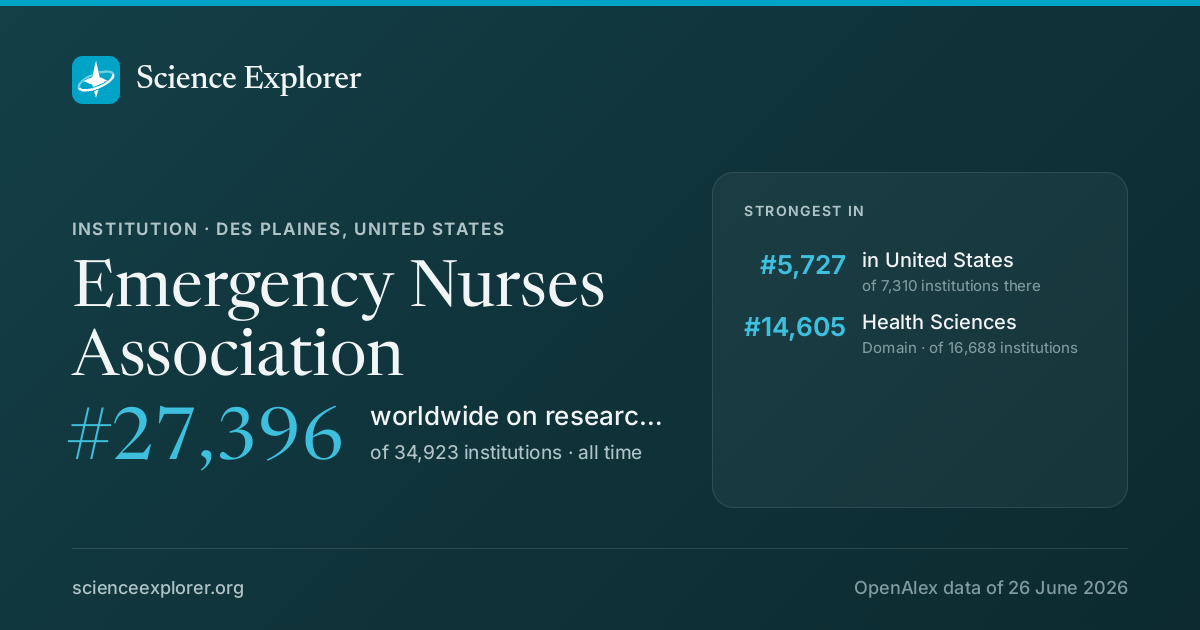
In research, Emergency Nurses Association stands highest in Health Sciences (#14,605 of 16,688 worldwide), over all time.
- World rank, all time
- #27,396 of 34,923
- Rank in United States
- #5,727 of 7,310
- Research works
- 323 ▲ 19% vs 2018-21
- Citations
- 2.1k 6.6 per fractional work
- Top-10% rate
- 6.1% all institutions 10.0%
- vs its own fields
- 0.75× 1.00× is exactly expected
- Open access
- 17% world 40%
- International
- 12% world 18%
What is Emergency Nurses Association known for in research?
The fields where it stands highest, over all time, ranked among every institution above the floor in each field.
| Field | World rank | Where that sits | Top-10% rate | Works |
|---|---|---|---|---|
| Health SciencesDomain | #14,605 of 16,688 | 4.7% | 219 |
Each strip is that field's whole ranked pool, with the notch where Emergency Nurses Association sits in it, in the colour of the band that rank falls in. The track under the rate is the rate itself: it carries no average mark, because the average differs by field (from about 6% in Dentistry to 21% in Economics).
Which fields of science does Emergency Nurses Association work in?
In 2022-now, 72% of research at Emergency Nurses Association is in Health Sciences, 25% in Social Sciences. Its largest fields are Medicine (39%), Health Professions (31%), Social Sciences (10%). It does 2.7× the world's share of Health Sciences.
Each ring splits the one inside it: the four domains of science, their fields, their subfields. Size is fractional works in 2022-now. Every slice is a page; the interactive view zooms down to single topics and colours each by how much more of it this institution does than the world.
Its 4 domains and 16 fields, with their numbers
- Health Sciences3772.4%
- Medicine2038.7%
- Health Professions1630.6%
- Nursing23.1%
- Social Sciences1325.2%
- Physical Sciences11.6%
- Environmental Science00.6%
- Mathematics00.4%
- Computer Science00.3%
- Engineering00.1%
- Life Sciences00.9%
Field profile
Location quotient across every field it publishes in: outside the ring is more than an institution of this size would be expected to publish, inside it is less.
Rings at 0.5×, 1× and 2×. Widest outward: Health Professions, 11.6×. Every wedge is a field page.
All 16 fields, with their numbers
- Health Professions11.62×16 works
- Nursing6.38×2 works
- Psychology3.16×5 works
- Medicine2.01×20 works
- Economics, Econometrics and Finance0.92×1 works
- Arts and Humanities0.91×1 works
- Social Sciences0.80×5 works
- Immunology and Microbiology0.43×0 works
- Mathematics0.37×0 works
- Business, Management and Accounting0.22×0 works
- Neuroscience0.20×0 works
- Decision Sciences0.17×0 works
- Environmental Science0.13×0 works
- Computer Science0.04×0 works
- Biochemistry, Genetics and Molecular Biology0.02×0 works
- Engineering0.01×0 works
- Health Professions 11.6×
- Nursing 6.4×
- Psychology 3.2×
- Medicine 2.0×
- Economics, Econometrics and Finance 0.9×
- Arts and Humanities 0.9×
- Social Sciences 0.8×
- Immunology and Microbiology 0.4×
- Mathematics 0.4×
- Business, Management and Accounting 0.2×
- Neuroscience 0.2×
- Decision Sciences 0.2×
- Environmental Science 0.1×
- Computer Science 0.0×
- Biochemistry, Genetics and Molecular Biology 0.0×
- Engineering 0.0×
Who are the top researchers at Emergency Nurses Association?
Ranked on the quality score, Cydne Perhats, Altair M. Delao and Susan L. MacLean lead among researchers whose main affiliation is Emergency Nurses Association.
- 1
Cydne Perhats
 United States · #1,048,596 worldwide
1.4k citations · 37 works
- 2
Altair M. Delao
United States · #1,448,342 worldwide
1.1k citations · 55 works
- 3
Susan L. MacLean
United States · #1,491,102 worldwide
1.1k citations · 32 works
- 4
Lisa Adams Wolf
United States · #1,513,450 worldwide
2k citations · 152 works
- 5
Isabel McIsaac
United States · #2,333,094 worldwide
6 citations · 61 works
- 6
Isabel Hampton Robb
United States · #2,720,495 worldwide
96 citations · 34 works
- 7
Sherri-Lynne Almeida
United States · #3,265,264 worldwide
255 citations · 18 works
- 8
Mary M. Jagim
United States · #4,856,546 worldwide
102 citations · 27 works
- 9
Benjamin E. Marett
United States · #5,237,511 worldwide
310 citations · 42 works
- 10
Anita Szczepanski
United States · #5,319,312 worldwide
2 citations · 27 works
Which keywords describe research at Emergency Nurses Association?
By fractional works in 2022-now, weighted toward what it does more of than the world: Public Health, Mental Health, Healthcare Workers, Primary Care, Patient Satisfaction, Health Care Utilization, Health Policy and Depression.
- Self-Efficacy
- Stress Management
- Health Outcomes
- Social Support
- doctors' strikes
- Mortality
- Health Promoting Schools
- Triage
- Disaster Response
- Stress
- Collaborative Practice
- Job Satisfaction
- Quality of Life
- Ethical Considerations
- Triage Systems
- COVID-19
- Clinical Outcomes
- Health Care Utilization
- Patient Satisfaction
- Mental Health
- Public Health
- Healthcare Workers
- Primary Care
- Health Policy
- Depression
- Emergency Department Crowding
- Nursing
- Health Education
- Infectious Diseases
- Anxiety
- Health Workforce
- Capacity Building
- Pandemic
- Health Promotion
- School Health Promotion
- NHS
- Quality Improvement
- Advanced Practice Nursing
- Nurse Practitioners
- Elderly Patients
Size is fractional works in 2022-now in the topics tagged with each word; colour is the word's share of this institution's work against its share of the world's. The 40 words are chosen for being large and distinctive. Each links to the topic it comes from most.
All 40 words, with their numbers
- Public Health6▲ 8.5×14 topics
- Mental Health6▲ 7.7×12 topics
- Healthcare Workers5▲ 45×4 topics
- Patient Satisfaction5▲ 34×5 topics
- Primary Care5▲ 29×8 topics
- Health Care Utilization5▲ 90×3 topics
- Health Policy5▲ 60×3 topics
- Clinical Outcomes4▲ 34×3 topics
- Depression4▲ 8.5×6 topics
- COVID-194▲ 5.5×6 topics
- Emergency Department Crowding4▲ 235×1 topic
- Triage Systems4▲ 235×1 topic
- Nursing3▲ 34×4 topics
- Ethical Considerations3▲ 17×4 topics
- Health Education3▲ 13×3 topics
- Quality of Life3▲ 4.0×9 topics
- Infectious Diseases3▲ 17×5 topics
- Job Satisfaction3▲ 12×4 topics
- Anxiety2▲ 10×4 topics
- Collaborative Practice2▲ 102×2 topics
- Health Workforce2▲ 106×2 topics
- Stress2▲ 12×4 topics
- Capacity Building2▲ 68×2 topics
- Disaster Response2▲ 54×1 topic
- Pandemic2▲ 4.2×4 topics
- Triage2▲ 99×1 topic
- Health Promotion2▲ 13×4 topics
- Health Promoting Schools2▲ 241×1 topic
- School Health Promotion2▲ 241×1 topic
- Mortality2▲ 6.3×6 topics
- NHS2▲ 246×1 topic
- doctors' strikes2▲ 309×1 topic
- Quality Improvement2▲ 17×5 topics
- Social Support2▲ 6.2×4 topics
- Advanced Practice Nursing2▲ 239×1 topic
- Health Outcomes2▲ 12×4 topics
- Nurse Practitioners2▲ 239×1 topic
- Stress Management2▲ 30×3 topics
- Elderly Patients2▲ 17×3 topics
- Self-Efficacy2▲ 12×3 topics
Which research topics does Emergency Nurses Association publish most on?
By volume in 2022-now: Emergency and Acute Care Studies, Disaster Response and Management, School Health and Nursing Education and Healthcare Systems and Challenges.
Area is fractional works; colour is the subfield each topic belongs to.
- 1 Emergency and Acute Care Studies Emergency Medicine 4 works
- 2 Disaster Response and Management Emergency Medical Services 2 works
- 3 School Health and Nursing Education Speech and Hearing 2 works
- 4 Healthcare Systems and Challenges General Health Professions 2 works
- 5 Nursing Roles and Practices General Health Professions 2 works
- 6 Pediatric health and respiratory diseases Emergency Medical Services 2 works
- 7 Health and Well-being Studies Clinical Psychology 1 works
- 8 Cardiac Health and Mental Health Cardiology and Cardiovascular Medicine 1 works
- 9 Workplace Violence and Bullying Sociology and Political Science 1 works
- 10 Trauma and Emergency Care Studies Emergency Medicine 1 works
How open and international is its research?
Against the world's own shares: the tick on each track. Both are shares of its output, so they sit on one scale and can be read against each other as well as against the world.
World: 40% of research is openly available.
World: 18% is written across borders.
How has Emergency Nurses Association's research output changed?
Output in 2022-2025 was 19% higher than in 2018-2021.
The same series as a ribbon: one cell per year, darker for more. The line above answers how much; this answers when.
Its share of all research
Growing output can still be a shrinking share: all of science grows. This is Emergency Nurses Association as a percentage of every work published that year, 0.00019% in 2024.
Fractional works of Emergency Nurses Association over all fractional works that year. How the balance of science has shifted.
Other research institutions in Des Plaines
- Gas Technology Institute
- Precision Research (United States)
- Oakton Community College
- Des Plaines Public Library
- Weil Foot & Ankle Institute
- United States Drug Testing Laboratories
- Society for Academic Emergency Medicine
- Motor Coach Industries (United States)

Share Emergency Nurses Association's ranking
Badges for a website1Each links back here and updates with every snapshot

Research measures only: rankings here say nothing about teaching, admissions or student experience. Comparable institutions and collaboration partners have tabs of their own, above.
Discussion
Ask a question or share a note about Emergency Nurses Association. Keep it to the research: no personal attacks, advertising or links. Any reader can report a post, which collapses it for everyone until it is opened.