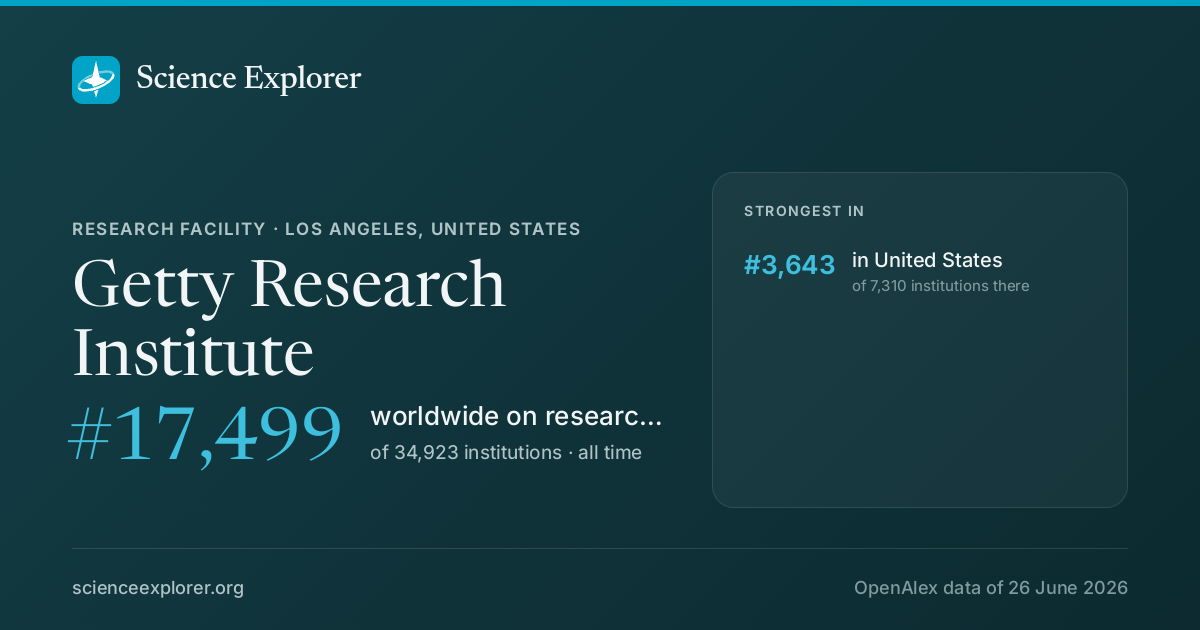
Getty Research Institute

- World rank, all time
- #17,499 of 34,923
- Rank in United States
- #3,643 of 7,310
- Research works
- 241 ▼ 17% vs 2018-21
- Citations
- 3k 12.5 per fractional work
- Top-10% rate
- 10.0% all institutions 10.0%
- vs its own fields
- 1.11× 1.00× is exactly expected
- Open access
- 35% world 40%
- International
- 15% world 18%
Which fields of science does Getty Research Institute work in?
In 2022-now, 65% of research at Getty Research Institute is in Social Sciences, 23% in Physical Sciences. Its largest fields are Arts and Humanities (30%), Social Sciences (29%), Computer Science (10%). It does 2.3× the world's share of Social Sciences.
Each ring splits the one inside it: the four domains of science, their fields, their subfields. Size is fractional works in 2022-now. Every slice is a page; the interactive view zooms down to single topics and colours each by how much more of it this institution does than the world.
Its 4 domains and 19 fields, with their numbers
- Social Sciences2764.7%
- Arts and Humanities1229.9%
- Social Sciences1228.8%
- Economics, Econometrics and Finance12.5%
- Business, Management and Accounting12.0%
- Psychology01.0%
- Decision Sciences00.5%
- Physical Sciences1023.0%
- Computer Science410.1%
- Earth and Planetary Sciences36.6%
- Engineering13.2%
- Environmental Science12.1%
- Materials Science00.4%
- Chemistry00.3%
- Physics and Astronomy00.3%
- Health Sciences36.2%
- Medicine25.6%
- Nursing00.4%
- Health Professions00.2%
- Life Sciences36.2%
Field profile
Location quotient across every field it publishes in: outside the ring is more than an institution of this size would be expected to publish, inside it is less.
Rings at 0.5×, 1× and 2×. Widest outward: Arts and Humanities, 10.4×. Every wedge is a field page.
All 19 fields, with their numbers
- Arts and Humanities10.36×12 works
- Earth and Planetary Sciences4.20×3 works
- Social Sciences2.28×12 works
- Computer Science1.30×4 works
- Economics, Econometrics and Finance1.17×1 works
- Neuroscience0.97×1 works
- Biochemistry, Genetics and Molecular Biology0.85×2 works
- Nursing0.82×0 works
- Business, Management and Accounting0.62×1 works
- Decision Sciences0.46×0 works
- Environmental Science0.42×1 works
- Psychology0.34×0 works
- Medicine0.29×2 works
- Engineering0.21×1 works
- Chemistry0.17×0 works
- Physics and Astronomy0.12×0 works
- Materials Science0.11×0 works
- Health Professions0.08×0 works
- Agricultural and Biological Sciences0.01×0 works
- Arts and Humanities 10.4×
- Earth and Planetary Sciences 4.2×
- Social Sciences 2.3×
- Computer Science 1.3×
- Economics, Econometrics and Finance 1.2×
- Neuroscience 1.0×
- Biochemistry, Genetics and Molecular Biology 0.8×
- Nursing 0.8×
- Business, Management and Accounting 0.6×
- Decision Sciences 0.5×
- Environmental Science 0.4×
- Psychology 0.3×
- Medicine 0.3×
- Engineering 0.2×
- Chemistry 0.2×
- Physics and Astronomy 0.1×
- Materials Science 0.1×
- Health Professions 0.1×
- Agricultural and Biological Sciences 0.0×
Who are the top researchers at Getty Research Institute?
Ranked on the quality score, Anthony M. Schwartz, Thomas E. Crow and Annette Michelson lead among researchers whose main affiliation is Getty Research Institute.
- 1
Anthony M. Schwartz
 United States · #863,043 worldwide
1.4k citations · 46 works
- 2
Thomas E. Crow
United States · #1,324,620 worldwide
640 citations · 80 works
- 3
Annette Michelson
United States · #2,087,379 worldwide
1.6k citations · 100 works
- 4
Lyman P. Powell
United States · #2,157,319 worldwide
104 citations · 16 works
- 5
Walton Muyumba
United States · #2,827,243 worldwide
126 citations · 18 works
- 6
Wendy A. Grossman
United States · #3,016,377 worldwide
88 citations · 16 works
- 7
Marco Collareta
United States · #3,092,478 worldwide
28 citations · 60 works
- 8
Michael D. Mathiowetz
United States · #3,098,724 worldwide
114 citations · 17 works
- 9
Matthew Lincoln
United States · #3,209,966 worldwide
77 citations · 65 works
- 10
Sandra van Ginhoven
United States · #3,524,588 worldwide
19 citations · 28 works
Which keywords describe research at Getty Research Institute?
By fractional works in 2022-now, weighted toward what it does more of than the world: Globalization, Cultural Heritage, Cultural Politics, Digital Repositories, Colonialism, Identity, Social Justice and Gender.
- Medieval Architecture
- Feminism
- Castle Construction
- Art Market
- Radiocarbon Dating
- Agricultural Origins
- Data Visualization
- Scientific Data Management
- Race
- Memory
- Data Sharing
- Visual Culture
- Health
- Conservation
- Contemporary Art
- Sexuality
- Gender
- Identity
- Cultural Politics
- Cultural Heritage
- Globalization
- Colonialism
- Digital Repositories
- Social Justice
- Gender Equality
- Aesthetics
- Intersectionality
- Cultural Studies
- Human Rights
- Archaeology
- Feminist Theory
- Performativity
- Religion
- Cultural History
- Nationalism
- Investment
- Archives
- Auctions
- Digital Preservation
- Linked Data
Size is fractional works in 2022-now in the topics tagged with each word; colour is the word's share of this institution's work against its share of the world's. The 40 words are chosen for being large and distinctive. Each links to the topic it comes from most.
All 40 words, with their numbers
- Globalization6▲ 7.2×12 topics
- Cultural Heritage4▲ 20×10 topics
- Colonialism2▲ 12×6 topics
- Cultural Politics2▲ 84×3 topics
- Digital Repositories2▲ 162×2 topics
- Identity2▲ 7.7×5 topics
- Social Justice2▲ 8.7×3 topics
- Gender2▲ 8.9×4 topics
- Gender Equality2▲ 16×3 topics
- Sexuality2▲ 60×2 topics
- Aesthetics2▲ 51×1 topic
- Contemporary Art2▲ 365×1 topic
- Intersectionality2▲ 21×2 topics
- Conservation2▲ 8.7×4 topics
- Cultural Studies2▲ 9.7×4 topics
- Health2▲ 9.0×2 topics
- Human Rights2▲ 3.6×3 topics
- Visual Culture2▲ 66×3 topics
- Archaeology1▲ 25×3 topics
- Data Sharing1▲ 100×1 topic
- Feminist Theory1▲ 72×1 topic
- Memory1▲ 13×2 topics
- Performativity1▲ 102×2 topics
- Race1▲ 27×1 topic
- Religion1▲ 6.9×3 topics
- Scientific Data Management1▲ 120×1 topic
- Cultural History1▲ 23×4 topics
- Data Visualization1▲ 52×2 topics
- Nationalism1▲ 6.2×2 topics
- Agricultural Origins1▲ 82×1 topic
- Investment1▲ 24×2 topics
- Radiocarbon Dating1▲ 82×1 topic
- Archives1▲ 180×1 topic
- Art Market1▲ 322×1 topic
- Auctions1▲ 322×1 topic
- Castle Construction1▲ 279×1 topic
- Digital Preservation1▲ 158×1 topic
- Feminism1▲ 8.2×2 topics
- Linked Data1▲ 60×1 topic
- Medieval Architecture1▲ 126×1 topic
Which research topics does Getty Research Institute publish most on?
By volume in 2022-now: Art, Politics, and Modernism, Research Data Management Practices, Feminist Theory and Gender Studies and Archaeology and ancient environmental studies.
Area is fractional works; colour is the subfield each topic belongs to.
- 1 Art, Politics, and Modernism Visual Arts and Performing Arts 2 works
- 2 Research Data Management Practices Information Systems 1 works
- 3 Feminist Theory and Gender Studies Gender Studies 1 works
- 4 Archaeology and ancient environmental studies Paleontology 1 works
- 5 Medieval European History and Architecture Archeology 1 works
- 6 Art History and Market Analysis Visual Arts and Performing Arts 1 works
- 7 Library Science and Information Systems Information Systems 1 works
- 8 Digital and Traditional Archives Management Conservation 1 works
- 9 Historical Art and Architecture Studies Conservation 1 works
- 10 Italian Fascism and Post-war Society Sociology and Political Science 1 works
How open and international is its research?
Against the world's own shares: the tick on each track. Both are shares of its output, so they sit on one scale and can be read against each other as well as against the world.
World: 40% of research is openly available.
World: 18% is written across borders.
How has Getty Research Institute's research output changed?
Output in 2022-2025 was 17% lower than in 2018-2021.
The same series as a ribbon: one cell per year, darker for more. The line above answers how much; this answers when.
Its share of all research
Growing output can still be a shrinking share: all of science grows. This is Getty Research Institute as a percentage of every work published that year, 0.00016% in 2024.
Fractional works of Getty Research Institute over all fractional works that year. How the balance of science has shifted.
Other research institutions in Los Angeles
- University of California, Los Angeles
- University of Southern California
- Cedars-Sinai Medical Center
- Film Independent
- California State University Los Angeles
- Loyola Marymount University
- Doheny Eye Institute
- Occidental College


Share Getty Research Institute's ranking
Badges for a website1Each links back here and updates with every snapshot

Research measures only: rankings here say nothing about teaching, admissions or student experience. Comparable institutions and collaboration partners have tabs of their own, above.
Discussion
Ask a question or share a note about Getty Research Institute. Keep it to the research: no personal attacks, advertising or links. Any reader can report a post, which collapses it for everyone until it is opened.