House Clinic
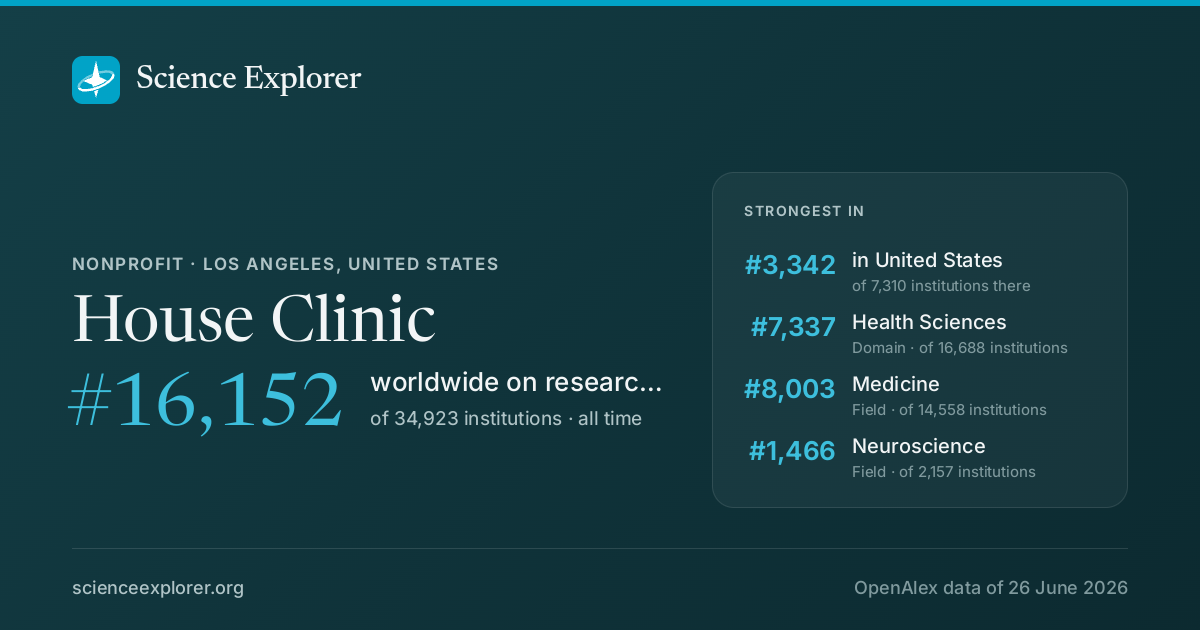
In research, House Clinic stands highest in Health Sciences (#7,337 of 16,688 worldwide), Medicine (#8,003 of 14,558 worldwide) and Neuroscience (#1,466 of 2,157 worldwide), over all time.
- World rank, all time
- #16,152 of 34,923
- Rank in United States
- #3,342 of 7,310
- Research works
- 1.2k ▼ 18% vs 2018-21
- Citations
- 54k 45.4 per fractional work
- Top-10% rate
- 5.0% all institutions 10.0%
- vs its own fields
- 0.93× 1.00× is exactly expected
- Open access
- 23% world 40%
- International
- 13% world 18%
What is House Clinic known for in research?
The fields where it stands highest, over all time, ranked among every institution above the floor in each field.
| Field | World rank | Where that sits | Top-10% rate | Works |
|---|---|---|---|---|
| Health SciencesDomain | #7,337 of 16,688 | 14.9% | 488 | |
| MedicineField | #8,003 of 14,558 | 14.3% | 424 | |
| NeuroscienceField | #1,466 of 2,157 | 14.5% | 419 | |
| Cognitive NeuroscienceSubfield | #868 of 1,124 | 16.2% | 231 | |
| Life SciencesDomain | #9,681 of 11,023 | 14.6% | 492 | |
| Physical SciencesDomain | #16,744 of 17,446 | 25.2% | 134 |
Each strip is that field's whole ranked pool, with the notch where House Clinic sits in it, in the colour of the band that rank falls in. The track under the rate is the rate itself: it carries no average mark, because the average differs by field (from about 6% in Dentistry to 21% in Economics).
Which fields of science does House Clinic work in?
In 2022-now, 52% of research at House Clinic is in Health Sciences, 31% in Life Sciences. Its largest fields are Medicine (49%), Neuroscience (28%), Psychology (7%). It does 2.0× the world's share of Health Sciences.
Each ring splits the one inside it: the four domains of science, their fields, their subfields. Size is fractional works in 2022-now. Every slice is a page; the interactive view zooms down to single topics and colours each by how much more of it this institution does than the world.
Its 4 domains and 13 fields, with their numbers
- Health Sciences2852.3%
- Medicine2648.7%
- Health Professions12.7%
- Dentistry00.6%
- Nursing00.2%
- Life Sciences1731.3%
- Social Sciences59.3%
- Psychology46.5%
- Social Sciences11.8%
- Decision Sciences00.9%
- Physical Sciences47.2%
- Computer Science24.2%
- Engineering12.7%
- Materials Science00.3%
Field profile
Location quotient across every field it publishes in: outside the ring is more than an institution of this size would be expected to publish, inside it is less.
Rings at 0.5×, 1× and 2×. Widest outward: Neuroscience, 17.4×. Every wedge is a field page.
All 13 fields, with their numbers
- Neuroscience17.45×15 works
- Medicine2.53×26 works
- Psychology2.15×4 works
- Dentistry1.27×0 works
- Health Professions1.02×2 works
- Decision Sciences0.96×0 works
- Computer Science0.54×2 works
- Nursing0.50×0 works
- Biochemistry, Genetics and Molecular Biology0.35×1 works
- Agricultural and Biological Sciences0.23×1 works
- Engineering0.18×2 works
- Social Sciences0.14×1 works
- Materials Science0.08×0 works
Who are the top researchers at House Clinic?
Ranked on the quality score, Robert V. Shannon, Jean Kavanagh Moore and Rick Adam Friedman lead among researchers whose main affiliation is House Clinic.
- 1
Robert V. Shannon
 United States · #462,611 worldwide
15k citations · 202 works
- 2
Jean Kavanagh Moore
United States · #844,391 worldwide
4.4k citations · 70 works
- 3
Rick Adam Friedman
United States · #1,012,970 worldwide
2.7k citations · 66 works
- 4
Manuel Don
United States · #1,125,111 worldwide
4.4k citations · 55 works
- 5
Paul Christopher Webster
United States · #1,285,850 worldwide
25k citations · 524 works
- 6
Derald E. Brackmann
United States · #1,383,374 worldwide
16k citations · 309 works
- 7
William E. Hitselberger
United States · #1,958,677 worldwide
5k citations · 110 works
- 8
Yvonne S. Sininger
United States · #2,047,523 worldwide
5k citations · 76 works
- 9
Qian‐Jie Fu
United States · #2,072,483 worldwide
8.6k citations · 215 works
- 10
Laurie S. Eisenberg
United States · #2,251,707 worldwide
5.1k citations · 167 works
Which keywords describe research at House Clinic?
By fractional works in 2022-now, weighted toward what it does more of than the world: Hearing Loss, Quality of Life, Language Development, Speech Perception, Cochlear Implants, Cognitive Decline, Surgical Management and Radiosurgery.
- Sign Language
- Pathophysiology
- Neural Correlates
- Audio-Visual Speech Recognition
- Neurofibromatosis
- Otitis Media
- Acute Otitis Media
- Cerebellum
- Cognition
- Neuroimaging
- Neurological Disorders
- Skull Base Reconstruction
- Genetic Mutations
- Cerebrospinal Fluid Leaks
- Meningiomas
- Epidemiology
- Surgical Management
- Cognitive Decline
- Speech Perception
- Quality of Life
- Hearing Loss
- Language Development
- Cochlear Implants
- Radiosurgery
- Prognostic Factors
- Genomic Analysis
- Neural Plasticity
- Endoscopic Surgery
- Nasoseptal Flap
- Cochlear Neuropathy
- Tinnitus
- Treatment
- Functional Connectivity
- Vestibular
- Bilingualism
- Language Acquisition
- Tumor Suppressor
- Speech Enhancement
- Neuropathic Pain
- Gesture
Size is fractional works in 2022-now in the topics tagged with each word; colour is the word's share of this institution's work against its share of the world's. The 40 words are chosen for being large and distinctive. Each links to the topic it comes from most.
All 40 words, with their numbers
- Hearing Loss13▲ 200×3 topics
- Quality of Life9▲ 12×9 topics
- Language Development8▲ 115×2 topics
- Speech Perception8▲ 167×2 topics
- Cochlear Implants7▲ 362×1 topic
- Cognitive Decline7▲ 108×1 topic
- Radiosurgery7▲ 140×3 topics
- Surgical Management7▲ 32×5 topics
- Prognostic Factors7▲ 29×5 topics
- Epidemiology6▲ 2.8×9 topics
- Genomic Analysis5▲ 37×1 topic
- Meningiomas5▲ 313×1 topic
- Neural Plasticity4▲ 42×3 topics
- Cerebrospinal Fluid Leaks4▲ 146×2 topics
- Endoscopic Surgery4▲ 75×3 topics
- Genetic Mutations4▲ 15×9 topics
- Nasoseptal Flap4▲ 193×1 topic
- Skull Base Reconstruction4▲ 193×1 topic
- Cochlear Neuropathy4▲ 213×1 topic
- Neurological Disorders4▲ 11×3 topics
- Tinnitus4▲ 213×1 topic
- Neuroimaging2▲ 17×4 topics
- Treatment2▲ 3.8×4 topics
- Cognition2▲ 31×2 topics
- Functional Connectivity2▲ 31×2 topics
- Cerebellum2▲ 80×1 topic
- Vestibular2▲ 126×1 topic
- Acute Otitis Media2▲ 181×1 topic
- Bilingualism2▲ 27×2 topics
- Otitis Media2▲ 181×1 topic
- Language Acquisition2▲ 30×2 topics
- Neurofibromatosis2▲ 179×1 topic
- Tumor Suppressor2▲ 84×1 topic
- Audio-Visual Speech Recognition2▲ 66×1 topic
- Speech Enhancement2▲ 66×1 topic
- Neural Correlates2▲ 32×2 topics
- Neuropathic Pain2▲ 42×2 topics
- Pathophysiology2▲ 9.4×2 topics
- Gesture1▲ 96×1 topic
- Sign Language1▲ 42×1 topic
Which research topics does House Clinic publish most on?
By volume in 2022-now: Hearing Loss and Rehabilitation, Meningioma and schwannoma management, Head and Neck Surgical Oncology and Hearing, Cochlea, Tinnitus, Genetics.
Area is fractional works; colour is the subfield each topic belongs to.
- 1 Hearing Loss and Rehabilitation Cognitive Neuroscience 7 works
- 2 Meningioma and schwannoma management Epidemiology 5 works
- 3 Head and Neck Surgical Oncology Surgery 4 works
- 4 Hearing, Cochlea, Tinnitus, Genetics Sensory Systems 4 works
- 5 Vestibular and auditory disorders Neurology 2 works
- 6 Ear Surgery and Otitis Media Otorhinolaryngology 2 works
- 7 Neurofibromatosis and Schwannoma Cases Neurology 2 works
- 8 Speech and Audio Processing Signal Processing 2 works
- 9 Hearing Impairment and Communication Developmental and Educational Psychology 1 works
- 10 Ophthalmology and Eye Disorders Pathology and Forensic Medicine 1 works
How open and international is its research?
Against the world's own shares: the tick on each track. Both are shares of its output, so they sit on one scale and can be read against each other as well as against the world.
World: 40% of research is openly available.
World: 18% is written across borders.
How has House Clinic's research output changed?
Output in 2022-2025 was 18% lower than in 2018-2021.
The same series as a ribbon: one cell per year, darker for more. The line above answers how much; this answers when.
Its share of all research
Growing output can still be a shrinking share: all of science grows. This is House Clinic as a percentage of every work published that year, 0.00022% in 2024.
Fractional works of House Clinic over all fractional works that year. How the balance of science has shifted.
How much of it reaches the world top 10%
Year by year, against all institutions in the same year.
Of each year's output, the share that reached the world's 10% most cited for its field and year. Peak 31.1% in 1994.
Other research institutions in Los Angeles
- University of California, Los Angeles
- University of Southern California
- Cedars-Sinai Medical Center
- Film Independent
- California State University Los Angeles
- Loyola Marymount University
- Doheny Eye Institute
- Occidental College


Share House Clinic's ranking
Badges for a website1Each links back here and updates with every snapshot

Research measures only: rankings here say nothing about teaching, admissions or student experience. Comparable institutions and collaboration partners have tabs of their own, above.
Discussion
Ask a question or share a note about House Clinic. Posts are plain text and can be reported.