Science Explorer Back to mapMap
Discussion
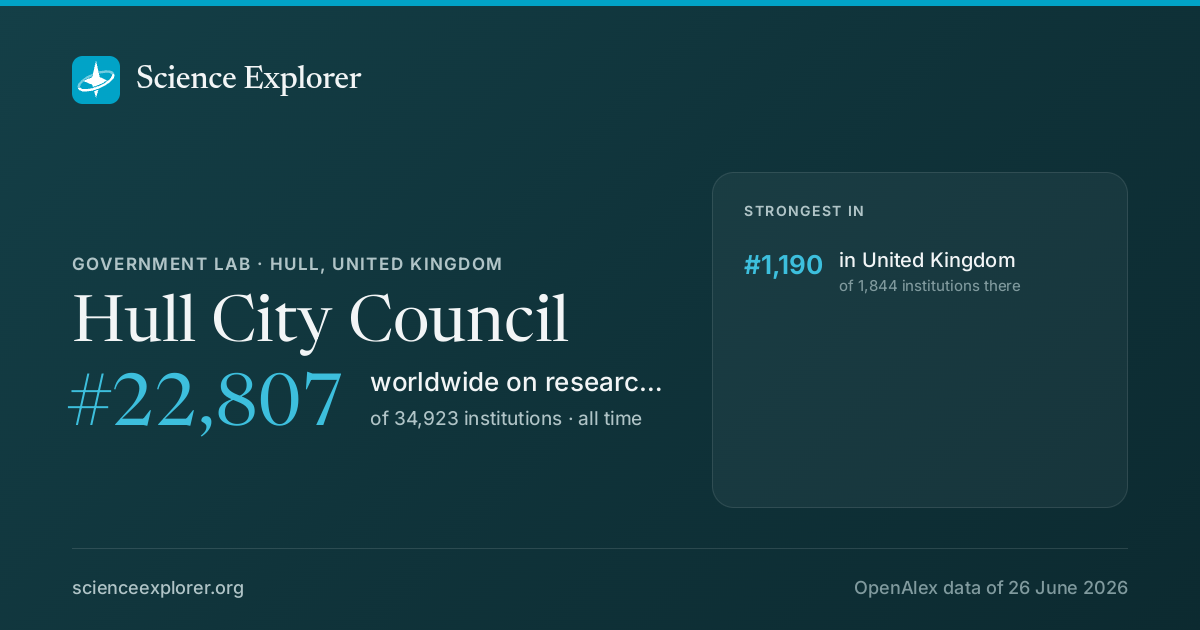
World rank, all time
#22,807
of 34,923
Rank in United Kingdom
#1,190
of 1,844
Research works
240
▲ 21% vs 2018-21
Citations
2.8k
11.7 per fractional work
Top-10% rate
9.2%
all institutions 10.0%
vs its own fields
0.83×
1.00× is exactly expected
Open access
43%
world 40%
International
14%
world 18%

Which fields of science does Hull City Council work in?

In 2022-now, 39% of research at Hull City Council is in Social Sciences, 35% in Health Sciences. Its largest fields are Medicine (21%), Social Sciences (15%), Health Professions (12%). It does 1.4× the world's share of Social Sciences.

Social Sciences: 15 fractional works · 39.1% of its workSocial Sciences: 5 fractional works · 14.5% of its workSociology and Political Science: 3 fractional works · 7.4% of its workPolitical Science and International Relations: 1 fractional works · 2.9% of its workHealth: 1 fractional works · 1.6% of its workDemography: 0 fractional works · 0.9% of its workCultural Studies: 0 fractional works · 0.9% of its workTransportation: 0 fractional works · 0.5% of its workGender Studies: 0 fractional works · 0.2% of its workSmaller subfields together: 0 fractional works · 0.1% of its workArts and Humanities: 3 fractional works · 9.1% of its workLiterature and Literary Theory: 1 fractional works · 3.0% of its workHistory: 1 fractional works · 2.1% of its workReligious studies: 1 fractional works · 1.8% of its workPhilosophy: 0 fractional works · 1.3% of its workConservation: 0 fractional works · 0.6% of its workSmaller subfields together: 0 fractional works · 0.3% of its workBusiness, Management and Accounting: 2 fractional works · 5.2% of its workAccounting: 1 fractional works · 2.7% of its workStrategy and Management: 1 fractional works · 1.5% of its workManagement Information Systems: 0 fractional works · 0.5% of its workManagement of Technology and Innovation: 0 fractional works · 0.3% of its workOrganizational Behavior and Human Resource Management: 0 fractional works · 0.3% of its workPsychology: 2 fractional works · 5.0% of its workDevelopmental and Educational Psychology: 1 fractional works · 2.6% of its workClinical Psychology: 1 fractional works · 2.0% of its workApplied Psychology: 0 fractional works · 0.5% of its workDecision Sciences: 1 fractional works · 3.0% of its workManagement Science and Operations Research: 1 fractional works · 3.0% of its workEconomics, Econometrics and Finance: 1 fractional works · 2.3% of its workEconomics and Econometrics: 1 fractional works · 1.9% of its workGeneral Economics, Econometrics and Finance: 0 fractional works · 0.5% of its workHealth Sciences: 13 fractional works · 35.3% of its workMedicine: 8 fractional works · 21.3% of its workOrthopedics and Sports Medicine: 2 fractional works · 5.4% of its workSurgery: 1 fractional works · 3.3% of its workPulmonary and Respiratory Medicine: 1 fractional works · 2.3% of its workPhysiology: 1 fractional works · 2.0% of its workEpidemiology: 1 fractional works · 1.9% of its workPublic Health, Environmental and Occupational Health: 0 fractional works · 1.2% of its workNeurology: 0 fractional works · 1.1% of its workCardiology and Cardiovascular Medicine: 0 fractional works · 0.9% of its workEmergency Medicine: 0 fractional works · 0.6% of its workImmunology and Allergy: 0 fractional works · 0.3% of its workRadiology, Nuclear Medicine and Imaging: 0 fractional works · 0.3% of its workEndocrinology, Diabetes and Metabolism: 0 fractional works · 0.3% of its workGastroenterology: 0 fractional works · 0.3% of its workInternal Medicine: 0 fractional works · 0.3% of its workPharmacology: 0 fractional works · 0.3% of its workSmaller subfields together: 0 fractional works · 0.7% of its workHealth Professions: 5 fractional works · 12.2% of its workGeneral Health Professions: 4 fractional works · 10.2% of its workPharmacy: 0 fractional works · 0.9% of its workEmergency Medical Services: 0 fractional works · 0.5% of its workHealth Information Management: 0 fractional works · 0.3% of its workSmaller subfields together: 0 fractional works · 0.3% of its workNursing: 0 fractional works · 1.3% of its workNutrition and Dietetics: 0 fractional works · 1.3% of its workDentistry: 0 fractional works · 0.2% of its workVeterinary: 0 fractional works · 0.2% of its workPhysical Sciences: 7 fractional works · 19.8% of its workEngineering: 3 fractional works · 6.9% of its workBiomedical Engineering: 1 fractional works · 1.9% of its workElectrical and Electronic Engineering: 1 fractional works · 1.8% of its workComputational Mechanics: 0 fractional works · 1.2% of its workControl and Systems Engineering: 0 fractional works · 0.5% of its workCivil and Structural Engineering: 0 fractional works · 0.3% of its workSafety, Risk, Reliability and Quality: 0 fractional works · 0.3% of its workAerospace Engineering: 0 fractional works · 0.2% of its workAutomotive Engineering: 0 fractional works · 0.2% of its workIndustrial and Manufacturing Engineering: 0 fractional works · 0.2% of its workSmaller subfields together: 0 fractional works · 0.2% of its workEnvironmental Science: 2 fractional works · 6.6% of its workEcology: 0 fractional works · 1.3% of its workEnvironmental Engineering: 0 fractional works · 1.3% of its workPollution: 0 fractional works · 1.3% of its workIndustrial and Manufacturing Engineering: 0 fractional works · 0.8% of its workHealth, Toxicology and Mutagenesis: 0 fractional works · 0.5% of its workWater Science and Technology: 0 fractional works · 0.5% of its workNature and Landscape Conservation: 0 fractional works · 0.3% of its workGlobal and Planetary Change: 0 fractional works · 0.3% of its workManagement, Monitoring, Policy and Law: 0 fractional works · 0.2% of its workComputer Science: 1 fractional works · 3.0% of its workInformation Systems: 1 fractional works · 2.1% of its workArtificial Intelligence: 0 fractional works · 0.9% of its workEarth and Planetary Sciences: 0 fractional works · 1.0% of its workAtmospheric Science: 0 fractional works · 0.5% of its workOceanography: 0 fractional works · 0.5% of its workPhysics and Astronomy: 0 fractional works · 0.9% of its workAstronomy and Astrophysics: 0 fractional works · 0.6% of its workNuclear and High Energy Physics: 0 fractional works · 0.3% of its workMaterials Science: 0 fractional works · 0.9% of its workMaterials Chemistry: 0 fractional works · 0.7% of its workSmaller subfields together: 0 fractional works · 0.2% of its workChemistry: 0 fractional works · 0.3% of its workSpectroscopy: 0 fractional works · 0.3% of its workEnergy: 0 fractional works · 0.3% of its workRenewable Energy, Sustainability and the Environment: 0 fractional works · 0.3% of its workLife Sciences: 2 fractional works · 5.8% of its workBiochemistry, Genetics and Molecular Biology: 1 fractional works · 2.0% of its workGenetics: 0 fractional works · 0.8% of its workMolecular Biology: 0 fractional works · 0.8% of its workSmaller subfields together: 0 fractional works · 0.3% of its workImmunology and Microbiology: 1 fractional works · 1.8% of its workImmunology: 0 fractional works · 0.9% of its workMicrobiology: 0 fractional works · 0.9% of its workSmaller subfields together: 0 fractional works · 0.0% of its workAgricultural and Biological Sciences: 0 fractional works · 1.2% of its workSoil Science: 0 fractional works · 0.5% of its workFood Science: 0 fractional works · 0.3% of its workEcology, Evolution, Behavior and Systematics: 0 fractional works · 0.2% of its workSmaller subfields together: 0 fractional works · 0.2% of its workNeuroscience: 0 fractional works · 0.9% of its workCognitive Neuroscience: 0 fractional works · 0.9% of its workALL ITS WORKHull City Council37fractional works, 2022-now
Life Sciences6%Physical Sciences20%Health Sciences35%Social Sciences39%

Each ring splits the one inside it: the four domains of science, their fields, their subfields. Size is fractional works in 2022-now. Every slice is a page; the interactive view zooms down to single topics and colours each by how much more of it this institution does than the world.

Its 4 domains and 23 fields, with their numbers
    1. Social Sciences514.5%
    2. Arts and Humanities39.1%
    3. Business, Management and Accounting25.2%
    4. Psychology25.0%
    5. Decision Sciences13.0%
    6. Economics, Econometrics and Finance12.3%
    1. Medicine821.3%
    2. Health Professions512.2%
    3. Nursing01.3%
    4. Dentistry00.2%
    5. Veterinary00.2%
    1. Engineering36.9%
    2. Environmental Science26.6%
    3. Computer Science13.0%
    4. Earth and Planetary Sciences01.0%
    5. Physics and Astronomy00.9%
    6. Materials Science00.9%
    7. Chemistry00.3%
    8. Energy00.3%
    1. Biochemistry, Genetics and Molecular Biology12.0%
    2. Immunology and Microbiology11.8%
    3. Agricultural and Biological Sciences01.2%
    4. Neuroscience00.9%
All of science, and how each field's share has moved since 1950: the Science domain explorer

Field profile

Location quotient across every field it publishes in: outside the ring is more than an institution of this size would be expected to publish, inside it is less.

Agricultural and Biological Sciences: 0.24× its world share, 0 worksAgricultural and Bio…Biochemistry, Genetics and Molecular Biology: 0.37× its world share, 1 worksBiochemistry, Geneti…Immunology and Microbiology: 1.78× its world share, 1 worksImmunology and Micro…Neuroscience: 0.55× its world share, 0 worksNeuroscienceChemistry: 0.21× its world share, 0 worksChemistryComputer Science: 0.38× its world share, 1 worksComputer ScienceEarth and Planetary Sciences: 0.62× its world share, 0 worksEarth and Planetary …Energy: 0.33× its world share, 0 worksEnergyEngineering: 0.46× its world share, 2 worksEngineeringEnvironmental Science: 1.33× its world share, 2 worksEnvironmental ScienceMaterials Science: 0.25× its world share, 0 worksMaterials SciencePhysics and Astronomy: 0.40× its world share, 0 worksPhysics and AstronomyDentistry: 0.51× its world share, 0 worksDentistryHealth Professions: 4.62× its world share, 4 worksHealth ProfessionsMedicine: 1.11× its world share, 8 worksMedicineNursing: 2.74× its world share, 0 worksNursingVeterinary: 1.32× its world share, 0 worksVeterinaryArts and Humanities: 3.13× its world share, 3 worksArts and HumanitiesBusiness, Management and Accounting: 1.62× its world share, 2 worksBusiness, Management…Decision Sciences: 3.09× its world share, 1 worksDecision SciencesEconomics, Econometrics and Finance: 1.08× its world share, 1 worksEconomics, Econometr…Psychology: 1.64× its world share, 2 worksPsychologySocial Sciences: 1.15× its world share, 5 worksSocial Sciences1×world share
more than its size predictsabout as predictedless

Rings at 0.5×, 1× and 2×. Widest outward: Health Professions, 4.6×. Every wedge is a field page.

All 23 fields, with their numbers
  1. Health Professions4.62×4 works
  2. Arts and Humanities3.13×3 works
  3. Decision Sciences3.09×1 works
  4. Nursing2.74×0 works
  5. Immunology and Microbiology1.78×1 works
  6. Psychology1.64×2 works
  7. Business, Management and Accounting1.62×2 works
  8. Environmental Science1.33×2 works
  9. Veterinary1.32×0 works
  10. Social Sciences1.15×5 works
  11. Medicine1.11×8 works
  12. Economics, Econometrics and Finance1.08×1 works
  13. Earth and Planetary Sciences0.62×0 works
  14. Neuroscience0.55×0 works
  15. Dentistry0.51×0 works
  16. Engineering0.46×2 works
  17. Physics and Astronomy0.40×0 works
  18. Computer Science0.38×1 works
  19. Biochemistry, Genetics and Molecular Biology0.37×1 works
  20. Energy0.33×0 works
  21. Materials Science0.25×0 works
  22. Agricultural and Biological Sciences0.24×0 works
  23. Chemistry0.21×0 works

Who are the top researchers at Hull City Council?

Ranked on the quality score, Orlin Yalnazov, Elizabeth Morling and D. J. T. Bagnall lead among researchers whose main affiliation is Hull City Council.

  1. 1 Orlin Yalnazov United Kingdom · #2,213,393 worldwide 70 citations · 18 works

  2. 2 Elizabeth Morling United Kingdom · #2,652,041 worldwide 25 citations · 44 works
  3. 3 D. J. T. Bagnall United Kingdom · #3,028,892 worldwide 74 citations · 31 works
  4. 4 R. C. ANDERSON United Kingdom · #3,172,099 worldwide 13 citations · 24 works
  5. 5 James M. Dunlop United Kingdom · #3,652,534 worldwide 96 citations · 22 works
  6. 6 Tim Chapman United Kingdom · #3,794,225 worldwide 942 citations · 182 works
  7. 7 Craig Hopkins United Kingdom · #4,857,090 worldwide 14 citations · 22 works
  8. 8 Lasar Dünner United Kingdom · #5,049,646 worldwide 236 citations · 80 works
All ranked researchers at Hull City Council

What are the most cited papers from Hull City Council?

The most cited paper from Hull City Council is "The CARE-HF study (CArdiac REsynchronisation in Heart Failure study): Rationale, Design and End-Points" (John G.F. Cleland, Claude Daubert, Erland Erdmann et al., 2001), with 325 citations. Next come "The Effectiveness and Relative Effectiveness of Intravenous Inotropic Drugs Acting Through the Adrenergic Pathway in Patients with Heart Failure—A Meta-Regression Analysis" (322) and "Carvedilol alone or in combination with digoxin for the management of atrial fibrillation in patients with heart failure?" (270).

Most cited papers
#PaperReleasedCitations
1 The CARE-HF study (CArdiac REsynchronisation in Heart Failure study): Rationale, Design and End-Points John G.F. Cleland, Claude Daubert, Erland Erdmann et al. · European Journal of Heart Failure Open access Aug 2001 325
2 The Effectiveness and Relative Effectiveness of Intravenous Inotropic Drugs Acting Through the Adrenergic Pathway in Patients with Heart Failure—A Meta-Regression Analysis Simon D.R. Thackray, Joanne Easthaugh, Nick Freemantle et al. · European Journal of Heart Failure Open access Aug 2002 322
3 Carvedilol alone or in combination with digoxin for the management of atrial fibrillation in patients with heart failure? Aleem U. Khand, ANDREW C. RANKIN, William Martin et al. · Journal of the American College of Cardiology Open access Dec 2003 270
4 Surface Electrocardiogram to Predict Outcome in Candidates for Cardiac Resynchronization Therapy: A Sub-Analysis of the CARE-HF Trial Renaud Gervais, Christophe Leclercq, Aparna Shankar et al. · European Journal of Heart Failure Open access 8 Jun 2009 246
5 Association of Galectin-3 and Fibrosis Markers with Long-Term Cardiovascular Outcomes in Patients with Heart Failure, Left Ventricular Dysfunction, and Dyssynchrony: Insights from the CARE-HF (Cardiac Resynchronization in Heart Failure) Trial Natalia López‐Andrés, Patrick Rossignol, Wafae Iraqi et al. · European Journal of Heart Failure 17 Nov 2011 228
All 60 most cited papers, with filters and sorting

Which keywords describe research at Hull City Council?

By fractional works in 2022-now, weighted toward what it does more of than the world: Epidemiology, Career Choice, Motivation, Well-being, Job Satisfaction, Injury Prevention, Risk Factors and Prevention.

▲ more of its work than of the world's◆ about the world's share▼ less than the world's

Size is fractional works in 2022-now in the topics tagged with each word; colour is the word's share of this institution's work against its share of the world's. The 27 words are chosen for being large and distinctive. Each links to the topic it comes from most.

All 27 words, with their numbers
  1. Epidemiology4▲ 2.5×17 topics
  2. Career Choice2▲ 192×1 topic
  3. Motivation2▲ 13×1 topic
  4. Risk Factors2▲ 4.4×8 topics
  5. Well-being2▲ 12×5 topics
  6. Injury Prevention1▲ 31×3 topics
  7. Job Satisfaction1▲ 8.7×3 topics
  8. Qualitative Research1▲ 4.3×4 topics
  9. Prevention1▲ 8.3×3 topics
  10. Depression1▲ 3.7×4 topics
  11. Globalization1▲ 1.60×5 topics
  12. Income Inequality1▲ 22×2 topics
  13. Investment Decisions1▲ 26×2 topics
  14. Muscle Injuries1▲ 49×1 topic
  15. Quality of Life1▲ 2.2×10 topics
  16. Sports Injury1▲ 49×1 topic
  17. Anxiety1▲ 6.0×2 topics
  18. Consumer Behavior1▲ 4.6×2 topics
  19. Mental Health1▲ 2.0×4 topics
  20. Work-Life Balance1▲ 15×2 topics
  21. Concept Mapping1▲ 74×1 topic
  22. Financial Literacy1▲ 29×1 topic
  23. Medical Student Distress1▲ 50×1 topic
  24. Physician Burnout1▲ 34×1 topic
  25. Retirement Planning1▲ 80×1 topic
  26. Social Support1▲ 5.0×4 topics
  27. Theory-Based Evaluation1▲ 161×1 topic

Which research topics does Hull City Council publish most on?

By volume in 2022-now: Dental Education, Practice, Research, Sports injuries and prevention, Healthcare professionals’ stress and burnout and Financial Literacy, Pension, Retirement Analysis.

  1. 1 Dental Education, Practice, Research General Health Professions 2 works
  2. 2 Sports injuries and prevention Orthopedics and Sports Medicine 1 works
  3. 3 Healthcare professionals’ stress and burnout General Health Professions 1 works
  4. 4 Financial Literacy, Pension, Retirement Analysis Accounting 1 works
  5. 5 Evaluation and Performance Assessment Management Science and Operations Research 1 works
  6. 6 Sports Performance and Training Orthopedics and Sports Medicine 1 works
  7. 7 Sport Psychology and Performance Developmental and Educational Psychology 1 works
  8. 8 Asthma and respiratory diseases Physiology 1 works
  9. 9 Air Quality Monitoring and Forecasting Environmental Engineering 0 works
  10. 10 Cybercrime and Law Enforcement Studies Information Systems 0 works

How open and international is its research?

Against the world's own shares: the tick on each track. Both are shares of its output, so they sit on one scale and can be read against each other as well as against the world.

openly available43.4%not open56.6%

World: 40% of research is openly available.

with international co-authors13.5%domestic only86.5%

World: 18% is written across borders.

How has Hull City Council's research output changed?

Output in 2022-2025 was 21% higher than in 2018-2021.

still counting1990200020102020
grewheldshrank

The same series as a ribbon: one cell per year, darker for more. The line above answers how much; this answers when.

Its share of all research

Growing output can still be a shrinking share: all of science grows. This is Hull City Council as a percentage of every work published that year, 0.00018% in 2024.

still counting0.0010%0.0020%Hull City Council0.00014% in 202519801990200020102020

Fractional works of Hull City Council over all fractional works that year. How the balance of science has shifted.

Other research institutions in Hull

All research institutions in Hull

Share Hull City Council's ranking

Hull City Council on Science Explorer

A card with Hull City Council's standing and the fields it leads in, for a post or a slide. A link to this page previews as the same card.

Download the card

1200 × 630 PNG, sized for social posts, drawn from the latest snapshot.

Badges for a website1Each links back here and updates with every snapshot

Research measures only: rankings here say nothing about teaching, admissions or student experience. Comparable institutions and collaboration partners have tabs of their own, above.

Discussion

Ask a question or share a note about Hull City Council. Posts are plain text and can be reported.