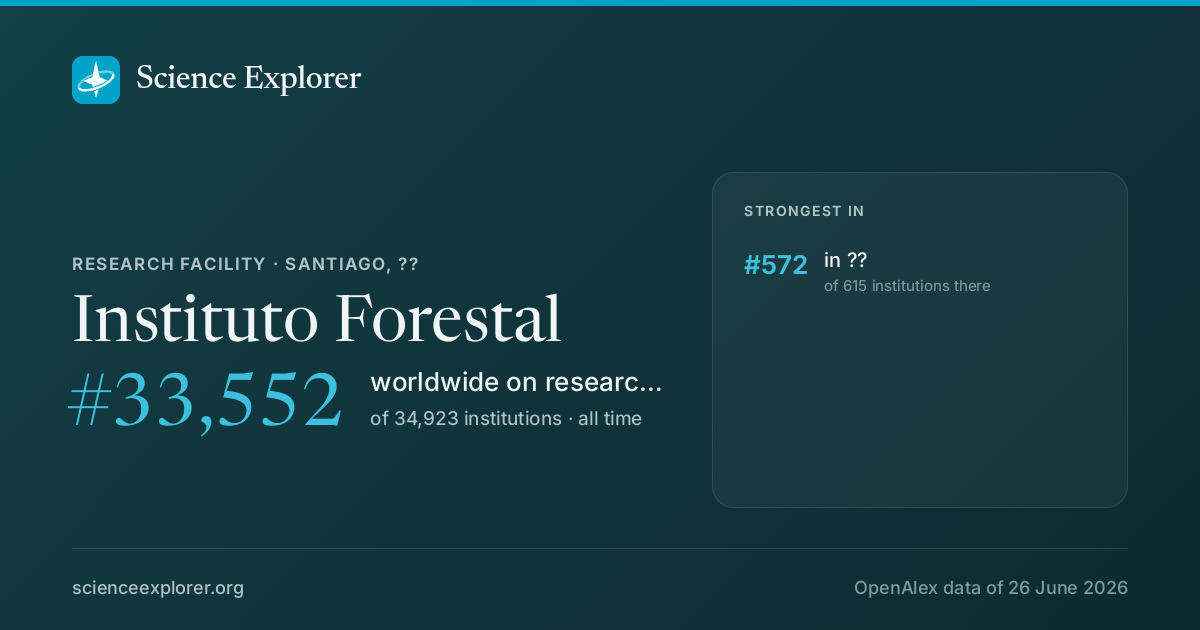
- World rank, all time
- #33,552 of 34,923
- Rank in ??
- #572 of 615
- Research works
- 140 ▲ 71% vs 2018-21
- Citations
- 868 6.2 per fractional work
- Top-10% rate
- 2.3% all institutions 10.0%
- vs its own fields
- 0.98× 1.00× is exactly expected
- Open access
- 84% world 40%
- International
- 21% world 18%
Which fields of science does Instituto Forestal work in?
In 2022-now, 51% of research at Instituto Forestal is in Physical Sciences, 40% in Life Sciences. Its largest fields are Agricultural and Biological Sciences (38%), Environmental Science (34%), Engineering (10%). It does 2.5× the world's share of Life Sciences.
Each ring splits the one inside it: the four domains of science, their fields, their subfields. Size is fractional works in 2022-now. Every slice is a page; the interactive view zooms down to single topics and colours each by how much more of it this institution does than the world.
Its 4 domains and 14 fields, with their numbers
- Physical Sciences2951.1%
- Environmental Science1933.6%
- Engineering69.7%
- Energy34.4%
- Earth and Planetary Sciences23.2%
- Chemistry00.1%
- Life Sciences2340.0%
- Social Sciences35.0%
- Health Sciences24.0%
- Medicine23.2%
- Nursing00.5%
- Health Professions00.3%
Field profile
Location quotient across every field it publishes in: outside the ring is more than an institution of this size would be expected to publish, inside it is less.
Rings at 0.5×, 1× and 2×. Widest outward: Agricultural and Biological Sciences, 8.0×. Every wedge is a field page.
All 14 fields, with their numbers
- Agricultural and Biological Sciences8.00×22 works
- Environmental Science6.77×19 works
- Energy4.80×2 works
- Earth and Planetary Sciences2.06×2 works
- Nursing0.96×0 works
- Economics, Econometrics and Finance0.66×1 works
- Engineering0.64×6 works
- Business, Management and Accounting0.56×1 works
- Biochemistry, Genetics and Molecular Biology0.37×1 works
- Arts and Humanities0.20×0 works
- Medicine0.17×2 works
- Health Professions0.11×0 works
- Chemistry0.09×0 works
- Social Sciences0.09×1 works
- Agricultural and Biological Sciences 8.0×
- Environmental Science 6.8×
- Energy 4.8×
- Earth and Planetary Sciences 2.1×
- Nursing 1.0×
- Economics, Econometrics and Finance 0.7×
- Engineering 0.6×
- Business, Management and Accounting 0.6×
- Biochemistry, Genetics and Molecular Biology 0.4×
- Arts and Humanities 0.2×
- Medicine 0.2×
- Health Professions 0.1×
- Chemistry 0.1×
- Social Sciences 0.1×
Who are the top researchers at Instituto Forestal?
Ranked on the quality score, Carlos Bahamóndez, Raúl Campos P. and Juan Carlos Bañados lead among researchers whose main affiliation is Instituto Forestal.
- 1 Carlos Bahamóndez #2,213,586 worldwide 387 citations · 21 works
- 2 Raúl Campos P. #2,498,118 worldwide 8 citations · 36 works
- 3 Juan Carlos Bañados #2,507,065 worldwide 20 citations · 29 works
- 4 Luis Vásquez V. #2,630,506 worldwide 8 citations · 38 works
- 5 Sabine Müller-Using #2,678,130 worldwide 281 citations · 29 works
- 6 Evaristo Pardo #2,733,645 worldwide 21 citations · 28 works
- 7 Patricio Elgueta M. #2,789,960 worldwide 8 citations · 31 works
- 8 Carlos Kahler #3,040,689 worldwide 20 citations · 32 works
- 9 Gonzalo Hernández C. #3,240,701 worldwide 19 citations · 46 works
- 10 Janina Gysling #3,273,234 worldwide 21 citations · 33 works
Which keywords describe research at Instituto Forestal?
By fractional works in 2022-now, weighted toward what it does more of than the world: Environmental Impact, Biodiversity, Biomass Estimation, Phylogeny, Climate Change, Aboveground Biomass, Climate Change Impact and Climate Change Impacts.
- Soil Properties
- Invasive Species
- Betalains
- Phytochemicals
- Forest Biomass
- Organic Farming
- Grasses
- Conservation
- Apomixis
- Logistics
- Life Cycle Assessment
- Biomass
- Genetics
- Antioxidant
- Tropical Forests
- Allometric Models
- Climate Change Impacts
- Phylogeny
- Aboveground Biomass
- Climate Change
- Environmental Impact
- Biodiversity
- Biomass Estimation
- Climate Change Impact
- Sustainability
- Carbon Stocks
- Sustainable Agriculture
- Evolution
- Bioenergy
- Indigenous Knowledge
- Biodiversity Conservation
- Supply Chain
- Biocultural Conservation
- Earth Stewardship
- Agroecology
- Biogeography
- Health Benefits
- Wood Residues
- Opuntia
- Forest Carbon Sequestration
Size is fractional works in 2022-now in the topics tagged with each word; colour is the word's share of this institution's work against its share of the world's. The 40 words are chosen for being large and distinctive. Each links to the topic it comes from most.
All 40 words, with their numbers
- Environmental Impact8▲ 7.7×8 topics
- Climate Change7▲ 4.7×24 topics
- Biodiversity7▲ 16×10 topics
- Aboveground Biomass6▲ 117×2 topics
- Biomass Estimation6▲ 65×3 topics
- Phylogeny6▲ 60×3 topics
- Climate Change Impact6▲ 43×2 topics
- Climate Change Impacts6▲ 81×2 topics
- Sustainability6▲ 3.9×9 topics
- Allometric Models5▲ 201×2 topics
- Carbon Stocks5▲ 363×1 topic
- Tropical Forests5▲ 274×1 topic
- Sustainable Agriculture5▲ 26×3 topics
- Antioxidant4▲ 11×4 topics
- Evolution4▲ 27×3 topics
- Genetics4▲ 10×2 topics
- Bioenergy4▲ 125×2 topics
- Biomass4▲ 60×2 topics
- Indigenous Knowledge4▲ 64×2 topics
- Life Cycle Assessment4▲ 24×2 topics
- Biodiversity Conservation4▲ 17×5 topics
- Logistics4▲ 41×1 topic
- Supply Chain4▲ 31×1 topic
- Apomixis3▲ 638×1 topic
- Biocultural Conservation3▲ 421×1 topic
- Conservation3▲ 14×6 topics
- Earth Stewardship3▲ 421×1 topic
- Grasses3▲ 638×1 topic
- Agroecology3▲ 41×1 topic
- Organic Farming3▲ 87×1 topic
- Biogeography3▲ 20×3 topics
- Forest Biomass3▲ 149×1 topic
- Health Benefits3▲ 15×2 topics
- Phytochemicals3▲ 45×2 topics
- Wood Residues3▲ 149×1 topic
- Betalains3▲ 185×1 topic
- Opuntia3▲ 185×1 topic
- Invasive Species3▲ 11×6 topics
- Forest Carbon Sequestration2▲ 188×1 topic
- Soil Properties2▲ 23×2 topics
Which research topics does Instituto Forestal publish most on?
By volume in 2022-now: Forest ecology and management, Forest Biomass Utilization and Management, Environmental and Cultural Studies in Latin America and Beyond and Plant Taxonomy and Phylogenetics.
Area is fractional works; colour is the subfield each topic belongs to.
- 1 Forest ecology and management Nature and Landscape Conservation 5 works
- 2 Forest Biomass Utilization and Management Mechanics of Materials 4 works
- 3 Environmental and Cultural Studies in Latin America and Beyond Ecology 3 works
- 4 Plant Taxonomy and Phylogenetics Ecology, Evolution, Behavior and Systematics 3 works
- 5 Plant and soil sciences General Agricultural and Biological Sciences 3 works
- 6 Agricultural and Food Sciences Forestry 3 works
- 7 Botanical Research and Applications Food Science 3 works
- 8 Forest Management and Policy Global and Planetary Change 2 works
- 9 Seedling growth and survival studies Nature and Landscape Conservation 2 works
- 10 Environmental and Ecological Studies Renewable Energy, Sustainability and the Environment 2 works
How open and international is its research?
Against the world's own shares: the tick on each track. Both are shares of its output, so they sit on one scale and can be read against each other as well as against the world.
World: 40% of research is openly available.
World: 18% is written across borders.
How has Instituto Forestal's research output changed?
Output in 2022-2025 was 71% higher than in 2018-2021.
The same series as a ribbon: one cell per year, darker for more. The line above answers how much; this answers when.
Its share of all research
Growing output can still be a shrinking share: all of science grows. This is Instituto Forestal as a percentage of every work published that year, 0.00035% in 2024.
Fractional works of Instituto Forestal over all fractional works that year. How the balance of science has shifted.
Other research institutions in Santiago
- Banco Central de Chile
- Ministerio de Agricultura
- Unión Médica Clínica Universitaria
- Sociedad de Neurología, Psiquiatría y Neurocirugía
- Instituto de Investigaciones y Control del Ejército de Chile
- Instituto Traumatológico Dr. Teodoro Gebauer Weisser
- CODELCO
- Empresa Nacional de Aeronáutica

Share Instituto Forestal's ranking
Badges for a website1Each links back here and updates with every snapshot

Research measures only: rankings here say nothing about teaching, admissions or student experience. Comparable institutions and collaboration partners have tabs of their own, above.
Discussion
Ask a question or share a note about Instituto Forestal. Keep it to the research: no personal attacks, advertising or links. Any reader can report a post, which collapses it for everyone until it is opened.