IVI Madrid Clinic
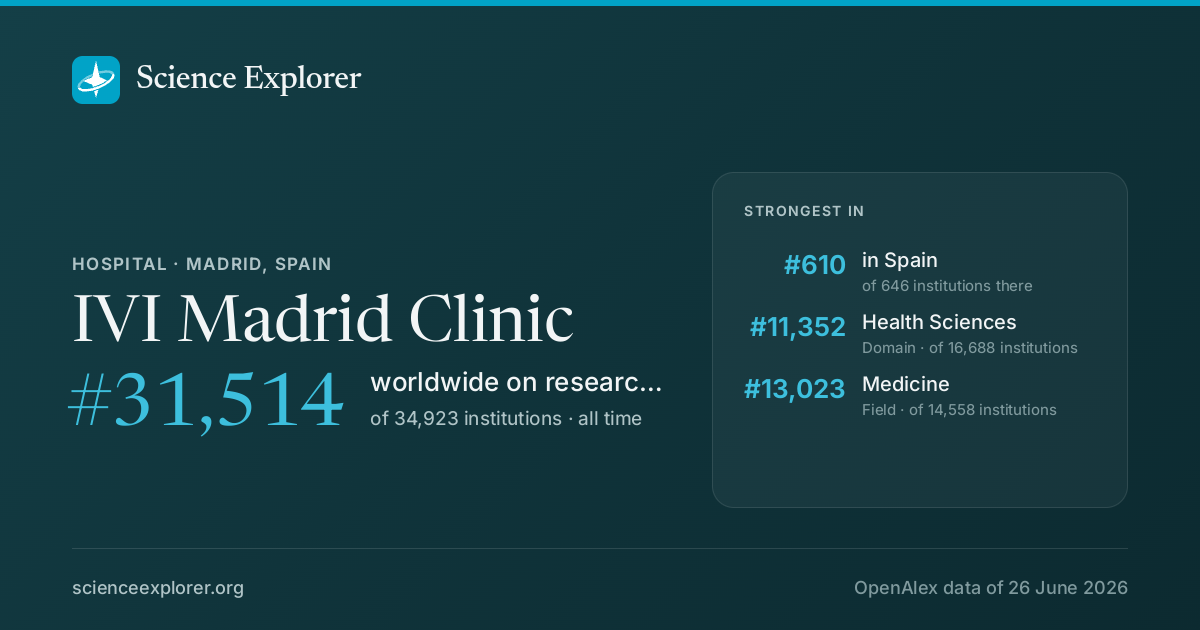
In research, IVI Madrid Clinic stands highest in Health Sciences (#11,352 of 16,688 worldwide) and Medicine (#13,023 of 14,558 worldwide), over all time. Relative to its size it is most specialised in Medicine and Health Sciences (Medicine is 4.2× its share of world research).
- World rank, all time
- #31,514 of 34,923
- Rank in Spain
- #610 of 646
- Research works
- 188 ▲ 6% vs 2018-21
- Citations
- 2.9k 15.3 per fractional work
- Top-10% rate
- 12.7% all institutions 10.0%
- vs its own fields
- 0.91× 1.00× is exactly expected
- Open access
- 48% world 40%
- International
- 24% world 18%
What is IVI Madrid Clinic known for in research?
The fields where it stands highest, over all time, ranked among every institution above the floor in each field.
| Field | World rank | Where that sits | Top-10% rate | Works |
|---|---|---|---|---|
| Health SciencesDomain | #11,352 of 16,688 | 10.6% | 155 | |
| MedicineField | #13,023 of 14,558 | 10.6% | 155 |
Each strip is that field's whole ranked pool, with the notch where IVI Madrid Clinic sits in it, in the colour of the band that rank falls in. The track under the rate is the rate itself: it carries no average mark, because the average differs by field (from about 6% in Dentistry to 21% in Economics).
Which fields of science does IVI Madrid Clinic work in?
In 2022-now, 80% of research at IVI Madrid Clinic is in Health Sciences, 13% in Life Sciences. Its largest fields are Medicine (80%), Biochemistry, Genetics and Molecular Biology (7%), Immunology and Microbiology (5%). It does 3.0× the world's share of Health Sciences.
Each ring splits the one inside it: the four domains of science, their fields, their subfields. Size is fractional works in 2022-now. Every slice is a page; the interactive view zooms down to single topics and colours each by how much more of it this institution does than the world.
Its 4 domains and 12 fields, with their numbers
- Health Sciences4179.9%
- Life Sciences612.5%
- Social Sciences24.6%
- Arts and Humanities23.4%
- Psychology11.0%
- Decision Sciences00.2%
- Physical Sciences23.0%
- Engineering12.3%
- Environmental Science00.5%
- Computer Science00.2%
What does IVI Madrid Clinic specialise in?
Where its research is concentrated relative to its size: Medicine takes 4.2× the share of its output that it takes of world research.
- MedicineField · 40.7 works4.2×
- Health SciencesDomain · 40.7 works3.5×
Location quotient, a volume reading rather than an impact one. It surfaces small, lopsided specialities.
Field profile
Location quotient across every field it publishes in: outside the ring is more than an institution of this size would be expected to publish, inside it is less.
Rings at 0.5×, 1× and 2×. Widest outward: Immunology and Microbiology, 4.7×. Every wedge is a field page.
All 12 fields, with their numbers
- Immunology and Microbiology4.68×2 works
- Medicine4.15×41 works
- Biochemistry, Genetics and Molecular Biology1.25×3 works
- Arts and Humanities1.19×2 works
- Psychology0.34×0 works
- Neuroscience0.30×0 works
- Decision Sciences0.17×0 works
- Engineering0.16×1 works
- Agricultural and Biological Sciences0.13×0 works
- Dentistry0.13×0 works
- Environmental Science0.10×0 works
- Computer Science0.02×0 works
Who are the top researchers at IVI Madrid Clinic?
Ranked on the quality score, Juan Antonio García-Velasco, Leyre Herrero and Fernando Bronet lead among researchers whose main affiliation is IVI Madrid Clinic.
- 1
Juan Antonio García-Velasco
 Spain · #206,323 worldwide
17k citations · 644 works
- 2
Leyre Herrero
Spain · #1,861,767 worldwide
475 citations · 30 works
- 3
Fernando Bronet
Spain · #1,982,284 worldwide
1k citations · 71 works
- 4
Israel Ortega
Spain · #2,284,629 worldwide
833 citations · 21 works
- 5
Natalia Basile
Spain · #2,399,051 worldwide
1.3k citations · 56 works
- 6
Antonio Requena
Spain · #2,807,905 worldwide
1k citations · 50 works
- 7
Graciela Kohls
Spain · #2,835,947 worldwide
176 citations · 24 works
- 8
Alfredo Guillén
Spain · #2,892,620 worldwide
871 citations · 37 works
- 9
Alberto Pacheco
Spain · #3,358,539 worldwide
1.8k citations · 107 works
- 10
Marta Ariza
Spain · #3,998,479 worldwide
140 citations · 18 works
Which keywords describe research at IVI Madrid Clinic?
By fractional works in 2022-now, weighted toward what it does more of than the world: Infertility, Fertility Preservation, Ovarian Tissue Cryopreservation, Cardiovascular Disease, Insulin Resistance, Metabolic Syndrome, Fertility and Obesity.
- Exosomes
- Pregnancy
- Maternal Mortality
- Uterine Leiomyoma
- Reproductive Outcome
- Management
- Health-related Quality of Life
- Regulatory T Cells
- Stem Cells
- Psychological Impact
- Gender Differences
- Stress
- Maternal Plasma DNA Sequencing
- Prenatal Diagnosis
- Assisted Reproductive Technology
- Ovarian Reserve
- Fertility
- Epidemiology
- Cardiovascular Disease
- Fertility Preservation
- Infertility
- Ovarian Tissue Cryopreservation
- Insulin Resistance
- Metabolic Syndrome
- Obesity
- Polycystic Ovary Syndrome
- Quality of Life
- Aneuploidy Screening
- In Vitro Fertilization
- Twin Pregnancy
- Global Trends
- Reproductive Technologies
- Decidual NK Cells
- Diagnosis
- Immunobiology
- Pathophysiology
- Uterine Fibroids
- Hysteroscopic Treatment
- Uterine Anomalies
- Breastfeeding
Size is fractional works in 2022-now in the topics tagged with each word; colour is the word's share of this institution's work against its share of the world's. The 40 words are chosen for being large and distinctive. Each links to the topic it comes from most.
All 40 words, with their numbers
- Infertility13▲ 176×3 topics
- Fertility Preservation9▲ 312×1 topic
- Ovarian Tissue Cryopreservation9▲ 312×1 topic
- Cardiovascular Disease9▲ 15×4 topics
- Insulin Resistance9▲ 37×3 topics
- Epidemiology8▲ 4.1×9 topics
- Metabolic Syndrome8▲ 19×5 topics
- Fertility8▲ 173×2 topics
- Obesity8▲ 20×3 topics
- Ovarian Reserve8▲ 333×1 topic
- Polycystic Ovary Syndrome8▲ 333×1 topic
- Assisted Reproductive Technology7▲ 220×2 topics
- Quality of Life5▲ 7.2×3 topics
- Prenatal Diagnosis4▲ 59×3 topics
- Aneuploidy Screening4▲ 326×1 topic
- Maternal Plasma DNA Sequencing4▲ 326×1 topic
- In Vitro Fertilization4▲ 313×1 topic
- Stress4▲ 19×3 topics
- Twin Pregnancy4▲ 313×1 topic
- Gender Differences3▲ 18×2 topics
- Global Trends3▲ 83×1 topic
- Psychological Impact3▲ 21×2 topics
- Reproductive Technologies3▲ 169×1 topic
- Stem Cells2▲ 18×3 topics
- Decidual NK Cells2▲ 115×1 topic
- Regulatory T Cells2▲ 38×1 topic
- Diagnosis2▲ 4.3×3 topics
- Health-related Quality of Life2▲ 15×2 topics
- Immunobiology2▲ 79×1 topic
- Management2▲ 4.7×2 topics
- Pathophysiology2▲ 13×1 topic
- Reproductive Outcome2▲ 89×2 topics
- Uterine Fibroids2▲ 117×1 topic
- Uterine Leiomyoma2▲ 117×1 topic
- Hysteroscopic Treatment1▲ 113×1 topic
- Maternal Mortality1▲ 12×4 topics
- Uterine Anomalies1▲ 113×1 topic
- Pregnancy1▲ 10×4 topics
- Breastfeeding1▲ 8.6×1 topic
- Exosomes1▲ 32×1 topic
Which research topics does IVI Madrid Clinic publish most on?
By volume in 2022-now: Reproductive Biology and Fertility, Ovarian function and disorders, Prenatal Screening and Diagnostics and Assisted Reproductive Technology and Twin Pregnancy.
Area is fractional works; colour is the subfield each topic belongs to.
- 1 Reproductive Biology and Fertility Public Health, Environmental and Occupational Health 9 works
- 2 Ovarian function and disorders Reproductive Medicine 8 works
- 3 Prenatal Screening and Diagnostics Pediatrics, Perinatology and Child Health 4 works
- 4 Assisted Reproductive Technology and Twin Pregnancy Pediatrics, Perinatology and Child Health 4 works
- 5 Reproductive Health and Technologies Reproductive Medicine 3 works
- 6 Reproductive System and Pregnancy Immunology 2 works
- 7 Endometriosis Research and Treatment Reproductive Medicine 2 works
- 8 Uterine Myomas and Treatments Obstetrics and Gynecology 2 works
- 9 Gynecological conditions and treatments Obstetrics and Gynecology 1 works
- 10 Extracellular vesicles in disease Molecular Biology 1 works
How open and international is its research?
Against the world's own shares: the tick on each track. Both are shares of its output, so they sit on one scale and can be read against each other as well as against the world.
World: 40% of research is openly available.
World: 18% is written across borders.
How has IVI Madrid Clinic's research output changed?
Output in 2022-2025 was 6% higher than in 2018-2021.
The same series as a ribbon: one cell per year, darker for more. The line above answers how much; this answers when.
Its share of all research
Growing output can still be a shrinking share: all of science grows. This is IVI Madrid Clinic as a percentage of every work published that year, 0.00016% in 2024.
Fractional works of IVI Madrid Clinic over all fractional works that year. How the balance of science has shifted.
Other research institutions in Madrid
- Consejo Superior de Investigaciones Científicas
- Universidad Complutense de Madrid
- Universidad Autónoma de Madrid
- Universidad Politécnica de Madrid
- Instituto de Salud Carlos III
- Universidad Carlos III de Madrid
- Universidad Rey Juan Carlos
- Universidad Nacional de Educación a Distancia




Share IVI Madrid Clinic's ranking
Badges for a website1Each links back here and updates with every snapshot

Research measures only: rankings here say nothing about teaching, admissions or student experience. Comparable institutions and collaboration partners have tabs of their own, above.
Discussion
Ask a question or share a note about IVI Madrid Clinic. Keep it to the research: no personal attacks, advertising or links. Any reader can report a post, which collapses it for everyone until it is opened.