Landesmuseum Kärnten
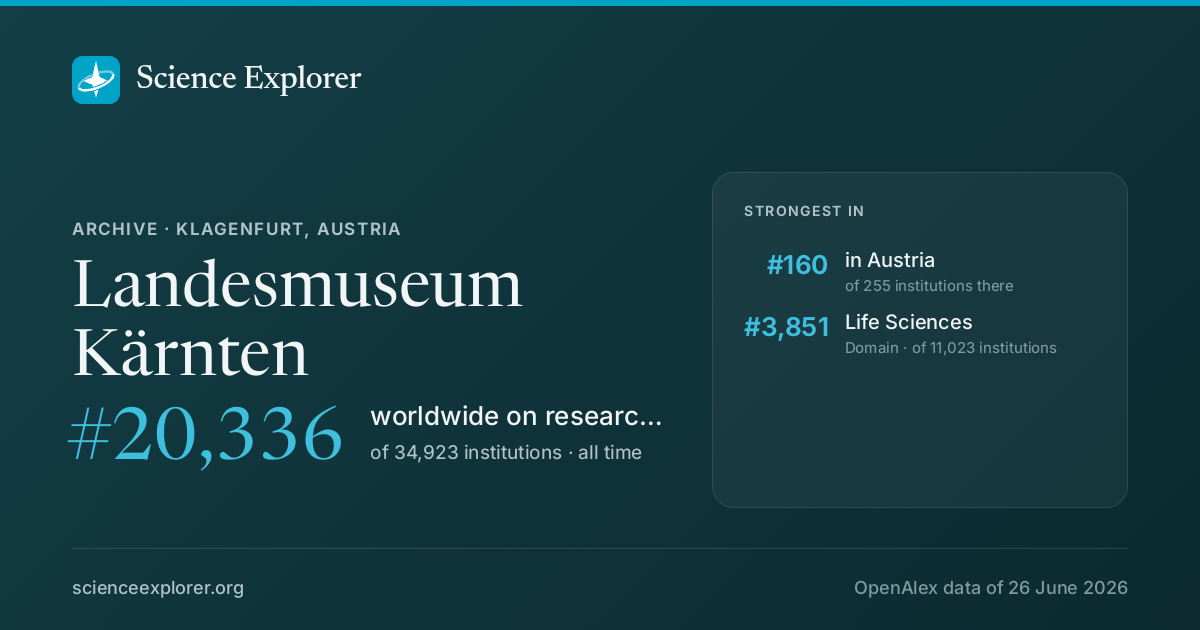
In research, Landesmuseum Kärnten stands highest in Life Sciences (#3,851 of 11,023 worldwide), over all time. Relative to its size it is most specialised in Agricultural and Biological Sciences (Agricultural and Biological Sciences is 9.0× its share of world research).
- World rank, all time
- #20,336 of 34,923
- Rank in Austria
- #160 of 255
- Research works
- 240 ▲ 14% vs 2018-21
- Citations
- 1.9k 7.8 per fractional work
- Top-10% rate
- 8.6% all institutions 10.0%
- vs its own fields
- 1.11× 1.00× is exactly expected
- Open access
- 53% world 40%
- International
- 50% world 18%
What is Landesmuseum Kärnten known for in research?
The fields where it stands highest, over all time, ranked among every institution above the floor in each field.
| Field | World rank | Where that sits | Top-10% rate | Works |
|---|---|---|---|---|
| Life SciencesDomain | #3,851 of 11,023 | 9.3% | 128 |
Each strip is that field's whole ranked pool, with the notch where Landesmuseum Kärnten sits in it, in the colour of the band that rank falls in. The track under the rate is the rate itself: it carries no average mark, because the average differs by field (from about 6% in Dentistry to 21% in Economics).
Which fields of science does Landesmuseum Kärnten work in?
In 2022-now, 56% of research at Landesmuseum Kärnten is in Life Sciences, 19% in Social Sciences. Its largest fields are Agricultural and Biological Sciences (43%), Biochemistry, Genetics and Molecular Biology (13%), Arts and Humanities (10%). It does 3.4× the world's share of Life Sciences.
Each ring splits the one inside it: the four domains of science, their fields, their subfields. Size is fractional works in 2022-now. Every slice is a page; the interactive view zooms down to single topics and colours each by how much more of it this institution does than the world.
Its 4 domains and 16 fields, with their numbers
- Life Sciences3856.0%
- Social Sciences1319.0%
- Physical Sciences1318.8%
- Environmental Science57.9%
- Earth and Planetary Sciences46.0%
- Materials Science12.1%
- Engineering11.6%
- Computer Science00.7%
- Mathematics00.4%
- Health Sciences46.2%
- Medicine34.4%
- Health Professions11.7%
What does Landesmuseum Kärnten specialise in?
Where its research is concentrated relative to its size: Agricultural and Biological Sciences takes 9.0× the share of its output that it takes of world research.
- Agricultural and Biological SciencesField · 28.7 works9.0×
Location quotient, a volume reading rather than an impact one. It surfaces small, lopsided specialities.
Field profile
Location quotient across every field it publishes in: outside the ring is more than an institution of this size would be expected to publish, inside it is less.
Rings at 0.5×, 1× and 2×. Widest outward: Agricultural and Biological Sciences, 9.0×. Every wedge is a field page.
All 16 fields, with their numbers
- Agricultural and Biological Sciences9.00×29 works
- Earth and Planetary Sciences3.84×4 works
- Arts and Humanities3.35×6 works
- Biochemistry, Genetics and Molecular Biology2.49×9 works
- Environmental Science1.60×5 works
- Business, Management and Accounting0.89×2 works
- Psychology0.84×2 works
- Health Professions0.66×1 works
- Materials Science0.61×1 works
- Mathematics0.35×0 works
- Social Sciences0.25×2 works
- Medicine0.23×3 works
- Economics, Econometrics and Finance0.23×0 works
- Decision Sciences0.17×0 works
- Engineering0.11×1 works
- Computer Science0.09×0 works
- Agricultural and Biological Sciences 9.0×
- Earth and Planetary Sciences 3.8×
- Arts and Humanities 3.4×
- Biochemistry, Genetics and Molecular Biology 2.5×
- Environmental Science 1.6×
- Business, Management and Accounting 0.9×
- Psychology 0.8×
- Health Professions 0.7×
- Materials Science 0.6×
- Mathematics 0.3×
- Social Sciences 0.2×
- Medicine 0.2×
- Economics, Econometrics and Finance 0.2×
- Decision Sciences 0.2×
- Engineering 0.1×
- Computer Science 0.1×
Who are the top researchers at Landesmuseum Kärnten?
Ranked on the quality score, Christian Wieser, Franz Speta and Jutta Leskovar lead among researchers whose main affiliation is Landesmuseum Kärnten.
- 1
Christian Wieser
 Austria · #1,629,550 worldwide
1.2k citations · 54 works
- 2
Franz Speta
Austria · #2,085,073 worldwide
833 citations · 22 works
- 3
Jutta Leskovar
Austria · #4,585,942 worldwide
27 citations · 17 works
- 4
Teresa Farino
Austria · #4,623,194 worldwide
13 citations · 18 works
- 5
Claudia Dojen
Austria · #4,663,288 worldwide
90 citations · 19 works
- 6
Paul Gleirscher
Austria · #4,794,593 worldwide
21 citations · 27 works
- 7
Gerhard M. Tarmann
Austria · #5,221,389 worldwide
3.2k citations · 292 works
- 8
Francisco Javier Gastón
Austria · #5,271,684 worldwide
34 citations · 26 works
- 9
Manfred Kahlen
Austria · #5,642,771 worldwide
159 citations · 62 works
- 10
Andreas Eckelt
Austria · #5,971,404 worldwide
356 citations · 76 works
Which keywords describe research at Landesmuseum Kärnten?
By fractional works in 2022-now, weighted toward what it does more of than the world: Phylogeny, Biodiversity, Invasive Species, DNA Barcoding, Taxonomy, Evolution, Climate Change and Biological Control.
- Ecological Niche
- Economic Assessment
- Jasmonate Signaling
- Parasitoid Wasps
- Insect Evolution
- beetles
- Phylogenetic Analysis
- Stink Bug
- Coleoptera
- Host Specificity
- Ecosystem Services
- Chemical Ecology
- Global Change
- Conservation
- Morphology
- Lepidoptera
- Biological Control
- Evolution
- DNA Barcoding
- Biodiversity
- Phylogeny
- Invasive Species
- Taxonomy
- Climate Change
- Pheromones
- Molecular Phylogenetics
- Biogeography
- Habitat Fragmentation
- Pest Management
- Odor Source Localization
- Pollinator Decline
- Molecular Phylogeny
- Halyomorpha halys
- Cretaceous
- Diversification
- Amber Fossils
- Gall-Inducing Insects
- Herbivore-Induced Plant Volatiles
- Ecological Impact
- Water Hyacinth
Size is fractional works in 2022-now in the topics tagged with each word; colour is the word's share of this institution's work against its share of the world's. The 40 words are chosen for being large and distinctive. Each links to the topic it comes from most.
All 40 words, with their numbers
- Phylogeny18▲ 157×11 topics
- Biodiversity17▲ 33×12 topics
- Invasive Species15▲ 52×13 topics
- DNA Barcoding13▲ 115×9 topics
- Taxonomy12▲ 125×7 topics
- Evolution12▲ 64×7 topics
- Climate Change11▲ 6.1×13 topics
- Biological Control10▲ 94×7 topics
- Pheromones8▲ 219×2 topics
- Lepidoptera8▲ 590×1 topic
- Molecular Phylogenetics8▲ 590×1 topic
- Morphology6▲ 52×6 topics
- Biogeography6▲ 33×11 topics
- Conservation6▲ 19×9 topics
- Habitat Fragmentation6▲ 38×3 topics
- Global Change5▲ 29×4 topics
- Pest Management5▲ 89×2 topics
- Chemical Ecology5▲ 739×1 topic
- Odor Source Localization5▲ 739×1 topic
- Ecosystem Services4▲ 17×1 topic
- Pollinator Decline4▲ 83×1 topic
- Host Specificity4▲ 51×2 topics
- Molecular Phylogeny4▲ 35×6 topics
- Coleoptera3▲ 183×2 topics
- Halyomorpha halys3▲ 621×1 topic
- Stink Bug3▲ 621×1 topic
- Cretaceous3▲ 175×2 topics
- Phylogenetic Analysis3▲ 14×8 topics
- Diversification3▲ 87×1 topic
- beetles3▲ 231×1 topic
- Amber Fossils2▲ 337×1 topic
- Insect Evolution2▲ 337×1 topic
- Gall-Inducing Insects2▲ 375×1 topic
- Parasitoid Wasps2▲ 375×1 topic
- Herbivore-Induced Plant Volatiles2▲ 71×1 topic
- Jasmonate Signaling2▲ 71×1 topic
- Ecological Impact2▲ 56×2 topics
- Economic Assessment2▲ 96×1 topic
- Water Hyacinth2▲ 213×1 topic
- Ecological Niche2▲ 38×1 topic
Which research topics does Landesmuseum Kärnten publish most on?
By volume in 2022-now: Lepidoptera: Biology and Taxonomy, Insect Pheromone Research and Control, Plant and animal studies and Hemiptera Insect Studies.
Area is fractional works; colour is the subfield each topic belongs to.
- 1 Lepidoptera: Biology and Taxonomy Genetics 8 works
- 2 Insect Pheromone Research and Control Insect Science 5 works
- 3 Plant and animal studies Ecology, Evolution, Behavior and Systematics 4 works
- 4 Hemiptera Insect Studies Ecology, Evolution, Behavior and Systematics 3 works
- 5 Coleoptera Taxonomy and Distribution Ecology, Evolution, Behavior and Systematics 3 works
- 6 Fossil Insects in Amber Ecology, Evolution, Behavior and Systematics 2 works
- 7 Hymenoptera taxonomy and phylogeny Ecology, Evolution, Behavior and Systematics 2 works
- 8 Insect-Plant Interactions and Control Insect Science 2 works
- 9 Biological Control of Invasive Species Insect Science 2 works
- 10 Species Distribution and Climate Change Ecological Modeling 2 works
How open and international is its research?
Against the world's own shares: the tick on each track. Both are shares of its output, so they sit on one scale and can be read against each other as well as against the world.
World: 40% of research is openly available.
World: 18% is written across borders.
How has Landesmuseum Kärnten's research output changed?
Output in 2022-2025 was 14% higher than in 2018-2021.
The same series as a ribbon: one cell per year, darker for more. The line above answers how much; this answers when.
Its share of all research
Growing output can still be a shrinking share: all of science grows. This is Landesmuseum Kärnten as a percentage of every work published that year, 0.00022% in 2024.
Fractional works of Landesmuseum Kärnten over all fractional works that year. How the balance of science has shifted.
Other research institutions in Klagenfurt
- University of Klagenfurt
- Klinikum Klagenfurt
- Lakeside Labs
- American Superconductor (Austria)
- CISC Semiconductor (Austria)
- Pädagogische Hochschule Viktor Frankl Hochschule
- Carinthian Economic Promotion Fund
- Pflanzensoziologische Institut

Share Landesmuseum Kärnten's ranking
Badges for a website1Each links back here and updates with every snapshot

Research measures only: rankings here say nothing about teaching, admissions or student experience. Comparable institutions and collaboration partners have tabs of their own, above.
Discussion
Ask a question or share a note about Landesmuseum Kärnten. Posts are plain text and can be reported.