Science Explorer Back to mapMap
Discussion

Massanutten Regional Library

World rank, all time
#22,111
of 34,923
Rank in United States
#4,603
of 7,310
Research works
180
▼ 7% vs 2018-21
Citations
4k
22.1 per fractional work
Top-10% rate
5.2%
all institutions 10.0%
vs its own fields
0.98×
1.00× is exactly expected
Open access
36%
world 40%
International
23%
world 18%

Which fields of science does Massanutten Regional Library work in?

In 2022-now, 43% of research at Massanutten Regional Library is in Health Sciences, 31% in Social Sciences. Its largest fields are Medicine (30%), Social Sciences (15%), Engineering (15%). It does 1.6× the world's share of Health Sciences.

Health Sciences: 11 fractional works · 42.7% of its workMedicine: 8 fractional works · 30.1% of its workPublic Health, Environmental and Occupational Health: 3 fractional works · 13.1% of its workSurgery: 1 fractional works · 2.3% of its workCardiology and Cardiovascular Medicine: 0 fractional works · 2.0% of its workPhysiology: 0 fractional works · 2.0% of its workPulmonary and Respiratory Medicine: 0 fractional works · 1.3% of its workPharmacology: 0 fractional works · 1.2% of its workAnesthesiology and Pain Medicine: 0 fractional works · 1.1% of its workRadiology, Nuclear Medicine and Imaging: 0 fractional works · 1.1% of its workInfectious Diseases: 0 fractional works · 1.0% of its workEpidemiology: 0 fractional works · 0.9% of its workBiochemistry: 0 fractional works · 0.7% of its workCritical Care and Intensive Care Medicine: 0 fractional works · 0.7% of its workEmergency Medicine: 0 fractional works · 0.7% of its workNeurology: 0 fractional works · 0.7% of its workPediatrics, Perinatology and Child Health: 0 fractional works · 0.5% of its workImmunology and Allergy: 0 fractional works · 0.4% of its workPsychiatry and Mental health: 0 fractional works · 0.3% of its workOrthopedics and Sports Medicine: 0 fractional works · 0.2% of its workSmaller subfields together: 0 fractional works · 0.2% of its workHealth Professions: 3 fractional works · 12.6% of its workGeneral Health Professions: 2 fractional works · 7.1% of its workHealth Information Management: 1 fractional works · 2.9% of its workEmergency Medical Services: 1 fractional works · 2.6% of its workNursing: 0 fractional works · 0.0% of its workSocial Sciences: 8 fractional works · 30.8% of its workSocial Sciences: 4 fractional works · 15.1% of its workSociology and Political Science: 1 fractional works · 4.9% of its workLibrary and Information Sciences: 1 fractional works · 2.6% of its workSafety Research: 1 fractional works · 2.6% of its workEducation: 0 fractional works · 2.0% of its workPolitical Science and International Relations: 0 fractional works · 1.3% of its workDemography: 0 fractional works · 0.7% of its workGender Studies: 0 fractional works · 0.7% of its workUrban Studies: 0 fractional works · 0.3% of its workBusiness, Management and Accounting: 2 fractional works · 9.1% of its workOrganizational Behavior and Human Resource Management: 2 fractional works · 5.9% of its workStrategy and Management: 1 fractional works · 3.3% of its workPsychology: 1 fractional works · 3.8% of its workClinical Psychology: 0 fractional works · 1.6% of its workSocial Psychology: 0 fractional works · 1.3% of its workExperimental and Cognitive Psychology: 0 fractional works · 1.0% of its workDecision Sciences: 0 fractional works · 2.0% of its workManagement Science and Operations Research: 0 fractional works · 2.0% of its workArts and Humanities: 0 fractional works · 0.4% of its workLiterature and Literary Theory: 0 fractional works · 0.3% of its workSmaller subfields together: 0 fractional works · 0.1% of its workEconomics, Econometrics and Finance: 0 fractional works · 0.3% of its workEconomics and Econometrics: 0 fractional works · 0.3% of its workPhysical Sciences: 6 fractional works · 22.2% of its workEngineering: 4 fractional works · 14.9% of its workElectrical and Electronic Engineering: 1 fractional works · 5.4% of its workMechanical Engineering: 1 fractional works · 2.4% of its workBiomedical Engineering: 0 fractional works · 1.5% of its workMedia Technology: 0 fractional works · 1.5% of its workControl and Systems Engineering: 0 fractional works · 1.0% of its workAutomotive Engineering: 0 fractional works · 0.7% of its workBuilding and Construction: 0 fractional works · 0.7% of its workCivil and Structural Engineering: 0 fractional works · 0.7% of its workIndustrial and Manufacturing Engineering: 0 fractional works · 0.7% of its workMechanics of Materials: 0 fractional works · 0.4% of its workSmaller subfields together: 0 fractional works · 0.2% of its workComputer Science: 1 fractional works · 3.9% of its workComputer Vision and Pattern Recognition: 1 fractional works · 2.6% of its workInformation Systems: 0 fractional works · 1.3% of its workEnvironmental Science: 1 fractional works · 2.6% of its workEcology: 0 fractional works · 1.1% of its workEnvironmental Chemistry: 0 fractional works · 0.9% of its workManagement, Monitoring, Policy and Law: 0 fractional works · 0.7% of its workEarth and Planetary Sciences: 0 fractional works · 0.4% of its workEarth-Surface Processes: 0 fractional works · 0.4% of its workMaterials Science: 0 fractional works · 0.2% of its workMaterials Chemistry: 0 fractional works · 0.2% of its workLife Sciences: 1 fractional works · 4.4% of its workBiochemistry, Genetics and Molecular Biology: 1 fractional works · 2.1% of its workMolecular Biology: 0 fractional works · 1.4% of its workCell Biology: 0 fractional works · 0.7% of its workSmaller subfields together: 0 fractional works · 0.0% of its workAgricultural and Biological Sciences: 0 fractional works · 1.6% of its workInsect Science: 0 fractional works · 0.8% of its workEcology, Evolution, Behavior and Systematics: 0 fractional works · 0.5% of its workPlant Science: 0 fractional works · 0.3% of its workImmunology and Microbiology: 0 fractional works · 0.3% of its workMicrobiology: 0 fractional works · 0.3% of its workNeuroscience: 0 fractional works · 0.3% of its workCognitive Neuroscience: 0 fractional works · 0.3% of its workALL ITS WORKMassanuttenRegional Library25fractional works, 2022-now
Life Sciences4%Physical Sciences22%Health Sciences43%Social Sciences31%

Each ring splits the one inside it: the four domains of science, their fields, their subfields. Size is fractional works in 2022-now. Every slice is a page; the interactive view zooms down to single topics and colours each by how much more of it this institution does than the world.

Its 4 domains and 18 fields, with their numbers
    1. Medicine830.1%
    2. Health Professions312.6%
    3. Nursing00.0%
    1. Social Sciences415.1%
    2. Business, Management and Accounting29.1%
    3. Psychology13.8%
    4. Decision Sciences02.0%
    5. Arts and Humanities00.4%
    6. Economics, Econometrics and Finance00.3%
    1. Engineering414.9%
    2. Computer Science13.9%
    3. Environmental Science12.6%
    4. Earth and Planetary Sciences00.4%
    5. Materials Science00.2%
    1. Biochemistry, Genetics and Molecular Biology12.1%
    2. Agricultural and Biological Sciences01.6%
    3. Immunology and Microbiology00.3%
    4. Neuroscience00.3%
All of science, and how each field's share has moved since 1950: the Science domain explorer

Field profile

Location quotient across every field it publishes in: outside the ring is more than an institution of this size would be expected to publish, inside it is less.

Agricultural and Biological Sciences: 0.34× its world share, 0 worksAgricultural and Bio…Biochemistry, Genetics and Molecular Biology: 0.40× its world share, 0 worksBiochemistry, Geneti…Immunology and Microbiology: 0.32× its world share, 0 worksImmunology and Micro…Neuroscience: 0.20× its world share, 0 worksNeuroscienceComputer Science: 0.50× its world share, 1 worksComputer ScienceEarth and Planetary Sciences: 0.28× its world share, 0 worksEarth and Planetary …Engineering: 1.00× its world share, 4 worksEngineeringEnvironmental Science: 0.53× its world share, 1 worksEnvironmental ScienceMaterials Science: 0.06× its world share, 0 worksMaterials ScienceHealth Professions: 4.78× its world share, 3 worksHealth ProfessionsMedicine: 1.56× its world share, 8 worksMedicineNursing: 0.07× its world share, 0 worksNursingArts and Humanities: 0.14× its world share, 0 worksArts and HumanitiesBusiness, Management and Accounting: 2.84× its world share, 2 worksBusiness, Management…Decision Sciences: 2.03× its world share, 0 worksDecision SciencesEconomics, Econometrics and Finance: 0.15× its world share, 0 worksEconomics, Econometr…Psychology: 1.26× its world share, 1 worksPsychologySocial Sciences: 1.19× its world share, 4 worksSocial Sciences1×world share
more than its size predictsabout as predictedless

Rings at 0.5×, 1× and 2×. Widest outward: Health Professions, 4.8×. Every wedge is a field page.

All 18 fields, with their numbers
  1. Health Professions4.78×3 works
  2. Business, Management and Accounting2.84×2 works
  3. Decision Sciences2.03×0 works
  4. Medicine1.56×8 works
  5. Psychology1.26×1 works
  6. Social Sciences1.19×4 works
  7. Engineering1.00×4 works
  8. Environmental Science0.53×1 works
  9. Computer Science0.50×1 works
  10. Biochemistry, Genetics and Molecular Biology0.40×0 works
  11. Agricultural and Biological Sciences0.34×0 works
  12. Immunology and Microbiology0.32×0 works
  13. Earth and Planetary Sciences0.28×0 works
  14. Neuroscience0.20×0 works
  15. Economics, Econometrics and Finance0.15×0 works
  16. Arts and Humanities0.14×0 works
  17. Nursing0.07×0 works
  18. Materials Science0.06×0 works

Who are the top researchers at Massanutten Regional Library?

Ranked on the quality score, Scot E. Dowd, William G. Kramer and Jessica Nilsson lead among researchers whose main affiliation is Massanutten Regional Library.

  1. 1 Scot E. Dowd United States · #226,057 worldwide 32k citations · 372 works
  2. 2 William G. Kramer United States · #2,249,377 worldwide 3.8k citations · 151 works
  3. 3 Jessica Nilsson United States · #4,136,464 worldwide 19 citations · 58 works
All ranked researchers at Massanutten Regional Library

What are the most cited papers from Massanutten Regional Library?

The most cited paper from Massanutten Regional Library is "Acetyl CoA Carboxylase Inhibition Reduces Hepatic Steatosis but Elevates Plasma Triglycerides in Mice and Humans: A Bedside to Bench Investigation" (Chai-Wan Kim, Carol Addy, Jun Kusunoki et al., 2017), with 425 citations. Next come "Exposure to a social stressor disrupts the community structure of the colonic mucosa-associated microbiota" (410) and "Pyrosequencing and mid-infrared spectroscopy reveal distinct aggregate stratification of soil bacterial communities and organic matter composition" (300).

Most cited papers
#PaperReleasedCitations
1 Acetyl CoA Carboxylase Inhibition Reduces Hepatic Steatosis but Elevates Plasma Triglycerides in Mice and Humans: A Bedside to Bench Investigation Chai-Wan Kim, Carol Addy, Jun Kusunoki et al. · Cell Metabolism Open access Aug 2017 425
2 Exposure to a social stressor disrupts the community structure of the colonic mucosa-associated microbiota Jeffrey D. Galley, Michael C. Nelson, Zhongtang Yu et al. · BMC Microbiology Open access 15 Jul 2014 410
3 Pyrosequencing and mid-infrared spectroscopy reveal distinct aggregate stratification of soil bacterial communities and organic matter composition Marko Davinic, Lisa M. Fultz, Verónica Acosta‐Martínez et al. · Soil Biology and Biochemistry 8 Dec 2011 300
4 Multidrug-Resistant Urinary Tract Isolates of Escherichia coli: Prevalence and Patient Demographics in the United States in 2000 Daniel F. Sahm, Clyde Thornsberry, David C. Mayfield et al. · Antimicrobial Agents and Chemotherapy Open access May 2001 296
5 454 Pyrosequencing Reveals a Shift in Fecal Microbiota of Healthy Adult Men Consuming Polydextrose or Soluble Corn Fiber Seema Hooda, Brittany M. Vester Boler, Mariana C Rossoni Serao et al. · Journal of Nutrition Open access 31 May 2012 277
All 61 most cited papers, with filters and sorting

Which keywords describe research at Massanutten Regional Library?

By fractional works in 2022-now, weighted toward what it does more of than the world: Academic Medicine, Career Development, Quality Improvement, Medical Research, Physician-Scientist, Competency-Based Education, Professional Identity Formation and Big Data.

▲ more of its work than of the world's◆ about the world's share▼ less than the world's

Size is fractional works in 2022-now in the topics tagged with each word; colour is the word's share of this institution's work against its share of the world's. The 17 words are chosen for being large and distinctive. Each links to the topic it comes from most.

All 17 words, with their numbers
  1. Academic Medicine2▲ 108×3 topics
  2. Career Development2▲ 70×3 topics
  3. Quality Improvement2▲ 40×4 topics
  4. Medical Research2▲ 253×1 topic
  5. Physician-Scientist2▲ 253×1 topic
  6. Machine Learning1▲ 1.70×4 topics
  7. Big Data1▲ 5.5×2 topics
  8. Competency-Based Education1▲ 52×1 topic
  9. Professional Identity Formation1▲ 74×1 topic
  10. Chronic Disease Management1▲ 22×2 topics
  11. Primary Care1▲ 11×2 topics
  12. Continuity of Care1▲ 83×1 topic
  13. Employee Engagement1▲ 22×2 topics
  14. Organizational Performance1▲ 15×3 topics
  15. Patient Satisfaction1▲ 13×3 topics
  16. Patient-Centered Medical Home1▲ 116×1 topic
  17. Social Media1▲ 2.8×2 topics

Which research topics does Massanutten Regional Library publish most on?

By volume in 2022-now: Health and Medical Research Impacts, Innovations in Medical Education, Primary Care and Health Outcomes and Healthcare Quality and Management.

  1. 1 Health and Medical Research Impacts Public Health, Environmental and Occupational Health 2 works
  2. 2 Innovations in Medical Education Public Health, Environmental and Occupational Health 1 works
  3. 3 Primary Care and Health Outcomes General Health Professions 1 works
  4. 4 Healthcare Quality and Management Health Information Management 1 works
  5. 5 Leadership and Management in Organizations Strategy and Management 1 works
  6. 6 Employer Branding and e-HRM Organizational Behavior and Human Resource Management 1 works
  7. 7 Ethics and Social Impacts of AI Safety Research 1 works
  8. 8 AI and HR Technologies Organizational Behavior and Human Resource Management 1 works
  9. 9 Complex Systems and Decision Making Management Science and Operations Research 0 works
  10. 10 Disaster Response and Management Emergency Medical Services 0 works

How open and international is its research?

Against the world's own shares: the tick on each track. Both are shares of its output, so they sit on one scale and can be read against each other as well as against the world.

openly available36.1%not open63.9%

World: 40% of research is openly available.

with international co-authors23.1%domestic only76.9%

World: 18% is written across borders.

How has Massanutten Regional Library's research output changed?

Output in 2022-2025 was 7% lower than in 2018-2021.

still counting1990200020102020
grewheldshrank

The same series as a ribbon: one cell per year, darker for more. The line above answers how much; this answers when.

Its share of all research

Growing output can still be a shrinking share: all of science grows. This is Massanutten Regional Library as a percentage of every work published that year, 0.000054% in 2024.

still counting0.00025%0.00050%0.00075%Massanutten Regional Library0.000035% in 202519801990200020102020

Fractional works of Massanutten Regional Library over all fractional works that year. How the balance of science has shifted.

Other research institutions in Harrisonburg

All research institutions in Harrisonburg

Share Massanutten Regional Library's ranking
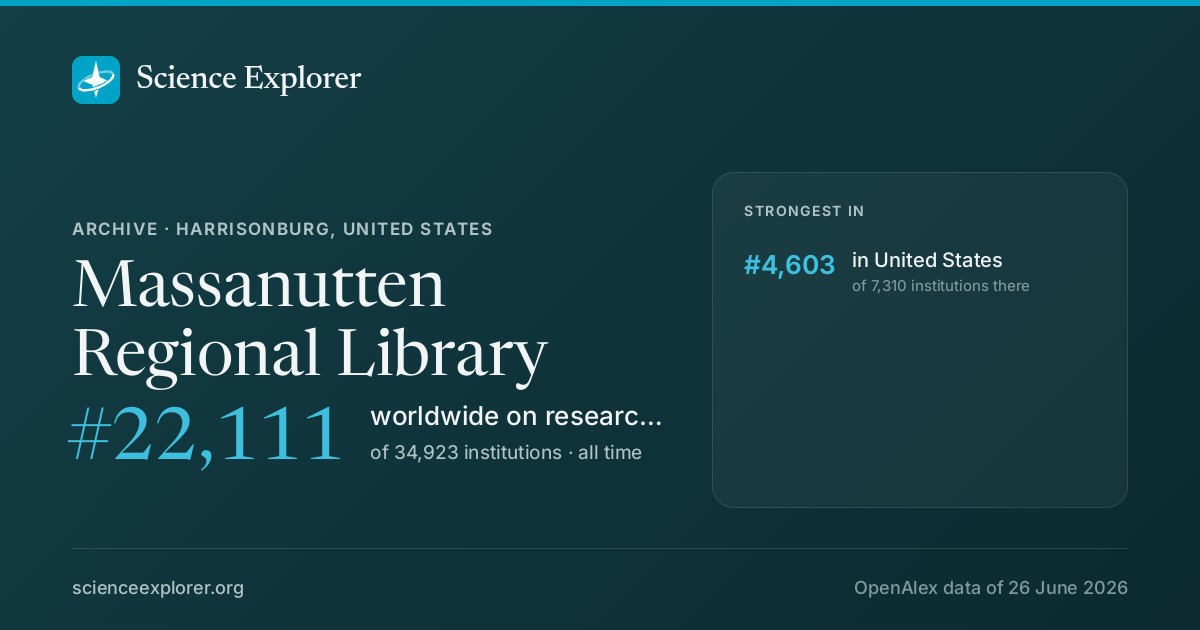
Massanutten Regional Library on Science Explorer

A card with Massanutten Regional Library's standing and the fields it leads in, for a post or a slide. A link to this page previews as the same card.

Download the card

1200 × 630 PNG, sized for social posts, drawn from the latest snapshot.

Badges for a website1Each links back here and updates with every snapshot

Research measures only: rankings here say nothing about teaching, admissions or student experience. Comparable institutions and collaboration partners have tabs of their own, above.

Discussion

Ask a question or share a note about Massanutten Regional Library. Keep it to the research: no personal attacks, advertising or links. Any reader can report a post, which collapses it for everyone until it is opened.
