Mediprobe Research (Canada)
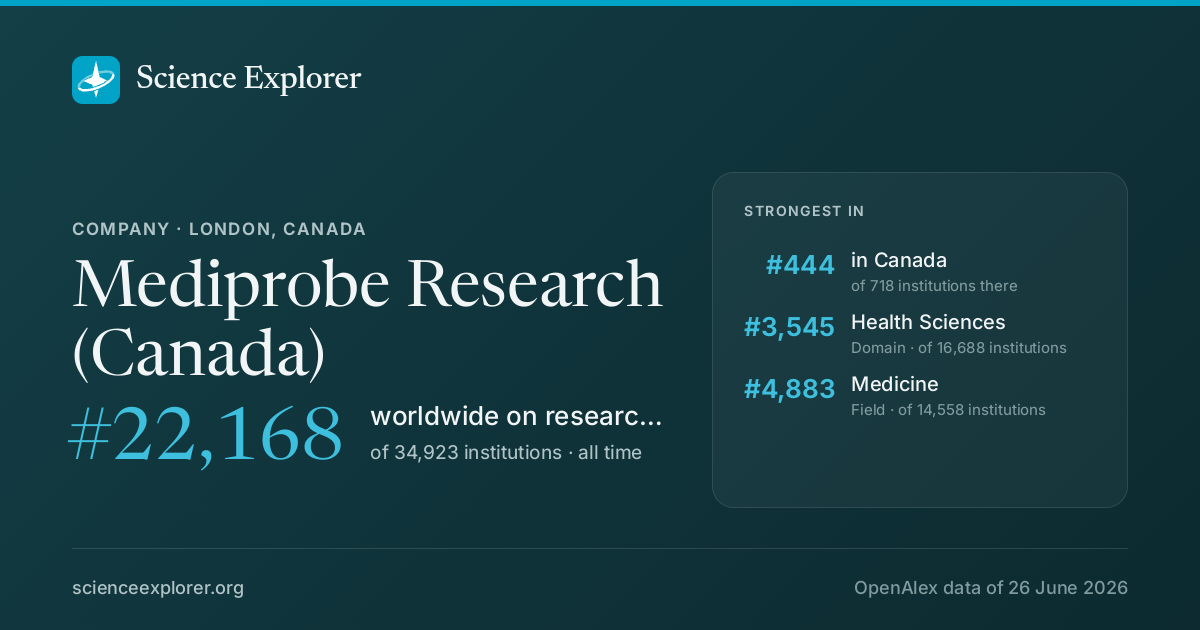
In research, Mediprobe Research (Canada) stands highest in Health Sciences (#3,545 of 16,688 worldwide) and Medicine (#4,883 of 14,558 worldwide), over all time.
- World rank, all time
- #22,168 of 34,923
- Rank in Canada
- #444 of 718
- Research works
- 189 ▲ 27% vs 2018-21
- Citations
- 5.5k 28.8 per fractional work
- Top-10% rate
- 34.2% all institutions 10.0%
- vs its own fields
- 1.37× 1.00× is exactly expected
- Open access
- 25% world 40%
- International
- 30% world 18%
What is Mediprobe Research (Canada) known for in research?
The fields where it stands highest, over all time, ranked among every institution above the floor in each field.
| Field | World rank | Where that sits | Top-10% rate | Works |
|---|---|---|---|---|
| Health SciencesDomain | #3,545 of 16,688 | 25.4% | 145 | |
| MedicineField | #4,883 of 14,558 | 25.9% | 140 |
Each strip is that field's whole ranked pool, with the notch where Mediprobe Research (Canada) sits in it, in the colour of the band that rank falls in. The track under the rate is the rate itself: it carries no average mark, because the average differs by field (from about 6% in Dentistry to 21% in Economics).
Which fields of science does Mediprobe Research (Canada) work in?
In 2022-now, 77% of research at Mediprobe Research (Canada) is in Health Sciences, 20% in Life Sciences. Its largest fields are Medicine (76%), Biochemistry, Genetics and Molecular Biology (12%), Immunology and Microbiology (4%). It does 2.9× the world's share of Health Sciences.
Each ring splits the one inside it: the four domains of science, their fields, their subfields. Size is fractional works in 2022-now. Every slice is a page; the interactive view zooms down to single topics and colours each by how much more of it this institution does than the world.
Its 4 domains and 14 fields, with their numbers
- Health Sciences4477.1%
- Medicine4475.9%
- Health Professions00.8%
- Dentistry00.3%
- Veterinary00.1%
- Life Sciences1119.9%
- Social Sciences12.0%
- Social Sciences11.1%
- Psychology00.8%
- Decision Sciences00.1%
- Physical Sciences11.0%
- Engineering10.9%
- Chemistry00.1%
Field profile
Location quotient across every field it publishes in: outside the ring is more than an institution of this size would be expected to publish, inside it is less.
Rings at 0.5×, 1× and 2×. Widest outward: Pharmacology, Toxicology and Pharmaceutics, 4.2×. Every wedge is a field page.
All 14 fields, with their numbers
- Pharmacology, Toxicology and Pharmaceutics4.16×1 works
- Medicine3.95×44 works
- Immunology and Microbiology3.62×2 works
- Biochemistry, Genetics and Molecular Biology2.26×7 works
- Veterinary0.71×0 works
- Dentistry0.54×0 works
- Neuroscience0.51×0 works
- Agricultural and Biological Sciences0.39×1 works
- Health Professions0.30×0 works
- Psychology0.25×0 works
- Decision Sciences0.15×0 works
- Social Sciences0.09×1 works
- Chemistry0.07×0 works
- Engineering0.06×0 works
- Pharmacology, Toxicology and Pharmaceutics 4.2×
- Medicine 4.0×
- Immunology and Microbiology 3.6×
- Biochemistry, Genetics and Molecular Biology 2.3×
- Veterinary 0.7×
- Dentistry 0.5×
- Neuroscience 0.5×
- Agricultural and Biological Sciences 0.4×
- Health Professions 0.3×
- Psychology 0.2×
- Decision Sciences 0.1×
- Social Sciences 0.1×
- Chemistry 0.1×
- Engineering 0.1×
Who are the top researchers at Mediprobe Research (Canada)?
Ranked on the quality score, Vasiliki Economopoulos, Mesbah Talukder and Mary A. Bamimore lead among researchers whose main affiliation is Mediprobe Research (Canada).
- 1
Vasiliki Economopoulos
 Canada · #412,716 worldwide
530 citations · 53 works
- 2
Mesbah Talukder
Canada · #445,930 worldwide
1.8k citations · 113 works
- 3
Mary A. Bamimore
Canada · #637,301 worldwide
1.3k citations · 83 works
- 4
Shruthi Polla Ravi
Canada · #707,450 worldwide
714 citations · 39 works
- 5
Wayne L. Bakotic
Canada · #710,281 worldwide
296 citations · 22 works
- 6
Tong Wang
Canada · #784,845 worldwide
1.4k citations · 130 works
- 7
Kelly A. Foley
Canada · #975,406 worldwide
2.5k citations · 78 works
- 8
Maanasa Venkataraman
Canada · #990,915 worldwide
1.7k citations · 74 works
- 9
Rachel R. Mays
Canada · #1,250,306 worldwide
987 citations · 32 works
- 10
Avantika Mann
Canada · #1,524,998 worldwide
197 citations · 24 works
Which keywords describe research at Mediprobe Research (Canada)?
By fractional works in 2022-now, weighted toward what it does more of than the world: Epidemiology, Antifungal Therapy, Diagnosis, Dermatophytes, Onychomycosis, Fungal Pathogens, Regeneration and Stem Cells.
- Mycosis Fungoides
- Rituximab
- Pemphigoid
- Autoimmune
- Dermal Fillers
- Invasive Fungal Infections
- Autoantibodies
- Wound Healing
- Metabolic Syndrome
- Acne Vulgaris
- Photodynamic Therapy
- Filaggrin
- Inflammation
- Endophytic Fungi
- Histoplasmosis
- Hair Follicle
- Stem Cells
- Fungal Pathogens
- Dermatophytes
- Antifungal Therapy
- Epidemiology
- Diagnosis
- Onychomycosis
- Regeneration
- Epidermal Niche
- Cryptococcal Disease
- Molecular Identification
- Phylogenetic Analysis
- Pathogenesis
- Skin Microbiome
- Treatment
- Rosacea
- Immunosuppressive Therapy
- Cosmetic Surgery
- Candidiasis
- Complications
- Hyaluronic Acid
- Ovarian Reserve
- Polycystic Ovary Syndrome
- Cutaneous Lymphomas
Size is fractional works in 2022-now in the topics tagged with each word; colour is the word's share of this institution's work against its share of the world's. The 40 words are chosen for being large and distinctive. Each links to the topic it comes from most.
All 40 words, with their numbers
- Epidemiology17▲ 7.6×18 topics
- Antifungal Therapy17▲ 329×3 topics
- Diagnosis11▲ 21×4 topics
- Dermatophytes10▲ 696×1 topic
- Onychomycosis10▲ 696×1 topic
- Fungal Pathogens10▲ 126×2 topics
- Regeneration8▲ 67×4 topics
- Stem Cells7▲ 47×4 topics
- Epidermal Niche7▲ 638×1 topic
- Hair Follicle7▲ 638×1 topic
- Cryptococcal Disease5▲ 348×1 topic
- Histoplasmosis5▲ 348×1 topic
- Molecular Identification4▲ 111×2 topics
- Endophytic Fungi4▲ 78×1 topic
- Phylogenetic Analysis4▲ 23×1 topic
- Inflammation4▲ 3.0×8 topics
- Pathogenesis3▲ 11×4 topics
- Filaggrin3▲ 109×1 topic
- Skin Microbiome3▲ 109×1 topic
- Photodynamic Therapy3▲ 23×2 topics
- Treatment3▲ 3.7×3 topics
- Acne Vulgaris2▲ 219×1 topic
- Rosacea2▲ 219×1 topic
- Metabolic Syndrome2▲ 4.9×4 topics
- Immunosuppressive Therapy2▲ 16×3 topics
- Wound Healing2▲ 11×5 topics
- Cosmetic Surgery2▲ 70×2 topics
- Autoantibodies1▲ 10×4 topics
- Candidiasis1▲ 52×1 topic
- Invasive Fungal Infections1▲ 64×1 topic
- Complications1▲ 4.7×2 topics
- Dermal Fillers1▲ 96×1 topic
- Hyaluronic Acid1▲ 96×1 topic
- Autoimmune1▲ 46×2 topics
- Ovarian Reserve1▲ 45×1 topic
- Pemphigoid1▲ 75×1 topic
- Polycystic Ovary Syndrome1▲ 45×1 topic
- Rituximab1▲ 13×1 topic
- Cutaneous Lymphomas1▲ 95×1 topic
- Mycosis Fungoides1▲ 95×1 topic
Which research topics does Mediprobe Research (Canada) publish most on?
By volume in 2022-now: Nail Diseases and Treatments, Hair Growth and Disorders, Fungal Infections and Studies and Plant Pathogens and Fungal Diseases.
Area is fractional works; colour is the subfield each topic belongs to.
- 1 Nail Diseases and Treatments Epidemiology 10 works
- 2 Hair Growth and Disorders Urology 7 works
- 3 Fungal Infections and Studies Epidemiology 5 works
- 4 Plant Pathogens and Fungal Diseases Cell Biology 4 works
- 5 Dermatology and Skin Diseases Dermatology 3 works
- 6 Acne and Rosacea Treatments and Effects Dermatology 2 works
- 7 Antifungal resistance and susceptibility Infectious Diseases 1 works
- 8 Facial Rejuvenation and Surgery Techniques Dermatology 1 works
- 9 Ovarian function and disorders Reproductive Medicine 1 works
- 10 Autoimmune Bullous Skin Diseases Pathology and Forensic Medicine 1 works
How open and international is its research?
Against the world's own shares: the tick on each track. Both are shares of its output, so they sit on one scale and can be read against each other as well as against the world.
World: 40% of research is openly available.
World: 18% is written across borders.
How has Mediprobe Research (Canada)'s research output changed?
Output in 2022-2025 was 27% higher than in 2018-2021.
The same series as a ribbon: one cell per year, darker for more. The line above answers how much; this answers when.
Its share of all research
Growing output can still be a shrinking share: all of science grows. This is Mediprobe Research (Canada) as a percentage of every work published that year, 0.00028% in 2024.
Fractional works of Mediprobe Research (Canada) over all fractional works that year. How the balance of science has shifted.
Other research institutions in London
- Western University
- London Health Sciences Centre
- Lawson Health Research Institute
- St. Joseph's Hospital
- Parkwood Institute
- Fanshawe College
- Trudell Medical International (Canada)
- Thames Valley Children's Centre
Share Mediprobe Research (Canada)'s ranking
Badges for a website1Each links back here and updates with every snapshot

Research measures only: rankings here say nothing about teaching, admissions or student experience. Comparable institutions and collaboration partners have tabs of their own, above.
Discussion
Ask a question or share a note about Mediprobe Research (Canada). Posts are plain text and can be reported.