Science Explorer Back to mapMap
Discussion
Hospital / health system · Molde · Norway

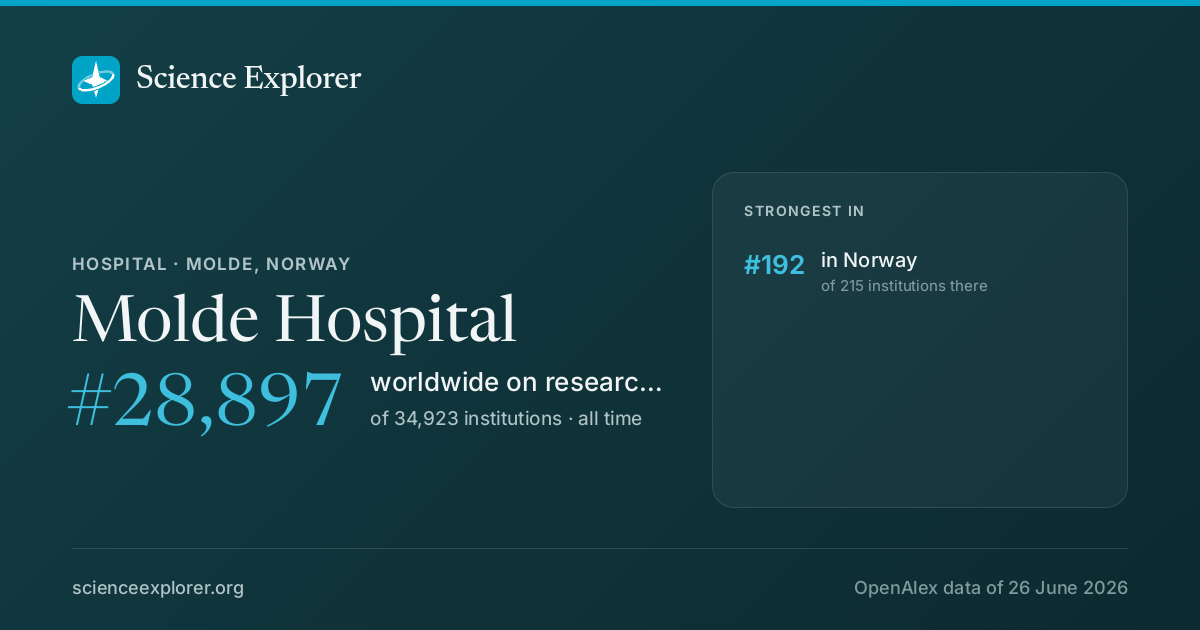
Molde Hospital

World rank, all time
#28,897
of 34,923
Rank in Norway
#192
of 215
Research works
150
▼ 8% vs 2018-21
Citations
3.3k
22.4 per fractional work
Top-10% rate
15.3%
all institutions 10.0%
vs its own fields
1.03×
1.00× is exactly expected
Open access
42%
world 40%
International
22%
world 18%

Which fields of science does Molde Hospital work in?

In 2022-now, 46% of research at Molde Hospital is in Health Sciences, 30% in Social Sciences. Its largest fields are Medicine (40%), Psychology (23%), Immunology and Microbiology (4%). It does 1.6× the world's share of Health Sciences.

Health Sciences: 10 fractional works · 46.1% of its workMedicine: 9 fractional works · 39.7% of its workEpidemiology: 2 fractional works · 6.9% of its workPublic Health, Environmental and Occupational Health: 1 fractional works · 4.5% of its workSurgery: 1 fractional works · 4.5% of its workOncology: 1 fractional works · 3.7% of its workPsychiatry and Mental health: 1 fractional works · 2.6% of its workPulmonary and Respiratory Medicine: 0 fractional works · 2.2% of its workNeurology: 0 fractional works · 2.0% of its workPathology and Forensic Medicine: 0 fractional works · 1.8% of its workCardiology and Cardiovascular Medicine: 0 fractional works · 1.6% of its workEmergency Medicine: 0 fractional works · 1.2% of its workPhysiology: 0 fractional works · 1.2% of its workRadiology, Nuclear Medicine and Imaging: 0 fractional works · 1.1% of its workInfectious Diseases: 0 fractional works · 0.8% of its workOphthalmology: 0 fractional works · 0.8% of its workCritical Care and Intensive Care Medicine: 0 fractional works · 0.6% of its workGenetics: 0 fractional works · 0.6% of its workOrthopedics and Sports Medicine: 0 fractional works · 0.6% of its workPharmacology: 0 fractional works · 0.6% of its workRehabilitation: 0 fractional works · 0.6% of its workGeriatrics and Gerontology: 0 fractional works · 0.3% of its workTransplantation: 0 fractional works · 0.3% of its workAnesthesiology and Pain Medicine: 0 fractional works · 0.2% of its workDermatology: 0 fractional works · 0.2% of its workSmaller subfields together: 0 fractional works · 0.7% of its workHealth Professions: 1 fractional works · 3.4% of its workEmergency Medical Services: 0 fractional works · 1.1% of its workGeneral Health Professions: 0 fractional works · 1.1% of its workRadiological and Ultrasound Technology: 0 fractional works · 0.8% of its workSpeech and Hearing: 0 fractional works · 0.3% of its workSmaller subfields together: 0 fractional works · 0.1% of its workVeterinary: 0 fractional works · 1.5% of its workSmall Animals: 0 fractional works · 1.5% of its workDentistry: 0 fractional works · 0.8% of its workOral Surgery: 0 fractional works · 0.4% of its workPeriodontics: 0 fractional works · 0.4% of its workSmaller subfields together: 0 fractional works · 0.0% of its workNursing: 0 fractional works · 0.8% of its workResearch and Theory: 0 fractional works · 0.8% of its workSocial Sciences: 7 fractional works · 29.7% of its workPsychology: 5 fractional works · 22.7% of its workClinical Psychology: 3 fractional works · 14.1% of its workExperimental and Cognitive Psychology: 1 fractional works · 4.2% of its workSocial Psychology: 0 fractional works · 2.2% of its workApplied Psychology: 0 fractional works · 2.0% of its workDevelopmental and Educational Psychology: 0 fractional works · 0.3% of its workSocial Sciences: 1 fractional works · 2.8% of its workSociology and Political Science: 0 fractional works · 1.5% of its workArcheology: 0 fractional works · 0.5% of its workDemography: 0 fractional works · 0.4% of its workHealth: 0 fractional works · 0.3% of its workSafety Research: 0 fractional works · 0.3% of its workArts and Humanities: 0 fractional works · 2.0% of its workHistory: 0 fractional works · 2.0% of its workDecision Sciences: 0 fractional works · 1.9% of its workInformation Systems and Management: 0 fractional works · 0.8% of its workStatistics, Probability and Uncertainty: 0 fractional works · 0.8% of its workManagement Science and Operations Research: 0 fractional works · 0.4% of its workBusiness, Management and Accounting: 0 fractional works · 0.4% of its workBusiness and International Management: 0 fractional works · 0.4% of its workLife Sciences: 4 fractional works · 15.6% of its workImmunology and Microbiology: 1 fractional works · 4.4% of its workParasitology: 0 fractional works · 2.1% of its workMicrobiology: 0 fractional works · 1.0% of its workVirology: 0 fractional works · 0.8% of its workImmunology: 0 fractional works · 0.4% of its workAgricultural and Biological Sciences: 1 fractional works · 4.0% of its workAgronomy and Crop Science: 1 fractional works · 3.4% of its workFood Science: 0 fractional works · 0.4% of its workPlant Science: 0 fractional works · 0.2% of its workNeuroscience: 1 fractional works · 4.0% of its workCognitive Neuroscience: 1 fractional works · 2.7% of its workCellular and Molecular Neuroscience: 0 fractional works · 0.6% of its workSensory Systems: 0 fractional works · 0.3% of its workSmaller subfields together: 0 fractional works · 0.4% of its workBiochemistry, Genetics and Molecular Biology: 1 fractional works · 3.2% of its workGenetics: 0 fractional works · 1.3% of its workMolecular Biology: 0 fractional works · 0.8% of its workDevelopmental Biology: 0 fractional works · 0.5% of its workMolecular Medicine: 0 fractional works · 0.2% of its workSmaller subfields together: 0 fractional works · 0.3% of its workPhysical Sciences: 2 fractional works · 8.6% of its workEarth and Planetary Sciences: 1 fractional works · 3.5% of its workAtmospheric Science: 0 fractional works · 2.0% of its workPaleontology: 0 fractional works · 1.5% of its workSmaller subfields together: 0 fractional works · 0.0% of its workEnvironmental Science: 1 fractional works · 2.5% of its workGlobal and Planetary Change: 0 fractional works · 1.4% of its workEnvironmental Engineering: 0 fractional works · 0.5% of its workManagement, Monitoring, Policy and Law: 0 fractional works · 0.4% of its workHealth, Toxicology and Mutagenesis: 0 fractional works · 0.3% of its workSmaller subfields together: 0 fractional works · 0.0% of its workEngineering: 1 fractional works · 2.5% of its workMechanical Engineering: 0 fractional works · 2.2% of its workBiomedical Engineering: 0 fractional works · 0.3% of its workMathematics: 0 fractional works · 0.1% of its workALL ITS WORKMolde Hospital22fractional works, 2022-now
Life Sciences16%Physical Sciences9%Health Sciences46%Social Sciences30%

Each ring splits the one inside it: the four domains of science, their fields, their subfields. Size is fractional works in 2022-now. Every slice is a page; the interactive view zooms down to single topics and colours each by how much more of it this institution does than the world.

Its 4 domains and 18 fields, with their numbers
    1. Medicine939.7%
    2. Health Professions13.4%
    3. Veterinary01.5%
    4. Dentistry00.8%
    5. Nursing00.8%
    1. Psychology522.7%
    2. Social Sciences12.8%
    3. Arts and Humanities02.0%
    4. Decision Sciences01.9%
    5. Business, Management and Accounting00.4%
    1. Immunology and Microbiology14.4%
    2. Agricultural and Biological Sciences14.0%
    3. Neuroscience14.0%
    4. Biochemistry, Genetics and Molecular Biology13.2%
    1. Earth and Planetary Sciences13.5%
    2. Environmental Science12.5%
    3. Engineering12.5%
    4. Mathematics00.1%
All of science, and how each field's share has moved since 1950: the Science domain explorer

Field profile

Location quotient across every field it publishes in: outside the ring is more than an institution of this size would be expected to publish, inside it is less.

Agricultural and Biological Sciences: 0.84× its world share, 1 worksAgricultural and Bio…Biochemistry, Genetics and Molecular Biology: 0.60× its world share, 1 worksBiochemistry, Geneti…Immunology and Microbiology: 4.35× its world share, 1 worksImmunology and Micro…Neuroscience: 2.47× its world share, 1 worksNeuroscienceEarth and Planetary Sciences: 2.21× its world share, 1 worksEarth and Planetary …Engineering: 0.17× its world share, 1 worksEngineeringEnvironmental Science: 0.51× its world share, 1 worksEnvironmental ScienceMathematics: 0.09× its world share, 0 worksMathematicsDentistry: 1.53× its world share, 0 worksDentistryHealth Professions: 1.28× its world share, 1 worksHealth ProfessionsMedicine: 2.07× its world share, 9 worksMedicineNursing: 1.52× its world share, 0 worksNursingVeterinary: 10.93× its world share, 0 worksVeterinaryArts and Humanities: 0.69× its world share, 0 worksArts and HumanitiesBusiness, Management and Accounting: 0.12× its world share, 0 worksBusiness, Management…Decision Sciences: 1.92× its world share, 0 worksDecision SciencesPsychology: 7.46× its world share, 5 worksPsychologySocial Sciences: 0.22× its world share, 1 worksSocial Sciences1×world share
more than its size predictsabout as predictedless

Rings at 0.5×, 1× and 2×. Widest outward: Veterinary, 10.9×. Every wedge is a field page.

All 18 fields, with their numbers
  1. Veterinary10.93×0 works
  2. Psychology7.46×5 works
  3. Immunology and Microbiology4.35×1 works
  4. Neuroscience2.47×1 works
  5. Earth and Planetary Sciences2.21×1 works
  6. Medicine2.07×9 works
  7. Decision Sciences1.92×0 works
  8. Dentistry1.53×0 works
  9. Nursing1.52×0 works
  10. Health Professions1.28×1 works
  11. Agricultural and Biological Sciences0.84×1 works
  12. Arts and Humanities0.69×0 works
  13. Biochemistry, Genetics and Molecular Biology0.60×1 works
  14. Environmental Science0.51×1 works
  15. Social Sciences0.22×1 works
  16. Engineering0.17×1 works
  17. Business, Management and Accounting0.12×0 works
  18. Mathematics0.09×0 works

Who are the top researchers at Molde Hospital?

Ranked on the quality score, Rune Midgard, Åse Hagen Morsund and Nils Ringdal lead among researchers whose main affiliation is Molde Hospital.

  1. 1 Rune Midgard Norway · #842,333 worldwide 3.6k citations · 93 works
  2. 2 Åse Hagen Morsund Norway · #1,840,811 worldwide 626 citations · 16 works
  3. 3 Nils Ringdal Norway · #2,333,403 worldwide 1.5k citations · 23 works
  4. 4 Kjell Erik Strømskag Norway · #2,790,168 worldwide 552 citations · 34 works
  5. 5 Bjørn Helland-Hansen Norway · #2,939,229 worldwide 435 citations · 17 works
  6. 6 Ove J. Lange Norway · #3,216,361 worldwide 493 citations · 20 works
  7. 7 Guttorm Eldøen Norway · #3,623,616 worldwide 244 citations · 23 works
All ranked researchers at Molde Hospital

What are the most cited papers from Molde Hospital?

The most cited paper from Molde Hospital is "Exercise in prevention and treatment of anxiety and depression among children and young people" (Lillebeth Larun, Lena Victoria Nordheim, Eilin Ekeland et al., 2006), with 498 citations. Next come "Oral doxycycline versus intravenous ceftriaxone for European Lyme neuroborreliosis: a multicentre, non-inferiority, double-blind, randomised trial" (275) and "Exercise to improve self-esteem in children and young people" (260).

Most cited papers
#PaperReleasedCitations
1 Exercise in prevention and treatment of anxiety and depression among children and young people Lillebeth Larun, Lena Victoria Nordheim, Eilin Ekeland et al. · Cochrane Database of Systematic Reviews Open access 18 Jul 2006 498
2 Oral doxycycline versus intravenous ceftriaxone for European Lyme neuroborreliosis: a multicentre, non-inferiority, double-blind, randomised trial Unn Ljøstad, Eirik Skogvoll, Randi Eikeland et al. · The Lancet Neurology 23 Jun 2008 275
3 Exercise to improve self-esteem in children and young people Eilin Ekeland, Frode Heian, Kåre Birger Hagen et al. · Cochrane Database of Systematic Reviews Open access 26 Jan 2004 260
4 The Strengths and Difficulties Questionnaire in the Nordic countries Carsten Obel, Einar Røshol Heiervang, Alina Rodriguez et al. · European Child & Adolescent Psychiatry Open access Jul 2004 234
5 Tenecteplase versus alteplase for the management of acute ischaemic stroke in Norway (NOR-TEST 2, part A): a phase 3, randomised, open-label, blinded endpoint, non-inferiority trial Christopher Elnan Kvistad, Halvor Næss, Bernt Harald Helleberg et al. · The Lancet Neurology 4 May 2022 213
All 61 most cited papers, with filters and sorting

Which keywords describe research at Molde Hospital?

By fractional works in 2022-now, weighted toward what it does more of than the world: Epidemiology, Depression, Neurobiological Correlates, Neuroimaging, Emotion Regulation, Mental Health, Treatment and Risk Factors.

▲ more of its work than of the world's◆ about the world's share▼ less than the world's

Size is fractional works in 2022-now in the topics tagged with each word; colour is the word's share of this institution's work against its share of the world's. The 8 words are chosen for being large and distinctive. Each links to the topic it comes from most.

All 8 words, with their numbers
  1. Epidemiology4▲ 4.1×28 topics
  2. Depression2▲ 7.5×9 topics
  3. Neurobiological Correlates1▲ 57×3 topics
  4. Mental Health1▲ 3.8×14 topics
  5. Neuroimaging1▲ 20×4 topics
  6. Emotion Regulation1▲ 15×5 topics
  7. Treatment1▲ 4.2×10 topics
  8. Risk Factors1▲ 4.0×10 topics

Which research topics does Molde Hospital publish most on?

By volume in 2022-now: Obsessive-Compulsive Spectrum Disorders, Anxiety, Depression, Psychometrics, Treatment, Cognitive Processes, Structural Integrity and Reliability Analysis and Cutaneous Melanoma Detection and Management.

  1. 1 Obsessive-Compulsive Spectrum Disorders Clinical Psychology 1 works
  2. 2 Anxiety, Depression, Psychometrics, Treatment, Cognitive Processes Experimental and Cognitive Psychology 1 works
  3. 3 Structural Integrity and Reliability Analysis Mechanical Engineering 0 works
  4. 4 Cutaneous Melanoma Detection and Management Oncology 0 works
  5. 5 Milk Quality and Mastitis in Dairy Cows Agronomy and Crop Science 0 works
  6. 6 Historical and Archaeological Studies History 0 works
  7. 7 Digital Mental Health Interventions Applied Psychology 0 works
  8. 8 Geology and Paleoclimatology Research Atmospheric Science 0 works
  9. 9 Animal Behavior and Welfare Studies Small Animals 0 works
  10. 10 Acute Ischemic Stroke Management Epidemiology 0 works

How open and international is its research?

Against the world's own shares: the tick on each track. Both are shares of its output, so they sit on one scale and can be read against each other as well as against the world.

openly available42.4%not open57.6%

World: 40% of research is openly available.

with international co-authors21.7%domestic only78.3%

World: 18% is written across borders.

How has Molde Hospital's research output changed?

Output in 2022-2025 was 8% lower than in 2018-2021.

still counting1990200020102020
grewheldshrank

The same series as a ribbon: one cell per year, darker for more. The line above answers how much; this answers when.

Its share of all research

Growing output can still be a shrinking share: all of science grows. This is Molde Hospital as a percentage of every work published that year, 0.000080% in 2024.

still counting0.00050%0.0010%0.0015%Molde Hospital0.00012% in 202519801990200020102020

Fractional works of Molde Hospital over all fractional works that year. How the balance of science has shifted.

Other research institutions in Molde

All research institutions in Molde

Share Molde Hospital's ranking

Molde Hospital on Science Explorer

A card with Molde Hospital's standing and the fields it leads in, for a post or a slide. A link to this page previews as the same card.

Download the card

1200 × 630 PNG, sized for social posts, drawn from the latest snapshot.

Badges for a website1Each links back here and updates with every snapshot

Research measures only: rankings here say nothing about teaching, admissions or student experience. Comparable institutions and collaboration partners have tabs of their own, above.

Discussion

Ask a question or share a note about Molde Hospital. Posts are plain text and can be reported.