Museu d'Arqueologia de Catalunya
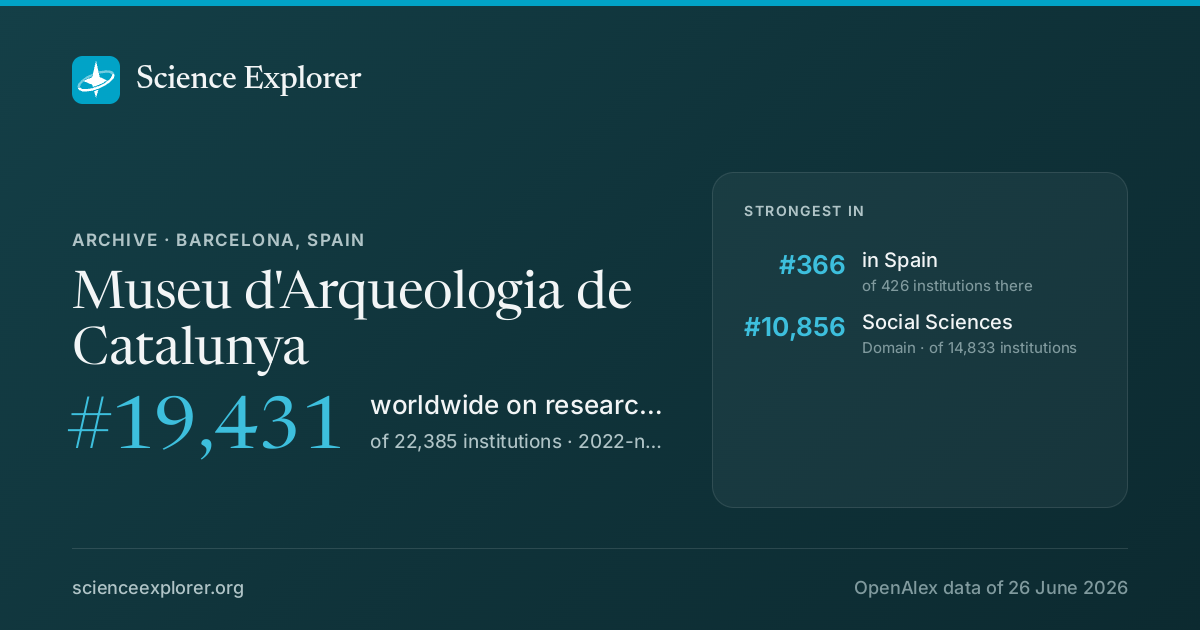
In research, Museu d'Arqueologia de Catalunya stands highest in Social Sciences (#10,856 of 14,833 worldwide), over all time. Relative to its size it is most specialised in Archeology (Archeology is 88.8× its share of world research).
- World rank, 2022-now
- #19,431 of 22,385 · #20,581 all time
- Rank in Spain
- #366 of 426
- Research works
- 266 ▲ 37% vs 2018-21
- Citations
- 2.9k 10.9 per fractional work
- Top-10% rate
- 11.4% all institutions 10.0%
- vs its own fields
- 1.07× 1.00× is exactly expected
- Open access
- 65% world 40%
- International
- 30% world 18%
What is Museu d'Arqueologia de Catalunya known for in research?
The fields where it stands highest, over all time, ranked among every institution above the floor in each field.
| Field | World rank | Where that sits | Top-10% rate | Works |
|---|---|---|---|---|
| Social SciencesDomain | #10,856 of 14,833 | 18.1% | 159 |
Each strip is that field's whole ranked pool, with the notch where Museu d'Arqueologia de Catalunya sits in it, in the colour of the band that rank falls in. The track under the rate is the rate itself: it carries no average mark, because the average differs by field (from about 6% in Dentistry to 21% in Economics).
Which fields of science does Museu d'Arqueologia de Catalunya work in?
In 2022-now, 62% of research at Museu d'Arqueologia de Catalunya is in Social Sciences, 27% in Physical Sciences. Its largest fields are Arts and Humanities (43%), Earth and Planetary Sciences (19%), Social Sciences (15%). It does 2.3× the world's share of Social Sciences.
Each ring splits the one inside it: the four domains of science, their fields, their subfields. Size is fractional works in 2022-now. Every slice is a page; the interactive view zooms down to single topics and colours each by how much more of it this institution does than the world.
Its 4 domains and 20 fields, with their numbers
- Social Sciences5261.6%
- Arts and Humanities3642.8%
- Social Sciences1214.7%
- Psychology11.6%
- Business, Management and Accounting11.6%
- Economics, Econometrics and Finance10.8%
- Decision Sciences00.1%
- Physical Sciences2327.1%
- Earth and Planetary Sciences1618.9%
- Environmental Science56.0%
- Computer Science10.9%
- Engineering00.4%
- Materials Science00.4%
- Mathematics00.4%
- Physics and Astronomy00.0%
- Chemistry00.0%
- Life Sciences67.5%
- Health Sciences33.7%
- Medicine33.6%
- Health Professions00.1%
- Dentistry00.0%
What does Museu d'Arqueologia de Catalunya specialise in?
Where its research is concentrated relative to its size: Archeology takes 88.8× the share of its output that it takes of world research.
- ArcheologySubfield · 22.7 works89×
Location quotient, a volume reading rather than an impact one. It surfaces small, lopsided specialities.
Field profile
Location quotient across every field it publishes in: outside the ring is more than an institution of this size would be expected to publish, inside it is less.
Rings at 0.5×, 1× and 2×. Widest outward: Arts and Humanities, 14.8×. Every wedge is a field page.
All 20 fields, with their numbers
- Arts and Humanities14.82×36 works
- Earth and Planetary Sciences12.08×16 works
- Environmental Science1.21×5 works
- Agricultural and Biological Sciences1.20×5 works
- Social Sciences1.16×12 works
- Psychology0.54×1 works
- Business, Management and Accounting0.49×1 works
- Economics, Econometrics and Finance0.37×1 works
- Mathematics0.31×0 works
- Biochemistry, Genetics and Molecular Biology0.29×1 works
- Medicine0.19×3 works
- Neuroscience0.18×0 works
- Computer Science0.12×1 works
- Materials Science0.11×0 works
- Dentistry0.09×0 works
- Decision Sciences0.09×0 works
- Engineering0.03×0 works
- Health Professions0.03×0 works
- Chemistry0.02×0 works
- Physics and Astronomy0.02×0 works
- Arts and Humanities 14.8×
- Earth and Planetary Sciences 12.1×
- Environmental Science 1.2×
- Agricultural and Biological Sciences 1.2×
- Social Sciences 1.2×
- Psychology 0.5×
- Business, Management and Accounting 0.5×
- Economics, Econometrics and Finance 0.4×
- Mathematics 0.3×
- Biochemistry, Genetics and Molecular Biology 0.3×
- Medicine 0.2×
- Neuroscience 0.2×
- Computer Science 0.1×
- Materials Science 0.1×
- Dentistry 0.1×
- Decision Sciences 0.1×
- Engineering 0.0×
- Health Professions 0.0×
- Chemistry 0.0×
- Physics and Astronomy 0.0×
Who are the top researchers at Museu d'Arqueologia de Catalunya?
Ranked on the quality score, Ramón Buxó, Rodrigo Gaete and Pere Castanyer lead among researchers whose main affiliation is Museu d'Arqueologia de Catalunya.
- 1
Ramón Buxó
 Spain · #571,457 worldwide
2k citations · 79 works
- 2
Rodrigo Gaete
Spain · #1,546,311 worldwide
658 citations · 49 works
- 3
Pere Castanyer
Spain · #1,621,987 worldwide
858 citations · 56 works
- 4
Marta Santos
Spain · #1,809,648 worldwide
753 citations · 27 works
- 5
Josep Tarrús
Spain · #2,315,139 worldwide
381 citations · 38 works
- 6
Gabriel de Prado
Spain · #2,800,492 worldwide
725 citations · 27 works
- 7
Enriqueta Pons
Spain · #2,835,603 worldwide
186 citations · 41 works
- 8
Laureà Pagarolas i Sabaté
Spain · #3,709,386 worldwide
64 citations · 23 works
- 9
Vicenç Ruiz Gómez
Spain · #3,839,690 worldwide
79 citations · 31 works
- 10
Jordí Principal
Spain · #4,254,930 worldwide
90 citations · 45 works
Which keywords describe research at Museu d'Arqueologia de Catalunya?
By fractional works in 2022-now, weighted toward what it does more of than the world: Archaeology, Iberian Peninsula, Cultural Heritage, Cultural Exchange, Settlement Patterns, Iron Age, Agricultural Origins and Radiocarbon Dating.
- Urban Development
- Mammal Evolution
- Evolution
- Phylogenetic Analysis
- Neolithic
- Prurigo Pigmentosa
- Holocene
- Historiography
- Paleolithic Archaeology
- Hominin Genetics
- History
- Rural Landscapes
- Conservation
- Climate Change
- Bronze Age
- Romanization
- Radiocarbon Dating
- Iron Age
- Cultural Exchange
- Iberian Peninsula
- Archaeology
- Cultural Heritage
- Settlement Patterns
- Agricultural Origins
- Celtic culture
- Mediterranean
- Medieval Architecture
- Social Organization
- Early Medieval Churches
- Biogeography
- Remote Sensing
- Nationalism
- Propaganda
- Gender
- Inflammatory Disease
- Artifacts
- Molecular Phylogeny
- Spain
- Urbanization
- Phylogenetic Comparative Analysis
Size is fractional works in 2022-now in the topics tagged with each word; colour is the word's share of this institution's work against its share of the world's. The 40 words are chosen for being large and distinctive. Each links to the topic it comes from most.
All 40 words, with their numbers
- Archaeology12▲ 111×7 topics
- Iberian Peninsula12▲ 492×3 topics
- Cultural Heritage9▲ 19×13 topics
- Cultural Exchange8▲ 78×7 topics
- Settlement Patterns8▲ 491×2 topics
- Iron Age6▲ 400×2 topics
- Agricultural Origins5▲ 188×1 topic
- Radiocarbon Dating5▲ 188×1 topic
- Celtic culture5▲ 529×1 topic
- Romanization5▲ 529×1 topic
- Mediterranean5▲ 64×6 topics
- Bronze Age5▲ 140×3 topics
- Medieval Architecture5▲ 288×2 topics
- Climate Change4▲ 1.97×21 topics
- Social Organization4▲ 271×2 topics
- Conservation4▲ 12×10 topics
- Early Medieval Churches4▲ 495×1 topic
- Rural Landscapes4▲ 495×1 topic
- Biogeography4▲ 18×8 topics
- History4▲ 7.4×10 topics
- Remote Sensing3▲ 3.3×10 topics
- Hominin Genetics3▲ 160×1 topic
- Nationalism3▲ 7.9×5 topics
- Paleolithic Archaeology3▲ 160×1 topic
- Propaganda3▲ 69×3 topics
- Historiography3▲ 28×5 topics
- Gender3▲ 6.1×8 topics
- Holocene3▲ 30×3 topics
- Inflammatory Disease3▲ 65×1 topic
- Prurigo Pigmentosa3▲ 314×1 topic
- Artifacts3▲ 432×1 topic
- Neolithic3▲ 432×1 topic
- Molecular Phylogeny2▲ 18×4 topics
- Phylogenetic Analysis2▲ 8.5×7 topics
- Spain2▲ 77×2 topics
- Evolution2▲ 9.7×3 topics
- Urbanization2▲ 6.3×3 topics
- Mammal Evolution2▲ 117×1 topic
- Phylogenetic Comparative Analysis2▲ 117×1 topic
- Urban Development2▲ 7.1×4 topics
Which research topics does Museu d'Arqueologia de Catalunya publish most on?
By volume in 2022-now: Archaeology and ancient environmental studies, Archaeological and Historical Studies, Medieval Architecture and Archaeology and Pleistocene-Era Hominins and Archaeology.
Area is fractional works; colour is the subfield each topic belongs to.
- 1 Archaeology and ancient environmental studies Paleontology 5 works
- 2 Archaeological and Historical Studies Archeology 5 works
- 3 Medieval Architecture and Archaeology Archeology 4 works
- 4 Pleistocene-Era Hominins and Archaeology Anthropology 3 works
- 5 Medicine and Dermatology Studies History Dermatology 3 works
- 6 Archaeological and Geological Studies Archeology 3 works
- 7 Evolution and Paleontology Studies Paleontology 2 works
- 8 Ancient Mediterranean Archaeology and History Archeology 2 works
- 9 Forensic Anthropology and Bioarchaeology Studies Archeology 2 works
- 10 Maritime and Coastal Archaeology Archeology 2 works
How open and international is its research?
Against the world's own shares: the tick on each track. Both are shares of its output, so they sit on one scale and can be read against each other as well as against the world.
World: 40% of research is openly available.
World: 18% is written across borders.
How has Museu d'Arqueologia de Catalunya's research output changed?
Output in 2022-2025 was 37% higher than in 2018-2021.
The same series as a ribbon: one cell per year, darker for more. The line above answers how much; this answers when.
Its share of all research
Growing output can still be a shrinking share: all of science grows. This is Museu d'Arqueologia de Catalunya as a percentage of every work published that year, 0.00024% in 2024.
Fractional works of Museu d'Arqueologia de Catalunya over all fractional works that year. How the balance of science has shifted.
Other research institutions in Barcelona
- Universitat de Barcelona
- Universitat Politècnica de Catalunya
- Universitat Pompeu Fabra
- CERCA Institution
- Vall d'Hebron Hospital Universitari
- Hospital de Sant Pau
- Universitat Oberta de Catalunya
- Institució Catalana de Recerca i Estudis Avançats


Share Museu d'Arqueologia de Catalunya's ranking
Badges for a website1Each links back here and updates with every snapshot

Research measures only: rankings here say nothing about teaching, admissions or student experience. Comparable institutions and collaboration partners have tabs of their own, above.
Discussion
Ask a question or share a note about Museu d'Arqueologia de Catalunya. Keep it to the research: no personal attacks, advertising or links. Any reader can report a post, which collapses it for everyone until it is opened.