CERCA Institution
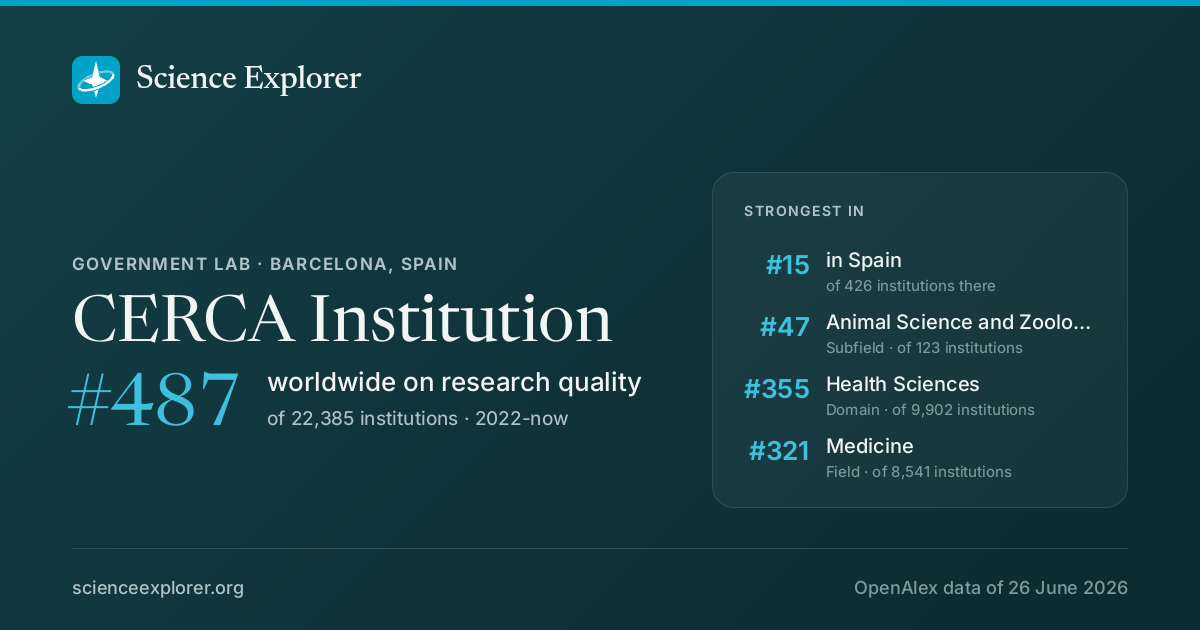
In research, CERCA Institution stands highest in Health Sciences (#355 of 9,902 worldwide), Medicine (#321 of 8,541 worldwide) and Physical Sciences (#570 of 10,670 worldwide), 2022-now. Relative to its size it is most specialised in Animal Science and Zoology, Paleontology and Small Animals (Animal Science and Zoology is 8.8× its share of world research).
- World rank, 2022-now
- #487 of 22,385 · #403 all time
- Rank in Spain
- #15 of 426
- Research works
- 17k ▲ 14% vs 2018-21
- Citations
- 546k 32.8 per fractional work
- Top-10% rate
- 13.4% all institutions 10.0%
- vs its own fields
- 1.30× 1.00× is exactly expected
- Open access
- 53% world 40%
- International
- 36% world 18%
What is CERCA Institution known for in research?
The fields where it stands highest, 2022-now, ranked among every institution above the floor in each field.
| Field | World rank | Where that sits | Top-10% rate | Works | All time |
|---|---|---|---|---|---|
| Health SciencesDomain | #355 of 9,902 | 14.7% | 1,399 | #255 | |
| MedicineField | #321 of 8,541 | 14.9% | 1,274 | #246 | |
| Physical SciencesDomain | #570 of 10,670 | 11.7% | 1,331 | #577 | |
| Life SciencesDomain | #356 of 6,403 | 13.9% | 902 | #271 | |
| Agricultural and Biological SciencesField | #201 of 3,157 | 16.2% | 355 | #126 | |
| EngineeringField | #662 of 5,901 | 10.0% | 575 | #576 | |
| Environmental ScienceField | #398 of 3,334 | 17.6% | 242 | #362 | |
| Computer ScienceField | #717 of 4,417 | 10.5% | 277 | #692 | |
| Plant ScienceSubfield | #236 of 1,317 | 17.6% | 104 | #175 | |
| Electrical and Electronic EngineeringSubfield | #395 of 2,176 | 10.2% | 300 | #261 |
Each strip is that field's whole ranked pool, with the notch where CERCA Institution sits in it, in the colour of the band that rank falls in. The track under the rate is the rate itself: it carries no average mark, because the average differs by field (from about 6% in Dentistry to 21% in Economics).
Which of those standings moved
The same fields on both windows: where it stood over the whole record, and where it stands in 2022-now. The distance is the story, and it is the one thing the two rank columns above cannot show.
- Health Sciences#255 #355
- Medicine#246 #321
- Physical Sciences#577 #570
- Life Sciences#271 #356
- Agricultural and Biological Sciences#126 #201
- Engineering#576 #662
- Environmental Science#362 #398
- Computer Science#692 #717
- Plant Science#175 #236
- Electrical and Electronic Engineering#261 #395
A dot further right is a better standing. Fields it was not ranked in over the whole record are left out.
Which fields of science does CERCA Institution work in?
In 2022-now, 36% of research at CERCA Institution is in Health Sciences, 34% in Physical Sciences. Its largest fields are Medicine (32%), Engineering (14%), Agricultural and Biological Sciences (9%). It does 1.7× the world's share of Life Sciences.
Each ring splits the one inside it: the four domains of science, their fields, their subfields. Size is fractional works in 2022-now. Every slice is a page; the interactive view zooms down to single topics and colours each by how much more of it this institution does than the world.
Its 4 domains and 26 fields, with their numbers
- Health Sciences1,58535.6%
- Medicine1,44232.4%
- Health Professions631.4%
- Nursing320.7%
- Veterinary310.7%
- Dentistry160.4%
- Physical Sciences1,49133.5%
- Engineering63214.2%
- Computer Science3096.9%
- Environmental Science2796.3%
- Materials Science791.8%
- Earth and Planetary Sciences761.7%
- Physics and Astronomy320.7%
- Energy310.7%
- Chemistry240.5%
- Chemical Engineering180.4%
- Mathematics100.2%
- Life Sciences1,02623.1%
- Social Sciences3467.8%
- Social Sciences1232.8%
- Psychology1062.4%
- Arts and Humanities461.0%
- Business, Management and Accounting360.8%
- Economics, Econometrics and Finance240.5%
- Decision Sciences120.3%
What does CERCA Institution specialise in?
Where its research is concentrated relative to its size: Animal Science and Zoology takes 8.8× the share of its output that it takes of world research.
- Animal Science and ZoologySubfield · 86.0 works8.8×
- PaleontologySubfield · 34.6 works6.5×
- Small AnimalsSubfield · 31.0 works5.7×
- VeterinaryField · 31.3 works5.2×
- Computer Networks and CommunicationsSubfield · 156.6 works4.0×
- HepatologySubfield · 32.3 works3.8×
Location quotient, a volume reading rather than an impact one. It surfaces small, lopsided specialities.
Field profile
Location quotient across every field it publishes in: outside the ring is more than an institution of this size would be expected to publish, inside it is less.
Rings at 0.5×, 1× and 2×. Widest outward: Veterinary, 5.2×. Every wedge is a field page.
All 26 fields, with their numbers
- Veterinary5.18×31 works
- Immunology and Microbiology2.29×103 works
- Agricultural and Biological Sciences1.90×402 works
- Neuroscience1.72×124 works
- Medicine1.69×1,442 works
- Biochemistry, Genetics and Molecular Biology1.64×388 works
- Nursing1.48×32 works
- Environmental Science1.26×279 works
- Chemical Engineering1.17×18 works
- Earth and Planetary Sciences1.08×76 works
- Engineering0.95×632 works
- Computer Science0.89×309 works
- Psychology0.78×106 works
- Energy0.77×31 works
- Dentistry0.75×16 works
- Pharmacology, Toxicology and Pharmaceutics0.58×9 works
- Health Professions0.54×63 works
- Materials Science0.51×79 works
- Chemistry0.35×24 works
- Arts and Humanities0.35×46 works
- Physics and Astronomy0.32×32 works
- Decision Sciences0.28×12 works
- Business, Management and Accounting0.25×36 works
- Economics, Econometrics and Finance0.25×24 works
- Social Sciences0.22×122 works
- Mathematics0.19×10 works
- Veterinary 5.2×
- Immunology and Microbiology 2.3×
- Agricultural and Biological Sciences 1.9×
- Neuroscience 1.7×
- Medicine 1.7×
- Biochemistry, Genetics and Molecular Biology 1.6×
- Nursing 1.5×
- Environmental Science 1.3×
- Chemical Engineering 1.2×
- Earth and Planetary Sciences 1.1×
- Engineering 0.9×
- Computer Science 0.9×
- Psychology 0.8×
- Energy 0.8×
- Dentistry 0.8×
- Pharmacology, Toxicology and Pharmaceutics 0.6×
- Health Professions 0.5×
- Materials Science 0.5×
- Chemistry 0.3×
- Arts and Humanities 0.3×
- Physics and Astronomy 0.3×
- Decision Sciences 0.3×
- Business, Management and Accounting 0.2×
- Economics, Econometrics and Finance 0.2×
- Social Sciences 0.2×
- Mathematics 0.2×
Which keywords describe research at CERCA Institution?
By fractional works in 2022-now, weighted toward what it does more of than the world: Epidemiology, Climate Change, 5G Networks, Inflammation, Energy Efficiency, Oxidative Stress, Genetics and Gut Microbiota.
- Coherent Detection
- Paleolithic Archaeology
- Intestinal Barrier
- Meat Quality
- Lipid Oxidation
- Wireless Networks
- Heat Stress
- Security and Privacy
- Software-Defined Networking
- Probiotics
- Immune Response
- Neurological Disorders
- Management
- Metabolic Syndrome
- Immunotherapy
- Cardiovascular Disease
- Treatment
- Oxidative Stress
- Deep Learning
- Climate Change
- Epidemiology
- Inflammation
- Energy Efficiency
- 5G Networks
- Diagnosis
- Genetics
- Cancer
- Biomarkers
- Gut Microbiota
- Pathogenesis
- Antioxidants
- Network Virtualization
- Consumer Perception
- Elastic Optical Networks
- Optical Networks
- Modified Atmosphere Packaging
- Massive MIMO
- Animal Welfare
- Hominin Genetics
- Digital Signal Processing
Size is fractional works in 2022-now in the topics tagged with each word; colour is the word's share of this institution's work against its share of the world's. The 40 words are chosen for being large and distinctive. Each links to the topic it comes from most.
All 40 words, with their numbers
- Epidemiology281▲ 1.59×134 topics
- Climate Change208▲ 1.72×93 topics
- Inflammation176▲ 1.86×81 topics
- Deep Learning121▼ 0.79×66 topics
- Energy Efficiency118▲ 2.9×28 topics
- Oxidative Stress118▲ 1.61×57 topics
- 5G Networks90▲ 10×5 topics
- Treatment89▲ 1.65×51 topics
- Diagnosis86▲ 2.1×41 topics
- Cardiovascular Disease85▲ 1.68×37 topics
- Genetics85▲ 2.7×26 topics
- Immunotherapy81▲ 2.5×19 topics
- Cancer80▲ 1.33×56 topics
- Metabolic Syndrome80▲ 2.2×23 topics
- Biomarkers68▲ 2.2×18 topics
- Management66▲ 1.86×34 topics
- Gut Microbiota65▲ 4.2×7 topics
- Neurological Disorders65▲ 2.6×20 topics
- Pathogenesis59▲ 2.6×23 topics
- Immune Response56▲ 2.2×23 topics
- Antioxidants51▲ 2.6×14 topics
- Probiotics50▲ 4.7×6 topics
- Network Virtualization46▲ 27×1 topic
- Software-Defined Networking46▲ 27×1 topic
- Consumer Perception42▲ 4.1×7 topics
- Security and Privacy38▲ 4.6×3 topics
- Elastic Optical Networks37▲ 52×1 topic
- Heat Stress37▲ 10×2 topics
- Optical Networks37▲ 52×1 topic
- Wireless Networks37▲ 5.6×9 topics
- Modified Atmosphere Packaging36▲ 9.4×2 topics
- Lipid Oxidation34▲ 7.6×2 topics
- Massive MIMO34▲ 9.6×3 topics
- Meat Quality31▲ 9.3×3 topics
- Animal Welfare31▲ 7.7×5 topics
- Intestinal Barrier30▲ 8.5×2 topics
- Hominin Genetics29▲ 30×1 topic
- Paleolithic Archaeology29▲ 30×1 topic
- Digital Signal Processing29▲ 14×2 topics
- Coherent Detection29▲ 16×1 topic
Which research topics does CERCA Institution publish most on?
By volume in 2022-now: Software-Defined Networks and 5G, Advanced Optical Network Technologies, Pleistocene-Era Hominins and Archaeology and Optical Network Technologies.
Area is fractional works; colour is the subfield each topic belongs to.
- 1 Software-Defined Networks and 5G Computer Networks and Communications 46 works
- 2 Advanced Optical Network Technologies Electrical and Electronic Engineering 37 works
- 3 Pleistocene-Era Hominins and Archaeology Anthropology 29 works
- 4 Optical Network Technologies Electrical and Electronic Engineering 29 works
- 5 Meat and Animal Product Quality Animal Science and Zoology 29 works
- 6 Animal Nutrition and Physiology Animal Science and Zoology 28 works
- 7 IoT and Edge/Fog Computing Computer Networks and Communications 28 works
- 8 Advanced Photonic Communication Systems Electrical and Electronic Engineering 25 works
- 9 Advanced MIMO Systems Optimization Electrical and Electronic Engineering 23 works
- 10 Archaeology and ancient environmental studies Paleontology 20 works
How open and international is its research?
Against the world's own shares: the tick on each track. Both are shares of its output, so they sit on one scale and can be read against each other as well as against the world.
World: 40% of research is openly available.
World: 18% is written across borders.
How has CERCA Institution's research output changed?
Output in 2022-2025 was 14% higher than in 2018-2021.
The same series as a ribbon: one cell per year, darker for more. The line above answers how much; this answers when.
Its share of all research
Growing output can still be a shrinking share: all of science grows. This is CERCA Institution as a percentage of every work published that year, 0.018% in 2024.
Fractional works of CERCA Institution over all fractional works that year. How the balance of science has shifted.
How much of it reaches the world top 10%
Year by year, against all institutions in the same year.
Of each year's output, the share that reached the world's 10% most cited for its field and year. Peak 20.5% in 1993.
Other research institutions in Barcelona
- Universitat de Barcelona
- Universitat Politècnica de Catalunya
- Universitat Pompeu Fabra
- Vall d'Hebron Hospital Universitari
- Hospital de Sant Pau
- Universitat Oberta de Catalunya
- Institució Catalana de Recerca i Estudis Avançats
- Universitat Ramon Llull


Compare CERCA Institution with
- vs
 Université Fédérale de Toulouse Midi-Pyrénées
- vs
 Nanjing University of Posts and Telecommunications
- vs Huazhong Agricultural University
- vs
 University of San Francisco
- vs
 Academia Sinica
- vs
 University of Twente
Share CERCA Institution's ranking



Research measures only: rankings here say nothing about teaching, admissions or student experience. Comparable institutions and collaboration partners have tabs of their own, above.
Discussion
Ask a question or share a note about CERCA Institution. Posts are plain text and can be reported.