Parenting Research Centre
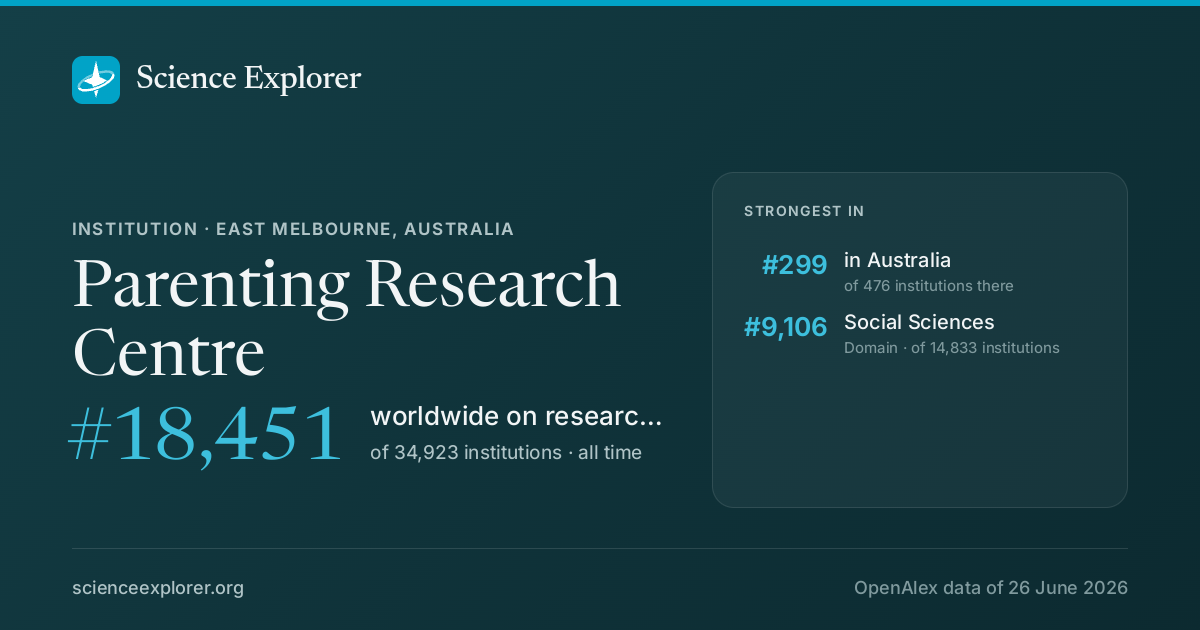
In research, Parenting Research Centre stands highest in Social Sciences (#9,106 of 14,833 worldwide), over all time.
- World rank, all time
- #18,451 of 34,923
- Rank in Australia
- #299 of 476
- Research works
- 276 ◆ 1% vs 2018-21
- Citations
- 11k 39.3 per fractional work
- Top-10% rate
- 19.9% all institutions 10.0%
- vs its own fields
- 1.14× 1.00× is exactly expected
- Open access
- 43% world 40%
- International
- 22% world 18%
What is Parenting Research Centre known for in research?
The fields where it stands highest, over all time, ranked among every institution above the floor in each field.
| Field | World rank | Where that sits | Top-10% rate | Works |
|---|---|---|---|---|
| Social SciencesDomain | #9,106 of 14,833 | 16.3% | 168 |
Each strip is that field's whole ranked pool, with the notch where Parenting Research Centre sits in it, in the colour of the band that rank falls in. The track under the rate is the rate itself: it carries no average mark, because the average differs by field (from about 6% in Dentistry to 21% in Economics).
Which fields of science does Parenting Research Centre work in?
In 2022-now, 63% of research at Parenting Research Centre is in Social Sciences, 28% in Health Sciences. Its largest fields are Psychology (33%), Social Sciences (25%), Medicine (16%). It does 2.3× the world's share of Social Sciences.
Each ring splits the one inside it: the four domains of science, their fields, their subfields. Size is fractional works in 2022-now. Every slice is a page; the interactive view zooms down to single topics and colours each by how much more of it this institution does than the world.
Its 4 domains and 18 fields, with their numbers
- Social Sciences3463.1%
- Psychology1833.4%
- Social Sciences1425.2%
- Arts and Humanities11.9%
- Economics, Econometrics and Finance11.5%
- Business, Management and Accounting00.8%
- Decision Sciences00.3%
- Health Sciences1528.3%
- Medicine916.1%
- Health Professions611.0%
- Nursing00.8%
- Dentistry00.4%
- Life Sciences24.5%
- Physical Sciences24.1%
- Physics and Astronomy11.8%
- Mathematics00.9%
- Environmental Science00.7%
- Computer Science00.3%
- Engineering00.3%
Field profile
Location quotient across every field it publishes in: outside the ring is more than an institution of this size would be expected to publish, inside it is less.
Rings at 0.5×, 1× and 2×. Widest outward: Psychology, 11.0×. Every wedge is a field page.
All 18 fields, with their numbers
- Psychology10.97×18 works
- Health Professions4.19×6 works
- Social Sciences1.99×14 works
- Neuroscience1.96×2 works
- Nursing1.60×0 works
- Medicine0.84×9 works
- Physics and Astronomy0.83×1 works
- Mathematics0.78×0 works
- Dentistry0.76×0 works
- Economics, Econometrics and Finance0.72×1 works
- Arts and Humanities0.65×1 works
- Decision Sciences0.32×0 works
- Business, Management and Accounting0.24×0 works
- Biochemistry, Genetics and Molecular Biology0.21×1 works
- Immunology and Microbiology0.18×0 works
- Environmental Science0.14×0 works
- Computer Science0.04×0 works
- Engineering0.02×0 works
- Psychology 11.0×
- Health Professions 4.2×
- Social Sciences 2.0×
- Neuroscience 2.0×
- Nursing 1.6×
- Medicine 0.8×
- Physics and Astronomy 0.8×
- Mathematics 0.8×
- Dentistry 0.8×
- Economics, Econometrics and Finance 0.7×
- Arts and Humanities 0.7×
- Decision Sciences 0.3×
- Business, Management and Accounting 0.2×
- Biochemistry, Genetics and Molecular Biology 0.2×
- Immunology and Microbiology 0.2×
- Environmental Science 0.1×
- Computer Science 0.0×
- Engineering 0.0×
Who are the top researchers at Parenting Research Centre?
Ranked on the quality score, Olivia Clayton, Jan Margaret Matthews and Catherine Wade lead among researchers whose main affiliation is Parenting Research Centre.
- 1
Olivia Clayton
 Australia · #346,473 worldwide
2.5k citations · 17 works
- 2
Jan Margaret Matthews
Australia · #838,715 worldwide
2.5k citations · 80 works
- 3
Catherine Wade
Australia · #1,165,164 worldwide
1.4k citations · 67 works
- 4
Robyn L. Mildon
Australia · #1,372,863 worldwide
865 citations · 48 works
- 5
Warren G. Cann
Australia · #1,562,580 worldwide
1.3k citations · 37 works
- 6
Victoria Hamilton
Australia · #1,739,023 worldwide
314 citations · 17 works
- 7
Natalie Rose
Australia · #2,119,069 worldwide
606 citations · 24 works
- 8
Cathryn Hunter
Australia · #3,903,959 worldwide
166 citations · 19 works
- 9
Annette Michaux
Australia · #4,157,618 worldwide
55 citations · 18 works
- 10
Dawn Francis-Pester
Australia · #7,060,847 worldwide
51 citations · 114 works
Which keywords describe research at Parenting Research Centre?
By fractional works in 2022-now, weighted toward what it does more of than the world: Mental Health, Adolescents, Depression, Developmental Trajectories, Emotion Regulation, Resilience, Children and Child Development.
- Intervention
- Elderly Care
- Child Welfare
- Psychiatric Disorders
- Preterm Birth
- Long-Term Care
- Attachment
- Maternal Mental Health
- Psychological Interventions
- School Engagement
- Social Support
- Self-Regulation
- Family Quality of Life
- Parenting Stress
- Coping Strategies
- Anxiety Disorders
- Child Development
- Resilience
- Developmental Trajectories
- Adolescents
- Mental Health
- Depression
- Emotion Regulation
- Children
- Parenting
- Behavioral Problems
- Psychopathology
- Caregiver Well-Being
- Academic Achievement
- Executive Functioning
- Early Childhood Education
- Student-Teacher Relationships
- Social Justice
- Perinatal Depression
- Well-being
- Neurodevelopmental Outcomes
- Parental Involvement
- Adverse Experiences
- Childhood Trauma
- Foster Care
Size is fractional works in 2022-now in the topics tagged with each word; colour is the word's share of this institution's work against its share of the world's. The 40 words are chosen for being large and distinctive. Each links to the topic it comes from most.
All 40 words, with their numbers
- Mental Health10▲ 13×14 topics
- Adolescents7▲ 36×6 topics
- Depression7▲ 14×6 topics
- Developmental Trajectories7▲ 101×2 topics
- Emotion Regulation7▲ 38×4 topics
- Resilience6▲ 24×6 topics
- Children6▲ 51×2 topics
- Child Development6▲ 27×8 topics
- Parenting6▲ 86×2 topics
- Anxiety Disorders5▲ 89×2 topics
- Behavioral Problems5▲ 121×1 topic
- Coping Strategies5▲ 38×4 topics
- Psychopathology5▲ 55×1 topic
- Parenting Stress5▲ 121×2 topics
- Caregiver Well-Being4▲ 152×1 topic
- Family Quality of Life4▲ 152×1 topic
- Academic Achievement3▲ 37×4 topics
- Self-Regulation3▲ 33×4 topics
- Executive Functioning3▲ 45×3 topics
- Social Support3▲ 9.4×7 topics
- Early Childhood Education3▲ 59×2 topics
- School Engagement3▲ 103×1 topic
- Student-Teacher Relationships3▲ 103×1 topic
- Psychological Interventions2▲ 32×2 topics
- Social Justice2▲ 7.5×4 topics
- Maternal Mental Health2▲ 82×1 topic
- Perinatal Depression2▲ 82×1 topic
- Attachment2▲ 46×3 topics
- Well-being2▲ 9.0×10 topics
- Long-Term Care2▲ 45×2 topics
- Neurodevelopmental Outcomes2▲ 18×1 topic
- Preterm Birth2▲ 50×1 topic
- Parental Involvement2▲ 16×2 topics
- Psychiatric Disorders2▲ 20×2 topics
- Adverse Experiences1▲ 65×1 topic
- Child Welfare1▲ 69×1 topic
- Childhood Trauma1▲ 43×1 topic
- Elderly Care1▲ 17×2 topics
- Foster Care1▲ 181×1 topic
- Intervention1▲ 63×2 topics
Which research topics does Parenting Research Centre publish most on?
By volume in 2022-now: Child and Adolescent Psychosocial and Emotional Development, Family and Disability Support Research, Early Childhood Education and Development and Maternal Mental Health During Pregnancy and Postpartum.
Area is fractional works; colour is the subfield each topic belongs to.
- 1 Child and Adolescent Psychosocial and Emotional Development Clinical Psychology 5 works
- 2 Family and Disability Support Research Clinical Psychology 4 works
- 3 Early Childhood Education and Development Education 3 works
- 4 Maternal Mental Health During Pregnancy and Postpartum Public Health, Environmental and Occupational Health 2 works
- 5 Infant Development and Preterm Care Pediatrics, Perinatology and Child Health 2 works
- 6 Child Welfare and Adoption Safety Research 1 works
- 7 Child Abuse and Trauma Clinical Psychology 1 works
- 8 Parental Involvement in Education Education 1 works
- 9 Intergenerational Family Dynamics and Caregiving Sociology and Political Science 1 works
- 10 Family Support in Illness Sociology and Political Science 1 works
How open and international is its research?
Against the world's own shares: the tick on each track. Both are shares of its output, so they sit on one scale and can be read against each other as well as against the world.
World: 40% of research is openly available.
World: 18% is written across borders.
How has Parenting Research Centre's research output changed?
Output in 2022-2025 was 1% higher than in 2018-2021.
The same series as a ribbon: one cell per year, darker for more. The line above answers how much; this answers when.
Its share of all research
Growing output can still be a shrinking share: all of science grows. This is Parenting Research Centre as a percentage of every work published that year, 0.00020% in 2024.
Fractional works of Parenting Research Centre over all fractional works that year. How the balance of science has shifted.
Other research institutions in East Melbourne
- The Royal Victorian Eye & Ear Hospital
- Royal Australian College of General Practitioners
- Natural Hazards Research Australia
- Sinclair Dermatology
- Royal Australian and New Zealand College of Obstetricians and Gynaecologists
- Orica (Australia)
- Australasian Leukaemia and Lymphoma Group
- Movember Foundation
Share Parenting Research Centre's ranking
Badges for a website1Each links back here and updates with every snapshot

Research measures only: rankings here say nothing about teaching, admissions or student experience. Comparable institutions and collaboration partners have tabs of their own, above.
Discussion
Ask a question or share a note about Parenting Research Centre. Posts are plain text and can be reported.