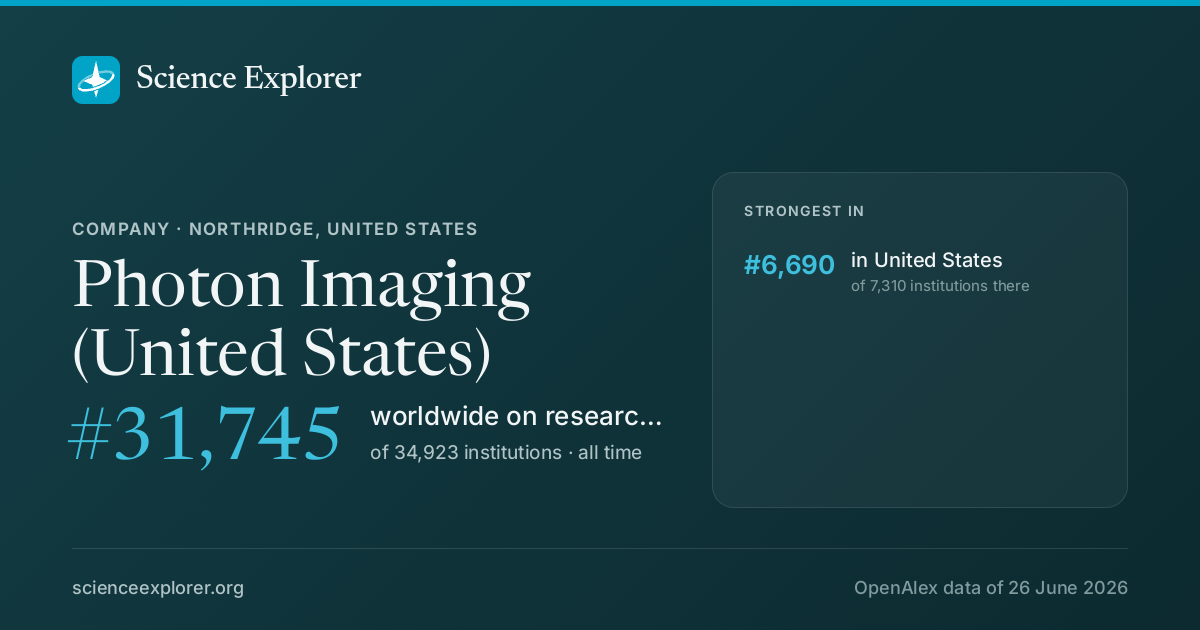
- World rank, all time
- #31,745 of 34,923
- Rank in United States
- #6,690 of 7,310
- Research works
- 123 ▲ 1292% vs 2018-21
- Citations
- 1.6k 12.9 per fractional work
- Top-10% rate
- 4.5% all institutions 10.0%
- vs its own fields
- 0.94× 1.00× is exactly expected
- Open access
- 20% world 40%
- International
- 18% world 18%
Which fields of science does Photon Imaging (United States) work in?
In 2022-now, 61% of research at Photon Imaging (United States) is in Health Sciences, 35% in Physical Sciences. Its largest fields are Medicine (59%), Engineering (22%), Physics and Astronomy (7%). It does 2.2× the world's share of Health Sciences.
Each ring splits the one inside it: the four domains of science, their fields, their subfields. Size is fractional works in 2022-now. Every slice is a page; the interactive view zooms down to single topics and colours each by how much more of it this institution does than the world.
Its 3 domains and 12 fields, with their numbers
- Health Sciences1961.0%
- Physical Sciences1135.5%
- Engineering721.8%
- Physics and Astronomy26.8%
- Materials Science13.5%
- Computer Science12.4%
- Chemistry00.8%
- Earth and Planetary Sciences00.1%
- Energy00.1%
- Life Sciences13.5%
Field profile
Location quotient across every field it publishes in: outside the ring is more than an institution of this size would be expected to publish, inside it is less.
Rings at 0.5×, 1× and 2×. Widest outward: Dentistry, 3.7×. Every wedge is a field page.
All 12 fields, with their numbers
- Dentistry3.69×1 works
- Medicine3.08×18 works
- Physics and Astronomy3.05×2 works
- Engineering1.45×7 works
- Pharmacology, Toxicology and Pharmaceutics1.14×0 works
- Materials Science1.01×1 works
- Biochemistry, Genetics and Molecular Biology0.55×1 works
- Chemistry0.49×0 works
- Computer Science0.31×1 works
- Neuroscience0.13×0 works
- Energy0.12×0 works
- Earth and Planetary Sciences0.07×0 works
Who are the top researchers at Photon Imaging (United States)?
Ranked on the quality score, Ze'ev Feit, R. J. Woods and Shaul Barkan lead among researchers whose main affiliation is Photon Imaging (United States).
- 1
Ze'ev Feit
 United States · #2,318,148 worldwide
507 citations · 30 works
- 2
R. J. Woods
United States · #2,501,403 worldwide
534 citations · 34 works
- 3
Shaul Barkan
United States · #3,009,608 worldwide
112 citations · 50 works
- 4
D. Kostyk
United States · #3,123,412 worldwide
183 citations · 15 works
- 5
Jan S. Iwanczyk
United States · #3,885,841 worldwide
4.3k citations · 211 works
- 6
C. Rossington Tull
United States · #4,245,905 worldwide
235 citations · 28 works
- 7
Joel Harold Bortz
United States · #5,214,813 worldwide
53 citations · 55 works
Which keywords describe research at Photon Imaging (United States)?
By fractional works in 2022-now, weighted toward what it does more of than the world: Guidelines, Mortality, Colorectal Cancer, Screening, Treatment, Clinical Practice Guidelines, Laparoscopic Surgery and Chemotherapy.
- Meckel's Diverticulum
- Gastric Cancer
- Survival Analysis
- Molecular Characterization
- Diagnosis
- Nonlinear Optics
- Imaging
- Rectal Cancer
- Preoperative Chemoradiotherapy
- Precision Medicine
- Quantitative Analysis
- Diverticulitis
- Adjuvant Chemotherapy
- Chemotherapy
- Machine Learning
- Treatment
- Colorectal Cancer
- Epidemiology
- Guidelines
- Mortality
- Screening
- Clinical Practice Guidelines
- Laparoscopic Surgery
- Neoadjuvant Therapy
- Colonic Diverticulitis
- Feature Extraction
- Medical Imaging
- Texture Analysis
- Radiomics
- Tumor Heterogeneity
- Biomedical Applications
- Adjuvant Therapy
- Fiber Lasers
- Deep Learning
- Endoscopic Resection
- Intussusception
Size is fractional works in 2022-now in the topics tagged with each word; colour is the word's share of this institution's work against its share of the world's. The 36 words are chosen for being large and distinctive. Each links to the topic it comes from most.
All 36 words, with their numbers
- Guidelines4▲ 24×3 topics
- Epidemiology3▲ 2.7×8 topics
- Mortality3▲ 19×2 topics
- Colorectal Cancer3▲ 137×1 topic
- Screening3▲ 111×1 topic
- Treatment3▲ 8.8×4 topics
- Clinical Practice Guidelines3▲ 18×3 topics
- Machine Learning2▲ 2.4×7 topics
- Laparoscopic Surgery2▲ 61×3 topics
- Chemotherapy2▲ 9.8×4 topics
- Neoadjuvant Therapy2▲ 29×2 topics
- Adjuvant Chemotherapy2▲ 94×2 topics
- Colonic Diverticulitis2▲ 350×1 topic
- Diverticulitis2▲ 350×1 topic
- Feature Extraction2▲ 14×3 topics
- Quantitative Analysis2▲ 30×2 topics
- Medical Imaging2▲ 11×2 topics
- Precision Medicine2▲ 12×2 topics
- Texture Analysis2▲ 28×2 topics
- Preoperative Chemoradiotherapy2▲ 74×1 topic
- Radiomics2▲ 51×1 topic
- Rectal Cancer2▲ 154×1 topic
- Tumor Heterogeneity2▲ 51×1 topic
- Imaging2▲ 22×2 topics
- Biomedical Applications2▲ 4.0×9 topics
- Nonlinear Optics1▲ 40×3 topics
- Adjuvant Therapy1▲ 30×2 topics
- Diagnosis1▲ 4.3×2 topics
- Fiber Lasers1▲ 41×2 topics
- Molecular Characterization1▲ 21×2 topics
- Deep Learning1◆ 1.02×10 topics
- Survival Analysis1▲ 13×2 topics
- Endoscopic Resection1▲ 32×1 topic
- Gastric Cancer1▲ 29×1 topic
- Intussusception1▲ 99×1 topic
- Meckel's Diverticulum1▲ 99×1 topic
Which research topics does Photon Imaging (United States) publish most on?
By volume in 2022-now: Colorectal Cancer Screening and Detection, Diverticular Disease and Complications, Colorectal Cancer Surgical Treatments and Radiomics and Machine Learning in Medical Imaging.
Area is fractional works; colour is the subfield each topic belongs to.
- 1 Colorectal Cancer Screening and Detection Oncology 3 works
- 2 Diverticular Disease and Complications Surgery 2 works
- 3 Colorectal Cancer Surgical Treatments Oncology 2 works
- 4 Radiomics and Machine Learning in Medical Imaging Radiology, Nuclear Medicine and Imaging 2 works
- 5 Gastric Cancer Management and Outcomes Pulmonary and Respiratory Medicine 1 works
- 6 Gastrointestinal disorders and treatments Surgery 1 works
- 7 Photonic Crystal and Fiber Optics Electrical and Electronic Engineering 1 works
- 8 Colorectal and Anal Carcinomas Surgery 1 works
- 9 Advanced X-ray and CT Imaging Biomedical Engineering 1 works
- 10 Optical Imaging and Spectroscopy Techniques Radiology, Nuclear Medicine and Imaging 1 works
How open and international is its research?
Against the world's own shares: the tick on each track. Both are shares of its output, so they sit on one scale and can be read against each other as well as against the world.
World: 40% of research is openly available.
World: 18% is written across borders.
How has Photon Imaging (United States)'s research output changed?
Output in 2022-2025 was 1292% higher than in 2018-2021.
The same series as a ribbon: one cell per year, darker for more. The line above answers how much; this answers when.
Its share of all research
Growing output can still be a shrinking share: all of science grows. This is Photon Imaging (United States) as a percentage of every work published that year, 0.000091% in 2024.
Fractional works of Photon Imaging (United States) over all fractional works that year. How the balance of science has shifted.
Other research institutions in Northridge
- California State University, Northridge
- Areté Associates (United States)
- Northridge Hospital Medical Center
- Particle Beam Lasers (United States)
- DxRay (United States)
- Chemat Technology (United States)
- CHIME Institute
Share Photon Imaging (United States)'s ranking
Badges for a website1Each links back here and updates with every snapshot

Research measures only: rankings here say nothing about teaching, admissions or student experience. Comparable institutions and collaboration partners have tabs of their own, above.
Discussion
Ask a question or share a note about Photon Imaging (United States). Posts are plain text and can be reported.