Royal Observatory in Greenwich
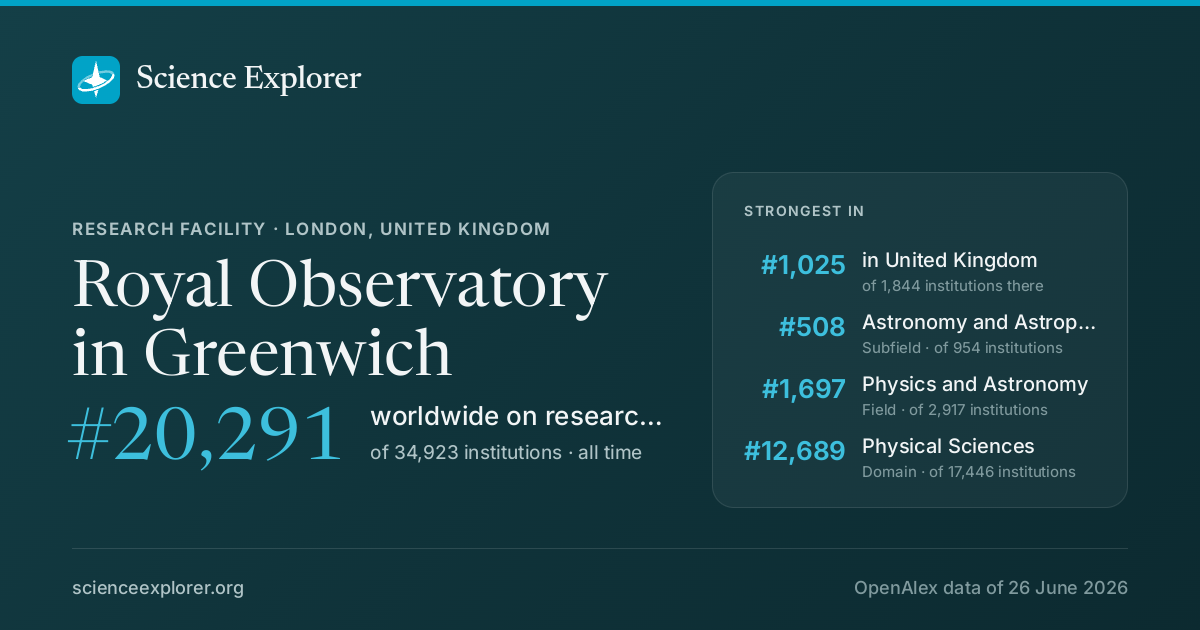
In research, Royal Observatory in Greenwich stands highest in Astronomy and Astrophysics (#508 of 954 worldwide), Physics and Astronomy (#1,697 of 2,917 worldwide) and Physical Sciences (#12,689 of 17,446 worldwide), over all time.
- World rank, all time
- #20,291 of 34,923
- Rank in United Kingdom
- #1,025 of 1,844
- Research works
- 1k ▼ 48% vs 2018-21
- Citations
- 21k 20.1 per fractional work
- Top-10% rate
- 3.7% all institutions 10.0%
- vs its own fields
- 0.80× 1.00× is exactly expected
- Open access
- 41% world 40%
- International
- 25% world 18%
What is Royal Observatory in Greenwich known for in research?
The fields where it stands highest, over all time, ranked among every institution above the floor in each field.
| Field | World rank | Where that sits | Top-10% rate | Works |
|---|---|---|---|---|
| Astronomy and AstrophysicsSubfield | #508 of 954 | 10.0% | 464 | |
| Physics and AstronomyField | #1,697 of 2,917 | 9.7% | 689 | |
| Physical SciencesDomain | #12,689 of 17,446 | 9.2% | 954 | |
| EngineeringField | #8,833 of 9,532 | 7.2% | 164 |
Each strip is that field's whole ranked pool, with the notch where Royal Observatory in Greenwich sits in it, in the colour of the band that rank falls in. The track under the rate is the rate itself: it carries no average mark, because the average differs by field (from about 6% in Dentistry to 21% in Economics).
Which fields of science does Royal Observatory in Greenwich work in?
In all years, 92% of research at Royal Observatory in Greenwich is in Physical Sciences, 5% in Social Sciences. Its largest fields are Physics and Astronomy (66%), Engineering (16%), Earth and Planetary Sciences (6%). It does 2.3× the world's share of Physical Sciences.
Each ring splits the one inside it: the four domains of science, their fields, their subfields. Size is fractional works in all years. Every slice is a page; the interactive view zooms down to single topics and colours each by how much more of it this institution does than the world.
Its 4 domains and 24 fields, with their numbers
- Physical Sciences95491.9%
- Physics and Astronomy68966.4%
- Engineering16415.8%
- Earth and Planetary Sciences585.5%
- Computer Science141.4%
- Chemistry111.1%
- Environmental Science101.0%
- Materials Science40.4%
- Mathematics30.3%
- Chemical Engineering00.0%
- Energy00.0%
- Social Sciences545.2%
- Social Sciences191.9%
- Arts and Humanities161.5%
- Decision Sciences111.0%
- Economics, Econometrics and Finance40.4%
- Psychology20.2%
- Business, Management and Accounting20.2%
- Life Sciences181.7%
- Health Sciences121.2%
- Medicine111.0%
- Health Professions10.1%
- Dentistry00.0%
- Veterinary00.0%
Field profile
Location quotient across every field it publishes in: outside the ring is more than an institution of this size would be expected to publish, inside it is less.
Rings at 0.5×, 1× and 2×. Widest outward: Physics and Astronomy, 20.8×. Every wedge is a field page.
All 10 fields, with their numbers
- Physics and Astronomy20.83×3 works
- Arts and Humanities6.40×1 works
- Earth and Planetary Sciences2.07×0 works
- Energy1.99×0 works
- Economics, Econometrics and Finance1.23×0 works
- Business, Management and Accounting1.01×0 works
- Social Sciences0.85×1 works
- Engineering0.52×0 works
- Chemistry0.31×0 works
- Medicine0.27×0 works
Who are the top researchers at Royal Observatory in Greenwich?
Ranked on the quality score, Jasper V. Wall, George Biddell Airy and Frank Watson Dyson lead among researchers whose main affiliation is Royal Observatory in Greenwich.
- 1
Jasper V. Wall
 United Kingdom · #1,340,299 worldwide
5.1k citations · 196 works
- 2
George Biddell Airy
United Kingdom · #1,945,872 worldwide
1.5k citations · 1,074 works
- 3
Frank Watson Dyson
United Kingdom · #2,029,519 worldwide
1.8k citations · 358 works
- 4
James Whitbread Lee Glaisher
United Kingdom · #2,448,195 worldwide
495 citations · 236 works
- 5
Michael V. Penston
United Kingdom · #2,502,713 worldwide
4.5k citations · 243 works
- 6
D. Carter
United Kingdom · #2,649,662 worldwide
2.1k citations · 16 works
- 7
H. W. Newton
United Kingdom · #2,864,228 worldwide
843 citations · 58 works
- 8
P. H. Cowell
United Kingdom · #3,008,416 worldwide
114 citations · 80 works
- 9
B. R. Leaton
United Kingdom · #3,029,848 worldwide
483 citations · 20 works
- 10
Bernard E. J. Pagel
United Kingdom · #3,140,994 worldwide
8k citations · 317 works
Which keywords describe research at Royal Observatory in Greenwich?
By fractional works in all years, weighted toward what it does more of than the world: Exoplanets, Stellar Astrophysics, Astronomical Instrumentation, Spectrograph, Star Formation, Spectroscopy, Radio Astronomy and Black Holes.
- Gamma-Ray Bursts
- Galactic Center
- Nucleosynthesis
- Gravitational Waves
- GRACE
- Geodetic Measurements
- Adaptive Optics
- Molecular Clouds
- Terrestrial Planets
- Stellar Populations
- Cosmology
- Climate Change
- Optical 3D Laser Measurement
- Accretion Disks
- Transits of Venus
- Historical Figures
- Black Holes
- Spectroscopy
- Spectrograph
- Stellar Astrophysics
- Exoplanets
- Astronomical Instrumentation
- Star Formation
- Radio Astronomy
- High-Resolution Imaging
- Solar Observations
- Magnetic Fields
- Structural Health Monitoring
- Position-Sensitive Detector
- Dark Matter
- Galaxies
- Solar System Abundances
- Turbulence
- Protoplanetary Disks
- Wavefront Sensing
- Sea Level Rise
- groundwater depletion
- Supernovae
- Solar Wind
- Historical Astronomy
Size is fractional works in all years in the topics tagged with each word; colour is the word's share of this institution's work against its share of the world's. The 40 words are chosen for being large and distinctive. Each links to the topic it comes from most.
All 40 words, with their numbers
- Exoplanets117▲ 154×1 topic
- Stellar Astrophysics117▲ 154×1 topic
- Astronomical Instrumentation113▲ 213×1 topic
- Spectrograph113▲ 213×1 topic
- Star Formation92▲ 96×2 topics
- Spectroscopy79▲ 24×5 topics
- Radio Astronomy79▲ 208×2 topics
- Black Holes77▲ 51×3 topics
- High-Resolution Imaging68▲ 107×3 topics
- Historical Figures66▲ 169×2 topics
- Solar Observations66▲ 323×1 topic
- Transits of Venus66▲ 323×1 topic
- Magnetic Fields64▲ 60×3 topics
- Accretion Disks64▲ 76×2 topics
- Structural Health Monitoring63▲ 59×2 topics
- Optical 3D Laser Measurement63▲ 308×1 topic
- Position-Sensitive Detector63▲ 308×1 topic
- Climate Change57▲ 2.0×21 topics
- Dark Matter54▲ 28×3 topics
- Cosmology53▲ 56×3 topics
- Galaxies52▲ 113×1 topic
- Stellar Populations52▲ 113×1 topic
- Solar System Abundances45▲ 51×1 topic
- Terrestrial Planets45▲ 51×1 topic
- Turbulence42▲ 28×2 topics
- Molecular Clouds40▲ 80×1 topic
- Protoplanetary Disks40▲ 80×1 topic
- Adaptive Optics39▲ 188×1 topic
- Wavefront Sensing39▲ 188×1 topic
- Geodetic Measurements38▲ 29×2 topics
- Sea Level Rise38▲ 28×2 topics
- GRACE37▲ 73×1 topic
- groundwater depletion37▲ 73×1 topic
- Gravitational Waves30▲ 45×2 topics
- Supernovae30▲ 28×2 topics
- Nucleosynthesis29▲ 27×3 topics
- Solar Wind27▲ 19×2 topics
- Galactic Center25▲ 39×2 topics
- Historical Astronomy24▲ 113×2 topics
- Gamma-Ray Bursts24▲ 69×1 topic
Which research topics does Royal Observatory in Greenwich publish most on?
By volume in 2022-now: History and Developments in Astronomy, Historical Astronomy and Related Studies, History of Science and Medicine and History of Science and Natural History.
Area is fractional works; colour is the subfield each topic belongs to.
- 1 History and Developments in Astronomy Astronomy and Astrophysics 1 works
- 2 Historical Astronomy and Related Studies Astronomy and Astrophysics 0 works
- 3 History of Science and Medicine History and Philosophy of Science 0 works
- 4 History of Science and Natural History History and Philosophy of Science 0 works
- 5 Radio Astronomy Observations and Technology Astronomy and Astrophysics 0 works
- 6 Electrical and Electromagnetic Research Atomic and Molecular Physics, and Optics 0 works
- 7 Semiconductor Lasers and Optical Devices Electrical and Electronic Engineering 0 works
- 8 Space Science and Extraterrestrial Life Astronomy and Astrophysics 0 works
- 9 Vaccine Coverage and Hesitancy Health 0 works
- 10 Transport and Economic Policies Strategy and Management 0 works
How open and international is its research?
Against the world's own shares: the tick on each track. Both are shares of its output, so they sit on one scale and can be read against each other as well as against the world.
World: 40% of research is openly available.
World: 18% is written across borders.
How has Royal Observatory in Greenwich's research output changed?
Output in 2022-2025 was 48% lower than in 2018-2021.
The same series as a ribbon: one cell per year, darker for more. The line above answers how much; this answers when.
Its share of all research
Growing output can still be a shrinking share: all of science grows. This is Royal Observatory in Greenwich as a percentage of every work published that year, 0.000029% in 2024.
Fractional works of Royal Observatory in Greenwich over all fractional works that year. How the balance of science has shifted.
How much of it reaches the world top 10%
Year by year, against all institutions in the same year.
Of each year's output, the share that reached the world's 10% most cited for its field and year. Peak 17.5% in 1996.
Other research institutions in London
- University College London
- Imperial College London
- King's College London
- Queen Mary University of London
- London School of Economics and Political Science
- University of London
- Barts Health NHS Trust
- Brunel University of London



Share Royal Observatory in Greenwich's ranking
Badges for a website1Each links back here and updates with every snapshot

Research measures only: rankings here say nothing about teaching, admissions or student experience. Comparable institutions and collaboration partners have tabs of their own, above.
Discussion
Ask a question or share a note about Royal Observatory in Greenwich. Keep it to the research: no personal attacks, advertising or links. Any reader can report a post, which collapses it for everyone until it is opened.