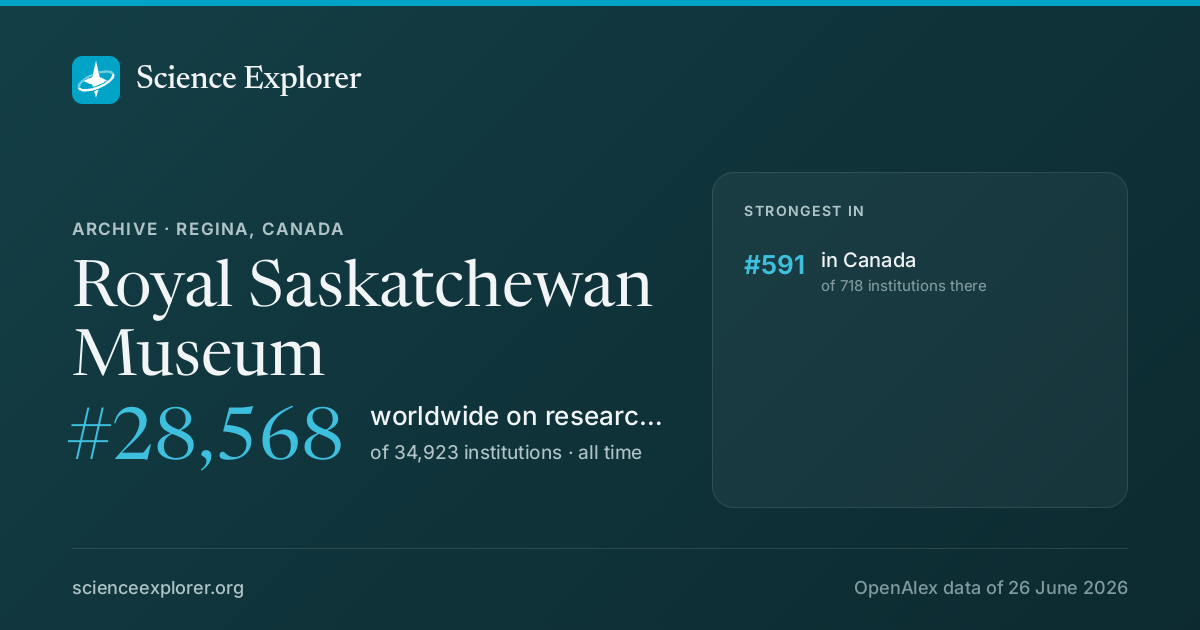
- World rank, all time
- #28,568 of 34,923
- Rank in Canada
- #591 of 718
- Research works
- 169 ▼ 34% vs 2018-21
- Citations
- 1.8k 10.6 per fractional work
- Top-10% rate
- 5.8% all institutions 10.0%
- vs its own fields
- 0.97× 1.00× is exactly expected
- Open access
- 62% world 40%
- International
- 14% world 18%
Which fields of science does Royal Saskatchewan Museum work in?
In all years, 37% of research at Royal Saskatchewan Museum is in Physical Sciences, 29% in Life Sciences. Its largest fields are Agricultural and Biological Sciences (23%), Environmental Science (22%), Social Sciences (14%). It does 1.8× the world's share of Life Sciences.
Each ring splits the one inside it: the four domains of science, their fields, their subfields. Size is fractional works in all years. Every slice is a page; the interactive view zooms down to single topics and colours each by how much more of it this institution does than the world.
Its 4 domains and 22 fields, with their numbers
- Physical Sciences6337.3%
- Environmental Science3621.6%
- Earth and Planetary Sciences2011.8%
- Computer Science31.8%
- Engineering21.3%
- Physics and Astronomy10.4%
- Chemistry00.3%
- Mathematics00.1%
- Life Sciences4928.9%
- Social Sciences4828.4%
- Social Sciences2313.6%
- Arts and Humanities1911.0%
- Psychology31.7%
- Decision Sciences21.0%
- Business, Management and Accounting10.6%
- Economics, Econometrics and Finance10.6%
- Health Sciences95.4%
- Health Professions63.8%
- Medicine21.5%
- Nursing00.1%
- Veterinary00.1%
Field profile
Location quotient across every field it publishes in: outside the ring is more than an institution of this size would be expected to publish, inside it is less.
Rings at 0.5×, 1× and 2×. Widest outward: Earth and Planetary Sciences, 8.8×. Every wedge is a field page.
All 11 fields, with their numbers
- Earth and Planetary Sciences8.77×2 works
- Agricultural and Biological Sciences8.32×7 works
- Environmental Science3.77×3 works
- Arts and Humanities3.32×2 works
- Biochemistry, Genetics and Molecular Biology1.25×1 works
- Social Sciences0.65×1 works
- Physics and Astronomy0.43×0 works
- Health Professions0.36×0 works
- Psychology0.21×0 works
- Computer Science0.08×0 works
- Medicine0.02×0 works
Who are the top researchers at Royal Saskatchewan Museum?
Ranked on the quality score, Cory Silas Sheffield, Ryan C. McKellar and Jennifer Heron lead among researchers whose main affiliation is Royal Saskatchewan Museum.
- 1
Cory Silas Sheffield
 Canada · #1,170,714 worldwide
3.4k citations · 109 works
- 2
Ryan C. McKellar
Canada · #1,487,011 worldwide
2.5k citations · 132 works
- 3
Jennifer Heron
Canada · #3,100,346 worldwide
280 citations · 32 works
- 4
Pierre F.D. Cockx
Canada · #3,698,529 worldwide
158 citations · 18 works
- 5
Glenn C. Sutter
Canada · #3,827,278 worldwide
562 citations · 39 works
- 6
Tim T. Tokaryk
Canada · #4,807,821 worldwide
637 citations · 69 works
- 7
Fred W. Lahrman
Canada · #5,465,273 worldwide
53 citations · 36 works
- 8
Ronald R. Hooper
Canada · #6,094,291 worldwide
66 citations · 55 works
- 9
Paul C. James
Canada · #6,686,478 worldwide
1.1k citations · 86 works
- 10
Saskatchewan Natural History Society
Canada · #7,706,629 worldwide
76 citations · 1,370 works
Which keywords describe research at Royal Saskatchewan Museum?
By fractional works in all years, weighted toward what it does more of than the world: Climate Change, Invasive Species, Biodiversity, Population Dynamics, Ecosystem Services, Habitat Fragmentation, Global Change and Conservation.
- Insect Evolution
- Radiocarbon Dating
- Cultural Sustainability
- Social Policy
- Language
- Nationalism
- DNA Barcoding
- Phylogenetic Analysis
- History
- Conservation Biology
- Cultural Heritage
- Morphology
- Cretaceous
- Phylogeny
- Plant-Animal Interactions
- Molecular Phylogeny
- Conservation
- Habitat Fragmentation
- Population Dynamics
- Invasive Species
- Climate Change
- Biodiversity
- Ecosystem Services
- Global Change
- Biogeography
- Habitat Selection
- Pollinator Decline
- Cultural Identity
- Evolution
- Trophic Cascades
- Animal Movement
- Occupancy Rates
- Adaptive Radiation
- Identity
- Mammal Evolution
- Phylogenetic Comparative Analysis
- Canada
- Phylogenetics
- Agricultural Origins
- Amber Fossils
Size is fractional works in all years in the topics tagged with each word; colour is the word's share of this institution's work against its share of the world's. The 40 words are chosen for being large and distinctive. Each links to the topic it comes from most.
All 40 words, with their numbers
- Climate Change38▲ 8.4×28 topics
- Invasive Species26▲ 26×14 topics
- Biodiversity25▲ 19×13 topics
- Population Dynamics16▲ 31×8 topics
- Ecosystem Services15▲ 26×4 topics
- Habitat Fragmentation15▲ 30×4 topics
- Global Change13▲ 26×3 topics
- Conservation13▲ 16×12 topics
- Biogeography12▲ 21×11 topics
- Molecular Phylogeny12▲ 34×7 topics
- Habitat Selection12▲ 74×2 topics
- Plant-Animal Interactions11▲ 57×1 topic
- Pollinator Decline11▲ 57×1 topic
- Phylogeny10▲ 32×9 topics
- Cultural Identity9▲ 12×4 topics
- Cretaceous9▲ 220×2 topics
- Evolution8▲ 17×7 topics
- Morphology8▲ 24×4 topics
- Trophic Cascades7▲ 38×2 topics
- Cultural Heritage7▲ 9.5×5 topics
- Animal Movement7▲ 70×1 topic
- Conservation Biology7▲ 37×4 topics
- Occupancy Rates7▲ 70×1 topic
- History7▲ 5.2×6 topics
- Adaptive Radiation7▲ 98×2 topics
- Phylogenetic Analysis6▲ 9.7×6 topics
- Identity6▲ 4.6×4 topics
- DNA Barcoding6▲ 21×7 topics
- Mammal Evolution6▲ 113×1 topic
- Nationalism6▲ 5.7×2 topics
- Phylogenetic Comparative Analysis6▲ 113×1 topic
- Language6▲ 14×2 topics
- Canada5▲ 117×1 topic
- Social Policy5▲ 24×1 topic
- Phylogenetics5▲ 57×2 topics
- Cultural Sustainability5▲ 65×2 topics
- Agricultural Origins5▲ 80×1 topic
- Radiocarbon Dating5▲ 80×1 topic
- Amber Fossils5▲ 309×1 topic
- Insect Evolution5▲ 309×1 topic
Which research topics does Royal Saskatchewan Museum publish most on?
By volume in 2022-now: Plant and animal studies, Fossil Insects in Amber, Hymenoptera taxonomy and phylogeny and Wildlife Ecology and Conservation.
Area is fractional works; colour is the subfield each topic belongs to.
- 1 Plant and animal studies Ecology, Evolution, Behavior and Systematics 2 works
- 2 Fossil Insects in Amber Ecology, Evolution, Behavior and Systematics 2 works
- 3 Hymenoptera taxonomy and phylogeny Ecology, Evolution, Behavior and Systematics 1 works
- 4 Wildlife Ecology and Conservation Ecology 1 works
- 5 Insect and Arachnid Ecology and Behavior Genetics 1 works
- 6 Plant Parasitism and Resistance Plant Science 1 works
- 7 Archaeology and ancient environmental studies Paleontology 1 works
- 8 Paleontology and Evolutionary Biology Paleontology 1 works
- 9 Evolution and Paleontology Studies Paleontology 0 works
- 10 Ecology and Vegetation Dynamics Studies Nature and Landscape Conservation 0 works
How open and international is its research?
Against the world's own shares: the tick on each track. Both are shares of its output, so they sit on one scale and can be read against each other as well as against the world.
World: 40% of research is openly available.
World: 18% is written across borders.
How has Royal Saskatchewan Museum's research output changed?
Output in 2022-2025 was 34% lower than in 2018-2021.
The same series as a ribbon: one cell per year, darker for more. The line above answers how much; this answers when.
Its share of all research
Growing output can still be a shrinking share: all of science grows. This is Royal Saskatchewan Museum as a percentage of every work published that year, 0.000092% in 2024.
Fractional works of Royal Saskatchewan Museum over all fractional works that year. How the balance of science has shifted.
Other research institutions in Regina
- University of Regina
- Saskatchewan Health
- Saskatchewan Cancer Agency
- Saskatchewan Ministry of Agriculture
- Saskatchewan Disease Control Laboratory
- Regina General Hospital
- Regina Qu'Appelle Health Region
- First Nations University of Canada

Share Royal Saskatchewan Museum's ranking
Badges for a website1Each links back here and updates with every snapshot

Research measures only: rankings here say nothing about teaching, admissions or student experience. Comparable institutions and collaboration partners have tabs of their own, above.
Discussion
Ask a question or share a note about Royal Saskatchewan Museum. Posts are plain text and can be reported.