Science Explorer Back to mapMap
Discussion
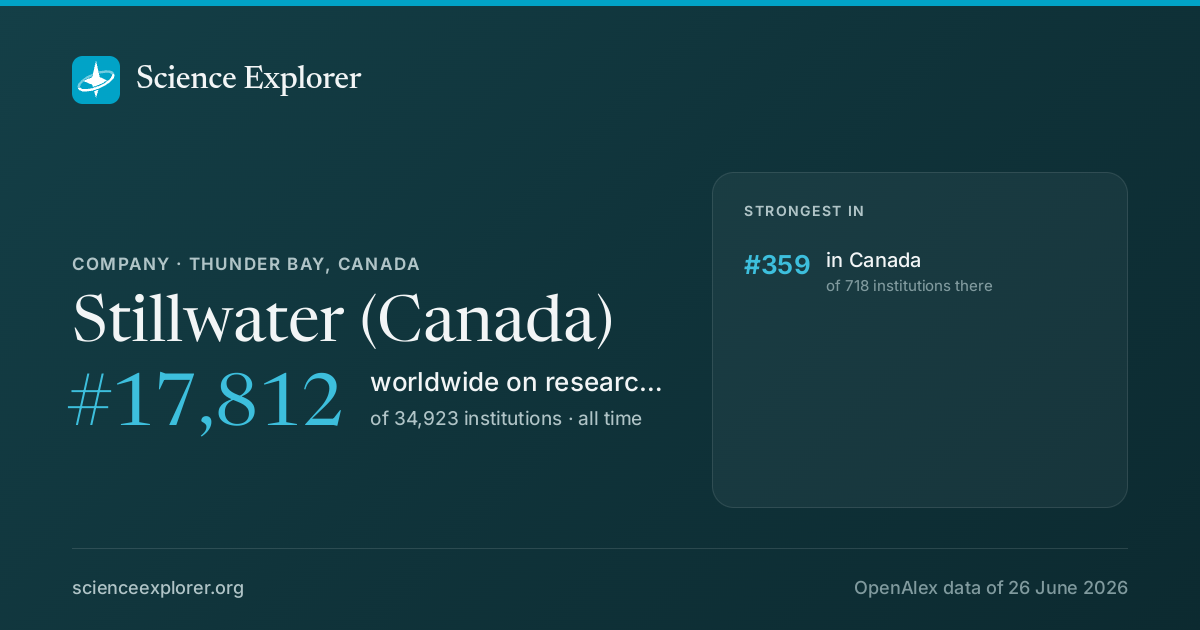
Company · Thunder Bay · Canada

Stillwater (Canada)

World rank, all time
#17,812
of 34,923
Rank in Canada
#359
of 718
Research works
136
▲ 8% vs 2018-21
Citations
1.6k
12.1 per fractional work
Top-10% rate
9.7%
all institutions 10.0%
vs its own fields
0.97×
1.00× is exactly expected
Open access
28%
world 40%
International
61%
world 18%

Which fields of science does Stillwater (Canada) work in?

In 2022-now, 67% of research at Stillwater (Canada) is in Physical Sciences, 14% in Social Sciences. Its largest fields are Earth and Planetary Sciences (21%), Engineering (20%), Environmental Science (15%). It does 1.5× the world's share of Physical Sciences.

Physical Sciences: 15 fractional works · 67.5% of its workEarth and Planetary Sciences: 4 fractional works · 20.5% of its workGeophysics: 2 fractional works · 10.9% of its workOceanography: 1 fractional works · 4.6% of its workGeology: 0 fractional works · 1.9% of its workAtmospheric Science: 0 fractional works · 1.5% of its workEarth-Surface Processes: 0 fractional works · 0.8% of its workGeochemistry and Petrology: 0 fractional works · 0.8% of its workEngineering: 4 fractional works · 19.8% of its workMechanics of Materials: 1 fractional works · 5.5% of its workOcean Engineering: 1 fractional works · 4.6% of its workMechanical Engineering: 0 fractional works · 2.3% of its workControl and Systems Engineering: 0 fractional works · 1.8% of its workAerospace Engineering: 0 fractional works · 1.5% of its workBuilding and Construction: 0 fractional works · 1.3% of its workComputational Mechanics: 0 fractional works · 0.8% of its workSafety, Risk, Reliability and Quality: 0 fractional works · 0.8% of its workIndustrial and Manufacturing Engineering: 0 fractional works · 0.7% of its workBiomedical Engineering: 0 fractional works · 0.5% of its workEnvironmental Science: 3 fractional works · 15.5% of its workWater Science and Technology: 1 fractional works · 6.6% of its workEcology: 1 fractional works · 3.3% of its workGlobal and Planetary Change: 0 fractional works · 2.0% of its workNature and Landscape Conservation: 0 fractional works · 1.7% of its workEnvironmental Chemistry: 0 fractional works · 0.8% of its workManagement, Monitoring, Policy and Law: 0 fractional works · 0.8% of its workEnvironmental Engineering: 0 fractional works · 0.3% of its workComputer Science: 2 fractional works · 8.0% of its workArtificial Intelligence: 1 fractional works · 3.8% of its workComputer Vision and Pattern Recognition: 0 fractional works · 1.8% of its workComputer Graphics and Computer-Aided Design: 0 fractional works · 1.1% of its workInformation Systems: 0 fractional works · 0.8% of its workComputational Theory and Mathematics: 0 fractional works · 0.4% of its workSmaller subfields together: 0 fractional works · 0.0% of its workPhysics and Astronomy: 1 fractional works · 2.9% of its workStatistical and Nonlinear Physics: 0 fractional works · 1.5% of its workAtomic and Molecular Physics, and Optics: 0 fractional works · 1.2% of its workSmaller subfields together: 0 fractional works · 0.2% of its workMaterials Science: 0 fractional works · 0.8% of its workBiomaterials: 0 fractional works · 0.5% of its workMaterials Chemistry: 0 fractional works · 0.3% of its workSocial Sciences: 3 fractional works · 13.8% of its workSocial Sciences: 1 fractional works · 6.4% of its workEducation: 1 fractional works · 2.8% of its workSociology and Political Science: 0 fractional works · 1.3% of its workArcheology: 0 fractional works · 0.8% of its workCommunication: 0 fractional works · 0.5% of its workPolitical Science and International Relations: 0 fractional works · 0.5% of its workTransportation: 0 fractional works · 0.5% of its workBusiness, Management and Accounting: 1 fractional works · 4.1% of its workOrganizational Behavior and Human Resource Management: 0 fractional works · 2.0% of its workManagement of Technology and Innovation: 0 fractional works · 1.5% of its workMarketing: 0 fractional works · 0.5% of its workSmaller subfields together: 0 fractional works · 0.0% of its workDecision Sciences: 0 fractional works · 1.5% of its workManagement Science and Operations Research: 0 fractional works · 1.5% of its workPsychology: 0 fractional works · 1.3% of its workSocial Psychology: 0 fractional works · 1.2% of its workSmaller subfields together: 0 fractional works · 0.1% of its workArts and Humanities: 0 fractional works · 0.5% of its workLiterature and Literary Theory: 0 fractional works · 0.5% of its workHealth Sciences: 2 fractional works · 11.0% of its workMedicine: 2 fractional works · 9.5% of its workSurgery: 0 fractional works · 2.1% of its workEpidemiology: 0 fractional works · 1.8% of its workCritical Care and Intensive Care Medicine: 0 fractional works · 1.0% of its workEmergency Medicine: 0 fractional works · 1.0% of its workOncology: 0 fractional works · 1.0% of its workCardiology and Cardiovascular Medicine: 0 fractional works · 0.7% of its workAnesthesiology and Pain Medicine: 0 fractional works · 0.4% of its workRehabilitation: 0 fractional works · 0.3% of its workComplementary and alternative medicine: 0 fractional works · 0.3% of its workGastroenterology: 0 fractional works · 0.3% of its workNeurology: 0 fractional works · 0.2% of its workSmaller subfields together: 0 fractional works · 0.4% of its workHealth Professions: 0 fractional works · 1.2% of its workGeneral Health Professions: 0 fractional works · 1.2% of its workVeterinary: 0 fractional works · 0.2% of its workSmall Animals: 0 fractional works · 0.2% of its workLife Sciences: 2 fractional works · 7.8% of its workNeuroscience: 1 fractional works · 4.9% of its workCognitive Neuroscience: 1 fractional works · 4.9% of its workAgricultural and Biological Sciences: 0 fractional works · 1.1% of its workEcology, Evolution, Behavior and Systematics: 0 fractional works · 0.5% of its workSmaller subfields together: 0 fractional works · 0.6% of its workBiochemistry, Genetics and Molecular Biology: 0 fractional works · 1.0% of its workMolecular Biology: 0 fractional works · 0.6% of its workGenetics: 0 fractional works · 0.5% of its workPharmacology, Toxicology and Pharmaceutics: 0 fractional works · 0.8% of its workPharmacology: 0 fractional works · 0.8% of its workImmunology and Microbiology: 0 fractional works · 0.0% of its workALL ITS WORKStillwater(Canada)22fractional works, 2022-now
Life Sciences8%Physical Sciences67%Health Sciences11%Social Sciences14%

Each ring splits the one inside it: the four domains of science, their fields, their subfields. Size is fractional works in 2022-now. Every slice is a page; the interactive view zooms down to single topics and colours each by how much more of it this institution does than the world.

Its 4 domains and 19 fields, with their numbers
    1. Earth and Planetary Sciences420.5%
    2. Engineering419.8%
    3. Environmental Science315.5%
    4. Computer Science28.0%
    5. Physics and Astronomy12.9%
    6. Materials Science00.8%
    1. Social Sciences16.4%
    2. Business, Management and Accounting14.1%
    3. Decision Sciences01.5%
    4. Psychology01.3%
    5. Arts and Humanities00.5%
    1. Medicine29.5%
    2. Health Professions01.2%
    3. Veterinary00.2%
    1. Neuroscience14.9%
    2. Agricultural and Biological Sciences01.1%
    3. Biochemistry, Genetics and Molecular Biology01.0%
    4. Pharmacology, Toxicology and Pharmaceutics00.8%
    5. Immunology and Microbiology00.0%
All of science, and how each field's share has moved since 1950: the Science domain explorer

Field profile

Location quotient across every field it publishes in: outside the ring is more than an institution of this size would be expected to publish, inside it is less.

Agricultural and Biological Sciences: 0.22× its world share, 0 worksAgricultural and Bio…Biochemistry, Genetics and Molecular Biology: 0.19× its world share, 0 worksBiochemistry, Geneti…Immunology and Microbiology: 0.04× its world share, 0 worksImmunology and Micro…Neuroscience: 2.99× its world share, 1 worksNeurosciencePharmacology, Toxicology and Pharmaceutics: 2.19× its world share, 0 worksPharmacology, Toxico…Computer Science: 1.02× its world share, 2 worksComputer ScienceEarth and Planetary Sciences: 13.11× its world share, 4 worksEarth and Planetary …Engineering: 1.32× its world share, 4 worksEngineeringEnvironmental Science: 3.12× its world share, 3 worksEnvironmental ScienceMaterials Science: 0.24× its world share, 0 worksMaterials SciencePhysics and Astronomy: 1.31× its world share, 1 worksPhysics and AstronomyHealth Professions: 0.46× its world share, 0 worksHealth ProfessionsMedicine: 0.50× its world share, 2 worksMedicineVeterinary: 1.62× its world share, 0 worksVeterinaryArts and Humanities: 0.16× its world share, 0 worksArts and HumanitiesBusiness, Management and Accounting: 1.28× its world share, 1 worksBusiness, Management…Decision Sciences: 1.60× its world share, 0 worksDecision SciencesPsychology: 0.43× its world share, 0 worksPsychologySocial Sciences: 0.50× its world share, 1 worksSocial Sciences1×world share
more than its size predictsabout as predictedless

Rings at 0.5×, 1× and 2×. Widest outward: Earth and Planetary Sciences, 13.1×. Every wedge is a field page.

All 19 fields, with their numbers
  1. Earth and Planetary Sciences13.11×4 works
  2. Environmental Science3.12×3 works
  3. Neuroscience2.99×1 works
  4. Pharmacology, Toxicology and Pharmaceutics2.19×0 works
  5. Veterinary1.62×0 works
  6. Decision Sciences1.60×0 works
  7. Engineering1.32×4 works
  8. Physics and Astronomy1.31×1 works
  9. Business, Management and Accounting1.28×1 works
  10. Computer Science1.02×2 works
  11. Medicine0.50×2 works
  12. Social Sciences0.50×1 works
  13. Health Professions0.46×0 works
  14. Psychology0.43×0 works
  15. Materials Science0.24×0 works
  16. Agricultural and Biological Sciences0.22×0 works
  17. Biochemistry, Genetics and Molecular Biology0.19×0 works
  18. Arts and Humanities0.16×0 works
  19. Immunology and Microbiology0.04×0 works

What are the most cited papers from Stillwater (Canada)?

The most cited paper from Stillwater (Canada) is "The Bagby and Kuslich Method of Lumbar Interbody Fusion" (Stephen D. Kuslich, Cynthia L. Ulstrom, Steven L. Griffith et al., 1998), with 508 citations. Next come "Responses of Contact Lens Wearers to a Dry Eye Survey" (249) and "Productivity of clear and humic lakes: nutrients, phytoplankton, bacteria" (195).

Most cited papers
#PaperReleasedCitations
1 The Bagby and Kuslich Method of Lumbar Interbody Fusion Stephen D. Kuslich, Cynthia L. Ulstrom, Steven L. Griffith et al. · Spine Jun 1998 508
2 Responses of Contact Lens Wearers to a Dry Eye Survey Carolyn G. Begley, Barbara E. Caffery, Kelly Kinney Nichols et al. · Optometry and Vision Science 2000 249
3 Productivity of clear and humic lakes: nutrients, phytoplankton, bacteria Gertrud K. Nürnberg, Margo A. Shaw · Hydrobiologia Sep 1998 195
4 Crystal field, phonon coupling and emission shift of Mn2+ in ZnS:Mn nanoparticles Wei Chen, Ramaswami Sammynaiken, Yining Huang et al. · Journal of Applied Physics 15 Jan 2001 193
5 Photocatalyst size controls electron and energy transfer: selectable E/Z isomer synthesis via C–F alkenylation Anuradha Singh, Christopher J. Fennell, Jimmie D. Weaver · Chemical Science Open access 2016 172
All 61 most cited papers, with filters and sorting

Which keywords describe research at Stillwater (Canada)?

By fractional works in 2022-now, weighted toward what it does more of than the world: Climate Change, Remote Sensing, Computer Vision, Machine Learning, Plate Tectonics, Rock Mechanics, Acoustic Techniques and Seafloor Mapping.

▲ more of its work than of the world's◆ about the world's share▼ less than the world's

Size is fractional works in 2022-now in the topics tagged with each word; colour is the word's share of this institution's work against its share of the world's. The 9 words are chosen for being large and distinctive. Each links to the topic it comes from most.

All 9 words, with their numbers
  1. Climate Change3▲ 4.8×16 topics
  2. Machine Learning2▲ 2.6×5 topics
  3. Remote Sensing2▲ 6.9×5 topics
  4. Computer Vision1▲ 20×2 topics
  5. Plate Tectonics1▲ 33×3 topics
  6. Sustainability1▲ 2.0×4 topics
  7. Acoustic Techniques1▲ 148×1 topic
  8. Rock Mechanics1▲ 48×3 topics
  9. Seafloor Mapping1▲ 148×1 topic

Which research topics does Stillwater (Canada) publish most on?

By volume in 2022-now: Underwater Acoustics Research, Water Quality Monitoring Technologies, earthquake and tectonic studies and Geological and Geochemical Analysis.

  1. 1 Underwater Acoustics Research Oceanography 1 works
  2. 2 Water Quality Monitoring Technologies Water Science and Technology 1 works
  3. 3 earthquake and tectonic studies Geophysics 1 works
  4. 4 Geological and Geochemical Analysis Geophysics 1 works
  5. 5 Seismic Imaging and Inversion Techniques Geophysics 0 works
  6. 6 Rock Mechanics and Modeling Mechanics of Materials 0 works
  7. 7 Water-Energy-Food Nexus Studies Water Science and Technology 0 works
  8. 8 Geotechnical and Geomechanical Engineering Mechanics of Materials 0 works
  9. 9 Underwater Vehicles and Communication Systems Ocean Engineering 0 works
  10. 10 Geological and Geophysical Studies Geology 0 works

How open and international is its research?

Against the world's own shares: the tick on each track. Both are shares of its output, so they sit on one scale and can be read against each other as well as against the world.

openly available27.8%not open72.2%

World: 40% of research is openly available.

with international co-authors61.1%domestic only38.9%

World: 18% is written across borders.

How has Stillwater (Canada)'s research output changed?

Output in 2022-2025 was 8% higher than in 2018-2021.

still counting1990200020102020
grewheldshrank

The same series as a ribbon: one cell per year, darker for more. The line above answers how much; this answers when.

Its share of all research

Growing output can still be a shrinking share: all of science grows. This is Stillwater (Canada) as a percentage of every work published that year, 0.00012% in 2024.

still counting0.00050%0.0010%0.0015%Stillwater (Canada)0.000082% in 202519801990200020102020

Fractional works of Stillwater (Canada) over all fractional works that year. How the balance of science has shifted.

Other research institutions in Thunder Bay

All research institutions in Thunder Bay

Share Stillwater (Canada)'s ranking

Stillwater (Canada) on Science Explorer

A card with Stillwater (Canada)'s standing and the fields it leads in, for a post or a slide. A link to this page previews as the same card.

Download the card

1200 × 630 PNG, sized for social posts, drawn from the latest snapshot.

Badges for a website1Each links back here and updates with every snapshot

Research measures only: rankings here say nothing about teaching, admissions or student experience. Comparable institutions and collaboration partners have tabs of their own, above.

Discussion

Ask a question or share a note about Stillwater (Canada). Posts are plain text and can be reported.