Science Explorer Back to mapMap
Government institution · Cardiff · United Kingdom

Welsh Government

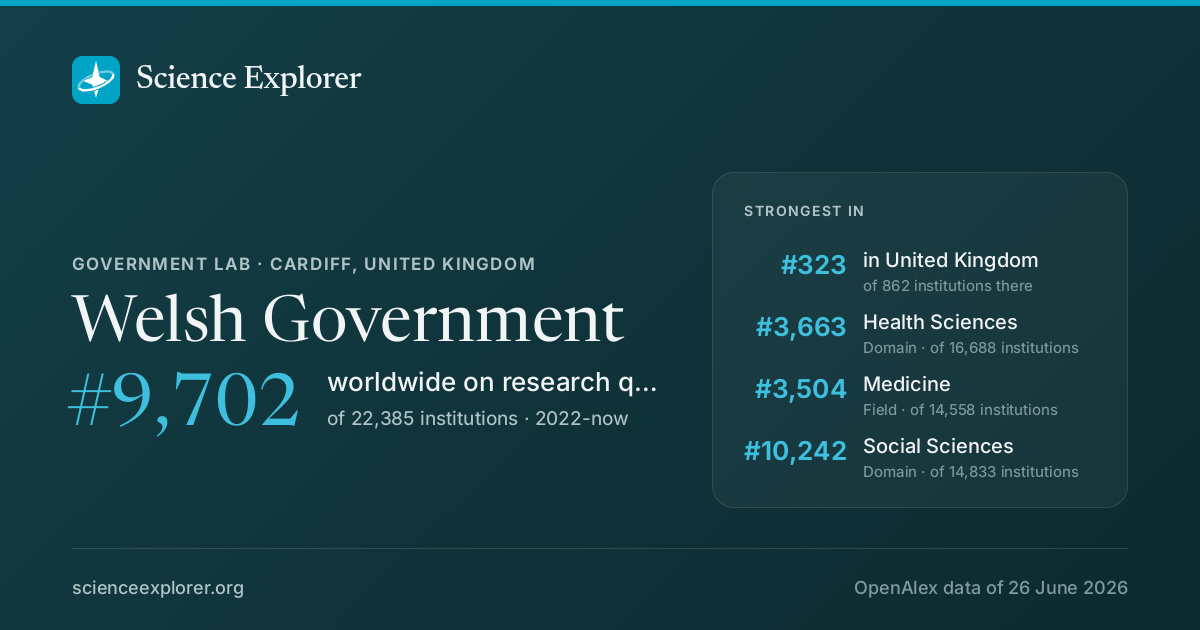
In research, Welsh Government stands highest in Health Sciences (#3,663 of 16,688 worldwide), Medicine (#3,504 of 14,558 worldwide) and Social Sciences (#10,242 of 14,833 worldwide), over all time.

World rank, 2022-now
#9,702
of 22,385 · #10,451 all time
Rank in United Kingdom
#323
of 862
Research works
1.6k
▲ 44% vs 2018-21
Citations
34k
20.9 per fractional work
Top-10% rate
11.1%
all institutions 10.0%
vs its own fields
1.06×
1.00× is exactly expected
Open access
28%
world 40%
International
9%
world 18%

What is Welsh Government known for in research?

The fields where it stands highest, over all time, ranked among every institution above the floor in each field.

FieldWorld rankWhere that sitsTop-10% rateWorks
Health SciencesDomain #3,663 of 16,688 10.4%795
MedicineField #3,504 of 14,558 9.9%635
Social SciencesDomain #10,242 of 14,833 9.1%238
Biochemistry, Genetics and Molecular BiologyField #4,200 of 5,801 6.5%165
Life SciencesDomain #9,312 of 11,023 6.4%367
Physical SciencesDomain #14,784 of 17,446 8.2%209

Each strip is that field's whole ranked pool, with the notch where Welsh Government sits in it, in the colour of the band that rank falls in. The track under the rate is the rate itself: it carries no average mark, because the average differs by field (from about 6% in Dentistry to 21% in Economics).

Which fields of science does Welsh Government work in?

In 2022-now, 39% of research at Welsh Government is in Health Sciences, 34% in Social Sciences. Its largest fields are Medicine (20%), Social Sciences (19%), Health Professions (17%). It does 1.6× the world's share of Health Sciences.

Health Sciences: 42 fractional works · 39.0% of its workMedicine: 22 fractional works · 20.2% of its workPublic Health, Environmental and Occupational Health: 4 fractional works · 3.3% of its workInfectious Diseases: 3 fractional works · 2.4% of its workEpidemiology: 2 fractional works · 2.2% of its workOncology: 2 fractional works · 1.6% of its workPhysiology: 1 fractional works · 1.2% of its workPulmonary and Respiratory Medicine: 1 fractional works · 1.0% of its workBiochemistry: 1 fractional works · 0.8% of its workSurgery: 1 fractional works · 0.7% of its workGeriatrics and Gerontology: 1 fractional works · 0.7% of its workPediatrics, Perinatology and Child Health: 1 fractional works · 0.7% of its workOrthopedics and Sports Medicine: 1 fractional works · 0.6% of its workCardiology and Cardiovascular Medicine: 1 fractional works · 0.6% of its workCritical Care and Intensive Care Medicine: 1 fractional works · 0.6% of its workRadiology, Nuclear Medicine and Imaging: 1 fractional works · 0.5% of its workNeurology: 1 fractional works · 0.5% of its workEmergency Medicine: 0 fractional works · 0.4% of its workGastroenterology: 0 fractional works · 0.3% of its workOtorhinolaryngology: 0 fractional works · 0.3% of its workUrology: 0 fractional works · 0.3% of its workEndocrinology, Diabetes and Metabolism: 0 fractional works · 0.2% of its workSmaller subfields together: 1 fractional works · 1.0% of its workHealth Professions: 18 fractional works · 16.9% of its workGeneral Health Professions: 14 fractional works · 12.6% of its workSpeech and Hearing: 3 fractional works · 2.6% of its workEmergency Medical Services: 1 fractional works · 1.1% of its workOccupational Therapy: 0 fractional works · 0.3% of its workHealth Information Management: 0 fractional works · 0.2% of its workNursing: 1 fractional works · 1.2% of its workResearch and Theory: 1 fractional works · 0.7% of its workNutrition and Dietetics: 0 fractional works · 0.3% of its workSmaller subfields together: 0 fractional works · 0.2% of its workDentistry: 1 fractional works · 0.5% of its workGeneral Dentistry: 0 fractional works · 0.3% of its workSmaller subfields together: 0 fractional works · 0.3% of its workVeterinary: 0 fractional works · 0.1% of its workSocial Sciences: 37 fractional works · 34.4% of its workSocial Sciences: 20 fractional works · 18.9% of its workSociology and Political Science: 6 fractional works · 5.4% of its workEducation: 4 fractional works · 3.8% of its workHealth: 4 fractional works · 3.6% of its workUrban Studies: 2 fractional works · 2.0% of its workPolitical Science and International Relations: 1 fractional works · 0.8% of its workGender Studies: 1 fractional works · 0.8% of its workLinguistics and Language: 1 fractional works · 0.7% of its workSafety Research: 1 fractional works · 0.6% of its workDemography: 0 fractional works · 0.5% of its workDevelopment: 0 fractional works · 0.3% of its workSmaller subfields together: 1 fractional works · 0.5% of its workArts and Humanities: 6 fractional works · 5.2% of its workHistory: 2 fractional works · 1.7% of its workMusic: 1 fractional works · 0.9% of its workArcheology: 1 fractional works · 0.7% of its workLanguage and Linguistics: 1 fractional works · 0.6% of its workLiterature and Literary Theory: 1 fractional works · 0.6% of its workPhilosophy: 0 fractional works · 0.3% of its workConservation: 0 fractional works · 0.3% of its workPsychology: 5 fractional works · 4.7% of its workClinical Psychology: 3 fractional works · 2.8% of its workSocial Psychology: 1 fractional works · 1.1% of its workDevelopmental and Educational Psychology: 1 fractional works · 0.6% of its workSmaller subfields together: 0 fractional works · 0.2% of its workDecision Sciences: 2 fractional works · 2.1% of its workManagement Science and Operations Research: 1 fractional works · 1.1% of its workInformation Systems and Management: 1 fractional works · 0.9% of its workSmaller subfields together: 0 fractional works · 0.1% of its workBusiness, Management and Accounting: 2 fractional works · 1.8% of its workOrganizational Behavior and Human Resource Management: 1 fractional works · 0.7% of its workManagement of Technology and Innovation: 1 fractional works · 0.6% of its workAccounting: 0 fractional works · 0.3% of its workSmaller subfields together: 0 fractional works · 0.3% of its workEconomics, Econometrics and Finance: 2 fractional works · 1.7% of its workEconomics and Econometrics: 1 fractional works · 1.2% of its workFinance: 1 fractional works · 0.5% of its workPhysical Sciences: 18 fractional works · 16.5% of its workEnvironmental Science: 8 fractional works · 7.4% of its workEnvironmental Engineering: 2 fractional works · 1.9% of its workHealth, Toxicology and Mutagenesis: 2 fractional works · 1.5% of its workManagement, Monitoring, Policy and Law: 1 fractional works · 1.3% of its workGlobal and Planetary Change: 1 fractional works · 1.1% of its workPollution: 1 fractional works · 0.7% of its workEnvironmental Chemistry: 1 fractional works · 0.5% of its workWater Science and Technology: 0 fractional works · 0.3% of its workEcology: 0 fractional works · 0.2% of its workEngineering: 7 fractional works · 6.2% of its workBuilding and Construction: 2 fractional works · 1.9% of its workElectrical and Electronic Engineering: 1 fractional works · 1.0% of its workArchitecture: 1 fractional works · 1.0% of its workBiomedical Engineering: 1 fractional works · 0.8% of its workAerospace Engineering: 0 fractional works · 0.5% of its workOcean Engineering: 0 fractional works · 0.3% of its workAutomotive Engineering: 0 fractional works · 0.3% of its workSmaller subfields together: 0 fractional works · 0.4% of its workComputer Science: 1 fractional works · 1.1% of its workComputer Networks and Communications: 0 fractional works · 0.5% of its workSmaller subfields together: 1 fractional works · 0.7% of its workEarth and Planetary Sciences: 1 fractional works · 1.0% of its workGeology: 1 fractional works · 0.5% of its workAtmospheric Science: 0 fractional works · 0.2% of its workOceanography: 0 fractional works · 0.2% of its workMathematics: 0 fractional works · 0.4% of its workModeling and Simulation: 0 fractional works · 0.3% of its workSmaller subfields together: 0 fractional works · 0.1% of its workPhysics and Astronomy: 0 fractional works · 0.2% of its workAstronomy and Astrophysics: 0 fractional works · 0.2% of its workEnergy: 0 fractional works · 0.1% of its workLife Sciences: 11 fractional works · 10.2% of its workAgricultural and Biological Sciences: 5 fractional works · 4.6% of its workGeneral Agricultural and Biological Sciences: 3 fractional works · 2.6% of its workEcology, Evolution, Behavior and Systematics: 1 fractional works · 0.8% of its workPlant Science: 1 fractional works · 0.7% of its workInsect Science: 0 fractional works · 0.3% of its workSmaller subfields together: 0 fractional works · 0.2% of its workBiochemistry, Genetics and Molecular Biology: 3 fractional works · 3.1% of its workGenetics: 1 fractional works · 1.1% of its workMolecular Biology: 1 fractional works · 0.8% of its workCell Biology: 1 fractional works · 0.7% of its workMolecular Medicine: 0 fractional works · 0.3% of its workSmaller subfields together: 0 fractional works · 0.3% of its workImmunology and Microbiology: 2 fractional works · 1.6% of its workApplied Microbiology and Biotechnology: 1 fractional works · 1.2% of its workImmunology: 0 fractional works · 0.3% of its workSmaller subfields together: 0 fractional works · 0.1% of its workPharmacology, Toxicology and Pharmaceutics: 1 fractional works · 0.5% of its workToxicology: 0 fractional works · 0.3% of its workSmaller subfields together: 0 fractional works · 0.2% of its workNeuroscience: 0 fractional works · 0.4% of its workCognitive Neuroscience: 0 fractional works · 0.3% of its workSmaller subfields together: 0 fractional works · 0.0% of its workALL ITS WORKWelsh Government108fractional works, 2022-now
Life Sciences10%Physical Sciences16%Health Sciences39%Social Sciences34%

Each ring splits the one inside it: the four domains of science, their fields, their subfields. Size is fractional works in 2022-now. Every slice is a page; the interactive view zooms down to single topics and colours each by how much more of it this institution does than the world.

Its 4 domains and 23 fields, with their numbers
    1. Medicine2220.2%
    2. Health Professions1816.9%
    3. Nursing11.2%
    4. Dentistry10.5%
    5. Veterinary00.1%
    1. Social Sciences2018.9%
    2. Arts and Humanities65.2%
    3. Psychology54.7%
    4. Decision Sciences22.1%
    5. Business, Management and Accounting21.8%
    6. Economics, Econometrics and Finance21.7%
    1. Environmental Science87.4%
    2. Engineering76.2%
    3. Computer Science11.1%
    4. Earth and Planetary Sciences11.0%
    5. Mathematics00.4%
    6. Physics and Astronomy00.2%
    7. Energy00.1%
    1. Agricultural and Biological Sciences54.6%
    2. Biochemistry, Genetics and Molecular Biology33.1%
    3. Immunology and Microbiology21.6%
    4. Pharmacology, Toxicology and Pharmaceutics10.5%
    5. Neuroscience00.4%
All of science, and how each field's share has moved since 1950: the Science domain explorer

Field profile

Location quotient across every field it publishes in: outside the ring is more than an institution of this size would be expected to publish, inside it is less.

Agricultural and Biological Sciences: 0.97× its world share, 5 worksAgricultural and Bio…Biochemistry, Genetics and Molecular Biology: 0.58× its world share, 3 worksBiochemistry, Geneti…Immunology and Microbiology: 1.59× its world share, 2 worksImmunology and Micro…Neuroscience: 0.22× its world share, 0 worksNeurosciencePharmacology, Toxicology and Pharmaceutics: 1.39× its world share, 0 worksPharmacology, Toxico…Computer Science: 0.15× its world share, 1 worksComputer ScienceEarth and Planetary Sciences: 0.65× its world share, 1 worksEarth and Planetary …Energy: 0.12× its world share, 0 worksEnergyEngineering: 0.41× its world share, 7 worksEngineeringEnvironmental Science: 1.50× its world share, 8 worksEnvironmental ScienceMathematics: 0.30× its world share, 0 worksMathematicsPhysics and Astronomy: 0.10× its world share, 0 worksPhysics and AstronomyDentistry: 1.13× its world share, 1 worksDentistryHealth Professions: 6.41× its world share, 18 worksHealth ProfessionsMedicine: 1.05× its world share, 22 worksMedicineNursing: 2.41× its world share, 1 worksNursingVeterinary: 0.91× its world share, 0 worksVeterinaryArts and Humanities: 1.79× its world share, 6 worksArts and HumanitiesBusiness, Management and Accounting: 0.57× its world share, 2 worksBusiness, Management…Decision Sciences: 2.17× its world share, 2 worksDecision SciencesEconomics, Econometrics and Finance: 0.80× its world share, 2 worksEconomics, Econometr…Psychology: 1.53× its world share, 5 worksPsychologySocial Sciences: 1.49× its world share, 20 worksSocial Sciences1×world share
more than its size predictsabout as predictedless

Rings at 0.5×, 1× and 2×. Widest outward: Health Professions, 6.4×. Every wedge is a field page.

All 23 fields, with their numbers
  1. Health Professions6.41×18 works
  2. Nursing2.41×1 works
  3. Decision Sciences2.17×2 works
  4. Arts and Humanities1.79×6 works
  5. Immunology and Microbiology1.59×2 works
  6. Psychology1.53×5 works
  7. Environmental Science1.50×8 works
  8. Social Sciences1.49×20 works
  9. Pharmacology, Toxicology and Pharmaceutics1.39×0 works
  10. Dentistry1.13×1 works
  11. Medicine1.05×22 works
  12. Agricultural and Biological Sciences0.97×5 works
  13. Veterinary0.91×0 works
  14. Economics, Econometrics and Finance0.80×2 works
  15. Earth and Planetary Sciences0.65×1 works
  16. Biochemistry, Genetics and Molecular Biology0.58×3 works
  17. Business, Management and Accounting0.57×2 works
  18. Engineering0.41×7 works
  19. Mathematics0.30×0 works
  20. Neuroscience0.22×0 works
  21. Computer Science0.15×1 works
  22. Energy0.12×0 works
  23. Physics and Astronomy0.10×0 works

Who are the top researchers at Welsh Government?

Ranked on the quality score, John A. Steward, H. Campbell and John P. Gonzalez lead among researchers whose main affiliation is Welsh Government.

  1. 1 John A. Steward United Kingdom · #1,243,452 worldwide 3.6k citations · 33 works
  2. 2 H. Campbell United Kingdom · #2,366,210 worldwide 2.4k citations · 87 works
  3. 3 John P. Gonzalez United Kingdom · #2,539,695 worldwide 1.2k citations · 29 works
  4. 4 Roger Pride United Kingdom · #2,654,983 worldwide 1.3k citations · 22 works
  5. 5 Jethro Gough United Kingdom · #2,841,620 worldwide 2k citations · 70 works
  6. 6 I.W. Kellaway United Kingdom · #2,978,470 worldwide 4.5k citations · 176 works
  7. 7 C. S. King United Kingdom · #3,521,862 worldwide 302 citations · 15 works
  8. 8 S G Woolfrey United Kingdom · #3,530,482 worldwide 587 citations · 18 works
  9. 9 Andrew Evans United Kingdom · #3,808,489 worldwide 461 citations · 38 works
  10. 10 Peter C. Howard United Kingdom · #4,143,093 worldwide 1.1k citations · 32 works
All ranked researchers at Welsh Government

What are the most cited papers from Welsh Government?

The most cited paper from Welsh Government is "Genome-wide association study of 14,000 cases of seven common diseases and 3,000 shared controls" (Paul R. Burton et al., 2007), with 9,692 citations. Next come "Comparison of overweight and obesity prevalence in school‐aged youth from 34 countries and their relationships with physical activity and dietary patterns" (1,177) and "Cancer survival in Australia, Canada, Denmark, Norway, Sweden, and the UK, 1995–2007 (the International Cancer Benchmarking Partnership): an analysis of population-based cancer registry data" (1,131).

Most cited papers
#PaperReleasedCitations
1 Genome-wide association study of 14,000 cases of seven common diseases and 3,000 shared controls Paul R. Burton et al. · Nature Open access276 authors 6 Jun 2007 9,692
2 Comparison of overweight and obesity prevalence in school‐aged youth from 34 countries and their relationships with physical activity and dietary patterns Ian Janssen, Peter Todd Katzmarzyk, William F. Boyce et al. · Obesity Reviews 18 Apr 2005 1,177
3 Cancer survival in Australia, Canada, Denmark, Norway, Sweden, and the UK, 1995–2007 (the International Cancer Benchmarking Partnership): an analysis of population-based cancer registry data Michel P. Coleman et al. · The Lancet Open access 22 Dec 2010 1,131
4 The role of fluorine in medicinal chemistry Poonam Shah, Andrew D. Westwell · Journal of Enzyme Inhibition and Medicinal Chemistry Open access 2007 802
5 SARS-CoV-2 infection rates of antibody-positive compared with antibody-negative health-care workers in England: a large, multicentre, prospective cohort study (SIREN) Victoria Jane Hall et al. · The Lancet Open access331 authors Apr 2021 742
All 59 most cited papers, with filters and sorting

Which keywords describe research at Welsh Government?

By fractional works in 2022-now, weighted toward what it does more of than the world: Public Health, Social Support, Primary Care, Health Equity, Health Disparities, Epidemiology, Neighborhood Effects and Mortality Risk.

▲ more of its work than of the world's◆ about the world's share▼ less than the world's

Size is fractional works in 2022-now in the topics tagged with each word; colour is the word's share of this institution's work against its share of the world's. The 40 words are chosen for being large and distinctive. Each links to the topic it comes from most.

All 40 words, with their numbers
  1. Public Health14▲ 9.2×21 topics
  2. Epidemiology9▲ 2.0×35 topics
  3. Social Support6▲ 10×5 topics
  4. Primary Care6▲ 15×10 topics
  5. Health Equity6▲ 18×5 topics
  6. COVID-194▲ 3.2×13 topics
  7. Health Disparities4▲ 16×4 topics
  8. Mental Health4▲ 2.9×12 topics
  9. Neighborhood Effects4▲ 37×2 topics
  10. Mortality Risk4▲ 14×3 topics
  11. Social Relationships4▲ 36×1 topic
  12. Socioeconomic Inequalities4▲ 50×1 topic
  13. Rural Development3▲ 8.7×4 topics
  14. Health Effects3▲ 4.5×4 topics
  15. Thermal Comfort3▲ 18×2 topics
  16. Environmental Noise2▲ 56×1 topic
  17. Global Health2▲ 15×3 topics
  18. Noise Pollution2▲ 56×1 topic
  19. Physical Activity2▲ 4.7×6 topics
  20. Health Outcomes2▲ 8.2×4 topics
  21. Ecosystem Services2▲ 5.4×4 topics
  22. Health2▲ 5.4×3 topics
  23. Patient Care2▲ 18×2 topics
  24. Systematic Review2▲ 40×2 topics
  25. Urbanization2▲ 5.2×4 topics
  26. Communication2▲ 6.2×2 topics
  27. Healthcare Outcomes2▲ 34×2 topics
  28. Health Care Utilization2▲ 17×2 topics
  29. Professional Practice2▲ 53×2 topics
  30. Quality Improvement2▲ 9.5×4 topics
  31. Collaborative Practice2▲ 43×2 topics
  32. Elderly Care2▲ 11×3 topics
  33. Exercise2▲ 15×2 topics
  34. Homelessness2▲ 44×1 topic
  35. Mental Illness2▲ 25×1 topic
  36. Social Innovation2▲ 12×2 topics
  37. Substance Abuse2▲ 26×2 topics
  38. Urban Poverty2▲ 41×2 topics
  39. Interprofessional Education2▲ 60×1 topic
  40. Teamwork2▲ 60×1 topic

Which research topics does Welsh Government publish most on?

By volume in 2022-now: Health disparities and outcomes, Noise Effects and Management, Homelessness and Social Issues and Interprofessional Education and Collaboration.

  1. 1 Health disparities and outcomes Health 4 works
  2. 2 Noise Effects and Management Speech and Hearing 3 works
  3. 3 Homelessness and Social Issues General Health Professions 2 works
  4. 4 Interprofessional Education and Collaboration General Health Professions 2 works
  5. 5 Rural development and sustainability General Agricultural and Biological Sciences 2 works
  6. 6 Delphi Technique in Research Sociology and Political Science 2 works
  7. 7 Healthcare innovation and challenges Education 2 works
  8. 8 Urban Heat Island Mitigation Environmental Engineering 1 works
  9. 9 Building Energy and Comfort Optimization Building and Construction 1 works
  10. 10 Antibiotic Use and Resistance Applied Microbiology and Biotechnology 1 works

How open and international is its research?

Against the world's own shares: the tick on each track. Both are shares of its output, so they sit on one scale and can be read against each other as well as against the world.

openly available27.8%not open72.2%

World: 40% of research is openly available.

with international co-authors8.9%domestic only91.1%

World: 18% is written across borders.

How has Welsh Government's research output changed?

Output in 2022-2025 was 44% higher than in 2018-2021.

still counting1990200020102020
grewheldshrank

The same series as a ribbon: one cell per year, darker for more. The line above answers how much; this answers when.

Its share of all research

Growing output can still be a shrinking share: all of science grows. This is Welsh Government as a percentage of every work published that year, 0.00042% in 2024.

still counting0.010%0.020%Welsh Government0.00046% in 202519801990200020102020

Fractional works of Welsh Government over all fractional works that year. How the balance of science has shifted.

How much of it reaches the world top 10%

Year by year, against all institutions in the same year.

still counting5%10%15%Welsh Government12.5% in 2025all institutions10.0% in 2025200020102020

Of each year's output, the share that reached the world's 10% most cited for its field and year. Peak 14.2% in 1995.

Other research institutions in Cardiff

All research institutions in Cardiff

Share Welsh Government's ranking

Welsh Government on Science Explorer

A card with Welsh Government's standing and the fields it leads in, for a post or a slide. A link to this page previews as the same card.

Download the card

1200 × 630 PNG, sized for social posts, drawn from the latest snapshot.

Badges for a website1Each links back here and updates with every snapshot

Research measures only: rankings here say nothing about teaching, admissions or student experience. Comparable institutions and collaboration partners have tabs of their own, above.

Discussion

Ask a question or share a note about Welsh Government. Posts are plain text and can be reported.