Aix-Marseille Université
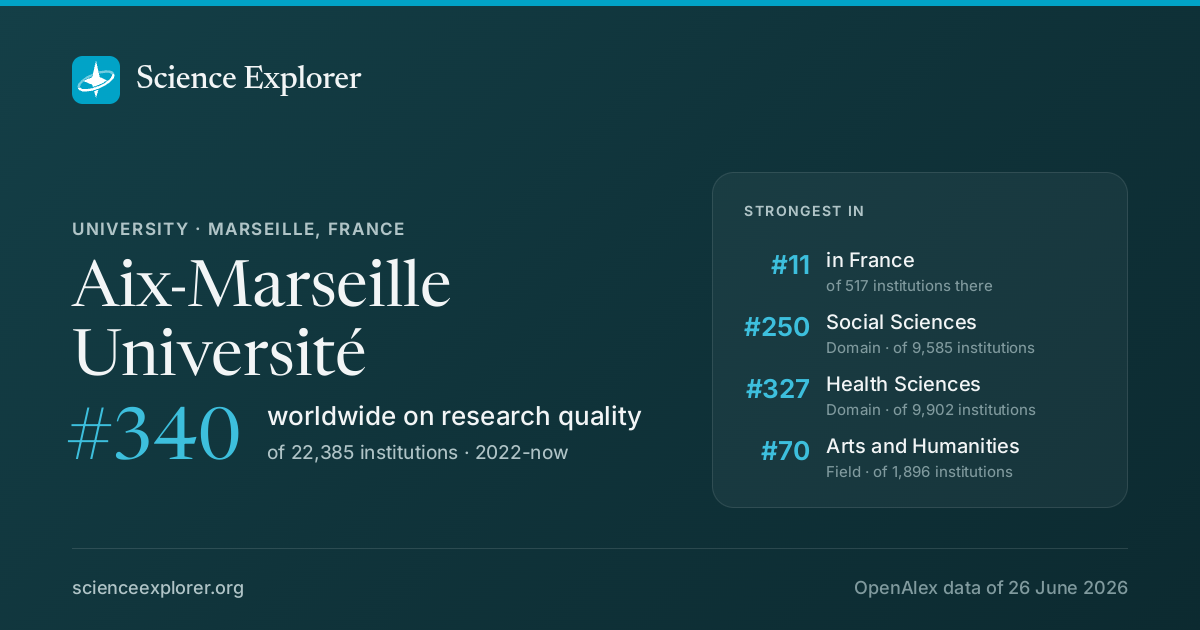
In research, Aix-Marseille Université stands highest in Social Sciences (#250 of 9,585 worldwide), Health Sciences (#327 of 9,902 worldwide) and Arts and Humanities (#70 of 1,896 worldwide), 2022-now. Relative to its size it is most specialised in General Arts and Humanities, Linguistics and Language and History and Philosophy of Science (General Arts and Humanities is 14.9× its share of world research).
- World rank, 2022-now
- #340 of 22,385 · #305 all time
- Rank in France
- #11 of 517
- Research works
- 41k ▼ 29% vs 2018-21
- Citations
- 627k 15.2 per fractional work
- Top-10% rate
- 8.1% all institutions 10.0%
- vs its own fields
- 1.16× 1.00× is exactly expected
- Open access
- 44% world 40%
- International
- 20% world 18%
What is Aix-Marseille Université known for in research?
The fields where it stands highest, 2022-now, ranked among every institution above the floor in each field.
| Field | World rank | Where that sits | Top-10% rate | Works | All time |
|---|---|---|---|---|---|
| Social SciencesDomain | #250 of 9,585 | 6.2% | 2,851 | #240 | |
| Health SciencesDomain | #327 of 9,902 | 11.0% | 1,489 | #226 | |
| Arts and HumanitiesField | #70 of 1,896 | 5.4% | 768 | #126 | |
| MedicineField | #328 of 8,541 | 11.4% | 1,242 | #237 | |
| Life SciencesDomain | #331 of 6,403 | 9.4% | 787 | #196 | |
| Physical SciencesDomain | #625 of 10,670 | 7.5% | 1,723 | #761 | |
| Social SciencesField | #364 of 5,988 | 6.4% | 1,519 | #215 | |
| Sociology and Political ScienceSubfield | #293 of 2,526 | 7.2% | 651 | #229 | |
| EngineeringField | #876 of 5,901 | 7.3% | 442 | #618 | |
| Biochemistry, Genetics and Molecular BiologyField | #442 of 2,964 | 9.5% | 346 | #290 |
Each strip is that field's whole ranked pool, with the notch where Aix-Marseille Université sits in it, in the colour of the band that rank falls in. The track under the rate is the rate itself: it carries no average mark, because the average differs by field (from about 6% in Dentistry to 21% in Economics).
Which of those standings moved
The same fields on both windows: where it stood over the whole record, and where it stands in 2022-now. The distance is the story, and it is the one thing the two rank columns above cannot show.
- Social Sciences#240 #250
- Health Sciences#226 #327
- Arts and Humanities#126 #70
- Medicine#237 #328
- Life Sciences#196 #331
- Physical Sciences#761 #625
- Social Sciences#215 #364
- Sociology and Political Science#229 #293
- Engineering#618 #876
- Biochemistry, Genetics and Molecular Biology#290 #442
A dot further right is a better standing. Fields it was not ranked in over the whole record are left out.
Which fields of science does Aix-Marseille Université work in?
In 2022-now, 40% of research at Aix-Marseille Université is in Social Sciences, 25% in Physical Sciences. Its largest fields are Social Sciences (22%), Medicine (19%), Arts and Humanities (11%). It does 1.6× the world's share of Social Sciences.
Each ring splits the one inside it: the four domains of science, their fields, their subfields. Size is fractional works in 2022-now. Every slice is a page; the interactive view zooms down to single topics and colours each by how much more of it this institution does than the world.
Its 4 domains and 26 fields, with their numbers
- Social Sciences3,04340.4%
- Social Sciences1,62121.5%
- Arts and Humanities81410.8%
- Psychology2673.5%
- Economics, Econometrics and Finance1592.1%
- Business, Management and Accounting1492.0%
- Decision Sciences330.4%
- Physical Sciences1,91925.5%
- Engineering4906.5%
- Computer Science3504.7%
- Physics and Astronomy3014.0%
- Environmental Science2413.2%
- Earth and Planetary Sciences1391.8%
- Materials Science1301.7%
- Mathematics1211.6%
- Chemistry1061.4%
- Energy310.4%
- Chemical Engineering100.1%
- Health Sciences1,67922.3%
- Medicine1,41018.7%
- Health Professions2273.0%
- Dentistry230.3%
- Nursing140.2%
- Veterinary50.1%
- Life Sciences88411.7%
What does Aix-Marseille Université specialise in?
Where its research is concentrated relative to its size: General Arts and Humanities takes 14.9× the share of its output that it takes of world research.
- General Arts and HumanitiesSubfield · 23.3 works15×
- Linguistics and LanguageSubfield · 77.7 works9.0×
- History and Philosophy of ScienceSubfield · 83.3 works7.2×
- AnthropologySubfield · 124.8 works5.9×
- ClassicsSubfield · 26.2 works5.9×
- HistorySubfield · 121.6 works5.0×
- ArcheologySubfield · 113.9 works5.0×
Location quotient, a volume reading rather than an impact one. It surfaces small, lopsided specialities.
Field profile
Location quotient across every field it publishes in: outside the ring is more than an institution of this size would be expected to publish, inside it is less.
Rings at 0.5×, 1× and 2×. Widest outward: Arts and Humanities, 3.8×. Every wedge is a field page.
All 26 fields, with their numbers
- Arts and Humanities3.75×814 works
- Neuroscience1.90×232 works
- Physics and Astronomy1.80×301 works
- Social Sciences1.70×1,621 works
- Mathematics1.37×121 works
- Earth and Planetary Sciences1.18×139 works
- Psychology1.16×267 works
- Immunology and Microbiology1.15×87 works
- Health Professions1.15×227 works
- Economics, Econometrics and Finance0.99×159 works
- Biochemistry, Genetics and Molecular Biology0.98×394 works
- Medicine0.97×1,410 works
- Chemistry0.89×106 works
- Pharmacology, Toxicology and Pharmaceutics0.65×17 works
- Environmental Science0.64×241 works
- Dentistry0.64×23 works
- Business, Management and Accounting0.61×149 works
- Computer Science0.60×350 works
- Veterinary0.50×5 works
- Materials Science0.49×130 works
- Decision Sciences0.46×33 works
- Energy0.45×31 works
- Agricultural and Biological Sciences0.43×153 works
- Engineering0.43×490 works
- Chemical Engineering0.38×10 works
- Nursing0.37×14 works
- Arts and Humanities 3.8×
- Neuroscience 1.9×
- Physics and Astronomy 1.8×
- Social Sciences 1.7×
- Mathematics 1.4×
- Earth and Planetary Sciences 1.2×
- Psychology 1.2×
- Immunology and Microbiology 1.1×
- Health Professions 1.1×
- Economics, Econometrics and Finance 1.0×
- Biochemistry, Genetics and Molecular Biology 1.0×
- Medicine 1.0×
- Chemistry 0.9×
- Pharmacology, Toxicology and Pharmaceutics 0.7×
- Environmental Science 0.6×
- Dentistry 0.6×
- Business, Management and Accounting 0.6×
- Computer Science 0.6×
- Veterinary 0.5×
- Materials Science 0.5×
- Decision Sciences 0.5×
- Energy 0.5×
- Agricultural and Biological Sciences 0.4×
- Engineering 0.4×
- Chemical Engineering 0.4×
- Nursing 0.4×
Who are the top researchers at Aix-Marseille Université?
Ranked on the quality score, P. Rados, S. Fracchia and S. P. Marsden lead among researchers whose main affiliation is Aix-Marseille Université.
- 1
P. Rados
 France · #592 worldwide
45k citations · 526 works
- 2
S. Fracchia
France · #1,008 worldwide
44k citations · 522 works
- 3
S. P. Marsden
France · #1,087 worldwide
44k citations · 550 works
- 4
M. D. Beattie
France · #1,464 worldwide
36k citations · 410 works
- 5
A. Zaman
France · #1,567 worldwide
39k citations · 445 works
- 6
G. Cree
France · #2,365 worldwide
37k citations · 430 works
- 7
Mika Giulini
France · #2,567 worldwide
31k citations · 364 works
- 8
N. R. Bernard
France · #2,841 worldwide
32k citations · 361 works
- 9
А. С. Болдырев
France · #3,411 worldwide
24k citations · 279 works
- 10
P. Rose
France · #3,481 worldwide
29k citations · 340 works
Which keywords describe research at Aix-Marseille Université?
By fractional works in 2022-now, weighted toward what it does more of than the world: Community Engagement, Territorial Governance, Local Development, Social Justice, Public Policy, Citizen Participation, Environmental Participation and Proximity and Innovation.
- North Africa
- Digital Literature
- Documentary Practices
- Pragmatics
- Digital Communication
- Social Determinants of Health
- Sociolinguistics
- Professional Practices
- Educational Policies
- Cultural Studies
- Migration
- Cultural Heritage
- Gender Studies
- Proximity and Innovation
- Citizen Participation
- Gender
- Sustainable Development
- Local Development
- Social Justice
- Globalization
- Epidemiology
- Community Engagement
- Territorial Governance
- Public Policy
- Identity
- Colonialism
- Environmental Participation
- Religion
- History
- Literature
- Nationalism
- Ethnographic Research
- Sociological Analysis
- Public Action
- Democracy
- Social Change
- Open Access
- New Media
- Citizenship
- Information Studies
Size is fractional works in 2022-now in the topics tagged with each word; colour is the word's share of this institution's work against its share of the world's. The 40 words are chosen for being large and distinctive. Each links to the topic it comes from most.
All 40 words, with their numbers
- Epidemiology317◆ 1.06×133 topics
- Globalization281▲ 1.90×126 topics
- Community Engagement255▲ 10×13 topics
- Social Justice253▲ 5.6×33 topics
- Territorial Governance242▲ 28×4 topics
- Local Development240▲ 31×2 topics
- Public Policy229▲ 6.4×22 topics
- Sustainable Development225▲ 1.91×67 topics
- Identity213▲ 3.9×65 topics
- Gender206▲ 5.1×49 topics
- Colonialism192▲ 5.4×45 topics
- Citizen Participation172▲ 20×3 topics
- Environmental Participation170▲ 32×1 topic
- Proximity and Innovation170▲ 32×1 topic
- Religion170▲ 4.9×36 topics
- Gender Studies169▲ 15×12 topics
- History156▲ 3.0×53 topics
- Cultural Heritage144▲ 3.6×34 topics
- Literature132▲ 3.2×51 topics
- Migration129▲ 5.0×26 topics
- Nationalism120▲ 3.5×29 topics
- Cultural Studies120▲ 4.3×32 topics
- Ethnographic Research114▲ 30×3 topics
- Educational Policies113▲ 14×2 topics
- Sociological Analysis112▲ 27×2 topics
- Professional Practices112▲ 41×1 topic
- Public Action112▲ 41×1 topic
- Sociolinguistics106▲ 7.8×8 topics
- Democracy105▲ 4.0×23 topics
- Social Determinants of Health98▲ 6.0×6 topics
- Social Change89▲ 9.6×11 topics
- Digital Communication87▲ 17×4 topics
- Open Access87▲ 11×7 topics
- Pragmatics85▲ 7.2×6 topics
- New Media85▲ 29×2 topics
- Documentary Practices84▲ 44×2 topics
- Citizenship83▲ 9.1×9 topics
- Digital Literature83▲ 57×1 topic
- Information Studies83▲ 57×1 topic
- North Africa80▲ 30×2 topics
Which research topics does Aix-Marseille Université publish most on?
By volume in 2022-now: French Urban and Social Studies, Education, sociology, and vocational training, Cultural Insights and Digital Impacts and Social Sciences and Governance.
Area is fractional works; colour is the subfield each topic belongs to.
- 1 French Urban and Social Studies Sociology and Political Science 170 works
- 2 Education, sociology, and vocational training Sociology and Political Science 112 works
- 3 Cultural Insights and Digital Impacts Computer Networks and Communications 83 works
- 4 Social Sciences and Governance Urban Studies 70 works
- 5 Multiculturalism, Politics, Migration, Gender Political Science and International Relations 67 works
- 6 Linguistics and Discourse Analysis Philosophy 58 works
- 7 Historical Studies and Socio-cultural Analysis History and Philosophy of Science 56 works
- 8 Healthcare Systems and Practices General Health Professions 56 works
- 9 Health, Medicine and Society General Health Professions 54 works
- 10 French Language Learning Methods Linguistics and Language 39 works
How open and international is its research?
Against the world's own shares: the tick on each track. Both are shares of its output, so they sit on one scale and can be read against each other as well as against the world.
World: 40% of research is openly available.
World: 18% is written across borders.
How has Aix-Marseille Université's research output changed?
Output in 2022-2025 was 29% lower than in 2018-2021.
The same series as a ribbon: one cell per year, darker for more. The line above answers how much; this answers when.
Its share of all research
Growing output can still be a shrinking share: all of science grows. This is Aix-Marseille Université as a percentage of every work published that year, 0.033% in 2024.
Fractional works of Aix-Marseille Université over all fractional works that year. How the balance of science has shifted.
How much of it reaches the world top 10%
Year by year, against all institutions in the same year.
Of each year's output, the share that reached the world's 10% most cited for its field and year. Peak 10.2% in 2013.
Other research institutions in Marseille
- Institut de Recherche pour le Développement
- Hôpital Nord
- Hôpital Sainte-Marguerite
- Hôpital Européen
- Hôpital de la Conception
- Institut Paoli-Calmettes
- Assistance Publique Hôpitaux de Marseille
- Centrale Marseille


Which institutions have research most like Aix-Marseille Université's?
Among the world's leading institutions, University of Cologne has the research profile closest to Aix-Marseille Université's, with both strong in Arts and Humanities.
- 1
University of Cologne
 Germany · Both strong in Arts and Humanities, Neuroscience, Mathematics
0.88 Compare
- 2
University of TübingenGermany · Both strong in Arts and Humanities, Neuroscience, Physics and Astronomy
0.85 Compare
- 3
Goethe University FrankfurtGermany · Both strong in Arts and Humanities, Neuroscience, Physics and Astronomy
0.84 Compare
- 4
Université de StrasbourgFrance · Both strong in Arts and Humanities, Social Sciences, Neuroscience
0.84 Compare
- 5
Universität HamburgGermany · Both strong in Arts and Humanities, Neuroscience, Physics and Astronomy
0.83 Compare



Similarity is the correlation of each side's location quotients across every field it publishes in, on a log scale: 1 is the same shape of research, 0 is unrelated. It ignores size. How it is measured.
Compare Aix-Marseille Université with
- vs
 University of California, Santa Cruz
- vs
 Qingdao University
- vs Northwest A&F University
- vs North China Electric Power University
- vs
 World Health Organization
- vs
 University of Victoria
Share Aix-Marseille Université's ranking



Research measures only: rankings here say nothing about teaching, admissions or student experience. Comparable institutions and collaboration partners have tabs of their own, above.
Discussion
Ask a question or share a note about Aix-Marseille Université. Posts are plain text and can be reported.