American Ceramic Society
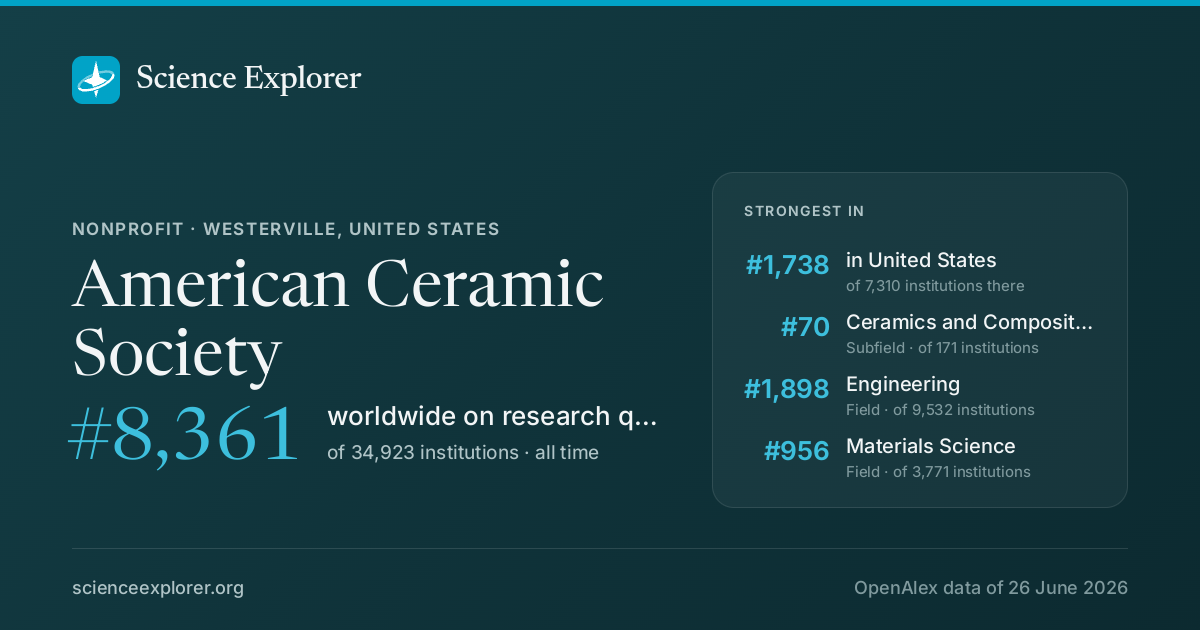
In research, American Ceramic Society stands highest in Engineering (#1,898 of 9,532 worldwide), Materials Science (#956 of 3,771 worldwide) and Materials Chemistry (#829 of 2,613 worldwide), over all time.
- World rank, all time
- #8,361 of 34,923
- Rank in United States
- #1,738 of 7,310
- Research works
- 4.4k ▼ 26% vs 2018-21
- Citations
- 244k 56.1 per fractional work
- Top-10% rate
- 3.8% all institutions 10.0%
- vs its own fields
- 1.48× 1.00× is exactly expected
- Open access
- 6% world 40%
- International
- 46% world 18%
What is American Ceramic Society known for in research?
The fields where it stands highest, over all time, ranked among every institution above the floor in each field.
| Field | World rank | Where that sits | Top-10% rate | Works |
|---|---|---|---|---|
| EngineeringField | #1,898 of 9,532 | 25.2% | 1,706 | |
| Materials ScienceField | #956 of 3,771 | 23.3% | 2,152 | |
| Materials ChemistrySubfield | #829 of 2,613 | 22.5% | 1,080 | |
| Mechanical EngineeringSubfield | #826 of 2,525 | 27.3% | 597 | |
| Ceramics and CompositesSubfield | #70 of 171 | 24.6% | 886 | |
| Electrical and Electronic EngineeringSubfield | #1,747 of 3,725 | 25.9% | 376 | |
| Mechanics of MaterialsSubfield | #765 of 1,474 | 21.3% | 262 | |
| Physical SciencesDomain | #9,672 of 17,446 | 23.6% | 4,298 | |
| Biomedical EngineeringSubfield | #1,689 of 2,564 | 23.3% | 158 | |
| ChemistryField | #2,151 of 2,902 | 25.2% | 126 |
Each strip is that field's whole ranked pool, with the notch where American Ceramic Society sits in it, in the colour of the band that rank falls in. The track under the rate is the rate itself: it carries no average mark, because the average differs by field (from about 6% in Dentistry to 21% in Economics).
Which fields of science does American Ceramic Society work in?
In all years, 99% of research at American Ceramic Society is in Physical Sciences, 1% in Health Sciences. Its largest fields are Materials Science (49%), Engineering (39%), Chemistry (3%). It does 2.4× the world's share of Physical Sciences.
Each ring splits the one inside it: the four domains of science, their fields, their subfields. Size is fractional works in all years. Every slice is a page; the interactive view zooms down to single topics and colours each by how much more of it this institution does than the world.
Its 4 domains and 22 fields, with their numbers
- Physical Sciences4,29898.8%
- Materials Science2,15249.4%
- Engineering1,70639.2%
- Chemistry1262.9%
- Physics and Astronomy1212.8%
- Earth and Planetary Sciences651.5%
- Environmental Science481.1%
- Energy370.8%
- Chemical Engineering360.8%
- Computer Science50.1%
- Mathematics30.1%
- Health Sciences340.8%
- Dentistry170.4%
- Medicine160.4%
- Health Professions10.0%
- Nursing00.0%
- Social Sciences130.3%
- Arts and Humanities60.1%
- Decision Sciences20.0%
- Social Sciences20.0%
- Psychology20.0%
- Economics, Econometrics and Finance10.0%
- Life Sciences60.1%
Field profile
Location quotient across every field it publishes in: outside the ring is more than an institution of this size would be expected to publish, inside it is less.
Who are the top researchers at American Ceramic Society?
Ranked on the quality score, Stephen J. Bennison, Seung Kun Lee and Eva M. Vogel lead among researchers whose main affiliation is American Ceramic Society.
- 1
Stephen J. Bennison
 United States · #1,477,295 worldwide
2.5k citations · 42 works
- 2
Seung Kun Lee
United States · #3,757,559 worldwide
975 citations · 22 works
- 3
Eva M. Vogel
United States · #3,989,989 worldwide
1.3k citations · 46 works
- 4
Michael J. Readey
United States · #4,740,671 worldwide
1k citations · 44 works
- 5
J. Arthur Thomson
United States · #4,753,178 worldwide
417 citations · 18 works
- 6
Anthony J. Fanelli
United States · #5,316,684 worldwide
368 citations · 15 works
- 7
Daniel F. Carroll
United States · #5,543,690 worldwide
524 citations · 29 works
- 8
Dennis R. Merkley
United States · #5,579,994 worldwide
450 citations · 19 works
- 9
Homer F. Priest
United States · #5,713,358 worldwide
260 citations · 27 works
- 10
George E. Gazza
United States · #5,817,665 worldwide
525 citations · 36 works
Which keywords describe research at American Ceramic Society?
By fractional works in all years, weighted toward what it does more of than the world: Sintering, Spark Plasma Sintering, Oxidation Resistance, Ceramic Materials, Composite Materials, Material Properties, High-Temperature Applications and Nanocrystalline Ceramics.
- Pyrochlore
- Friction Stir Processing
- Actinides
- Low-Loss
- Dielectric
- Resonators
- Perovskite
- Graphene
- Lead-free Piezoceramics
- Nanocomposites
- Cemented Carbides
- Rare-Earth Doped Materials
- Structural Analysis
- Materials
- Ceramics
- Microstructure
- Nanocrystalline Ceramics
- Material Properties
- Ceramic Materials
- Spark Plasma Sintering
- Sintering
- Oxidation Resistance
- Composite Materials
- High-Temperature Applications
- Mechanical Properties
- Nanoparticles
- Optical Properties
- Fiber Lasers
- Glass Science
- Nanostructured Materials
- Tungsten Carbide
- Ferroelectric Materials
- Nanostructures
- Processing Techniques
- Thin Films
- Microwave
- LTCC
- Carbon Nanotubes
- Metal Matrix Composites
- Nuclear Waste Disposal
Size is fractional works in all years in the topics tagged with each word; colour is the word's share of this institution's work against its share of the world's. The 40 words are chosen for being large and distinctive. Each links to the topic it comes from most.
All 40 words, with their numbers
- Sintering1,061▲ 159×5 topics
- Spark Plasma Sintering876▲ 177×2 topics
- Oxidation Resistance748▲ 120×3 topics
- Ceramic Materials739▲ 160×4 topics
- Composite Materials723▲ 73×7 topics
- Material Properties664▲ 118×4 topics
- High-Temperature Applications662▲ 249×1 topic
- Nanocrystalline Ceramics662▲ 249×1 topic
- Mechanical Properties580▲ 14×33 topics
- Microstructure477▲ 22×19 topics
- Nanoparticles318▲ 5.5×28 topics
- Ceramics316▲ 67×4 topics
- Optical Properties272▲ 54×4 topics
- Materials229▲ 31×6 topics
- Fiber Lasers226▲ 36×3 topics
- Structural Analysis223▲ 33×2 topics
- Glass Science223▲ 114×1 topic
- Rare-Earth Doped Materials223▲ 114×1 topic
- Nanostructured Materials217▲ 26×5 topics
- Cemented Carbides214▲ 93×1 topic
- Tungsten Carbide214▲ 93×1 topic
- Nanocomposites214▲ 6.3×20 topics
- Ferroelectric Materials205▲ 94×1 topic
- Lead-free Piezoceramics205▲ 94×1 topic
- Nanostructures191▲ 9.1×16 topics
- Graphene181▲ 8.1×11 topics
- Processing Techniques180▲ 43×2 topics
- Perovskite171▲ 107×2 topics
- Thin Films159▲ 14×10 topics
- Resonators159▲ 52×3 topics
- Microwave157▲ 74×3 topics
- Dielectric157▲ 99×2 topics
- LTCC156▲ 155×1 topic
- Low-Loss156▲ 155×1 topic
- Carbon Nanotubes145▲ 9.4×8 topics
- Actinides141▲ 41×2 topics
- Metal Matrix Composites130▲ 37×2 topics
- Friction Stir Processing130▲ 41×2 topics
- Nuclear Waste Disposal130▲ 135×1 topic
- Pyrochlore130▲ 135×1 topic
Which research topics does American Ceramic Society publish most on?
By volume in 2022-now: Mining and Gasification Technologies, Innovative concrete reinforcement materials, Concrete and Cement Materials Research and Advanced ceramic materials synthesis.
Area is fractional works; colour is the subfield each topic belongs to.
- 1 Mining and Gasification Technologies Mechanical Engineering 0 works
- 2 Innovative concrete reinforcement materials Civil and Structural Engineering 0 works
- 3 Concrete and Cement Materials Research Civil and Structural Engineering 0 works
- 4 Advanced ceramic materials synthesis Ceramics and Composites 0 works
- 5 biodegradable polymer synthesis and properties Biomaterials 0 works
- 6 Natural Fiber Reinforced Composites Polymers and Plastics 0 works
- 7 Bone Tissue Engineering Materials Biomedical Engineering 0 works
- 8 MXene and MAX Phase Materials Materials Chemistry 0 works
- 9 Magnesium Oxide Properties and Applications Materials Chemistry 0 works
- 10 Energetic Materials and Combustion Mechanics of Materials 0 works
How open and international is its research?
Against the world's own shares: the tick on each track. Both are shares of its output, so they sit on one scale and can be read against each other as well as against the world.
World: 40% of research is openly available.
World: 18% is written across borders.
How has American Ceramic Society's research output changed?
Output in 2022-2025 was 26% lower than in 2018-2021.
The same series as a ribbon: one cell per year, darker for more. The line above answers how much; this answers when.
Its share of all research
Growing output can still be a shrinking share: all of science grows. This is American Ceramic Society as a percentage of every work published that year, 0.0000096% in 2024.
Fractional works of American Ceramic Society over all fractional works that year. How the balance of science has shifted.
How much of it reaches the world top 10%
Year by year, against all institutions in the same year.
Of each year's output, the share that reached the world's 10% most cited for its field and year. Peak 32.0% in 1991.
Other research institutions in Westerville
- Otterbein University
- Orthopedic Foot & Ankle Center
- Lake Shore Cryotronics (United States)
- State Science and Technology Institute
- Mount Carmel St. Ann's
- METSS (United States)
Share American Ceramic Society's ranking
Badges for a website1Each links back here and updates with every snapshot

Research measures only: rankings here say nothing about teaching, admissions or student experience. Comparable institutions and collaboration partners have tabs of their own, above.
Discussion
Ask a question or share a note about American Ceramic Society. Keep it to the research: no personal attacks, advertising or links. Any reader can report a post, which collapses it for everyone until it is opened.