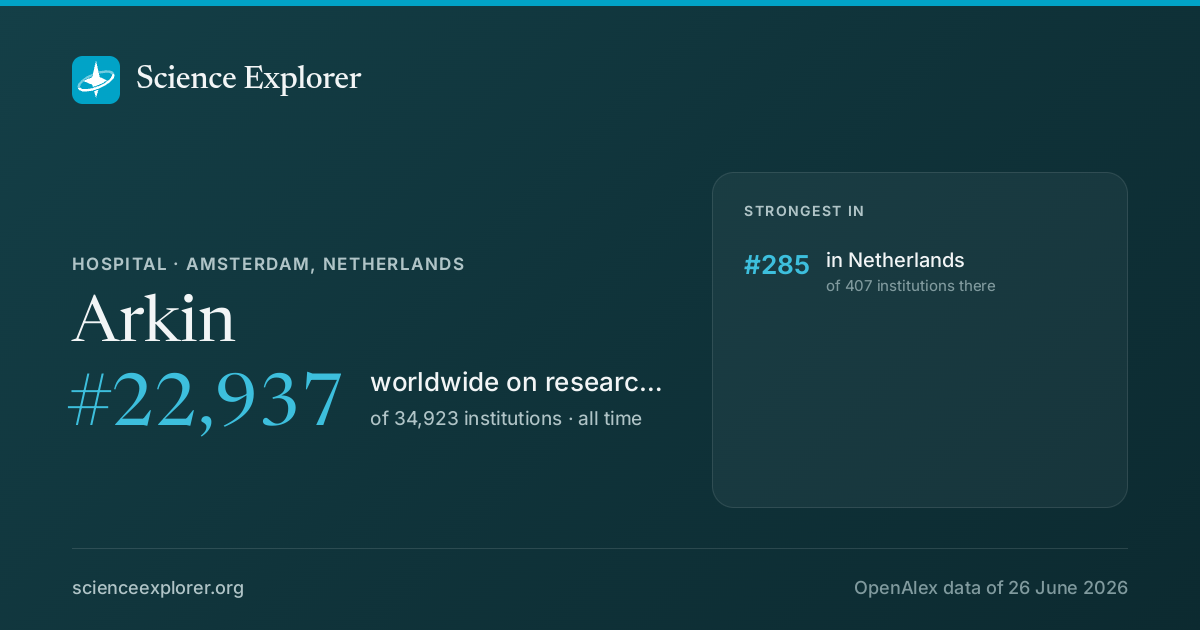
- World rank, all time
- #22,937 of 34,923
- Rank in Netherlands
- #285 of 407
- Research works
- 187 ▲ 4% vs 2018-21
- Citations
- 4.2k 22.5 per fractional work
- Top-10% rate
- 12.6% all institutions 10.0%
- vs its own fields
- 1.06× 1.00× is exactly expected
- Open access
- 65% world 40%
- International
- 30% world 18%
Which fields of science does Arkin work in?
In 2022-now, 61% of research at Arkin is in Social Sciences, 28% in Health Sciences. Its largest fields are Psychology (42%), Medicine (24%), Social Sciences (11%). It does 2.2× the world's share of Social Sciences.
Each ring splits the one inside it: the four domains of science, their fields, their subfields. Size is fractional works in 2022-now. Every slice is a page; the interactive view zooms down to single topics and colours each by how much more of it this institution does than the world.
Its 4 domains and 22 fields, with their numbers
- Social Sciences3861.3%
- Psychology2642.1%
- Social Sciences711.0%
- Arts and Humanities34.9%
- Economics, Econometrics and Finance11.8%
- Decision Sciences11.2%
- Business, Management and Accounting00.4%
- Health Sciences1727.8%
- Medicine1523.5%
- Health Professions34.2%
- Veterinary00.1%
- Nursing00.0%
- Physical Sciences35.5%
- Engineering11.3%
- Materials Science11.1%
- Computer Science10.9%
- Energy00.7%
- Environmental Science00.7%
- Earth and Planetary Sciences00.4%
- Physics and Astronomy00.2%
- Mathematics00.1%
- Life Sciences35.4%
What does Arkin specialise in?
Where its research is concentrated relative to its size: Psychology takes 13.8× the share of its output that it takes of world research.
- PsychologyField · 26.2 works14×
Location quotient, a volume reading rather than an impact one. It surfaces small, lopsided specialities.
Field profile
Location quotient across every field it publishes in: outside the ring is more than an institution of this size would be expected to publish, inside it is less.
Rings at 0.5×, 1× and 2×. Widest outward: Psychology, 13.8×. Every wedge is a field page.
All 22 fields, with their numbers
- Psychology13.82×26 works
- Neuroscience2.14×2 works
- Arts and Humanities1.70×3 works
- Health Professions1.58×3 works
- Decision Sciences1.23×1 works
- Medicine1.22×15 works
- Pharmacology, Toxicology and Pharmaceutics1.20×0 works
- Veterinary0.99×0 works
- Social Sciences0.87×7 works
- Economics, Econometrics and Finance0.82×1 works
- Energy0.80×0 works
- Materials Science0.31×1 works
- Earth and Planetary Sciences0.24×0 works
- Agricultural and Biological Sciences0.15×0 works
- Environmental Science0.15×0 works
- Biochemistry, Genetics and Molecular Biology0.14×0 works
- Computer Science0.12×1 works
- Business, Management and Accounting0.12×0 works
- Engineering0.09×1 works
- Mathematics0.09×0 works
- Physics and Astronomy0.09×0 works
- Nursing0.03×0 works
- Psychology 13.8×
- Neuroscience 2.1×
- Arts and Humanities 1.7×
- Health Professions 1.6×
- Decision Sciences 1.2×
- Medicine 1.2×
- Pharmacology, Toxicology and Pharmaceutics 1.2×
- Veterinary 1.0×
- Social Sciences 0.9×
- Economics, Econometrics and Finance 0.8×
- Energy 0.8×
- Materials Science 0.3×
- Earth and Planetary Sciences 0.2×
- Agricultural and Biological Sciences 0.1×
- Environmental Science 0.1×
- Biochemistry, Genetics and Molecular Biology 0.1×
- Computer Science 0.1×
- Business, Management and Accounting 0.1×
- Engineering 0.1×
- Mathematics 0.1×
- Physics and Astronomy 0.1×
- Nursing 0.0×
Who are the top researchers at Arkin?
Ranked on the quality score, Jack Dekker, Martijn Kikkert and Matthijs Blankers lead among researchers whose main affiliation is Arkin.
- 1
Jack Dekker
 Netherlands · #658,117 worldwide
11k citations · 300 works
- 2
Martijn Kikkert
Netherlands · #798,772 worldwide
2.2k citations · 94 works
- 3
Matthijs Blankers
Netherlands · #975,970 worldwide
3.4k citations · 183 works
- 4
Marleen M. de Waal
Netherlands · #1,028,731 worldwide
672 citations · 39 works
- 5
Nick M. Lommerse
Netherlands · #1,111,903 worldwide
297 citations · 22 works
- 6
Kathleen Thomaes
Netherlands · #1,129,441 worldwide
1.8k citations · 83 works
- 7
Margo de Jonge
Netherlands · #1,597,468 worldwide
273 citations · 24 works
- 8
Henricus L. Van
Netherlands · #1,631,218 worldwide
2.3k citations · 98 works
- 9
Astrid Vellinga
Netherlands · #1,694,419 worldwide
524 citations · 29 works
- 10
Natasja Schutter
Netherlands · #1,712,554 worldwide
516 citations · 16 works
Which keywords describe research at Arkin?
By fractional works in 2022-now, weighted toward what it does more of than the world: Depression, Mental Health, Psychopathology, Neurobiological Correlates, Prevalence, Cognitive Therapy, Adolescents and Emotion Regulation.
- Parenting
- Comorbidity
- Psychological Factors
- Therapeutic Alliance
- Impulsivity
- Social Support
- Evidence-Based Practice
- Psychological Interventions
- Anxiety Disorders
- DSM-5
- Risk Factors
- Personality Traits
- Meta-Analysis
- Antipsychotic Drugs
- Metabolic Syndrome
- Anxiety
- Emotion Regulation
- Cognitive Therapy
- Neurobiological Correlates
- Mental Health
- Depression
- Psychopathology
- Prevalence
- Adolescents
- Epidemiology
- Psychiatric Disorders
- Treatment
- Genetics
- Neurocognitive Deficits
- Resilience
- Borderline Personality Disorder
- Mental Disorders
- Psychological Distress
- Obesity
- Neurobiology
- Body Image
- Psychotherapy Outcome
- Eating Disorders
- Children
- Developmental Trajectories
Size is fractional works in 2022-now in the topics tagged with each word; colour is the word's share of this institution's work against its share of the world's. The 40 words are chosen for being large and distinctive. Each links to the topic it comes from most.
All 40 words, with their numbers
- Depression7▲ 14×14 topics
- Mental Health7▲ 7.5×14 topics
- Psychopathology6▲ 52×3 topics
- Neurobiological Correlates6▲ 89×3 topics
- Prevalence6▲ 22×7 topics
- Cognitive Therapy5▲ 77×3 topics
- Adolescents5▲ 22×5 topics
- Emotion Regulation5▲ 25×8 topics
- Epidemiology5▲ 1.90×13 topics
- Anxiety4▲ 12×8 topics
- Psychiatric Disorders4▲ 44×4 topics
- Metabolic Syndrome4▲ 7.1×4 topics
- Treatment4▲ 4.6×4 topics
- Antipsychotic Drugs3▲ 137×1 topic
- Genetics3▲ 7.8×5 topics
- Meta-Analysis3▲ 9.2×7 topics
- Neurocognitive Deficits3▲ 137×1 topic
- Personality Traits3▲ 37×3 topics
- Resilience3▲ 9.7×5 topics
- Risk Factors3▲ 4.4×4 topics
- Borderline Personality Disorder3▲ 224×1 topic
- DSM-53▲ 224×1 topic
- Mental Disorders3▲ 38×3 topics
- Anxiety Disorders3▲ 39×2 topics
- Psychological Distress3▲ 17×3 topics
- Psychological Interventions3▲ 30×3 topics
- Obesity2▲ 5.2×4 topics
- Evidence-Based Practice2▲ 27×2 topics
- Neurobiology2▲ 14×7 topics
- Social Support2▲ 6.8×6 topics
- Body Image2▲ 46×2 topics
- Impulsivity2▲ 62×2 topics
- Psychotherapy Outcome2▲ 161×1 topic
- Therapeutic Alliance2▲ 161×1 topic
- Eating Disorders2▲ 72×1 topic
- Psychological Factors2▲ 16×2 topics
- Children2▲ 14×2 topics
- Comorbidity2▲ 27×4 topics
- Developmental Trajectories2▲ 25×1 topic
- Parenting2▲ 24×1 topic
Which research topics does Arkin publish most on?
By volume in 2022-now: Schizophrenia research and treatment, Personality Disorders and Psychopathology, Psychotherapy Techniques and Applications and Eating Disorders and Behaviors.
Area is fractional works; colour is the subfield each topic belongs to.
- 1 Schizophrenia research and treatment Psychiatry and Mental health 3 works
- 2 Personality Disorders and Psychopathology Clinical Psychology 3 works
- 3 Psychotherapy Techniques and Applications Clinical Psychology 2 works
- 4 Eating Disorders and Behaviors Clinical Psychology 2 works
- 5 Child and Adolescent Psychosocial and Emotional Development Clinical Psychology 2 works
- 6 Digital Mental Health Interventions Applied Psychology 2 works
- 7 Substance Abuse Treatment and Outcomes Epidemiology 2 works
- 8 Posttraumatic Stress Disorder Research Clinical Psychology 1 works
- 9 Child Abuse and Trauma Clinical Psychology 1 works
- 10 Mental Health Treatment and Access Social Psychology 1 works
How open and international is its research?
Against the world's own shares: the tick on each track. Both are shares of its output, so they sit on one scale and can be read against each other as well as against the world.
World: 40% of research is openly available.
World: 18% is written across borders.
How has Arkin's research output changed?
Output in 2022-2025 was 4% higher than in 2018-2021.
The same series as a ribbon: one cell per year, darker for more. The line above answers how much; this answers when.
Its share of all research
Growing output can still be a shrinking share: all of science grows. This is Arkin as a percentage of every work published that year, 0.00026% in 2024.
Fractional works of Arkin over all fractional works that year. How the balance of science has shifted.
Other research institutions in Amsterdam
- University of Amsterdam
- Vrije Universiteit Amsterdam
- Philips (Netherlands)
- Amsterdam UMC Location University of Amsterdam
- Royal Netherlands Academy of Arts and Sciences
- Amsterdam University Medical Centers
- Centrum Wiskunde & Informatica
- Institute for Atomic and Molecular Physics


Share Arkin's ranking
Badges for a website1Each links back here and updates with every snapshot

Research measures only: rankings here say nothing about teaching, admissions or student experience. Comparable institutions and collaboration partners have tabs of their own, above.
Discussion
Ask a question or share a note about Arkin. Keep it to the research: no personal attacks, advertising or links. Any reader can report a post, which collapses it for everyone until it is opened.