Science Explorer Back to mapMap
Government institution · Is-sur-Tille · France

CEA Valduc

In research, CEA Valduc stands highest in Health Sciences (#7,618 of 16,688 worldwide), Medicine (#7,147 of 14,558 worldwide) and Physical Sciences (#13,235 of 17,446 worldwide), over all time.

World rank, all time
#12,824
of 34,923
Rank in France
#406
of 943
Research works
790
▼ 42% vs 2018-21
Citations
17k
20.9 per fractional work
Top-10% rate
6.0%
all institutions 10.0%
vs its own fields
0.91×
1.00× is exactly expected
Open access
20%
world 40%
International
14%
world 18%

What is CEA Valduc known for in research?

The fields where it stands highest, over all time, ranked among every institution above the floor in each field.

FieldWorld rankWhere that sitsTop-10% rateWorks
Health SciencesDomain #7,618 of 16,688 10.4%304
MedicineField #7,147 of 14,558 10.0%284
Physical SciencesDomain #13,235 of 17,446 5.7%372
EngineeringField #8,314 of 9,532 6.1%154

Each strip is that field's whole ranked pool, with the notch where CEA Valduc sits in it, in the colour of the band that rank falls in. The track under the rate is the rate itself: it carries no average mark, because the average differs by field (from about 6% in Dentistry to 21% in Economics).

Which fields of science does CEA Valduc work in?

In 2022-now, 67% of research at CEA Valduc is in Physical Sciences, 16% in Social Sciences. Its largest fields are Engineering (29%), Materials Science (11%), Medicine (11%). It does 1.6× the world's share of Physical Sciences.

Physical Sciences: 17 fractional works · 66.8% of its workEngineering: 7 fractional works · 29.0% of its workMechanical Engineering: 3 fractional works · 11.9% of its workMechanics of Materials: 2 fractional works · 7.2% of its workElectrical and Electronic Engineering: 1 fractional works · 2.3% of its workAerospace Engineering: 1 fractional works · 2.2% of its workBiomedical Engineering: 0 fractional works · 1.8% of its workBuilding and Construction: 0 fractional works · 1.3% of its workOcean Engineering: 0 fractional works · 1.3% of its workControl and Systems Engineering: 0 fractional works · 0.7% of its workSmaller subfields together: 0 fractional works · 0.4% of its workMaterials Science: 3 fractional works · 11.5% of its workMaterials Chemistry: 3 fractional works · 10.9% of its workPolymers and Plastics: 0 fractional works · 0.3% of its workSmaller subfields together: 0 fractional works · 0.3% of its workEarth and Planetary Sciences: 2 fractional works · 9.4% of its workAtmospheric Science: 1 fractional works · 5.0% of its workGeophysics: 1 fractional works · 2.8% of its workEarth-Surface Processes: 0 fractional works · 1.3% of its workSmaller subfields together: 0 fractional works · 0.4% of its workPhysics and Astronomy: 2 fractional works · 8.2% of its workNuclear and High Energy Physics: 1 fractional works · 2.6% of its workCondensed Matter Physics: 1 fractional works · 2.3% of its workRadiation: 1 fractional works · 2.0% of its workAtomic and Molecular Physics, and Optics: 0 fractional works · 1.0% of its workStatistical and Nonlinear Physics: 0 fractional works · 0.2% of its workEnvironmental Science: 1 fractional works · 4.2% of its workEcology: 0 fractional works · 1.4% of its workIndustrial and Manufacturing Engineering: 0 fractional works · 1.4% of its workGlobal and Planetary Change: 0 fractional works · 0.6% of its workEnvironmental Chemistry: 0 fractional works · 0.3% of its workWater Science and Technology: 0 fractional works · 0.3% of its workNature and Landscape Conservation: 0 fractional works · 0.2% of its workChemical Engineering: 0 fractional works · 1.8% of its workFluid Flow and Transfer Processes: 0 fractional works · 1.0% of its workCatalysis: 0 fractional works · 0.8% of its workChemistry: 0 fractional works · 1.5% of its workInorganic Chemistry: 0 fractional works · 0.8% of its workAnalytical Chemistry: 0 fractional works · 0.7% of its workSmaller subfields together: 0 fractional works · 0.1% of its workComputer Science: 0 fractional works · 1.2% of its workSignal Processing: 0 fractional works · 0.7% of its workArtificial Intelligence: 0 fractional works · 0.3% of its workComputational Theory and Mathematics: 0 fractional works · 0.2% of its workSocial Sciences: 4 fractional works · 16.1% of its workSocial Sciences: 2 fractional works · 6.5% of its workSociology and Political Science: 1 fractional works · 4.6% of its workAnthropology: 0 fractional works · 1.3% of its workPolitical Science and International Relations: 0 fractional works · 0.7% of its workArts and Humanities: 1 fractional works · 4.1% of its workHistory: 1 fractional works · 2.1% of its workArcheology: 1 fractional works · 2.0% of its workDecision Sciences: 1 fractional works · 3.3% of its workStatistics, Probability and Uncertainty: 1 fractional works · 3.3% of its workBusiness, Management and Accounting: 0 fractional works · 2.0% of its workManagement Information Systems: 0 fractional works · 2.0% of its workEconomics, Econometrics and Finance: 0 fractional works · 0.2% of its workEconomics and Econometrics: 0 fractional works · 0.2% of its workHealth Sciences: 3 fractional works · 13.5% of its workMedicine: 3 fractional works · 11.4% of its workOncology: 1 fractional works · 2.6% of its workPulmonary and Respiratory Medicine: 1 fractional works · 2.5% of its workEpidemiology: 0 fractional works · 1.2% of its workSurgery: 0 fractional works · 1.1% of its workReproductive Medicine: 0 fractional works · 0.6% of its workCardiology and Cardiovascular Medicine: 0 fractional works · 0.5% of its workPublic Health, Environmental and Occupational Health: 0 fractional works · 0.5% of its workObstetrics and Gynecology: 0 fractional works · 0.4% of its workRadiology, Nuclear Medicine and Imaging: 0 fractional works · 0.4% of its workOtorhinolaryngology: 0 fractional works · 0.3% of its workPathology and Forensic Medicine: 0 fractional works · 0.3% of its workGenetics: 0 fractional works · 0.2% of its workSmaller subfields together: 0 fractional works · 0.7% of its workHealth Professions: 1 fractional works · 2.1% of its workRadiological and Ultrasound Technology: 1 fractional works · 2.1% of its workLife Sciences: 1 fractional works · 3.6% of its workBiochemistry, Genetics and Molecular Biology: 1 fractional works · 3.0% of its workMolecular Biology: 0 fractional works · 0.9% of its workCancer Research: 0 fractional works · 0.8% of its workGenetics: 0 fractional works · 0.7% of its workBiophysics: 0 fractional works · 0.3% of its workSmaller subfields together: 0 fractional works · 0.3% of its workAgricultural and Biological Sciences: 0 fractional works · 0.5% of its workPlant Science: 0 fractional works · 0.4% of its workSmaller subfields together: 0 fractional works · 0.1% of its workImmunology and Microbiology: 0 fractional works · 0.0% of its workALL ITS WORKCEA Valduc26fractional works, 2022-now
Life Sciences4%Physical Sciences67%Health Sciences14%Social Sciences16%

Each ring splits the one inside it: the four domains of science, their fields, their subfields. Size is fractional works in 2022-now. Every slice is a page; the interactive view zooms down to single topics and colours each by how much more of it this institution does than the world.

Its 4 domains and 18 fields, with their numbers
    1. Engineering729.0%
    2. Materials Science311.5%
    3. Earth and Planetary Sciences29.4%
    4. Physics and Astronomy28.2%
    5. Environmental Science14.2%
    6. Chemical Engineering01.8%
    7. Chemistry01.5%
    8. Computer Science01.2%
    1. Social Sciences26.5%
    2. Arts and Humanities14.1%
    3. Decision Sciences13.3%
    4. Business, Management and Accounting02.0%
    5. Economics, Econometrics and Finance00.2%
    1. Medicine311.4%
    2. Health Professions12.1%
    1. Biochemistry, Genetics and Molecular Biology13.0%
    2. Agricultural and Biological Sciences00.5%
    3. Immunology and Microbiology00.0%
All of science, and how each field's share has moved since 1950: the Science domain explorer

Field profile

Location quotient across every field it publishes in: outside the ring is more than an institution of this size would be expected to publish, inside it is less.

Agricultural and Biological Sciences: 0.12× its world share, 0 worksAgricultural and Bio…Biochemistry, Genetics and Molecular Biology: 0.56× its world share, 1 worksBiochemistry, Geneti…Immunology and Microbiology: 0.05× its world share, 0 worksImmunology and Micro…Chemical Engineering: 5.02× its world share, 0 worksChemical EngineeringChemistry: 0.97× its world share, 0 worksChemistryComputer Science: 0.15× its world share, 0 worksComputer ScienceEarth and Planetary Sciences: 6.03× its world share, 2 worksEarth and Planetary …Engineering: 1.93× its world share, 7 worksEngineeringEnvironmental Science: 0.85× its world share, 1 worksEnvironmental ScienceMaterials Science: 3.29× its world share, 3 worksMaterials SciencePhysics and Astronomy: 3.68× its world share, 2 worksPhysics and AstronomyHealth Professions: 0.79× its world share, 0 worksHealth ProfessionsMedicine: 0.59× its world share, 3 worksMedicineArts and Humanities: 1.42× its world share, 1 worksArts and HumanitiesBusiness, Management and Accounting: 0.61× its world share, 0 worksBusiness, Management…Decision Sciences: 3.38× its world share, 1 worksDecision SciencesEconomics, Econometrics and Finance: 0.10× its world share, 0 worksEconomics, Econometr…Social Sciences: 0.52× its world share, 2 worksSocial Sciences1×world share
more than its size predictsabout as predictedless

Rings at 0.5×, 1× and 2×. Widest outward: Earth and Planetary Sciences, 6.0×. Every wedge is a field page.

All 18 fields, with their numbers
  1. Earth and Planetary Sciences6.03×2 works
  2. Chemical Engineering5.02×0 works
  3. Physics and Astronomy3.68×2 works
  4. Decision Sciences3.38×1 works
  5. Materials Science3.29×3 works
  6. Engineering1.93×7 works
  7. Arts and Humanities1.42×1 works
  8. Chemistry0.97×0 works
  9. Environmental Science0.85×1 works
  10. Health Professions0.79×0 works
  11. Business, Management and Accounting0.61×0 works
  12. Medicine0.59×3 works
  13. Biochemistry, Genetics and Molecular Biology0.56×1 works
  14. Social Sciences0.52×2 works
  15. Computer Science0.15×0 works
  16. Agricultural and Biological Sciences0.12×0 works
  17. Economics, Econometrics and Finance0.10×0 works
  18. Immunology and Microbiology0.05×0 works

Who are the top researchers at CEA Valduc?

Ranked on the quality score, Gilles Romieu, S. Gourgou-Bourgade and Bernard Saint‐Aubert lead among researchers whose main affiliation is CEA Valduc.

  1. 1 Gilles Romieu France · #95,714 worldwide 28k citations · 279 works
  2. 2 S. Gourgou-Bourgade France · #954,307 worldwide 12k citations · 74 works
  3. 3 Bernard Saint‐Aubert France · #1,333,071 worldwide 4.5k citations · 109 works
  4. 4 Gilles Roy France · #1,407,121 worldwide 7k citations · 126 works
  5. 5 Jacqueline Duffour France · #3,071,897 worldwide 1.2k citations · 35 works
  6. 6 Jean Bernard Dubois France · #3,382,743 worldwide 4.9k citations · 83 works
  7. 7 Phillippe Rouanet France · #3,667,302 worldwide 572 citations · 42 works
  8. 8 Jean‐Bernard Dubois France · #3,750,603 worldwide 3k citations · 135 works
  9. 9 Joachim C. Fest France · #3,767,758 worldwide 333 citations · 47 works
  10. 10 Christine A. Kerr France · #3,862,092 worldwide 3.7k citations · 137 works
All ranked researchers at CEA Valduc

What are the most cited papers from CEA Valduc?

The most cited paper from CEA Valduc is "FOLFIRINOX versus Gemcitabine for Metastatic Pancreatic Cancer" (Thierry Conroy, Françoise Desseigne, Marc Ychou et al., 2011), with 7,927 citations. Next come "Platinum-Based Chemotherapy plus Cetuximab in Head and Neck Cancer" (3,762) and "Regorafenib monotherapy for previously treated metastatic colorectal cancer (CORRECT): an international, multicentre, randomised, placebo-controlled, phase 3 trial" (2,934).

Most cited papers
#PaperReleasedCitations
1 FOLFIRINOX versus Gemcitabine for Metastatic Pancreatic Cancer Thierry Conroy, Françoise Desseigne, Marc Ychou et al. · New England Journal of Medicine Open access 11 May 2011 7,927
2 Platinum-Based Chemotherapy plus Cetuximab in Head and Neck Cancer Jan B. Vermorken, Ricard Mesı́a, Fernando Rivera et al. · New England Journal of Medicine Open access 10 Sep 2008 3,762
3 Regorafenib monotherapy for previously treated metastatic colorectal cancer (CORRECT): an international, multicentre, randomised, placebo-controlled, phase 3 trial Axel F. Grothey, Eric Van Cutsem, Alberto Felice Sobrero et al. · The Lancet 21 Nov 2012 2,934
4 Death toll exceeded 70,000 in Europe during the summer of 2003 Jean‐Marie Robine, Siu Lan Karen Cheung, Sophie Roy et al. · Comptes Rendus Biologies Open access 31 Dec 2007 2,167
5 Long-term results with immediate androgen suppression and external irradiation in patients with locally advanced prostate cancer (an EORTC study): a phase III randomised trial M. Bolla, Laurence Collette, LEO E. C. M. BLANK et al. · The Lancet Jul 2002 1,698
All 60 most cited papers, with filters and sorting

Which keywords describe research at CEA Valduc?

By fractional works in 2022-now, weighted toward what it does more of than the world: Mechanical Properties, Holocene, Microstructure, Solar Influence, Glacial Cycles, Paleoclimatology, Superconductivity and Hydrogen Embrittlement.

▲ more of its work than of the world's◆ about the world's share▼ less than the world's

Size is fractional works in 2022-now in the topics tagged with each word; colour is the word's share of this institution's work against its share of the world's. The 12 words are chosen for being large and distinctive. Each links to the topic it comes from most.

All 12 words, with their numbers
  1. Mechanical Properties3▲ 10×10 topics
  2. Holocene2▲ 62×2 topics
  3. Climate Change2▲ 2.3×5 topics
  4. Microstructure2▲ 11×6 topics
  5. Solar Influence1▲ 75×2 topics
  6. Glacial Cycles1▲ 75×1 topic
  7. Paleoclimatology1▲ 59×1 topic
  8. Superconductivity1▲ 27×2 topics
  9. Hydrogen Embrittlement1▲ 54×3 topics
  10. Tomography1▲ 24×4 topics
  11. Environmental Participation1▲ 55×1 topic
  12. Territorial Governance1▲ 34×1 topic

Which research topics does CEA Valduc publish most on?

By volume in 2022-now: Geology and Paleoclimatology Research, French Urban and Social Studies, Metal Alloys Wear and Properties and Nuclear Materials and Properties.

  1. 1 Geology and Paleoclimatology Research Atmospheric Science 1 works
  2. 2 French Urban and Social Studies Sociology and Political Science 1 works
  3. 3 Metal Alloys Wear and Properties Materials Chemistry 1 works
  4. 4 Nuclear Materials and Properties Materials Chemistry 1 works
  5. 5 Laser-Plasma Interactions and Diagnostics Nuclear and High Energy Physics 1 works
  6. 6 High-pressure geophysics and materials Geophysics 1 works
  7. 7 Metallurgy and Material Forming Mechanics of Materials 1 works
  8. 8 Rare-earth and actinide compounds Condensed Matter Physics 1 works
  9. 9 Travel Writing and Literature History 0 works
  10. 10 Maritime and Coastal Archaeology Archeology 0 works

How open and international is its research?

Against the world's own shares: the tick on each track. Both are shares of its output, so they sit on one scale and can be read against each other as well as against the world.

openly available20.0%not open80.0%

World: 40% of research is openly available.

with international co-authors13.9%domestic only86.1%

World: 18% is written across borders.

How has CEA Valduc's research output changed?

Output in 2022-2025 was 42% lower than in 2018-2021.

still counting1990200020102020
grewheldshrank

The same series as a ribbon: one cell per year, darker for more. The line above answers how much; this answers when.

Its share of all research

Growing output can still be a shrinking share: all of science grows. This is CEA Valduc as a percentage of every work published that year, 0.000052% in 2024.

still counting0.0010%0.0020%0.0030%CEA Valduc0.000093% in 202519801990200020102020

Fractional works of CEA Valduc over all fractional works that year. How the balance of science has shifted.

How much of it reaches the world top 10%

Year by year, against all institutions in the same year.

5%10%15%CEA Valduc10.5% in 2013all institutions10.0% in 201320002010

Of each year's output, the share that reached the world's 10% most cited for its field and year. Peak 14.9% in 2007.

Share CEA Valduc's ranking
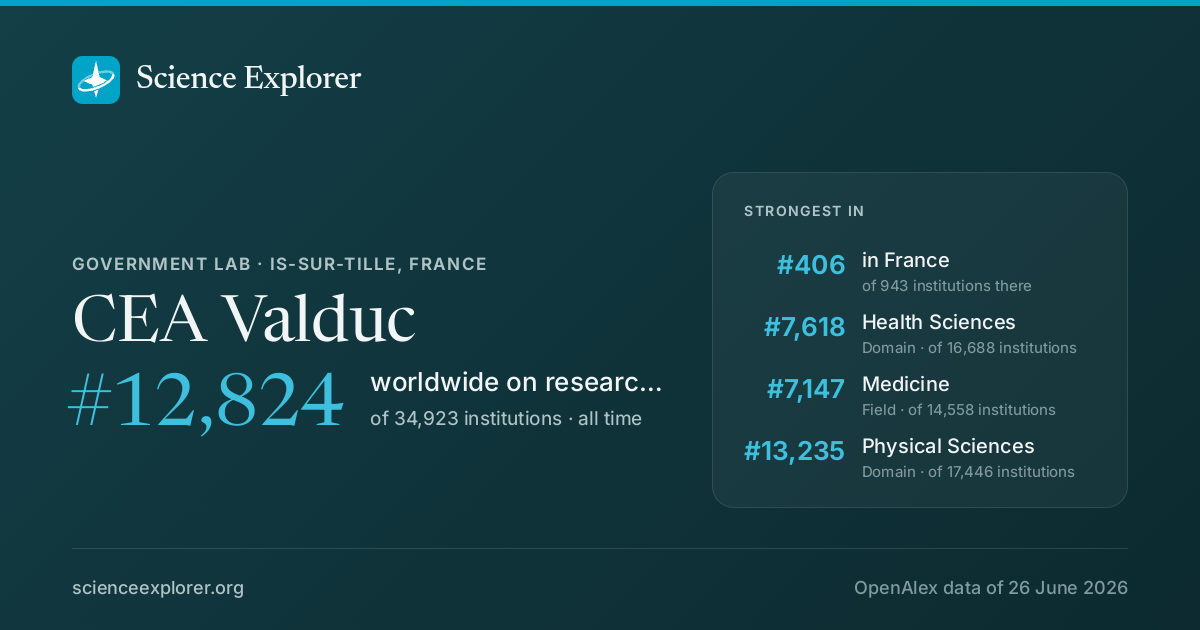
CEA Valduc on Science Explorer

A card with CEA Valduc's standing and the fields it leads in, for a post or a slide. A link to this page previews as the same card.

Download the card

1200 × 630 PNG, sized for social posts, drawn from the latest snapshot.

Badges for a website1Each links back here and updates with every snapshot

Research measures only: rankings here say nothing about teaching, admissions or student experience. Comparable institutions and collaboration partners have tabs of their own, above.

Discussion

Ask a question or share a note about CEA Valduc. Keep it to the research: no personal attacks, advertising or links. Any reader can report a post, which collapses it for everyone until it is opened.
