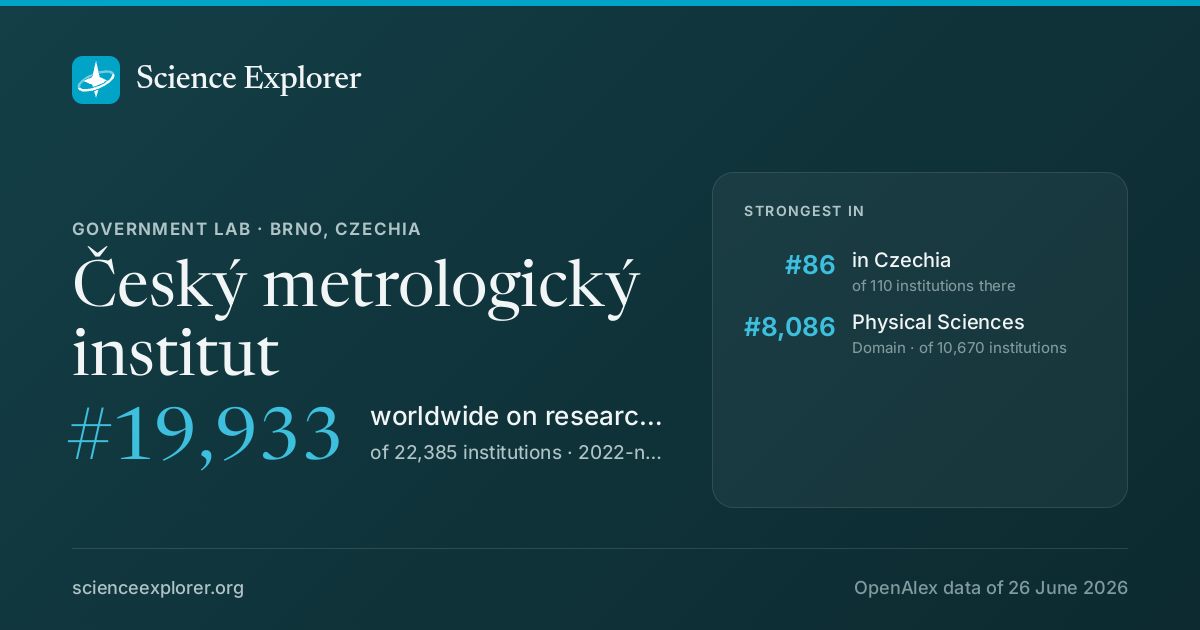
Český metrologický institut
In research, Český metrologický institut stands highest in Physical Sciences (#8,086 of 10,670 worldwide), 2022-now. Relative to its size it is most specialised in Electrical and Electronic Engineering (Electrical and Electronic Engineering is 6.2× its share of world research).
- World rank, 2022-now
- #19,933 of 22,385 · #18,826 all time
- Rank in Czechia
- #86 of 110
- Research works
- 496 ▼ 4% vs 2018-21
- Citations
- 5.1k 10.2 per fractional work
- Top-10% rate
- 6.0% all institutions 10.0%
- vs its own fields
- 0.97× 1.00× is exactly expected
- Open access
- 33% world 40%
- International
- 35% world 18%
What is Český metrologický institut known for in research?
The fields where it stands highest, 2022-now, ranked among every institution above the floor in each field.
| Field | World rank | Where that sits | Top-10% rate | Works | All time |
|---|---|---|---|---|---|
| Physical SciencesDomain | #8,086 of 10,670 | 7.1% | 69 | #7628 |
Each strip is that field's whole ranked pool, with the notch where Český metrologický institut sits in it, in the colour of the band that rank falls in. The track under the rate is the rate itself: it carries no average mark, because the average differs by field (from about 6% in Dentistry to 21% in Economics).
Which fields of science does Český metrologický institut work in?
In 2022-now, 81% of research at Český metrologický institut is in Physical Sciences, 10% in Social Sciences. Its largest fields are Engineering (49%), Physics and Astronomy (14%), Decision Sciences (9%). It does 2.0× the world's share of Physical Sciences.
Each ring splits the one inside it: the four domains of science, their fields, their subfields. Size is fractional works in 2022-now. Every slice is a page; the interactive view zooms down to single topics and colours each by how much more of it this institution does than the world.
Its 4 domains and 19 fields, with their numbers
- Physical Sciences8181.0%
- Engineering4949.0%
- Physics and Astronomy1413.9%
- Computer Science77.1%
- Materials Science44.2%
- Environmental Science33.0%
- Earth and Planetary Sciences11.1%
- Chemistry11.0%
- Chemical Engineering10.9%
- Mathematics10.9%
- Social Sciences1010.4%
- Decision Sciences98.9%
- Social Sciences10.7%
- Business, Management and Accounting10.5%
- Psychology00.3%
- Health Sciences66.1%
- Medicine55.1%
- Health Professions11.0%
- Life Sciences22.5%
What does Český metrologický institut specialise in?
Where its research is concentrated relative to its size: Electrical and Electronic Engineering takes 6.2× the share of its output that it takes of world research.
- Electrical and Electronic EngineeringSubfield · 22.2 works6.2×
Location quotient, a volume reading rather than an impact one. It surfaces small, lopsided specialities.
Field profile
Location quotient across every field it publishes in: outside the ring is more than an institution of this size would be expected to publish, inside it is less.
Rings at 0.5×, 1× and 2×. Widest outward: Decision Sciences, 9.2×. Every wedge is a field page.
All 19 fields, with their numbers
- Decision Sciences9.22×9 works
- Physics and Astronomy6.24×14 works
- Engineering3.27×49 works
- Chemical Engineering2.59×1 works
- Materials Science1.20×4 works
- Computer Science0.91×7 works
- Mathematics0.76×1 works
- Earth and Planetary Sciences0.69×1 works
- Chemistry0.65×1 works
- Environmental Science0.61×3 works
- Pharmacology, Toxicology and Pharmaceutics0.47×0 works
- Health Professions0.39×1 works
- Biochemistry, Genetics and Molecular Biology0.38×2 works
- Medicine0.27×5 works
- Business, Management and Accounting0.16×0 works
- Psychology0.09×0 works
- Agricultural and Biological Sciences0.05×0 works
- Social Sciences0.05×1 works
- Neuroscience0.04×0 works
- Decision Sciences 9.2×
- Physics and Astronomy 6.2×
- Engineering 3.3×
- Chemical Engineering 2.6×
- Materials Science 1.2×
- Computer Science 0.9×
- Mathematics 0.8×
- Earth and Planetary Sciences 0.7×
- Chemistry 0.7×
- Environmental Science 0.6×
- Pharmacology, Toxicology and Pharmaceutics 0.5×
- Health Professions 0.4×
- Biochemistry, Genetics and Molecular Biology 0.4×
- Medicine 0.3×
- Business, Management and Accounting 0.2×
- Psychology 0.1×
- Agricultural and Biological Sciences 0.1×
- Social Sciences 0.1×
- Neuroscience 0.0×
Who are the top researchers at Český metrologický institut?
Ranked on the quality score, J. Šolc, Geiland Porrovecchio and Pavel Mašika lead among researchers whose main affiliation is Český metrologický institut.
- 1
J. Šolc
 Czechia · #12,459 worldwide
63k citations · 780 works
- 2
Geiland Porrovecchio
Czechia · #2,991,838 worldwide
1.9k citations · 92 works
- 3
Pavel Mašika
Czechia · #3,173,588 worldwide
285 citations · 16 works
- 4
Martina Králová
Czechia · #3,251,971 worldwide
2 citations · 37 works
- 5
Marek Šmíd
Czechia · #3,294,910 worldwide
832 citations · 63 works
- 6
Petr Balling
Czechia · #3,662,118 worldwide
723 citations · 54 works
- 7
Lenka Kňazovická
Czechia · #3,980,590 worldwide
131 citations · 43 works
- 8
Lukáš Vavrečka
Czechia · #4,296,077 worldwide
17 citations · 19 works
- 9
Michal Voldán
Czechia · #4,367,096 worldwide
8 citations · 17 works
- 10
Jakub Sýkora
Czechia · #4,481,014 worldwide
52 citations · 26 works
Which keywords describe research at Český metrologický institut?
By fractional works in 2022-now, weighted toward what it does more of than the world: Quality Assurance, Measurement Uncertainty, Redefinition of SI Units, Fourier Coefficients, Frequency Estimation, Artificial Neural Networks, Smart Sensors and IEEE 1451.
- Quantum Dots
- Radionuclides
- Dimensional Metrology
- Microfluidic
- Machine Tools
- Radiation Detection
- Dielectric
- Radiometric Calibration
- Microwave
- Sensors
- Small-Angle Scattering
- Delta-Sigma Modulator
- Resonators
- Health Effects
- Monte Carlo Simulation
- Transducer Interface Standards
- Smart Sensors
- Neural Networks
- Fourier Coefficients
- Measurement Uncertainty
- Quality Assurance
- Redefinition of SI Units
- Frequency Estimation
- Artificial Neural Networks
- IEEE 1451
- Data Analysis
- CMOS Technology
- Microfabrication
- Tomography
- Neutron Imaging
- Characterization
- Gas Turbine Engines
- On-Orbit Performance
- Biosensing
- High Temperature Sensors
- Thin Film Thermocouples
- Metamaterial
- Signal Processing
- Error Compensation
- CMOS
Size is fractional works in 2022-now in the topics tagged with each word; colour is the word's share of this institution's work against its share of the world's. The 40 words are chosen for being large and distinctive. Each links to the topic it comes from most.
All 40 words, with their numbers
- Quality Assurance9▲ 53×2 topics
- Measurement Uncertainty8▲ 837×1 topic
- Redefinition of SI Units8▲ 837×1 topic
- Fourier Coefficients4▲ 661×1 topic
- Frequency Estimation4▲ 661×1 topic
- Neural Networks4▲ 2.5×5 topics
- Artificial Neural Networks4▲ 8.0×5 topics
- Smart Sensors4▲ 44×2 topics
- IEEE 14513▲ 151×1 topic
- Transducer Interface Standards3▲ 151×1 topic
- Data Analysis3▲ 12×2 topics
- Monte Carlo Simulation3▲ 16×5 topics
- CMOS Technology3▲ 37×5 topics
- Health Effects3▲ 4.4×6 topics
- Microfabrication3▲ 62×2 topics
- Resonators3▲ 57×3 topics
- Tomography3▲ 15×3 topics
- Delta-Sigma Modulator2▲ 77×2 topics
- Neutron Imaging2▲ 77×1 topic
- Small-Angle Scattering2▲ 48×1 topic
- Characterization2▲ 18×4 topics
- Sensors2▲ 20×2 topics
- Gas Turbine Engines2▲ 45×2 topics
- Microwave2▲ 53×3 topics
- On-Orbit Performance2▲ 215×1 topic
- Radiometric Calibration2▲ 215×1 topic
- Biosensing2▲ 25×2 topics
- Dielectric2▲ 82×2 topics
- High Temperature Sensors2▲ 199×1 topic
- Radiation Detection2▲ 49×2 topics
- Thin Film Thermocouples2▲ 199×1 topic
- Machine Tools2▲ 31×2 topics
- Metamaterial2▲ 23×1 topic
- Microfluidic2▲ 209×1 topic
- Signal Processing2▲ 14×2 topics
- Dimensional Metrology2▲ 94×1 topic
- Error Compensation2▲ 94×1 topic
- Radionuclides2▲ 49×2 topics
- CMOS2▲ 36×2 topics
- Quantum Dots2▲ 19×3 topics
Which research topics does Český metrologický institut publish most on?
By volume in 2022-now: Scientific Measurement and Uncertainty Evaluation, Advanced Electrical Measurement Techniques, Sensor Technology and Measurement Systems and Nuclear Physics and Applications.
Area is fractional works; colour is the subfield each topic belongs to.
- 1 Scientific Measurement and Uncertainty Evaluation Statistics, Probability and Uncertainty 8 works
- 2 Advanced Electrical Measurement Techniques Electrical and Electronic Engineering 4 works
- 3 Sensor Technology and Measurement Systems Computer Networks and Communications 3 works
- 4 Nuclear Physics and Applications Radiation 2 works
- 5 Calibration and Measurement Techniques Aerospace Engineering 2 works
- 6 Advanced Sensor Technologies Research Biomedical Engineering 2 works
- 7 Microwave and Dielectric Measurement Techniques Electrical and Electronic Engineering 2 works
- 8 Advanced Measurement and Metrology Techniques Mechanical Engineering 2 works
- 9 Electromagnetic Compatibility and Measurements Electrical and Electronic Engineering 2 works
- 10 Radiation Detection and Scintillator Technologies Radiation 1 works
How open and international is its research?
Against the world's own shares: the tick on each track. Both are shares of its output, so they sit on one scale and can be read against each other as well as against the world.
World: 40% of research is openly available.
World: 18% is written across borders.
How has Český metrologický institut's research output changed?
Output in 2022-2025 was 4% lower than in 2018-2021.
The same series as a ribbon: one cell per year, darker for more. The line above answers how much; this answers when.
Its share of all research
Growing output can still be a shrinking share: all of science grows. This is Český metrologický institut as a percentage of every work published that year, 0.00037% in 2024.
Fractional works of Český metrologický institut over all fractional works that year. How the balance of science has shifted.
How much of it reaches the world top 10%
Year by year, against all institutions in the same year.
Of each year's output, the share that reached the world's 10% most cited for its field and year. Peak 22.3% in 2011.
Other research institutions in Brno
- Masaryk University
- Brno University of Technology
- Mendel University in Brno
- University of Defence
- University of Veterinary Sciences Brno
- St. Anne's University Hospital Brno
- Veterinary Research Institute
- Research Institute for Pharmacy and Biochemistry (Czechia)


Share Český metrologický institut's ranking
Badges for a website1Each links back here and updates with every snapshot

Research measures only: rankings here say nothing about teaching, admissions or student experience. Comparable institutions and collaboration partners have tabs of their own, above.
Discussion
Ask a question or share a note about Český metrologický institut. Posts are plain text and can be reported.