Science Explorer Back to mapMap
Discussion
Institution · Miami · United States

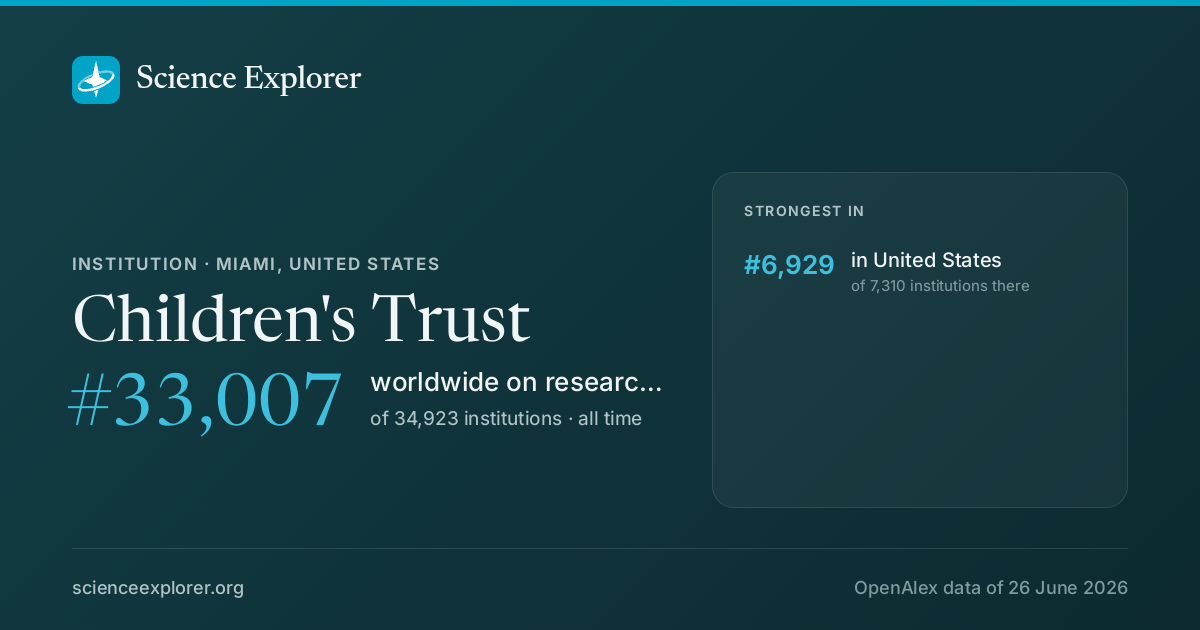
Children's Trust

World rank, all time
#33,007
of 34,923
Rank in United States
#6,929
of 7,310
Research works
157
▼ 51% vs 2018-21
Citations
1.5k
9.3 per fractional work
Top-10% rate
11.0%
all institutions 10.0%
vs its own fields
0.84×
1.00× is exactly expected
Open access
16%
world 40%
International
13%
world 18%

Which fields of science does Children's Trust work in?

In all years, 52% of research at Children's Trust is in Health Sciences, 42% in Social Sciences. Its largest fields are Medicine (31%), Health Professions (19%), Social Sciences (19%). It does 2.1× the world's share of Health Sciences.

Health Sciences: 82 fractional works · 52.1% of its workMedicine: 49 fractional works · 31.5% of its workPsychiatry and Mental health: 11 fractional works · 6.8% of its workPediatrics, Perinatology and Child Health: 9 fractional works · 5.9% of its workEpidemiology: 7 fractional works · 4.4% of its workPublic Health, Environmental and Occupational Health: 5 fractional works · 3.2% of its workRehabilitation: 4 fractional works · 2.8% of its workPulmonary and Respiratory Medicine: 2 fractional works · 1.4% of its workNeurology: 2 fractional works · 1.3% of its workPhysiology: 2 fractional works · 1.1% of its workEmergency Medicine: 2 fractional works · 1.0% of its workGeriatrics and Gerontology: 1 fractional works · 0.5% of its workOncology: 1 fractional works · 0.4% of its workAnatomy: 0 fractional works · 0.3% of its workSurgery: 0 fractional works · 0.3% of its workGenetics: 0 fractional works · 0.3% of its workReproductive Medicine: 0 fractional works · 0.3% of its workDermatology: 0 fractional works · 0.2% of its workEndocrinology, Diabetes and Metabolism: 0 fractional works · 0.2% of its workHematology: 0 fractional works · 0.2% of its workPharmacology: 0 fractional works · 0.2% of its workUrology: 0 fractional works · 0.2% of its workSmaller subfields together: 1 fractional works · 0.4% of its workHealth Professions: 30 fractional works · 19.4% of its workGeneral Health Professions: 24 fractional works · 15.3% of its workSpeech and Hearing: 2 fractional works · 1.2% of its workRadiological and Ultrasound Technology: 2 fractional works · 1.0% of its workOccupational Therapy: 1 fractional works · 0.9% of its workEmergency Medical Services: 1 fractional works · 0.3% of its workMedical Laboratory Technology: 0 fractional works · 0.2% of its workMedical Terminology: 0 fractional works · 0.2% of its workSmaller subfields together: 0 fractional works · 0.2% of its workNursing: 1 fractional works · 0.8% of its workNutrition and Dietetics: 1 fractional works · 0.7% of its workSmaller subfields together: 0 fractional works · 0.1% of its workVeterinary: 0 fractional works · 0.2% of its workSmall Animals: 0 fractional works · 0.2% of its workDentistry: 0 fractional works · 0.2% of its workSocial Sciences: 66 fractional works · 42.1% of its workSocial Sciences: 30 fractional works · 19.3% of its workEducation: 12 fractional works · 7.6% of its workSafety Research: 4 fractional works · 2.8% of its workSociology and Political Science: 3 fractional works · 2.1% of its workDemography: 3 fractional works · 2.0% of its workGender Studies: 2 fractional works · 1.5% of its workHealth: 2 fractional works · 1.5% of its workLaw: 1 fractional works · 0.9% of its workPublic Administration: 0 fractional works · 0.2% of its workPolitical Science and International Relations: 0 fractional works · 0.2% of its workTransportation: 0 fractional works · 0.2% of its workSmaller subfields together: 0 fractional works · 0.2% of its workPsychology: 27 fractional works · 17.5% of its workClinical Psychology: 22 fractional works · 14.1% of its workDevelopmental and Educational Psychology: 2 fractional works · 1.4% of its workSocial Psychology: 2 fractional works · 1.1% of its workApplied Psychology: 1 fractional works · 0.5% of its workNeuropsychology and Physiological Psychology: 0 fractional works · 0.2% of its workSmaller subfields together: 0 fractional works · 0.1% of its workBusiness, Management and Accounting: 4 fractional works · 2.5% of its workAccounting: 2 fractional works · 1.3% of its workOrganizational Behavior and Human Resource Management: 1 fractional works · 0.8% of its workStrategy and Management: 1 fractional works · 0.4% of its workEconomics, Econometrics and Finance: 3 fractional works · 1.6% of its workEconomics and Econometrics: 2 fractional works · 1.1% of its workFinance: 1 fractional works · 0.5% of its workArts and Humanities: 2 fractional works · 1.2% of its workConservation: 2 fractional works · 1.0% of its workLiterature and Literary Theory: 0 fractional works · 0.2% of its workDecision Sciences: 0 fractional works · 0.1% of its workPhysical Sciences: 6 fractional works · 3.7% of its workEnvironmental Science: 2 fractional works · 1.6% of its workEcology: 1 fractional works · 0.9% of its workHealth, Toxicology and Mutagenesis: 1 fractional works · 0.4% of its workGlobal and Planetary Change: 0 fractional works · 0.3% of its workSmaller subfields together: 0 fractional works · 0.0% of its workComputer Science: 2 fractional works · 1.1% of its workInformation Systems: 2 fractional works · 1.1% of its workEngineering: 1 fractional works · 0.4% of its workBiomedical Engineering: 0 fractional works · 0.2% of its workSmaller subfields together: 0 fractional works · 0.2% of its workEarth and Planetary Sciences: 0 fractional works · 0.3% of its workGeology: 0 fractional works · 0.3% of its workMathematics: 0 fractional works · 0.3% of its workStatistics and Probability: 0 fractional works · 0.3% of its workLife Sciences: 3 fractional works · 2.2% of its workNeuroscience: 2 fractional works · 1.4% of its workCognitive Neuroscience: 2 fractional works · 1.0% of its workCellular and Molecular Neuroscience: 0 fractional works · 0.2% of its workSmaller subfields together: 0 fractional works · 0.1% of its workBiochemistry, Genetics and Molecular Biology: 1 fractional works · 0.6% of its workMolecular Biology: 0 fractional works · 0.3% of its workGenetics: 0 fractional works · 0.3% of its workAgricultural and Biological Sciences: 0 fractional works · 0.1% of its workImmunology and Microbiology: 0 fractional works · 0.1% of its workALL ITS WORKChildren's Trust157fractional works, all years
Life Sciences2%Physical Sciences4%Health Sciences52%Social Sciences42%

Each ring splits the one inside it: the four domains of science, their fields, their subfields. Size is fractional works in all years. Every slice is a page; the interactive view zooms down to single topics and colours each by how much more of it this institution does than the world.

Its 4 domains and 20 fields, with their numbers
    1. Medicine4931.5%
    2. Health Professions3019.4%
    3. Nursing10.8%
    4. Veterinary00.2%
    5. Dentistry00.2%
    1. Social Sciences3019.3%
    2. Psychology2717.5%
    3. Business, Management and Accounting42.5%
    4. Economics, Econometrics and Finance31.6%
    5. Arts and Humanities21.2%
    6. Decision Sciences00.1%
    1. Environmental Science21.6%
    2. Computer Science21.1%
    3. Engineering10.4%
    4. Earth and Planetary Sciences00.3%
    5. Mathematics00.3%
    1. Neuroscience21.4%
    2. Biochemistry, Genetics and Molecular Biology10.6%
    3. Agricultural and Biological Sciences00.1%
    4. Immunology and Microbiology00.1%
All of science, and how each field's share has moved since 1950: the Science domain explorer

Field profile

Location quotient across every field it publishes in: outside the ring is more than an institution of this size would be expected to publish, inside it is less.

Immunology and Microbiology: 0.15× its world share, 0 worksImmunology and Micro…Neuroscience: 0.76× its world share, 0 worksNeuroscienceEnvironmental Science: 0.93× its world share, 1 worksEnvironmental ScienceMathematics: 0.33× its world share, 0 worksMathematicsHealth Professions: 8.20× its world share, 3 worksHealth ProfessionsMedicine: 1.33× its world share, 4 worksMedicineArts and Humanities: 0.40× its world share, 0 worksArts and HumanitiesPsychology: 6.41× its world share, 3 worksPsychologySocial Sciences: 2.04× its world share, 4 worksSocial Sciences1×world share
more than its size predictsabout as predictedless

Rings at 0.5×, 1× and 2×. Widest outward: Health Professions, 8.2×. Every wedge is a field page.

All 9 fields, with their numbers
  1. Health Professions8.20×3 works
  2. Psychology6.41×3 works
  3. Social Sciences2.04×4 works
  4. Medicine1.33×4 works
  5. Environmental Science0.93×1 works
  6. Neuroscience0.76×0 works
  7. Arts and Humanities0.40×0 works
  8. Mathematics0.33×0 works
  9. Immunology and Microbiology0.15×0 works

Who are the top researchers at Children's Trust?

Ranked on the quality score, Melissa Strompolis, Aditi Srivastav and Lorna Wales lead among researchers whose main affiliation is Children's Trust.

  1. 1 Melissa Strompolis United States · #1,805,610 worldwide 753 citations · 37 works
  2. 2 Aditi Srivastav United States · #2,215,377 worldwide 589 citations · 25 works
  3. 3 Lorna Wales United States · #5,127,233 worldwide 152 citations · 23 works
  4. 4 Patricia Mucavele United States · #6,151,448 worldwide 48 citations · 51 works
All ranked researchers at Children's Trust

What are the most cited papers from Children's Trust?

The most cited paper from Children's Trust is "Influence of Reported Study Design Characteristics on Intervention Effect Estimates From Randomized, Controlled Trials" (Jelena Savović, Hayley E. Jones, Douglas G. Altman et al., 2012), with 1,065 citations. Next come "Stroke Prevention Trial in Sickle Cell Anemia" (277) and "Mental health needs of boys in secure care for serious or persistent offending: a prospective, longitudinal study" (168).

Most cited papers
#PaperReleasedCitations
1 Influence of Reported Study Design Characteristics on Intervention Effect Estimates From Randomized, Controlled Trials Jelena Savović, Hayley E. Jones, Douglas G. Altman et al. · Annals of Internal Medicine 18 Sep 2012 1,065
2 Stroke Prevention Trial in Sickle Cell Anemia Robert J. Adams et al. · Controlled Clinical Trials Open access Feb 1998 277
3 Mental health needs of boys in secure care for serious or persistent offending: a prospective, longitudinal study Leo Kroll, James J. Rothwell, David Bradley et al. · The Lancet Jun 2002 168
4 Gender and Cancer Support Group Participation Claudette R. Krizek, Cleora S. Roberts, Robin Ragan et al. · Cancer Practice Mar 1999 160
5 Safe, Stable, and Nurtured: Protective Factors against Poor Physical and Mental Health Outcomes Following Exposure to Adverse Childhood Experiences (ACEs) Elizabeth L. Crouch, Elizabeth Radcliff, Melissa Strompolis et al. · Journal of Child & Adolescent Trauma Open access 25 May 2018 156
All 60 most cited papers, with filters and sorting

Which keywords describe research at Children's Trust?

By fractional works in all years, weighted toward what it does more of than the world: Mental Health, Public Health, Primary Care, Resilience, Epidemiology, Social Determinants, Social Support and Health Equity.

▲ more of its work than of the world's◆ about the world's share▼ less than the world's

Size is fractional works in all years in the topics tagged with each word; colour is the word's share of this institution's work against its share of the world's. The 40 words are chosen for being large and distinctive. Each links to the topic it comes from most.

All 40 words, with their numbers
  1. Mental Health21▲ 12×19 topics
  2. Public Health19▲ 8.9×20 topics
  3. Epidemiology18▲ 2.9×23 topics
  4. Primary Care17▲ 25×12 topics
  5. Resilience14▲ 22×5 topics
  6. Social Determinants9▲ 30×3 topics
  7. Social Support8▲ 12×10 topics
  8. Health Equity8▲ 28×2 topics
  9. Healthcare8▲ 7.2×7 topics
  10. Training8▲ 27×3 topics
  11. Adolescents7▲ 13×7 topics
  12. Community Health7▲ 33×1 topic
  13. Pediatrics7▲ 107×1 topic
  14. Psychiatric Disorders7▲ 30×3 topics
  15. Adverse Experiences7▲ 117×1 topic
  16. Childhood Trauma7▲ 64×1 topic
  17. Rehabilitation6▲ 11×2 topics
  18. Cerebral Palsy6▲ 52×1 topic
  19. ICF Model6▲ 102×1 topic
  20. Coping Strategies6▲ 23×3 topics
  21. Caregiver Well-Being6▲ 77×1 topic
  22. Parenting Stress6▲ 53×1 topic
  23. Encephalopathy5▲ 54×2 topics
  24. Concussion5▲ 89×1 topic
  25. Developmental Trajectories5▲ 25×3 topics
  26. Neurological5▲ 89×1 topic
  27. Depression5▲ 4.2×8 topics
  28. Executive Functioning5▲ 27×3 topics
  29. Child Development4▲ 9.9×5 topics
  30. Academic Achievement4▲ 19×2 topics
  31. Pedagogy4▲ 8.2×7 topics
  32. Health Disparities4▲ 12×4 topics
  33. Health Care Utilization4▲ 18×2 topics
  34. Neurodevelopmental Outcomes4▲ 12×3 topics
  35. Constraint-Induced Therapy4▲ 42×1 topic
  36. Emotion Regulation4▲ 7.3×4 topics
  37. Motor Recovery4▲ 42×1 topic
  38. Neural Plasticity4▲ 12×2 topics
  39. Cognitive Function4▲ 11×2 topics
  40. Elderly Care4▲ 17×2 topics

Which research topics does Children's Trust publish most on?

By volume in 2022-now: Cerebral Palsy and Movement Disorders, Gender, Labor, and Family Dynamics, Child and Adolescent Health and Family and Disability Support Research.

  1. 1 Cerebral Palsy and Movement Disorders Psychiatry and Mental health 2 works
  2. 2 Gender, Labor, and Family Dynamics Gender Studies 1 works
  3. 3 Child and Adolescent Health General Health Professions 1 works
  4. 4 Family and Disability Support Research Clinical Psychology 1 works
  5. 5 Health disparities and outcomes Health 1 works
  6. 6 Child Abuse and Trauma Clinical Psychology 1 works
  7. 7 Climate Change and Health Impacts Health, Toxicology and Mutagenesis 1 works
  8. 8 Child and Adolescent Psychosocial and Emotional Development Clinical Psychology 1 works
  9. 9 Infant Development and Preterm Care Pediatrics, Perinatology and Child Health 1 works
  10. 10 Food Security and Health in Diverse Populations General Health Professions 0 works

How open and international is its research?

Against the world's own shares: the tick on each track. Both are shares of its output, so they sit on one scale and can be read against each other as well as against the world.

openly available15.6%not open84.4%

World: 40% of research is openly available.

with international co-authors12.6%domestic only87.4%

World: 18% is written across borders.

How has Children's Trust's research output changed?

Output in 2022-2025 was 51% lower than in 2018-2021.

still counting1990200020102020
grewheldshrank

The same series as a ribbon: one cell per year, darker for more. The line above answers how much; this answers when.

Its share of all research

Growing output can still be a shrinking share: all of science grows. This is Children's Trust as a percentage of every work published that year, 0.000034% in 2024.

still counting0.00020%0.00040%0.00060%Children's Trust0.000052% in 202519801990200020102020

Fractional works of Children's Trust over all fractional works that year. How the balance of science has shifted.

Other research institutions in Miami

All research institutions in Miami

Share Children's Trust's ranking

Children's Trust on Science Explorer

A card with Children's Trust's standing and the fields it leads in, for a post or a slide. A link to this page previews as the same card.

Download the card

1200 × 630 PNG, sized for social posts, drawn from the latest snapshot.

Badges for a website1Each links back here and updates with every snapshot

Research measures only: rankings here say nothing about teaching, admissions or student experience. Comparable institutions and collaboration partners have tabs of their own, above.

Discussion

Ask a question or share a note about Children's Trust. Posts are plain text and can be reported.