CHN Energy (China)
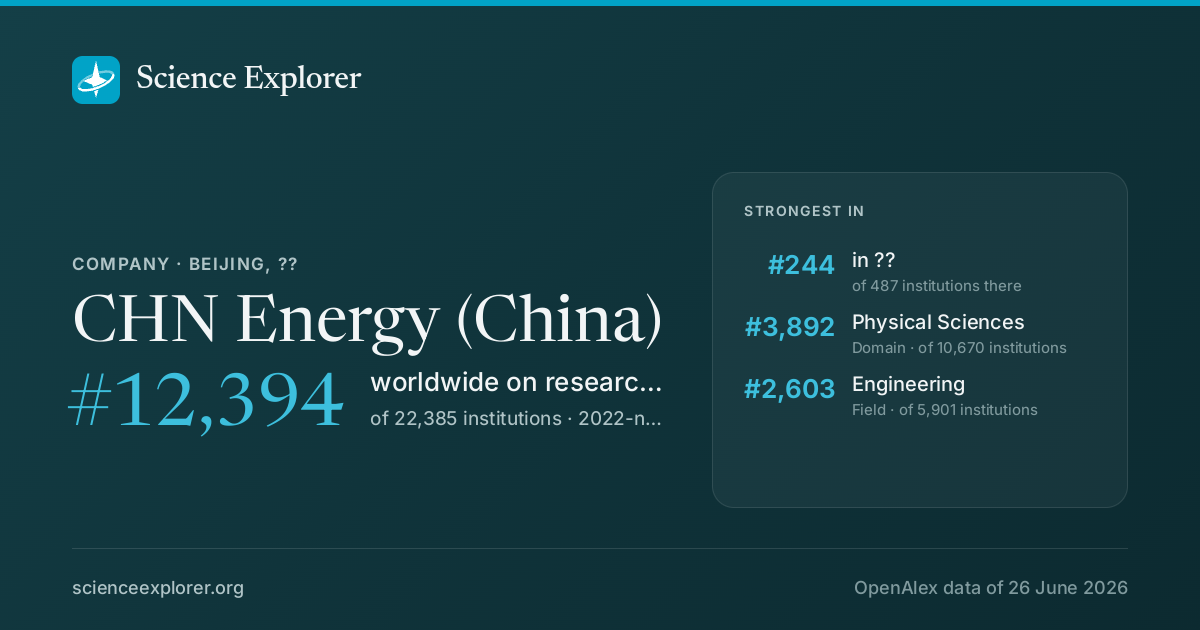
In research, CHN Energy (China) stands highest in Physical Sciences (#3,892 of 10,670 worldwide) and Engineering (#2,603 of 5,901 worldwide), 2022-now.
- World rank, 2022-now
- #12,394 of 22,385 · #26,595 all time
- Rank in ??
- #244 of 487
- Research works
- 229 ▲ 318% vs 2018-21
- Citations
- 1.7k 7.2 per fractional work
- Top-10% rate
- 9.5% all institutions 10.0%
- vs its own fields
- 1.00× 1.00× is exactly expected
- Open access
- 50% world 40%
- International
- 6% world 18%
What is CHN Energy (China) known for in research?
The fields where it stands highest, 2022-now, ranked among every institution above the floor in each field.
| Field | World rank | Where that sits | Top-10% rate | Works | All time |
|---|---|---|---|---|---|
| Physical SciencesDomain | #3,892 of 10,670 | 9.4% | 168 | #8416 | |
| EngineeringField | #2,603 of 5,901 | 8.7% | 108 | #5457 |
Each strip is that field's whole ranked pool, with the notch where CHN Energy (China) sits in it, in the colour of the band that rank falls in. The track under the rate is the rate itself: it carries no average mark, because the average differs by field (from about 6% in Dentistry to 21% in Economics).
Which fields of science does CHN Energy (China) work in?
In 2022-now, 92% of research at CHN Energy (China) is in Physical Sciences, 6% in Social Sciences. Its largest fields are Engineering (60%), Environmental Science (10%), Energy (7%). It does 2.3× the world's share of Physical Sciences.
Each ring splits the one inside it: the four domains of science, their fields, their subfields. Size is fractional works in 2022-now. Every slice is a page; the interactive view zooms down to single topics and colours each by how much more of it this institution does than the world.
Its 4 domains and 19 fields, with their numbers
- Physical Sciences17192.2%
- Engineering11159.6%
- Environmental Science189.8%
- Energy126.5%
- Computer Science126.3%
- Materials Science94.8%
- Earth and Planetary Sciences52.8%
- Chemical Engineering21.0%
- Chemistry21.0%
- Physics and Astronomy10.4%
- Social Sciences126.4%
- Health Sciences20.9%
- Medicine10.5%
- Health Professions10.3%
- Life Sciences10.6%
Field profile
Location quotient across every field it publishes in: outside the ring is more than an institution of this size would be expected to publish, inside it is less.
Rings at 0.5×, 1× and 2×. Widest outward: Energy, 7.1×. Every wedge is a field page.
All 19 fields, with their numbers
- Energy7.11×12 works
- Engineering3.97×111 works
- Chemical Engineering2.92×2 works
- Environmental Science1.96×18 works
- Decision Sciences1.94×4 works
- Earth and Planetary Sciences1.77×5 works
- Materials Science1.38×9 works
- Computer Science0.82×12 works
- Business, Management and Accounting0.74×4 works
- Chemistry0.62×2 works
- Economics, Econometrics and Finance0.26×1 works
- Physics and Astronomy0.19×1 works
- Health Professions0.13×1 works
- Social Sciences0.11×3 works
- Neuroscience0.07×0 works
- Agricultural and Biological Sciences0.05×0 works
- Biochemistry, Genetics and Molecular Biology0.04×0 works
- Psychology0.04×0 works
- Medicine0.03×1 works
- Energy 7.1×
- Engineering 4.0×
- Chemical Engineering 2.9×
- Environmental Science 2.0×
- Decision Sciences 1.9×
- Earth and Planetary Sciences 1.8×
- Materials Science 1.4×
- Computer Science 0.8×
- Business, Management and Accounting 0.7×
- Chemistry 0.6×
- Economics, Econometrics and Finance 0.3×
- Physics and Astronomy 0.2×
- Health Professions 0.1×
- Social Sciences 0.1×
- Neuroscience 0.1×
- Agricultural and Biological Sciences 0.1×
- Biochemistry, Genetics and Molecular Biology 0.0×
- Psychology 0.0×
- Medicine 0.0×
Which keywords describe research at CHN Energy (China)?
By fractional works in 2022-now, weighted toward what it does more of than the world: Renewable Energy, Smart Grid, Energy Efficiency, Environmental Impact, Energy Storage, Power Systems, Battery Technology and Neural Networks.
- Fault Diagnosis
- Pore Structure
- Energy Transition
- Distribution Automation
- Coal Seam
- Renewable Fuels
- Biochar
- Reliability Analysis
- Heat Transfer
- Rock Mechanics
- Power System
- Power Electronics
- Wind Power
- Grid Integration
- Battery Technology
- Internet of Things
- Neural Networks
- Energy Storage
- Energy Efficiency
- Smart Grid
- Renewable Energy
- Environmental Impact
- Deep Learning
- Machine Learning
- Remote Sensing
- Power Systems
- Frequency Regulation
- Risk Assessment
- Big Data
- Photovoltaic Generation
- Renewable Energy Integration
- Numerical Simulation
- Intelligent Control
- Cloud Computing
- Fuzzy Logic
- CO2 Sequestration
- Genetic Algorithm
- Electric Power
- Robotics
- District Heating
Size is fractional works in 2022-now in the topics tagged with each word; colour is the word's share of this institution's work against its share of the world's. The 40 words are chosen for being large and distinctive. Each links to the topic it comes from most.
All 40 words, with their numbers
- Renewable Energy25▲ 9.2×26 topics
- Smart Grid15▲ 22×7 topics
- Environmental Impact14▲ 4.3×20 topics
- Energy Efficiency12▲ 7.0×15 topics
- Deep Learning12▲ 1.82×30 topics
- Energy Storage10▲ 8.6×9 topics
- Machine Learning10▲ 1.62×22 topics
- Neural Networks10▲ 3.5×14 topics
- Remote Sensing9▲ 3.8×21 topics
- Internet of Things8▲ 4.7×10 topics
- Power Systems7▲ 37×2 topics
- Battery Technology7▲ 14×3 topics
- Frequency Regulation7▲ 65×2 topics
- Grid Integration7▲ 35×3 topics
- Risk Assessment7▲ 5.4×7 topics
- Wind Power7▲ 39×3 topics
- Big Data6▲ 3.6×7 topics
- Power Electronics6▲ 11×8 topics
- Photovoltaic Generation6▲ 83×1 topic
- Power System6▲ 38×4 topics
- Renewable Energy Integration6▲ 9.5×5 topics
- Rock Mechanics6▲ 32×3 topics
- Numerical Simulation6▲ 10×9 topics
- Heat Transfer4▲ 4.8×11 topics
- Intelligent Control4▲ 60×2 topics
- Reliability Analysis4▲ 23×2 topics
- Cloud Computing4▲ 7.8×2 topics
- Biochar4▲ 12×4 topics
- Fuzzy Logic4▲ 8.9×3 topics
- Renewable Fuels4▲ 17×3 topics
- CO2 Sequestration4▲ 10×4 topics
- Coal Seam4▲ 100×2 topics
- Genetic Algorithm4▲ 15×2 topics
- Distribution Automation4▲ 88×1 topic
- Electric Power4▲ 88×1 topic
- Energy Transition4▲ 13×3 topics
- Robotics4▲ 8.1×4 topics
- Pore Structure4▲ 16×3 topics
- District Heating4▲ 37×1 topic
- Fault Diagnosis4▲ 13×3 topics
Which research topics does CHN Energy (China) publish most on?
By volume in 2022-now: Power Systems and Renewable Energy, Smart Grid and Power Systems, Integrated Energy Systems Optimization and Rock Mechanics and Modeling.
Area is fractional works; colour is the subfield each topic belongs to.
- 1 Power Systems and Renewable Energy Energy Engineering and Power Technology 6 works
- 2 Smart Grid and Power Systems Electrical and Electronic Engineering 4 works
- 3 Integrated Energy Systems Optimization Electrical and Electronic Engineering 4 works
- 4 Rock Mechanics and Modeling Mechanics of Materials 3 works
- 5 Thermochemical Biomass Conversion Processes Biomedical Engineering 3 works
- 6 Coal Properties and Utilization Ocean Engineering 3 works
- 7 Advanced Algorithms and Applications Control and Systems Engineering 3 works
- 8 Microgrid Control and Optimization Control and Systems Engineering 2 works
- 9 Smart Grid Energy Management Electrical and Electronic Engineering 2 works
- 10 Catalytic Processes in Materials Science Materials Chemistry 2 works
How open and international is its research?
Against the world's own shares: the tick on each track. Both are shares of its output, so they sit on one scale and can be read against each other as well as against the world.
World: 40% of research is openly available.
World: 18% is written across borders.
How has CHN Energy (China)'s research output changed?
Output in 2022-2025 was 318% higher than in 2018-2021.
The same series as a ribbon: one cell per year, darker for more. The line above answers how much; this answers when.
Other research institutions in Beijing
- Chinese People's Armed Police Force
- China Telecom
- Kuaishou (China)
- Changcheng Institute of Metrology & Measurement
- State Key Laboratory of Kidney Diseases
- State Key Laboratory of Cardiovascular Disease
- China National Botanical Garden
- Didi Chuxing (China)

Share CHN Energy (China)'s ranking
Badges for a website1Each links back here and updates with every snapshot

Research measures only: rankings here say nothing about teaching, admissions or student experience. Comparable institutions and collaboration partners have tabs of their own, above.
Discussion
Ask a question or share a note about CHN Energy (China). Posts are plain text and can be reported.