Columbus University
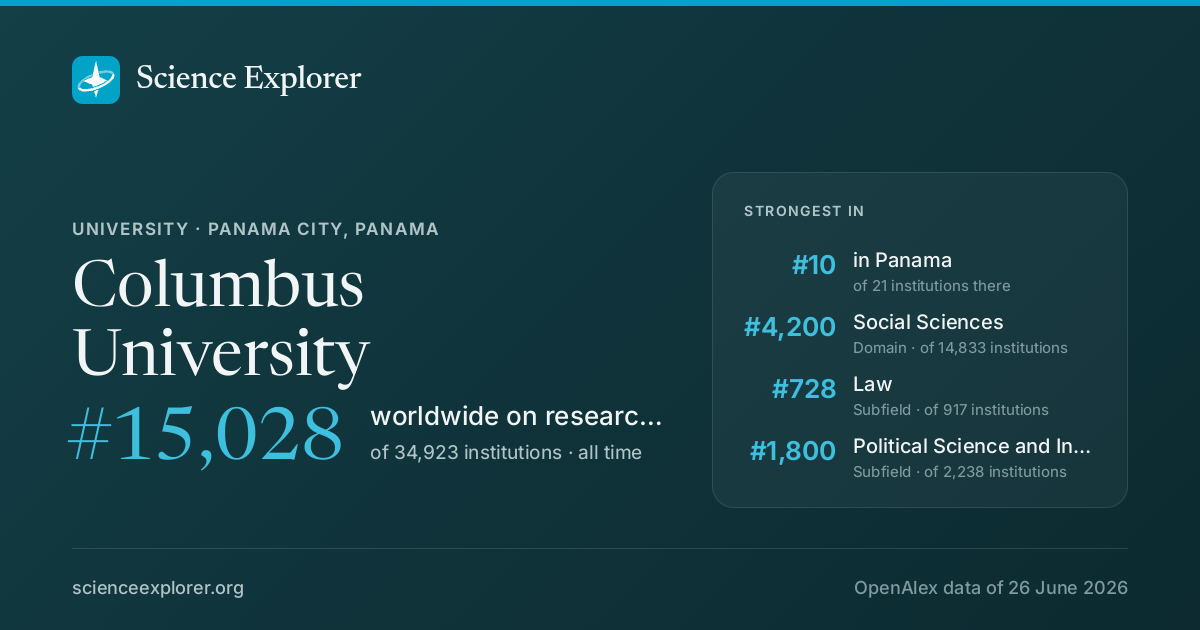
In research, Columbus University stands highest in Social Sciences (#4,200 of 14,833 worldwide), Social Sciences (#6,999 of 9,330 worldwide) and Law (#728 of 917 worldwide), over all time.
- World rank, all time
- #15,028 of 34,923
- Rank in Panama
- #10 of 21
- Research works
- 2k ▲ 101% vs 2018-21
- Citations
- 3.8k 1.9 per fractional work
- Top-10% rate
- 29.0% all institutions 10.0%
- vs its own fields
- 0.47× 1.00× is exactly expected
- Open access
- 78% world 40%
- International
- 2% world 18%
What is Columbus University known for in research?
The fields where it stands highest, over all time, ranked among every institution above the floor in each field.
| Field | World rank | Where that sits | Top-10% rate | Works |
|---|---|---|---|---|
| Social SciencesDomain | #4,200 of 14,833 | 2.9% | 1,646 | |
| Social SciencesField | #6,999 of 9,330 | 2.7% | 1,092 | |
| LawSubfield | #728 of 917 | 3.6% | 297 | |
| Political Science and International RelationsSubfield | #1,800 of 2,238 | 2.8% | 460 | |
| Sociology and Political ScienceSubfield | #3,542 of 4,066 | 1.7% | 201 | |
| Health SciencesDomain | #15,094 of 16,688 | 2.4% | 183 | |
| Business, Management and AccountingField | #3,583 of 3,886 | 3.1% | 215 | |
| Economics, Econometrics and FinanceField | #2,986 of 3,142 | 1.1% | 202 | |
| Economics and EconometricsSubfield | #2,288 of 2,401 | 1.0% | 171 |
Each strip is that field's whole ranked pool, with the notch where Columbus University sits in it, in the colour of the band that rank falls in. The track under the rate is the rate itself: it carries no average mark, because the average differs by field (from about 6% in Dentistry to 21% in Economics).
Which fields of science does Columbus University work in?
In all years, 84% of research at Columbus University is in Social Sciences, 9% in Health Sciences. Its largest fields are Social Sciences (56%), Business, Management and Accounting (11%), Economics, Econometrics and Finance (10%). It does 4.0× the world's share of Social Sciences.
Each ring splits the one inside it: the four domains of science, their fields, their subfields. Size is fractional works in all years. Every slice is a page; the interactive view zooms down to single topics and colours each by how much more of it this institution does than the world.
Its 4 domains and 24 fields, with their numbers
- Social Sciences1,64684.2%
- Social Sciences1,09255.9%
- Business, Management and Accounting21511.0%
- Economics, Econometrics and Finance20210.3%
- Arts and Humanities834.3%
- Psychology462.4%
- Decision Sciences80.4%
- Health Sciences1839.4%
- Medicine1065.4%
- Health Professions743.8%
- Nursing30.1%
- Physical Sciences934.8%
- Environmental Science341.7%
- Engineering281.4%
- Computer Science221.2%
- Earth and Planetary Sciences30.2%
- Energy20.1%
- Mathematics10.1%
- Physics and Astronomy10.0%
- Materials Science10.0%
- Chemical Engineering00.0%
- Chemistry00.0%
- Life Sciences321.6%
Field profile
Location quotient across every field it publishes in: outside the ring is more than an institution of this size would be expected to publish, inside it is less.
Rings at 0.5×, 1× and 2×. Widest outward: Arts and Humanities, 13.5×. Every wedge is a field page.
All 9 fields, with their numbers
- Arts and Humanities13.48×4 works
- Health Professions2.76×1 works
- Economics, Econometrics and Finance2.27×0 works
- Materials Science1.86×1 works
- Social Sciences1.45×2 works
- Medicine1.06×2 works
- Engineering0.22×0 works
- Business, Management and Accounting0.14×0 works
- Agricultural and Biological Sciences0.02×0 works
Who are the top researchers at Columbus University?
Ranked on the quality score, James Edward McKeown, William A. Kaplin and Stewart A. Baker lead among researchers whose main affiliation is Columbus University.
- 1
James Edward McKeown
 Panama · #986,425 worldwide
575 citations · 38 works
- 2
William A. Kaplin
Panama · #2,963,934 worldwide
443 citations · 55 works
- 3
Stewart A. Baker
Panama · #3,061,956 worldwide
254 citations · 42 works
- 4
William J. Byrnes
Panama · #3,308,716 worldwide
91 citations · 36 works
- 5
Daniel M. Berman
Panama · #3,413,019 worldwide
158 citations · 40 works
- 6
Jack Valenti
Panama · #3,724,064 worldwide
31 citations · 21 works
- 7
Milton Viorst
Panama · #3,809,024 worldwide
199 citations · 48 works
- 8
Roger C. Hartley
Panama · #4,145,738 worldwide
72 citations · 26 works
- 9
George E. Garvey
Panama · #4,230,176 worldwide
30 citations · 15 works
- 10
Sarah Helene Duggin
Panama · #4,319,377 worldwide
42 citations · 18 works
Which keywords describe research at Columbus University?
By fractional works in all years, weighted toward what it does more of than the world: Human Rights, Intellectual Property, Corporate Governance, Constitutional Law, Environmental Law, Criminal Justice, Policy Dimensions and Transnational Law.
- Enforcement
- Exclusionary Rule
- Welfare Rights Advice
- Access to Justice
- Criminal Trials
- Liability
- Freedom of Speech
- Media
- Global Governance
- Privacy
- Surveillance
- Equality
- American founding
- Regulation
- Federalism
- Public Opinion
- Transnational Law
- Criminal Justice
- Constitutional Law
- Intellectual Property
- Human Rights
- Corporate Governance
- Environmental Law
- Policy Dimensions
- Property Rights
- International Law
- Nationalism
- Globalization
- Constitutional government
- Democracy
- Discrimination
- Sovereignty
- Civil Rights
- First Amendment
- Privacy Rights
- Legal Education
- Professionalism
- Health Impacts
- Legal Ethics
- Human Rights Act
Size is fractional works in all years in the topics tagged with each word; colour is the word's share of this institution's work against its share of the world's. The 40 words are chosen for being large and distinctive. Each links to the topic it comes from most.
All 40 words, with their numbers
- Human Rights472▲ 28×49 topics
- Intellectual Property252▲ 127×7 topics
- Corporate Governance246▲ 23×17 topics
- Constitutional Law238▲ 93×4 topics
- Environmental Law224▲ 83×4 topics
- Criminal Justice214▲ 70×6 topics
- Policy Dimensions199▲ 452×1 topic
- Transnational Law199▲ 415×1 topic
- Property Rights131▲ 58×6 topics
- Public Opinion124▲ 35×5 topics
- International Law118▲ 22×22 topics
- Federalism118▲ 56×4 topics
- Nationalism116▲ 10×13 topics
- Regulation115▲ 9.6×10 topics
- Globalization113▲ 3.1×51 topics
- American founding98▲ 68×1 topic
- Constitutional government98▲ 68×1 topic
- Equality91▲ 62×6 topics
- Democracy91▲ 12×11 topics
- Surveillance76▲ 25×4 topics
- Discrimination72▲ 26×4 topics
- Privacy70▲ 20×5 topics
- Sovereignty70▲ 33×9 topics
- Global Governance70▲ 16×15 topics
- Civil Rights69▲ 50×3 topics
- Media67▲ 26×4 topics
- First Amendment66▲ 322×1 topic
- Freedom of Speech66▲ 322×1 topic
- Privacy Rights62▲ 155×2 topics
- Liability60▲ 81×2 topics
- Legal Education57▲ 46×3 topics
- Criminal Trials56▲ 130×2 topics
- Professionalism53▲ 21×4 topics
- Access to Justice52▲ 84×2 topics
- Health Impacts52▲ 41×1 topic
- Welfare Rights Advice52▲ 102×1 topic
- Legal Ethics48▲ 78×2 topics
- Exclusionary Rule47▲ 144×1 topic
- Human Rights Act47▲ 144×1 topic
- Enforcement47▲ 63×2 topics
Which research topics does Columbus University publish most on?
By volume in 2022-now: Medieval Literature and History, Simulation-Based Education in Healthcare, Innovations in Medical Education and Healthcare professionals’ stress and burnout.
Area is fractional works; colour is the subfield each topic belongs to.
- 1 Medieval Literature and History Classics 2 works
- 2 Simulation-Based Education in Healthcare Physiology 1 works
- 3 Innovations in Medical Education Public Health, Environmental and Occupational Health 1 works
- 4 Healthcare professionals’ stress and burnout General Health Professions 1 works
- 5 Historical and Archaeological Studies History 0 works
- 6 Medieval European History and Architecture Archeology 0 works
- 7 Legal Studies and Reforms Political Science and International Relations 0 works
- 8 Medieval Philosophy and Theology Philosophy 0 works
- 9 Digital Transformation in Law General Economics, Econometrics and Finance 0 works
- 10 Cardiac Health and Mental Health Cardiology and Cardiovascular Medicine 0 works
How open and international is its research?
Against the world's own shares: the tick on each track. Both are shares of its output, so they sit on one scale and can be read against each other as well as against the world.
World: 40% of research is openly available.
World: 18% is written across borders.
How has Columbus University's research output changed?
Output in 2022-2025 was 101% higher than in 2018-2021.
The same series as a ribbon: one cell per year, darker for more. The line above answers how much; this answers when.
Its share of all research
Growing output can still be a shrinking share: all of science grows. This is Columbus University as a percentage of every work published that year, 0.000072% in 2024.
Fractional works of Columbus University over all fractional works that year. How the balance of science has shifted.
How much of it reaches the world top 10%
Year by year, against all institutions in the same year.
Of each year's output, the share that reached the world's 10% most cited for its field and year. Peak 9.3% in 2011.
Other research institutions in Panama City
- Universidad de Panamá
- Universidad Tecnológica de Panamá
- Universidad Metropolitana de Educación, Ciencia y Tecnología
- Hospital del Niño
- Universidad de Santander
- Stem Cell Institute
- Instituto Conmemorativo Gorgas de Estudios de la Salud
- Panama Canal Authority
Share Columbus University's ranking
Badges for a website1Each links back here and updates with every snapshot

Research measures only: rankings here say nothing about teaching, admissions or student experience. Comparable institutions and collaboration partners have tabs of their own, above.
Discussion
Ask a question or share a note about Columbus University. Posts are plain text and can be reported.