COM DEV International
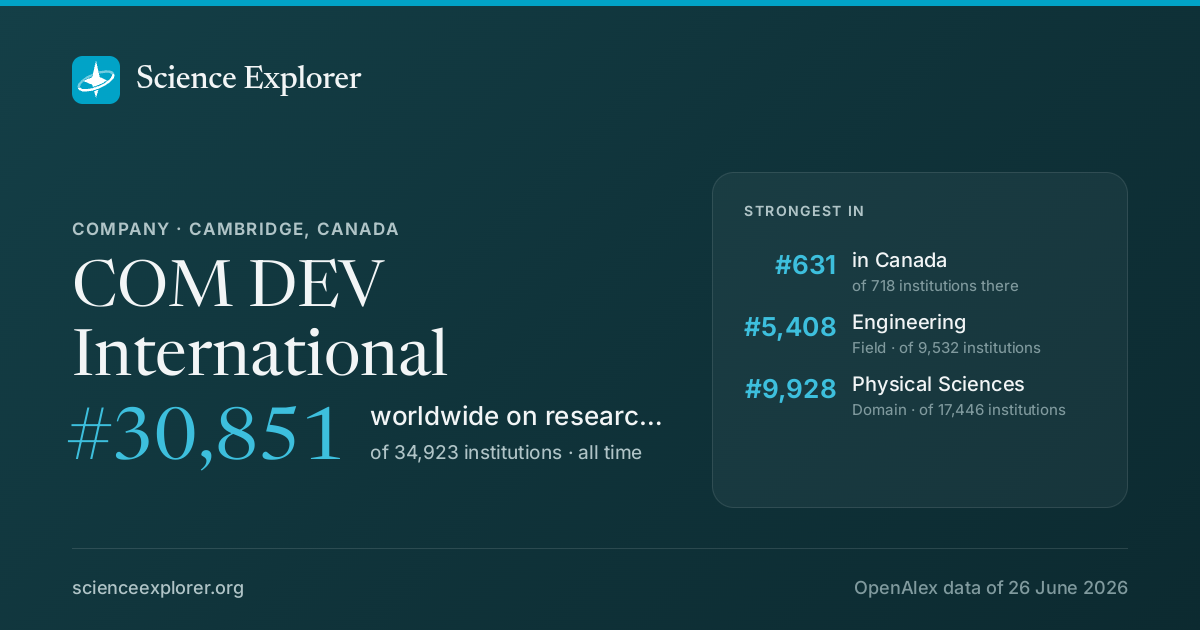
In research, COM DEV International stands highest in Engineering (#5,408 of 9,532 worldwide) and Physical Sciences (#9,928 of 17,446 worldwide), over all time.
- World rank, all time
- #30,851 of 34,923
- Rank in Canada
- #631 of 718
- Research works
- 267 ▲ 336% vs 2018-21
- Citations
- 5k 18.7 per fractional work
- Top-10% rate
- 1.8% all institutions 10.0%
- vs its own fields
- 0.96× 1.00× is exactly expected
- Open access
- 3% world 40%
- International
- 16% world 18%
What is COM DEV International known for in research?
The fields where it stands highest, over all time, ranked among every institution above the floor in each field.
| Field | World rank | Where that sits | Top-10% rate | Works |
|---|---|---|---|---|
| EngineeringField | #5,408 of 9,532 | 13.0% | 214 | |
| Physical SciencesDomain | #9,928 of 17,446 | 12.2% | 262 |
Each strip is that field's whole ranked pool, with the notch where COM DEV International sits in it, in the colour of the band that rank falls in. The track under the rate is the rate itself: it carries no average mark, because the average differs by field (from about 6% in Dentistry to 21% in Economics).
Which fields of science does COM DEV International work in?
In all years, 98% of research at COM DEV International is in Physical Sciences, 1% in Social Sciences. Its largest fields are Engineering (80%), Physics and Astronomy (11%), Computer Science (3%). It does 2.4× the world's share of Physical Sciences.
Each ring splits the one inside it: the four domains of science, their fields, their subfields. Size is fractional works in all years. Every slice is a page; the interactive view zooms down to single topics and colours each by how much more of it this institution does than the world.
Its 4 domains and 19 fields, with their numbers
- Physical Sciences26298.2%
- Engineering21480.3%
- Physics and Astronomy2910.7%
- Computer Science93.3%
- Earth and Planetary Sciences31.3%
- Materials Science31.0%
- Environmental Science20.9%
- Chemistry10.5%
- Chemical Engineering00.1%
- Energy00.0%
- Mathematics00.0%
- Social Sciences20.9%
- Health Sciences20.6%
- Medicine10.3%
- Health Professions10.2%
- Dentistry00.0%
- Life Sciences10.3%
Field profile
Location quotient across every field it publishes in: outside the ring is more than an institution of this size would be expected to publish, inside it is less.
Rings at 0.5×, 1× and 2×. Widest outward: Dentistry, 10.5×. Every wedge is a field page.
All 11 fields, with their numbers
- Dentistry10.49×0 works
- Energy5.54×0 works
- Environmental Science4.61×0 works
- Business, Management and Accounting3.55×0 works
- Engineering1.87×1 works
- Physics and Astronomy1.87×0 works
- Health Professions1.79×0 works
- Arts and Humanities1.59×0 works
- Materials Science1.46×0 works
- Social Sciences0.53×0 works
- Medicine0.11×0 works
Who are the top researchers at COM DEV International?
Ranked on the quality score, Richard J. Cameron, Van Dokas and Jeffrey S Cain lead among researchers whose main affiliation is COM DEV International.
- 1
Richard J. Cameron
 Canada · #500,785 worldwide
6.1k citations · 102 works
- 2
Van Dokas
Canada · #2,103,603 worldwide
422 citations · 16 works
- 3
Jeffrey S Cain
Canada · #2,461,151 worldwide
416 citations · 15 works
- 4
Chandra M. Kudsia
Canada · #2,545,906 worldwide
2.7k citations · 63 works
- 5
Fraser S. Thomson
Canada · #3,332,740 worldwide
190 citations · 19 works
- 6
Antonio Panariello
Canada · #3,582,740 worldwide
275 citations · 16 works
- 7
John Paul Hackett
Canada · #3,868,878 worldwide
312 citations · 35 works
- 8
A. R. Raab
Canada · #4,529,884 worldwide
39 citations · 22 works
- 9
Clinton E. Evans
Canada · #5,243,269 worldwide
135 citations · 24 works
- 10
Robert C. Peach
Canada · #5,488,386 worldwide
384 citations · 44 works
Which keywords describe research at COM DEV International?
By fractional works in all years, weighted toward what it does more of than the world: Artificial Neural Networks, Microwave Filters, Substrate Integrated Waveguide, Integrated Circuits, Millimeter-Wave, Frequency Selective Surfaces, Metasurfaces and Frequency Synthesizer.
- Electromagnetic Compatibility
- Microcavities
- Silicon Photonics
- CubeSat
- Resource Allocation
- Sensors
- Electromagnetics
- Biosensors
- Antenna
- Antenna Arrays
- Satellite Communications
- IoT Applications
- Optimization
- Metamaterial
- Low-Noise Amplifiers
- Acoustic Wave Biosensors
- Frequency Synthesizer
- Frequency Selective Surfaces
- Integrated Circuits
- Microwave Filters
- Artificial Neural Networks
- Substrate Integrated Waveguide
- Millimeter-Wave
- Metasurfaces
- CMOS
- Thin Film Resonators
- Oscillators
- Wireless Communications
- Particle Swarm Optimization
- LEO Satellite Constellation
- Stability Analysis
- Differential Evolution
- Microstrip
- Maxwell's Equations
- Finite-Difference Time-Domain
- Resonators
- Thermal Analysis
- small satellite
- Wireless Networks
- Optical Modulators
Size is fractional works in all years in the topics tagged with each word; colour is the word's share of this institution's work against its share of the world's. The 40 words are chosen for being large and distinctive. Each links to the topic it comes from most.
All 40 words, with their numbers
- Artificial Neural Networks52▲ 46×4 topics
- Microwave Filters51▲ 281×1 topic
- Substrate Integrated Waveguide51▲ 281×1 topic
- Integrated Circuits20▲ 32×2 topics
- Millimeter-Wave18▲ 127×2 topics
- Frequency Selective Surfaces18▲ 120×1 topic
- Metasurfaces18▲ 120×1 topic
- Frequency Synthesizer15▲ 89×2 topics
- CMOS14▲ 71×2 topics
- Acoustic Wave Biosensors14▲ 108×1 topic
- Thin Film Resonators14▲ 108×1 topic
- Low-Noise Amplifiers14▲ 130×1 topic
- Oscillators14▲ 130×1 topic
- Metamaterial13▲ 57×2 topics
- Wireless Communications10▲ 25×2 topics
- Optimization10▲ 6.7×2 topics
- Particle Swarm Optimization10▲ 33×3 topics
- IoT Applications10▲ 130×2 topics
- LEO Satellite Constellation9▲ 174×1 topic
- Satellite Communications9▲ 174×1 topic
- Stability Analysis9▲ 16×3 topics
- Antenna Arrays9▲ 115×1 topic
- Differential Evolution9▲ 52×1 topic
- Antenna9▲ 49×1 topic
- Microstrip9▲ 49×1 topic
- Biosensors8▲ 5.3×4 topics
- Maxwell's Equations8▲ 51×2 topics
- Electromagnetics7▲ 95×1 topic
- Finite-Difference Time-Domain7▲ 95×1 topic
- Sensors7▲ 19×3 topics
- Resonators7▲ 38×3 topics
- Resource Allocation6▲ 10×4 topics
- Thermal Analysis6▲ 16×2 topics
- CubeSat6▲ 97×1 topic
- small satellite6▲ 97×1 topic
- Silicon Photonics6▲ 14×2 topics
- Wireless Networks6▲ 9.2×2 topics
- Microcavities6▲ 13×1 topic
- Optical Modulators6▲ 9.9×1 topic
- Electromagnetic Compatibility5▲ 64×1 topic
Which research topics does COM DEV International publish most on?
By volume in 2022-now: Flow Measurement and Analysis, Water Quality Monitoring Technologies, Electrocatalysts for Energy Conversion and Machine Learning in Materials Science.
Area is fractional works; colour is the subfield each topic belongs to.
- 1 Flow Measurement and Analysis Mechanics of Materials 0 works
- 2 Water Quality Monitoring Technologies Water Science and Technology 0 works
- 3 Electrocatalysts for Energy Conversion Renewable Energy, Sustainability and the Environment 0 works
- 4 Machine Learning in Materials Science Materials Chemistry 0 works
- 5 Fuel Cells and Related Materials Electrical and Electronic Engineering 0 works
- 6 Discourse Analysis in Language Studies Literature and Literary Theory 0 works
- 7 Higher Education Practises and Engagement Education 0 works
- 8 Dental Radiography and Imaging Oral Surgery 0 works
- 9 Maternal and Neonatal Healthcare General Health Professions 0 works
- 10 Orthodontics and Dentofacial Orthopedics Orthodontics 0 works
How open and international is its research?
Against the world's own shares: the tick on each track. Both are shares of its output, so they sit on one scale and can be read against each other as well as against the world.
World: 40% of research is openly available.
World: 18% is written across borders.
How has COM DEV International's research output changed?
Output in 2022-2025 was 336% higher than in 2018-2021.
The same series as a ribbon: one cell per year, darker for more. The line above answers how much; this answers when.
Its share of all research
Growing output can still be a shrinking share: all of science grows. This is COM DEV International as a percentage of every work published that year, 0.0000087% in 2024.
Fractional works of COM DEV International over all fractional works that year. How the balance of science has shifted.
Other research institutions in Cambridge
- Rockwell Automation (Canada)
- Cambridge Memorial Hospital
- Advanced Electrophoresis Solutions (Canada)
- Cambridge Cardiac Care Centre
- Heritage College and Seminary
- Canadian General-Tower (Canada)
- ATS Automation Tooling Systems (Canada)
- LGL (Canada)
Share COM DEV International's ranking
Badges for a website1Each links back here and updates with every snapshot

Research measures only: rankings here say nothing about teaching, admissions or student experience. Comparable institutions and collaboration partners have tabs of their own, above.
Discussion
Ask a question or share a note about COM DEV International. Keep it to the research: no personal attacks, advertising or links. Any reader can report a post, which collapses it for everyone until it is opened.