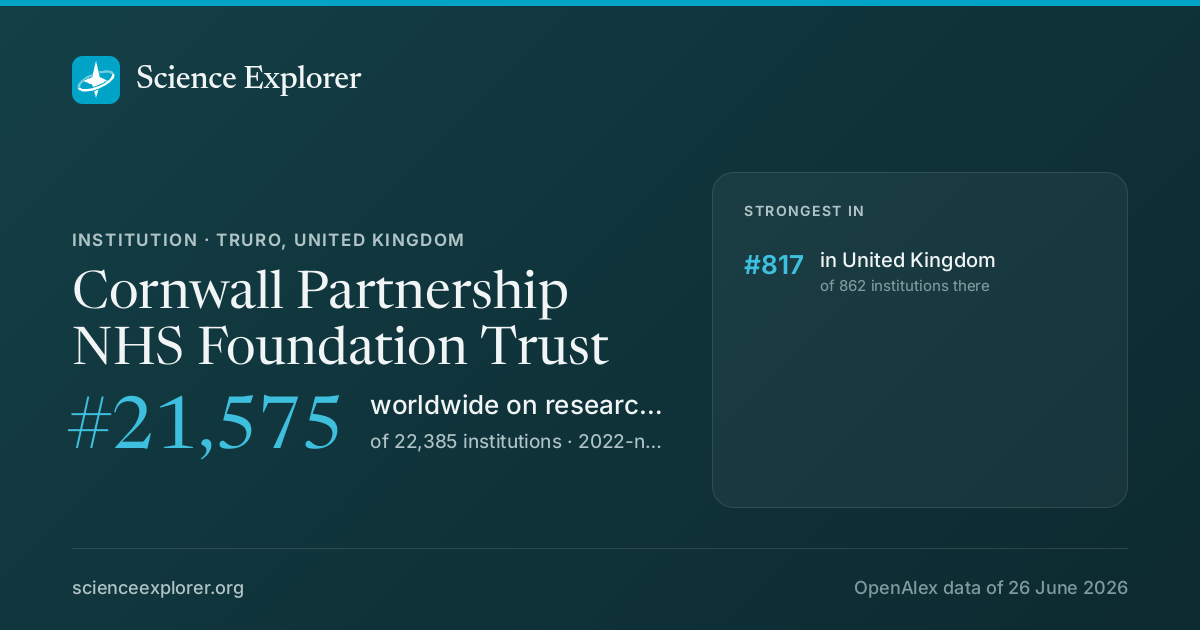
Cornwall Partnership NHS Foundation Trust
- World rank, 2022-now
- #21,575 of 22,385 · #29,287 all time
- Rank in United Kingdom
- #817 of 862
- Research works
- 203 ▲ 93% vs 2018-21
- Citations
- 2k 9.9 per fractional work
- Top-10% rate
- 8.9% all institutions 10.0%
- vs its own fields
- 0.96× 1.00× is exactly expected
- Open access
- 54% world 40%
- International
- 13% world 18%
Which fields of science does Cornwall Partnership NHS Foundation Trust work in?
In 2022-now, 61% of research at Cornwall Partnership NHS Foundation Trust is in Health Sciences, 28% in Social Sciences. Its largest fields are Medicine (40%), Psychology (20%), Health Professions (20%). It does 2.4× the world's share of Health Sciences.
Each ring splits the one inside it: the four domains of science, their fields, their subfields. Size is fractional works in 2022-now. Every slice is a page; the interactive view zooms down to single topics and colours each by how much more of it this institution does than the world.
Its 4 domains and 16 fields, with their numbers
- Health Sciences4861.4%
- Medicine3139.7%
- Health Professions1519.7%
- Nursing22.0%
- Social Sciences2228.5%
- Life Sciences56.2%
- Physical Sciences33.9%
- Environmental Science22.8%
- Engineering00.6%
- Computer Science00.5%
- Materials Science00.0%
Field profile
Location quotient across every field it publishes in: outside the ring is more than an institution of this size would be expected to publish, inside it is less.
Rings at 0.5×, 1× and 2×. Widest outward: Health Professions, 7.5×. Every wedge is a field page.
All 15 fields, with their numbers
- Health Professions7.47×15 works
- Psychology6.65×16 works
- Nursing4.13×2 works
- Neuroscience2.20×3 works
- Medicine2.07×31 works
- Arts and Humanities1.10×2 works
- Environmental Science0.56×2 works
- Biochemistry, Genetics and Molecular Biology0.45×2 works
- Social Sciences0.34×3 works
- Decision Sciences0.25×0 works
- Immunology and Microbiology0.21×0 works
- Business, Management and Accounting0.11×0 works
- Computer Science0.07×0 works
- Economics, Econometrics and Finance0.06×0 works
- Engineering0.04×0 works
- Health Professions 7.5×
- Psychology 6.7×
- Nursing 4.1×
- Neuroscience 2.2×
- Medicine 2.1×
- Arts and Humanities 1.1×
- Environmental Science 0.6×
- Biochemistry, Genetics and Molecular Biology 0.5×
- Social Sciences 0.3×
- Decision Sciences 0.2×
- Immunology and Microbiology 0.2×
- Business, Management and Accounting 0.1×
- Computer Science 0.1×
- Economics, Econometrics and Finance 0.1×
- Engineering 0.0×
Who are the top researchers at Cornwall Partnership NHS Foundation Trust?
Ranked on the quality score, Richard A. Laugharne, Brendan McLean and Sharon Eustice lead among researchers whose main affiliation is Cornwall Partnership NHS Foundation Trust.
- 1
Richard A. Laugharne
 United Kingdom · #1,291,377 worldwide
3.9k citations · 142 works
- 2
Brendan McLean
United Kingdom · #1,953,964 worldwide
596 citations · 20 works
- 3
Sharon Eustice
United Kingdom · #1,996,749 worldwide
1.2k citations · 28 works
- 4
Rohit Shankar
United Kingdom · #2,479,121 worldwide
4.2k citations · 382 works
- 5
Anna Samya Sri
United Kingdom · #2,540,826 worldwide
125 citations · 15 works
- 6
Cathy McQuaid
United Kingdom · #2,723,427 worldwide
10 citations · 32 works
- 7
Beth L. Chapman
United Kingdom · #2,857,515 worldwide
61 citations · 21 works
- 8
Ellen Wilkinson
United Kingdom · #3,262,054 worldwide
296 citations · 22 works
- 9
Clark Alex
United Kingdom · #3,314,071 worldwide
203 citations · 20 works
- 10
Katy Oak
United Kingdom · #3,461,768 worldwide
192 citations · 17 works
Which keywords describe research at Cornwall Partnership NHS Foundation Trust?
By fractional works in 2022-now, weighted toward what it does more of than the world: Quality of Life, Depression, Prevalence, Mental Health, Genetics, Public Health, Anxiety and Antiepileptic Drugs.
- Recovery Model
- Mobile Health
- Adherence
- Cognitive Therapy
- Primary Care
- Intellectual Disability
- Down Syndrome
- Psychological Distress
- Patient Engagement
- Health Disparities
- Status Epilepticus
- Integrated Care
- Epilepsy
- Evidence-Based Practice
- Classification
- Anxiety
- Genetics
- Inflammation
- Mental Health
- Epidemiology
- Quality of Life
- Depression
- Public Health
- Prevalence
- Antiepileptic Drugs
- Well-being
- Neurobiology
- Drug Resistance
- Surgery
- Seizures
- Ethical Considerations
- Neurological Complications
- Job Satisfaction
- Crisis Resolution
- Home Treatment
- Coping Strategies
- Mental Health Services
- Community Health
- Health Policy
- Public Involvement
Size is fractional works in 2022-now in the topics tagged with each word; colour is the word's share of this institution's work against its share of the world's. The 40 words are chosen for being large and distinctive. Each links to the topic it comes from most.
All 40 words, with their numbers
- Quality of Life8▲ 6.8×16 topics
- Epidemiology7▲ 2.3×25 topics
- Depression6▲ 8.3×10 topics
- Mental Health6▲ 5.0×14 topics
- Public Health5▲ 4.7×13 topics
- Inflammation5▲ 3.1×10 topics
- Prevalence5▲ 15×10 topics
- Genetics4▲ 8.0×8 topics
- Antiepileptic Drugs4▲ 68×2 topics
- Anxiety4▲ 11×5 topics
- Well-being4▲ 12×4 topics
- Classification3▲ 9.5×2 topics
- Neurobiology3▲ 17×5 topics
- Evidence-Based Practice3▲ 32×4 topics
- Drug Resistance3▲ 14×2 topics
- Epilepsy3▲ 37×3 topics
- Surgery3▲ 12×3 topics
- Integrated Care3▲ 94×2 topics
- Seizures3▲ 63×1 topic
- Status Epilepticus3▲ 83×1 topic
- Ethical Considerations3▲ 10×6 topics
- Health Disparities3▲ 14×4 topics
- Neurological Complications3▲ 56×3 topics
- Patient Engagement3▲ 28×3 topics
- Job Satisfaction3▲ 7.7×4 topics
- Psychological Distress3▲ 14×4 topics
- Crisis Resolution2▲ 250×1 topic
- Down Syndrome2▲ 267×1 topic
- Home Treatment2▲ 250×1 topic
- Intellectual Disability2▲ 129×1 topic
- Coping Strategies2▲ 12×5 topics
- Primary Care2▲ 8.3×10 topics
- Mental Health Services2▲ 56×2 topics
- Cognitive Therapy2▲ 25×3 topics
- Community Health2▲ 17×2 topics
- Adherence2▲ 22×2 topics
- Health Policy2▲ 17×3 topics
- Mobile Health2▲ 18×2 topics
- Public Involvement2▲ 97×1 topic
- Recovery Model2▲ 97×1 topic
Which research topics does Cornwall Partnership NHS Foundation Trust publish most on?
By volume in 2022-now: Epilepsy research and treatment, Psychiatric care and mental health services, Down syndrome and intellectual disability research and Mental Health and Patient Involvement.
Area is fractional works; colour is the subfield each topic belongs to.
- 1 Epilepsy research and treatment Psychiatry and Mental health 3 works
- 2 Psychiatric care and mental health services Clinical Psychology 2 works
- 3 Down syndrome and intellectual disability research Public Health, Environmental and Occupational Health 2 works
- 4 Mental Health and Patient Involvement General Health Professions 2 works
- 5 Urban Green Space and Health Health, Toxicology and Mutagenesis 2 works
- 6 Mental Health Treatment and Access Social Psychology 1 works
- 7 Digital Mental Health Interventions Applied Psychology 1 works
- 8 Schizophrenia research and treatment Psychiatry and Mental health 1 works
- 9 Psychotherapy Techniques and Applications Clinical Psychology 1 works
- 10 Geriatric Care and Nursing Homes General Health Professions 1 works
How open and international is its research?
Against the world's own shares: the tick on each track. Both are shares of its output, so they sit on one scale and can be read against each other as well as against the world.
World: 40% of research is openly available.
World: 18% is written across borders.
How has Cornwall Partnership NHS Foundation Trust's research output changed?
Output in 2022-2025 was 93% higher than in 2018-2021.
The same series as a ribbon: one cell per year, darker for more. The line above answers how much; this answers when.
Its share of all research
Growing output can still be a shrinking share: all of science grows. This is Cornwall Partnership NHS Foundation Trust as a percentage of every work published that year, 0.00036% in 2024.
Fractional works of Cornwall Partnership NHS Foundation Trust over all fractional works that year. How the balance of science has shifted.
Other research institutions in Truro
- Royal Cornwall Hospital
- Royal Cornwall Hospital Trust
- Cornwall Council
- Duchy Hospital
- MJ Medical (United Kingdom)
- Bennamann (United Kingdom)
- Driving Mobility
- Cornwall Museums Partnership

Share Cornwall Partnership NHS Foundation Trust's ranking
Badges for a website1Each links back here and updates with every snapshot

Research measures only: rankings here say nothing about teaching, admissions or student experience. Comparable institutions and collaboration partners have tabs of their own, above.
Discussion
Ask a question or share a note about Cornwall Partnership NHS Foundation Trust. Keep it to the research: no personal attacks, advertising or links. Any reader can report a post, which collapses it for everyone until it is opened.