Science Explorer Back to mapMap
Discussion
Government institution · Truro · United Kingdom

Cornwall Council

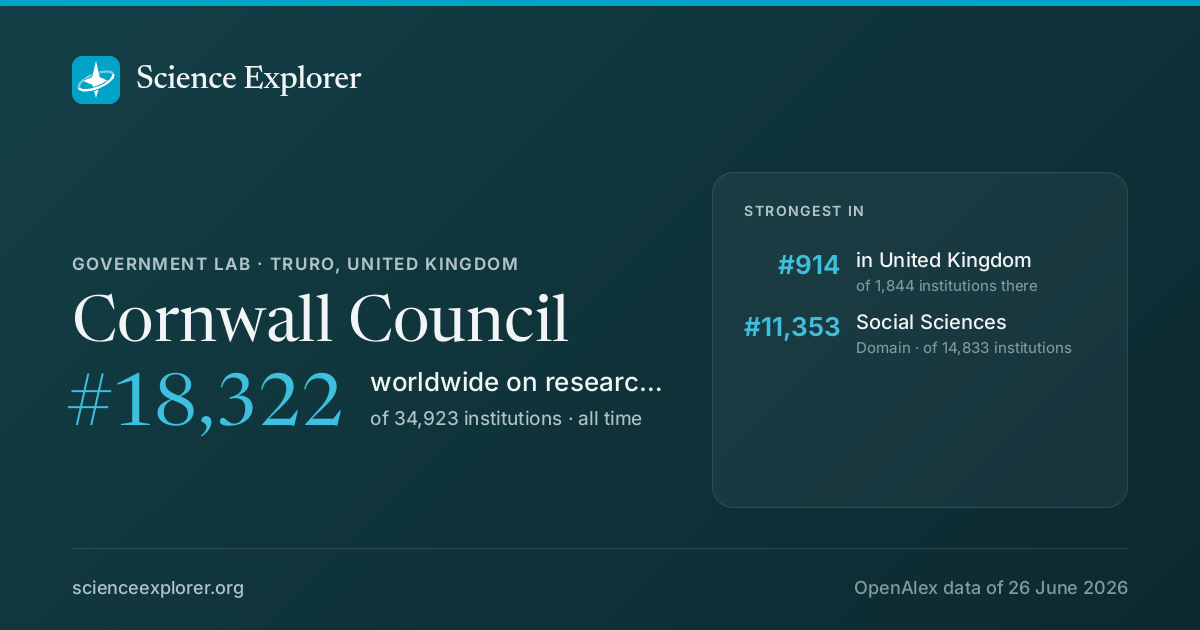
In research, Cornwall Council stands highest in Social Sciences (#11,353 of 14,833 worldwide), over all time.

World rank, all time
#18,322
of 34,923
Rank in United Kingdom
#914
of 1,844
Research works
421
▼ 15% vs 2018-21
Citations
5.6k
13.2 per fractional work
Top-10% rate
9.3%
all institutions 10.0%
vs its own fields
0.78×
1.00× is exactly expected
Open access
27%
world 40%
International
13%
world 18%

What is Cornwall Council known for in research?

The fields where it stands highest, over all time, ranked among every institution above the floor in each field.

FieldWorld rankWhere that sitsTop-10% rateWorks
Social SciencesDomain #11,353 of 14,833 6.1%159

Each strip is that field's whole ranked pool, with the notch where Cornwall Council sits in it, in the colour of the band that rank falls in. The track under the rate is the rate itself: it carries no average mark, because the average differs by field (from about 6% in Dentistry to 21% in Economics).

Which fields of science does Cornwall Council work in?

In 2022-now, 34% of research at Cornwall Council is in Physical Sciences, 31% in Health Sciences. Its largest fields are Medicine (20%), Environmental Science (12%), Social Sciences (11%). It does 1.3× the world's share of Health Sciences.

Physical Sciences: 22 fractional works · 33.6% of its workEnvironmental Science: 8 fractional works · 11.6% of its workEcology: 3 fractional works · 3.9% of its workGlobal and Planetary Change: 1 fractional works · 1.8% of its workHealth, Toxicology and Mutagenesis: 1 fractional works · 1.2% of its workPollution: 1 fractional works · 1.0% of its workNature and Landscape Conservation: 1 fractional works · 0.9% of its workEnvironmental Engineering: 1 fractional works · 0.8% of its workWater Science and Technology: 0 fractional works · 0.6% of its workIndustrial and Manufacturing Engineering: 0 fractional works · 0.6% of its workManagement, Monitoring, Policy and Law: 0 fractional works · 0.4% of its workEnvironmental Chemistry: 0 fractional works · 0.3% of its workSmaller subfields together: 0 fractional works · 0.2% of its workEarth and Planetary Sciences: 5 fractional works · 7.5% of its workPaleontology: 2 fractional works · 2.8% of its workEarth-Surface Processes: 1 fractional works · 1.5% of its workAtmospheric Science: 1 fractional works · 1.0% of its workOceanography: 1 fractional works · 1.0% of its workSpace and Planetary Science: 0 fractional works · 0.6% of its workGeophysics: 0 fractional works · 0.3% of its workSmaller subfields together: 0 fractional works · 0.2% of its workEngineering: 3 fractional works · 5.2% of its workElectrical and Electronic Engineering: 1 fractional works · 1.2% of its workCivil and Structural Engineering: 1 fractional works · 0.9% of its workMechanical Engineering: 1 fractional works · 0.9% of its workBiomedical Engineering: 0 fractional works · 0.6% of its workMechanics of Materials: 0 fractional works · 0.6% of its workSafety, Risk, Reliability and Quality: 0 fractional works · 0.3% of its workBuilding and Construction: 0 fractional works · 0.3% of its workAerospace Engineering: 0 fractional works · 0.3% of its workSmaller subfields together: 0 fractional works · 0.1% of its workPhysics and Astronomy: 2 fractional works · 3.0% of its workAstronomy and Astrophysics: 1 fractional works · 2.0% of its workInstrumentation: 1 fractional works · 1.0% of its workMaterials Science: 1 fractional works · 2.0% of its workBiomaterials: 0 fractional works · 0.7% of its workMaterials Chemistry: 0 fractional works · 0.6% of its workSurfaces, Coatings and Films: 0 fractional works · 0.5% of its workMetals and Alloys: 0 fractional works · 0.3% of its workChemistry: 1 fractional works · 1.5% of its workInorganic Chemistry: 1 fractional works · 1.3% of its workElectrochemistry: 0 fractional works · 0.3% of its workEnergy: 1 fractional works · 1.5% of its workRenewable Energy, Sustainability and the Environment: 1 fractional works · 1.5% of its workComputer Science: 1 fractional works · 1.3% of its workInformation Systems: 0 fractional works · 0.8% of its workArtificial Intelligence: 0 fractional works · 0.5% of its workHealth Sciences: 20 fractional works · 30.7% of its workMedicine: 13 fractional works · 20.3% of its workPhysiology: 3 fractional works · 4.4% of its workComplementary and alternative medicine: 3 fractional works · 3.9% of its workPublic Health, Environmental and Occupational Health: 2 fractional works · 3.6% of its workSurgery: 1 fractional works · 1.5% of its workEpidemiology: 1 fractional works · 1.4% of its workPsychiatry and Mental health: 1 fractional works · 1.4% of its workInfectious Diseases: 0 fractional works · 0.8% of its workRadiology, Nuclear Medicine and Imaging: 0 fractional works · 0.8% of its workPediatrics, Perinatology and Child Health: 0 fractional works · 0.4% of its workPharmacology: 0 fractional works · 0.4% of its workNeurology: 0 fractional works · 0.3% of its workOncology: 0 fractional works · 0.3% of its workGastroenterology: 0 fractional works · 0.3% of its workSmaller subfields together: 1 fractional works · 0.9% of its workHealth Professions: 6 fractional works · 8.6% of its workPhysical Therapy, Sports Therapy and Rehabilitation: 3 fractional works · 3.9% of its workGeneral Health Professions: 2 fractional works · 2.8% of its workHealth Information Management: 1 fractional works · 0.9% of its workSpeech and Hearing: 0 fractional works · 0.6% of its workEmergency Medical Services: 0 fractional works · 0.4% of its workVeterinary: 1 fractional works · 1.0% of its workEquine: 0 fractional works · 0.5% of its workSmall Animals: 0 fractional works · 0.5% of its workDentistry: 1 fractional works · 0.9% of its workPeriodontics: 0 fractional works · 0.4% of its workOral Surgery: 0 fractional works · 0.3% of its workSmaller subfields together: 0 fractional works · 0.2% of its workSocial Sciences: 15 fractional works · 23.5% of its workSocial Sciences: 7 fractional works · 10.5% of its workSociology and Political Science: 2 fractional works · 2.6% of its workAnthropology: 1 fractional works · 1.3% of its workDemography: 1 fractional works · 1.0% of its workSafety Research: 1 fractional works · 0.8% of its workUrban Studies: 0 fractional works · 0.8% of its workArcheology: 0 fractional works · 0.7% of its workEducation: 0 fractional works · 0.7% of its workHealth: 0 fractional works · 0.6% of its workCommunication: 0 fractional works · 0.5% of its workGender Studies: 0 fractional works · 0.5% of its workLinguistics and Language: 0 fractional works · 0.5% of its workPolitical Science and International Relations: 0 fractional works · 0.5% of its workSmaller subfields together: 0 fractional works · 0.1% of its workPsychology: 5 fractional works · 8.1% of its workClinical Psychology: 2 fractional works · 2.7% of its workDevelopmental and Educational Psychology: 2 fractional works · 2.4% of its workSocial Psychology: 1 fractional works · 2.1% of its workNeuropsychology and Physiological Psychology: 0 fractional works · 0.5% of its workSmaller subfields together: 0 fractional works · 0.3% of its workArts and Humanities: 2 fractional works · 3.5% of its workArcheology: 1 fractional works · 2.2% of its workMuseology: 1 fractional works · 1.0% of its workHistory: 0 fractional works · 0.3% of its workSmaller subfields together: 0 fractional works · 0.1% of its workBusiness, Management and Accounting: 1 fractional works · 1.1% of its workMarketing: 0 fractional works · 0.3% of its workOrganizational Behavior and Human Resource Management: 0 fractional works · 0.3% of its workManagement Information Systems: 0 fractional works · 0.3% of its workSmaller subfields together: 0 fractional works · 0.2% of its workEconomics, Econometrics and Finance: 0 fractional works · 0.3% of its workFinance: 0 fractional works · 0.3% of its workLife Sciences: 8 fractional works · 12.1% of its workBiochemistry, Genetics and Molecular Biology: 3 fractional works · 5.1% of its workMolecular Biology: 3 fractional works · 4.1% of its workStructural Biology: 0 fractional works · 0.5% of its workGenetics: 0 fractional works · 0.3% of its workSmaller subfields together: 0 fractional works · 0.2% of its workAgricultural and Biological Sciences: 3 fractional works · 4.5% of its workGeneral Agricultural and Biological Sciences: 1 fractional works · 1.6% of its workEcology, Evolution, Behavior and Systematics: 0 fractional works · 0.6% of its workAgronomy and Crop Science: 0 fractional works · 0.5% of its workPlant Science: 0 fractional works · 0.5% of its workSoil Science: 0 fractional works · 0.5% of its workAnimal Science and Zoology: 0 fractional works · 0.4% of its workAquatic Science: 0 fractional works · 0.3% of its workNeuroscience: 1 fractional works · 1.4% of its workCognitive Neuroscience: 1 fractional works · 1.2% of its workSmaller subfields together: 0 fractional works · 0.2% of its workImmunology and Microbiology: 1 fractional works · 0.9% of its workImmunology: 0 fractional works · 0.7% of its workSmaller subfields together: 0 fractional works · 0.3% of its workPharmacology, Toxicology and Pharmaceutics: 0 fractional works · 0.2% of its workALL ITS WORKCornwall Council66fractional works, 2022-now
Life Sciences12%Physical Sciences34%Health Sciences31%Social Sciences24%

Each ring splits the one inside it: the four domains of science, their fields, their subfields. Size is fractional works in 2022-now. Every slice is a page; the interactive view zooms down to single topics and colours each by how much more of it this institution does than the world.

Its 4 domains and 22 fields, with their numbers
    1. Environmental Science811.6%
    2. Earth and Planetary Sciences57.5%
    3. Engineering35.2%
    4. Physics and Astronomy23.0%
    5. Materials Science12.0%
    6. Chemistry11.5%
    7. Energy11.5%
    8. Computer Science11.3%
    1. Medicine1320.3%
    2. Health Professions68.6%
    3. Veterinary11.0%
    4. Dentistry10.9%
    1. Social Sciences710.5%
    2. Psychology58.1%
    3. Arts and Humanities23.5%
    4. Business, Management and Accounting11.1%
    5. Economics, Econometrics and Finance00.3%
    1. Biochemistry, Genetics and Molecular Biology35.1%
    2. Agricultural and Biological Sciences34.5%
    3. Neuroscience11.4%
    4. Immunology and Microbiology10.9%
    5. Pharmacology, Toxicology and Pharmaceutics00.2%
All of science, and how each field's share has moved since 1950: the Science domain explorer

Field profile

Location quotient across every field it publishes in: outside the ring is more than an institution of this size would be expected to publish, inside it is less.

Agricultural and Biological Sciences: 0.94× its world share, 3 worksAgricultural and Bio…Biochemistry, Genetics and Molecular Biology: 0.96× its world share, 3 worksBiochemistry, Geneti…Immunology and Microbiology: 0.94× its world share, 1 worksImmunology and Micro…Neuroscience: 0.86× its world share, 1 worksNeurosciencePharmacology, Toxicology and Pharmaceutics: 0.48× its world share, 0 worksPharmacology, Toxico…Chemistry: 0.97× its world share, 1 worksChemistryComputer Science: 0.16× its world share, 1 worksComputer ScienceEarth and Planetary Sciences: 4.76× its world share, 5 worksEarth and Planetary …Energy: 1.65× its world share, 1 worksEnergyEngineering: 0.35× its world share, 3 worksEngineeringEnvironmental Science: 2.33× its world share, 8 worksEnvironmental ScienceMaterials Science: 0.59× its world share, 1 worksMaterials SciencePhysics and Astronomy: 1.37× its world share, 2 worksPhysics and AstronomyDentistry: 1.76× its world share, 1 worksDentistryHealth Professions: 3.28× its world share, 6 worksHealth ProfessionsMedicine: 1.05× its world share, 13 worksMedicineVeterinary: 7.21× its world share, 1 worksVeterinaryArts and Humanities: 1.23× its world share, 2 worksArts and HumanitiesBusiness, Management and Accounting: 0.34× its world share, 1 worksBusiness, Management…Economics, Econometrics and Finance: 0.12× its world share, 0 worksEconomics, Econometr…Psychology: 2.65× its world share, 5 worksPsychologySocial Sciences: 0.83× its world share, 7 worksSocial Sciences1×world share
more than its size predictsabout as predictedless

Rings at 0.5×, 1× and 2×. Widest outward: Veterinary, 7.2×. Every wedge is a field page.

All 22 fields, with their numbers
  1. Veterinary7.21×1 works
  2. Earth and Planetary Sciences4.76×5 works
  3. Health Professions3.28×6 works
  4. Psychology2.65×5 works
  5. Environmental Science2.33×8 works
  6. Dentistry1.76×1 works
  7. Energy1.65×1 works
  8. Physics and Astronomy1.37×2 works
  9. Arts and Humanities1.23×2 works
  10. Medicine1.05×13 works
  11. Chemistry0.97×1 works
  12. Biochemistry, Genetics and Molecular Biology0.96×3 works
  13. Agricultural and Biological Sciences0.94×3 works
  14. Immunology and Microbiology0.94×1 works
  15. Neuroscience0.86×1 works
  16. Social Sciences0.83×7 works
  17. Materials Science0.59×1 works
  18. Pharmacology, Toxicology and Pharmaceutics0.48×0 works
  19. Engineering0.35×3 works
  20. Business, Management and Accounting0.34×1 works
  21. Computer Science0.16×1 works
  22. Economics, Econometrics and Finance0.12×0 works

Who are the top researchers at Cornwall Council?

Ranked on the quality score, Andy M. Jones, Sue Palmer and Charles G. Thomas lead among researchers whose main affiliation is Cornwall Council.

  1. 1 Andy M. Jones United Kingdom · #1,566,264 worldwide 1k citations · 72 works
  2. 2 Sue Palmer United Kingdom · #2,024,044 worldwide 983 citations · 17 works
  3. 3 Charles G. Thomas United Kingdom · #2,106,370 worldwide 588 citations · 90 works
  4. 4 David A. Pearman United Kingdom · #2,353,523 worldwide 727 citations · 23 works
  5. 5 Victor R Simpson United Kingdom · #2,354,390 worldwide 2.3k citations · 71 works
  6. 6 Peter Grego United Kingdom · #2,722,121 worldwide 98 citations · 79 works
  7. 7 Thomas N. Belt United Kingdom · #2,985,388 worldwide 434 citations · 49 works
  8. 8 Alan Trevennor United Kingdom · #3,084,868 worldwide 13 citations · 22 works
  9. 9 E. Dora Earthy United Kingdom · #3,493,134 worldwide 35 citations · 28 works
  10. 9 Judy A. Owen United Kingdom · #3,493,134 worldwide 8 citations · 28 works
All ranked researchers at Cornwall Council

What are the most cited papers from Cornwall Council?

The most cited paper from Cornwall Council is "Guidelines for the use and interpretation of assays for monitoring autophagy (3rd edition)" (Daniel J. Klionsky et al., 2016), with 6,023 citations. Next come "Investigating microplastic trophic transfer in marine top predators" (1,047) and "The Serotonin Theory of Depression: A Systematic Umbrella Review of the Evidence" (931).

Most cited papers
#PaperReleasedCitations
1 Guidelines for the use and interpretation of assays for monitoring autophagy (3rd edition) Daniel J. Klionsky et al. · Autophagy Open access2,467 authors 2 Jan 2016 6,023
2 Investigating microplastic trophic transfer in marine top predators Sarah E. Nelms, Tamara S. Galloway, Brendan John Godley et al. · Environmental Pollution Open access 21 Feb 2018 1,047
3 The Serotonin Theory of Depression: A Systematic Umbrella Review of the Evidence Joanna Moncrieff, Ruth E Cooper, Tom Stockmann et al. · Molecular Psychiatry Open access 19 Jul 2022 931
4 Global quieting of high-frequency seismic noise due to COVID-19 pandemic lockdown measures Thomas Lecocq et al. · Science Open access 23 Jul 2020 388
5 Three-dimensional graphene oxide/polypyrrole composite electrodes fabricated by one-step electrodeposition for high performance supercapacitors Jianyun Cao, Yaming Wang, Junchen Chen et al. · Journal of Materials Chemistry A 2015 276
All 63 most cited papers, with filters and sorting

Which keywords describe research at Cornwall Council?

By fractional works in 2022-now, weighted toward what it does more of than the world: Mental Health, Public Health, Climate Change, Health Benefits, Physical Activity, Elderly, Parkinson's Disease and Exercise.

▲ more of its work than of the world's◆ about the world's share▼ less than the world's

Size is fractional works in 2022-now in the topics tagged with each word; colour is the word's share of this institution's work against its share of the world's. The 40 words are chosen for being large and distinctive. Each links to the topic it comes from most.

All 40 words, with their numbers
  1. Climate Change5▲ 2.7×19 topics
  2. Mental Health5▲ 5.1×9 topics
  3. Public Health4▲ 4.7×14 topics
  4. Cardiovascular Disease3▲ 4.3×4 topics
  5. Health Benefits3▲ 13×2 topics
  6. Physical Activity3▲ 8.7×2 topics
  7. Sustainability3▲ 1.72×7 topics
  8. Elderly3▲ 17×2 topics
  9. Parkinson's Disease3▲ 16×3 topics
  10. Cardiorespiratory Fitness3▲ 89×1 topic
  11. Exercise3▲ 33×1 topic
  12. Exercise Capacity3▲ 89×1 topic
  13. Fall Risk3▲ 85×1 topic
  14. Gait Speed3▲ 85×1 topic
  15. Sedentary Behavior3▲ 90×1 topic
  16. Globalization2▲ 1.70×8 topics
  17. Agricultural Origins2▲ 70×1 topic
  18. Dynamic Assessment2▲ 98×1 topic
  19. Educational Psychology2▲ 44×1 topic
  20. Neurobiology2▲ 9.0×5 topics
  21. Radiocarbon Dating2▲ 70×1 topic
  22. Anxiety1▲ 4.5×3 topics
  23. Prevalence1▲ 5.3×5 topics
  24. Ecosystem Services1▲ 5.1×4 topics
  25. Biocatalysis1▲ 28×1 topic
  26. Enzyme Immobilization1▲ 59×1 topic
  27. Psychological Impact1▲ 5.7×4 topics
  28. Rural Development1▲ 5.2×3 topics
  29. Social Behavior1▲ 30×2 topics
  30. Tectonics1▲ 15×3 topics
  31. Mortality Risk1▲ 6.8×3 topics
  32. Oxytocin1▲ 36×2 topics
  33. Agricultural Change1▲ 104×1 topic
  34. Attachment1▲ 17×1 topic
  35. EROI1▲ 47×1 topic
  36. Fluvial Systems1▲ 54×1 topic
  37. Fossil Fuels1▲ 32×1 topic
  38. Metabolic Engineering1▲ 16×2 topics
  39. Sedimentation1▲ 27×1 topic
  40. Social Innovation1▲ 9.9×1 topic

Which research topics does Cornwall Council publish most on?

By volume in 2022-now: Physical Activity and Health, Balance, Gait, and Falls Prevention, Cardiovascular and exercise physiology and Archaeology and ancient environmental studies.

  1. 1 Physical Activity and Health Physiology 3 works
  2. 2 Balance, Gait, and Falls Prevention Physical Therapy, Sports Therapy and Rehabilitation 3 works
  3. 3 Cardiovascular and exercise physiology Complementary and alternative medicine 3 works
  4. 4 Archaeology and ancient environmental studies Paleontology 2 works
  5. 5 Educational and Psychological Assessments Developmental and Educational Psychology 2 works
  6. 6 Enzyme Catalysis and Immobilization Molecular Biology 1 works
  7. 7 Neuroendocrine regulation and behavior Social Psychology 1 works
  8. 8 Global Energy and Sustainability Research Renewable Energy, Sustainability and the Environment 1 works
  9. 9 Rural development and sustainability General Agricultural and Biological Sciences 1 works
  10. 10 Geological formations and processes Earth-Surface Processes 1 works

How open and international is its research?

Against the world's own shares: the tick on each track. Both are shares of its output, so they sit on one scale and can be read against each other as well as against the world.

openly available27.3%not open72.7%

World: 40% of research is openly available.

with international co-authors13.0%domestic only87.0%

World: 18% is written across borders.

How has Cornwall Council's research output changed?

Output in 2022-2025 was 15% lower than in 2018-2021.

still counting1990200020102020
grewheldshrank

The same series as a ribbon: one cell per year, darker for more. The line above answers how much; this answers when.

Its share of all research

Growing output can still be a shrinking share: all of science grows. This is Cornwall Council as a percentage of every work published that year, 0.00020% in 2024.

still counting0.00050%0.0010%0.0015%Cornwall Council0.00020% in 202519801990200020102020

Fractional works of Cornwall Council over all fractional works that year. How the balance of science has shifted.

Other research institutions in Truro

All research institutions in Truro

Share Cornwall Council's ranking

Cornwall Council on Science Explorer

A card with Cornwall Council's standing and the fields it leads in, for a post or a slide. A link to this page previews as the same card.

Download the card

1200 × 630 PNG, sized for social posts, drawn from the latest snapshot.

Badges for a website1Each links back here and updates with every snapshot

Research measures only: rankings here say nothing about teaching, admissions or student experience. Comparable institutions and collaboration partners have tabs of their own, above.

Discussion

Ask a question or share a note about Cornwall Council. Keep it to the research: no personal attacks, advertising or links. Any reader can report a post, which collapses it for everyone until it is opened.