Dalian Polytechnic University
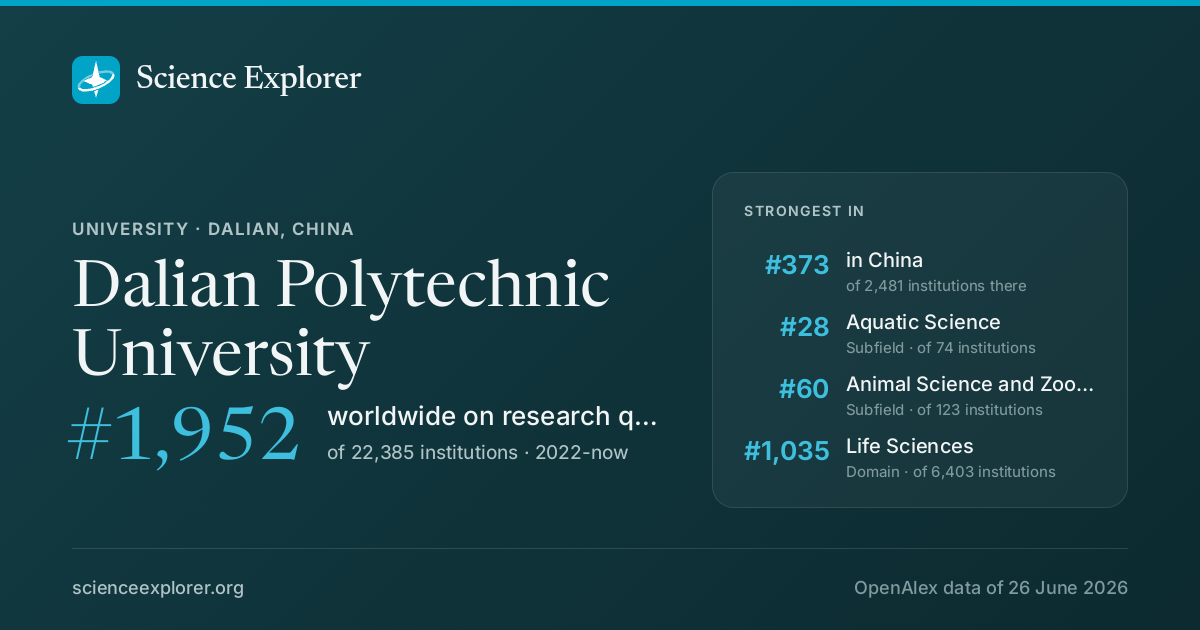
In research, Dalian Polytechnic University stands highest in Life Sciences (#1,035 of 6,403 worldwide), Physical Sciences (#2,391 of 10,670 worldwide) and Health Sciences (#2,559 of 9,902 worldwide), 2022-now. Relative to its size it is most specialised in Animal Science and Zoology, Aquatic Science and Food Science (Animal Science and Zoology is 12.9× its share of world research).
- World rank, 2022-now
- #1,952 of 22,385 · #2,980 all time
- Rank in China
- #373 of 2,481
- Research works
- 8.5k ▲ 131% vs 2018-21
- Citations
- 108k 12.7 per fractional work
- Top-10% rate
- 14.1% all institutions 10.0%
- vs its own fields
- 1.31× 1.00× is exactly expected
- Open access
- 30% world 40%
- International
- 8% world 18%
What is Dalian Polytechnic University known for in research?
The fields where it stands highest, 2022-now, ranked among every institution above the floor in each field.
| Field | World rank | Where that sits | Top-10% rate | Works | All time |
|---|---|---|---|---|---|
| Life SciencesDomain | #1,035 of 6,403 | 19.5% | 1,006 | #1711 | |
| Physical SciencesDomain | #2,391 of 10,670 | 11.0% | 2,019 | #3371 | |
| Health SciencesDomain | #2,559 of 9,902 | 23.5% | 328 | #4139 | |
| Agricultural and Biological SciencesField | #834 of 3,157 | 20.3% | 539 | #1395 | |
| Food ScienceSubfield | #139 of 517 | 18.3% | 254 | #400 | |
| EngineeringField | #1,987 of 5,901 | 9.2% | 740 | #3455 | |
| Materials ScienceField | #814 of 2,276 | 12.5% | 455 | #1246 | |
| Aquatic ScienceSubfield | #28 of 74 | 20.8% | 77 | #129 | |
| Biochemistry, Genetics and Molecular BiologyField | #1,135 of 2,964 | 17.4% | 387 | #1849 | |
| MedicineField | #3,424 of 8,541 | 21.5% | 226 | #5267 |
Each strip is that field's whole ranked pool, with the notch where Dalian Polytechnic University sits in it, in the colour of the band that rank falls in. The track under the rate is the rate itself: it carries no average mark, because the average differs by field (from about 6% in Dentistry to 21% in Economics).
Which of those standings moved
The same fields on both windows: where it stood over the whole record, and where it stands in 2022-now. The distance is the story, and it is the one thing the two rank columns above cannot show.
- Life Sciences#1,711 #1,035
- Physical Sciences#3,371 #2,391
- Health Sciences#4,139 #2,559
- Agricultural and Biological Sciences#1,395 #834
- Food Science#400 #139
- Engineering#3,455 #1,987
- Materials Science#1,246 #814
- Aquatic Science#129 #28
- Biochemistry, Genetics and Molecular Biology#1,849 #1,135
- Medicine#5,267 #3,424
A dot further right is a better standing. Fields it was not ranked in over the whole record are left out.
Which fields of science does Dalian Polytechnic University work in?
In 2022-now, 56% of research at Dalian Polytechnic University is in Physical Sciences, 28% in Life Sciences. Its largest fields are Engineering (20%), Agricultural and Biological Sciences (15%), Materials Science (13%). It does 2.1× the world's share of Life Sciences.
Each ring splits the one inside it: the four domains of science, their fields, their subfields. Size is fractional works in 2022-now. Every slice is a page; the interactive view zooms down to single topics and colours each by how much more of it this institution does than the world.
Its 4 domains and 26 fields, with their numbers
- Physical Sciences2,28756.3%
- Engineering83120.5%
- Materials Science52112.8%
- Computer Science3498.6%
- Environmental Science1794.4%
- Chemistry1593.9%
- Energy1363.3%
- Physics and Astronomy591.4%
- Chemical Engineering270.7%
- Earth and Planetary Sciences220.6%
- Mathematics50.1%
- Life Sciences1,15128.3%
- Health Sciences3558.7%
- Medicine2436.0%
- Nursing972.4%
- Health Professions120.3%
- Dentistry20.0%
- Veterinary10.0%
- Social Sciences2706.6%
- Business, Management and Accounting832.0%
- Social Sciences822.0%
- Psychology320.8%
- Economics, Econometrics and Finance260.7%
- Arts and Humanities240.6%
- Decision Sciences230.6%
What does Dalian Polytechnic University specialise in?
Where its research is concentrated relative to its size: Animal Science and Zoology takes 12.9× the share of its output that it takes of world research.
- Animal Science and ZoologySubfield · 115.0 works13×
- Aquatic ScienceSubfield · 87.8 works12×
- Food ScienceSubfield · 294.8 works9.6×
- BiomaterialsSubfield · 155.4 works9.0×
- BiotechnologySubfield · 52.2 works8.2×
- Surfaces, Coatings and FilmsSubfield · 26.5 works6.7×
- Molecular MedicineSubfield · 26.9 works6.1×
- Computer Graphics and Computer-Aided DesignSubfield · 20.0 works6.0×
Location quotient, a volume reading rather than an impact one. It surfaces small, lopsided specialities.
Field profile
Location quotient across every field it publishes in: outside the ring is more than an institution of this size would be expected to publish, inside it is less.
Rings at 0.5×, 1× and 2×. Widest outward: Nursing, 4.8×. Every wedge is a field page.
All 26 fields, with their numbers
- Nursing4.85×96 works
- Materials Science3.67×521 works
- Energy3.63×136 works
- Agricultural and Biological Sciences3.21×620 works
- Chemistry2.49×159 works
- Biochemistry, Genetics and Molecular Biology2.04×442 works
- Chemical Engineering1.92×27 works
- Engineering1.36×831 works
- Pharmacology, Toxicology and Pharmaceutics1.16×17 works
- Computer Science1.10×349 works
- Environmental Science0.89×179 works
- Immunology and Microbiology0.71×29 works
- Neuroscience0.66×44 works
- Physics and Astronomy0.65×59 works
- Business, Management and Accounting0.63×82 works
- Decision Sciences0.59×23 works
- Earth and Planetary Sciences0.35×22 works
- Medicine0.31×243 works
- Economics, Econometrics and Finance0.30×26 works
- Psychology0.26×32 works
- Veterinary0.22×1 works
- Arts and Humanities0.20×24 works
- Social Sciences0.16×82 works
- Mathematics0.11×5 works
- Health Professions0.11×12 works
- Dentistry0.10×2 works
- Nursing 4.8×
- Materials Science 3.7×
- Energy 3.6×
- Agricultural and Biological Sciences 3.2×
- Chemistry 2.5×
- Biochemistry, Genetics and Molecular Biology 2.0×
- Chemical Engineering 1.9×
- Engineering 1.4×
- Pharmacology, Toxicology and Pharmaceutics 1.2×
- Computer Science 1.1×
- Environmental Science 0.9×
- Immunology and Microbiology 0.7×
- Neuroscience 0.7×
- Physics and Astronomy 0.7×
- Business, Management and Accounting 0.6×
- Decision Sciences 0.6×
- Earth and Planetary Sciences 0.3×
- Medicine 0.3×
- Economics, Econometrics and Finance 0.3×
- Psychology 0.3×
- Veterinary 0.2×
- Arts and Humanities 0.2×
- Social Sciences 0.2×
- Mathematics 0.1×
- Health Professions 0.1×
- Dentistry 0.1×
Who are the top researchers at Dalian Polytechnic University?
Ranked on the quality score, Changyou Shao, Wentao Su and Shasha Cheng lead among researchers whose main affiliation is Dalian Polytechnic University.
- 1
Changyou Shao
 China · #29,982 worldwide
5.2k citations · 73 works
- 2
Wentao Su
China · #122,641 worldwide
7.3k citations · 171 works
- 3
Shasha Cheng
China · #129,438 worldwide
2.6k citations · 91 works
- 4
Mingqian Tan
China · #168,475 worldwide
14k citations · 423 works
- 5
Jian Du
China · #171,655 worldwide
5.8k citations · 129 works
- 6
Lei Qin
China · #176,834 worldwide
27k citations · 508 works
- 7
Wenfeng Ren
China · #180,962 worldwide
3.5k citations · 85 works
- 8
Ling‐Ping Xiao
China · #196,777 worldwide
6k citations · 160 works
- 9
Yufan Feng
China · #212,059 worldwide
1.3k citations · 29 works
- 10
Xiaomeng Ren
China · #223,236 worldwide
4.3k citations · 123 works
Which keywords describe research at Dalian Polytechnic University?
By fractional works in 2022-now, weighted toward what it does more of than the world: Biomedical Applications, Antioxidant Activity, Lipid Oxidation, Health Benefits, Nanomaterials, Antioxidants, Nanocomposites and Nanoparticles.
- Fermentation
- Aquaculture
- Gut Microbiota
- Ionic Liquids
- Digestion
- Bioactive Peptides
- Protein Hydrolysates
- Metal-Organic Frameworks
- Energy Storage
- Polyphenols
- Protein Oxidation
- Emulsions
- Modified Atmosphere Packaging
- Hydrocolloids
- Antioxidant
- Graphene
- Nanocomposites
- Nanoparticles
- Nanomaterials
- Deep Learning
- Biomedical Applications
- Antioxidant Activity
- Lipid Oxidation
- Health Benefits
- Antioxidants
- Tissue Engineering
- Nutritional Significance
- Consumer Perception
- Enzymatic Hydrolysis
- Meat Quality
- Spoilage Microbiota
- Drug Delivery
- Water Splitting
- Proteins
- ACE Inhibitory Peptides
- Stabilization
- Nanoemulsions
- Biomaterials
- Visible Light
- Probiotics
Size is fractional works in 2022-now in the topics tagged with each word; colour is the word's share of this institution's work against its share of the world's. The 40 words are chosen for being large and distinctive. Each links to the topic it comes from most.
All 40 words, with their numbers
- Biomedical Applications302▲ 6.3×31 topics
- Deep Learning230▲ 1.64×77 topics
- Antioxidant Activity221▲ 8.8×24 topics
- Nanomaterials213▲ 5.0×16 topics
- Lipid Oxidation201▲ 49×2 topics
- Nanoparticles197▲ 3.9×32 topics
- Health Benefits180▲ 13×14 topics
- Nanocomposites172▲ 5.4×20 topics
- Antioxidants148▲ 8.2×13 topics
- Graphene145▲ 5.3×11 topics
- Tissue Engineering144▲ 5.8×12 topics
- Antioxidant136▲ 4.9×45 topics
- Nutritional Significance125▲ 20×4 topics
- Hydrocolloids121▲ 38×2 topics
- Consumer Perception120▲ 13×7 topics
- Modified Atmosphere Packaging119▲ 34×2 topics
- Enzymatic Hydrolysis114▲ 29×2 topics
- Emulsions114▲ 40×2 topics
- Meat Quality110▲ 37×3 topics
- Protein Oxidation109▲ 48×1 topic
- Spoilage Microbiota109▲ 48×1 topic
- Polyphenols102▲ 14×6 topics
- Drug Delivery100▲ 4.5×16 topics
- Energy Storage100▲ 3.8×10 topics
- Water Splitting100▲ 6.6×4 topics
- Metal-Organic Frameworks98▲ 5.8×6 topics
- Proteins95▲ 26×3 topics
- Protein Hydrolysates94▲ 33×2 topics
- ACE Inhibitory Peptides93▲ 53×1 topic
- Bioactive Peptides93▲ 53×1 topic
- Stabilization92▲ 42×2 topics
- Digestion92▲ 50×1 topic
- Nanoemulsions92▲ 50×1 topic
- Ionic Liquids91▲ 8.0×10 topics
- Biomaterials87▲ 8.8×7 topics
- Gut Microbiota84▲ 6.0×7 topics
- Visible Light80▲ 8.4×3 topics
- Aquaculture78▲ 7.5×8 topics
- Probiotics76▲ 7.8×6 topics
- Fermentation72▲ 13×6 topics
Which research topics does Dalian Polytechnic University publish most on?
By volume in 2022-now: Meat and Animal Product Quality, Protein Hydrolysis and Bioactive Peptides, Proteins in Food Systems and Advanced Photocatalysis Techniques.
Area is fractional works; colour is the subfield each topic belongs to.
- 1 Meat and Animal Product Quality Animal Science and Zoology 109 works
- 2 Protein Hydrolysis and Bioactive Peptides Molecular Biology 93 works
- 3 Proteins in Food Systems Food Science 92 works
- 4 Advanced Photocatalysis Techniques Renewable Energy, Sustainability and the Environment 62 works
- 5 Probiotics and Fermented Foods Food Science 45 works
- 6 Supercapacitor Materials and Fabrication Electronic, Optical and Magnetic Materials 44 works
- 7 Lignin and Wood Chemistry Biomedical Engineering 42 works
- 8 Seaweed-derived Bioactive Compounds Aquatic Science 41 works
- 9 Advanced Cellulose Research Studies Biomaterials 39 works
- 10 Advanced Sensor and Energy Harvesting Materials Biomedical Engineering 39 works
How open and international is its research?
Against the world's own shares: the tick on each track. Both are shares of its output, so they sit on one scale and can be read against each other as well as against the world.
World: 40% of research is openly available.
World: 18% is written across borders.
How has Dalian Polytechnic University's research output changed?
Output in 2022-2025 was 131% higher than in 2018-2021.
The same series as a ribbon: one cell per year, darker for more. The line above answers how much; this answers when.
Its share of all research
Growing output can still be a shrinking share: all of science grows. This is Dalian Polytechnic University as a percentage of every work published that year, 0.018% in 2024.
Fractional works of Dalian Polytechnic University over all fractional works that year. How the balance of science has shifted.
How much of it reaches the world top 10%
Year by year, against all institutions in the same year.
Of each year's output, the share that reached the world's 10% most cited for its field and year. Peak 14.8% in 2024.
Other research institutions in Dalian
- Dalian University of Technology
- Dalian Maritime University
- Dalian University
- Dalian Medical University
- Liaoning Normal University
- Dalian Jiaotong University
- Dalian Ocean University
- Dongbei University of Finance and Economics
Share Dalian Polytechnic University's ranking
Badges for a website1Each links back here and updates with every snapshot

Research measures only: rankings here say nothing about teaching, admissions or student experience. Comparable institutions and collaboration partners have tabs of their own, above.
Discussion
Ask a question or share a note about Dalian Polytechnic University. Posts are plain text and can be reported.