Ecolab (France)
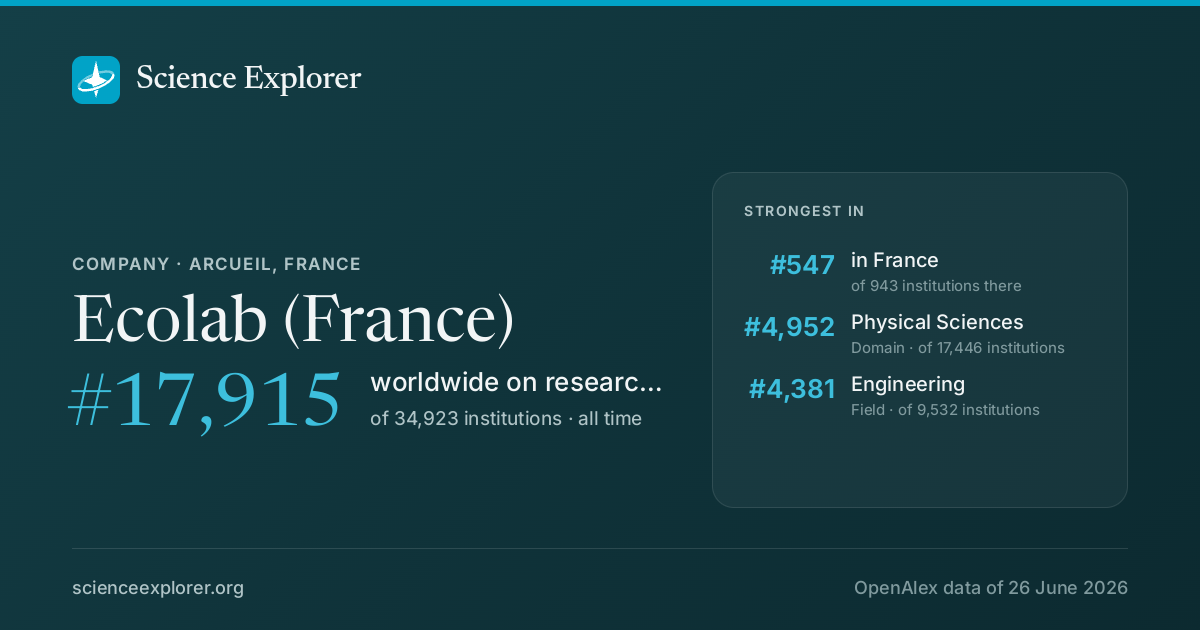
In research, Ecolab (France) stands highest in Physical Sciences (#4,952 of 17,446 worldwide) and Engineering (#4,381 of 9,532 worldwide), over all time.
- World rank, all time
- #17,915 of 34,923
- Rank in France
- #547 of 943
- Research works
- 333 ▲ 92% vs 2018-21
- Citations
- 17k 52.1 per fractional work
- Top-10% rate
- 7.3% all institutions 10.0%
- vs its own fields
- 1.03× 1.00× is exactly expected
- Open access
- 23% world 40%
- International
- 10% world 18%
What is Ecolab (France) known for in research?
The fields where it stands highest, over all time, ranked among every institution above the floor in each field.
| Field | World rank | Where that sits | Top-10% rate | Works |
|---|---|---|---|---|
| Physical SciencesDomain | #4,952 of 17,446 | 10.3% | 290 | |
| EngineeringField | #4,381 of 9,532 | 10.5% | 155 |
Each strip is that field's whole ranked pool, with the notch where Ecolab (France) sits in it, in the colour of the band that rank falls in. The track under the rate is the rate itself: it carries no average mark, because the average differs by field (from about 6% in Dentistry to 21% in Economics).
Which fields of science does Ecolab (France) work in?
In all years, 87% of research at Ecolab (France) is in Physical Sciences, 5% in Social Sciences. Its largest fields are Engineering (46%), Materials Science (14%), Computer Science (13%). It does 2.1× the world's share of Physical Sciences.
Each ring splits the one inside it: the four domains of science, their fields, their subfields. Size is fractional works in all years. Every slice is a page; the interactive view zooms down to single topics and colours each by how much more of it this institution does than the world.
Its 4 domains and 24 fields, with their numbers
- Physical Sciences29087.2%
- Engineering15546.5%
- Materials Science4613.7%
- Computer Science4413.1%
- Physics and Astronomy185.3%
- Chemistry92.6%
- Environmental Science92.6%
- Earth and Planetary Sciences61.7%
- Mathematics30.8%
- Chemical Engineering20.5%
- Energy10.3%
- Social Sciences185.3%
- Health Sciences144.2%
- Medicine102.9%
- Health Professions41.1%
- Veterinary10.2%
- Life Sciences113.4%
Field profile
Location quotient across every field it publishes in: outside the ring is more than an institution of this size would be expected to publish, inside it is less.
Rings at 0.5×, 1× and 2×. Widest outward: Immunology and Microbiology, 3.7×. Every wedge is a field page.
All 15 fields, with their numbers
- Immunology and Microbiology3.73×0 works
- Environmental Science3.49×2 works
- Engineering2.92×6 works
- Earth and Planetary Sciences2.77×1 works
- Decision Sciences2.69×0 works
- Chemistry1.07×0 works
- Medicine0.76×2 works
- Neuroscience0.53×0 works
- Social Sciences0.51×1 works
- Materials Science0.37×0 works
- Mathematics0.32×0 works
- Physics and Astronomy0.32×0 works
- Agricultural and Biological Sciences0.18×0 works
- Computer Science0.10×0 works
- Biochemistry, Genetics and Molecular Biology0.08×0 works
- Immunology and Microbiology 3.7×
- Environmental Science 3.5×
- Engineering 2.9×
- Earth and Planetary Sciences 2.8×
- Decision Sciences 2.7×
- Chemistry 1.1×
- Medicine 0.8×
- Neuroscience 0.5×
- Social Sciences 0.5×
- Materials Science 0.4×
- Mathematics 0.3×
- Physics and Astronomy 0.3×
- Agricultural and Biological Sciences 0.2×
- Computer Science 0.1×
- Biochemistry, Genetics and Molecular Biology 0.1×
Who are the top researchers at Ecolab (France)?
Ranked on the quality score, Edouard Geoffrois, Jean-Pierre Bérenger and N. Celati lead among researchers whose main affiliation is Ecolab (France).
- 1
Edouard Geoffrois
 France · #1,030,968 worldwide
1.1k citations · 25 works
- 2
Jean-Pierre Bérenger
France · #1,457,108 worldwide
13k citations · 82 works
- 3
N. Celati
France · #3,874,989 worldwide
345 citations · 15 works
- 4
B. Mortaigne
France · #4,118,337 worldwide
1.3k citations · 55 works
- 5
Eric Beauprez
France · #4,770,118 worldwide
191 citations · 18 works
- 6
Lilian Sabatier
France · #5,117,194 worldwide
219 citations · 33 works
- 7
E. Lafontaine
France · #5,181,858 worldwide
483 citations · 41 works
- 8
Dominique Luzeaux
France · #5,982,720 worldwide
236 citations · 79 works
Which keywords describe research at Ecolab (France)?
By fractional works in all years, weighted toward what it does more of than the world: Mechanical Properties, Microstructure, Maxwell's Equations, Stability Analysis, Process Optimization, Numerical Simulation, Additive Manufacturing and Residual Stress.
- X-ray Photoelectron Spectroscopy
- Space Applications
- Electromagnetic Scattering
- Recycling
- Boundary Element Method
- Micromachining
- Femtosecond Laser
- Metal Powders
- Polymerization
- Laser Ablation
- Weld Pool Dynamics
- Welding
- Heat Transfer
- Microstructural Evolution
- Residual Stress
- Electromagnetics
- Numerical Simulation
- Stability Analysis
- Deep Learning
- Microstructure
- Mechanical Properties
- Maxwell's Equations
- Nanocomposites
- Process Optimization
- Additive Manufacturing
- Finite-Difference Time-Domain
- Artificial Neural Networks
- Ballistic Impact
- Laser Welding
- Keyhole Formation
- Material Characterization
- Polymer Composites
- Process Parameters
- Epoxy Resins
- Metallic Components
- Selective Laser Melting
- Microwave Filters
- Substrate Integrated Waveguide
- Integral Equation Methods
- Constitutive Modeling
Size is fractional works in all years in the topics tagged with each word; colour is the word's share of this institution's work against its share of the world's. The 40 words are chosen for being large and distinctive. Each links to the topic it comes from most.
All 40 words, with their numbers
- Mechanical Properties34▲ 11×23 topics
- Microstructure15▲ 9.1×13 topics
- Maxwell's Equations15▲ 76×2 topics
- Deep Learning12▲ 1.74×23 topics
- Nanocomposites11▲ 4.1×11 topics
- Stability Analysis10▲ 14×3 topics
- Process Optimization10▲ 46×3 topics
- Numerical Simulation9▲ 8.4×6 topics
- Additive Manufacturing9▲ 13×3 topics
- Electromagnetics9▲ 93×1 topic
- Finite-Difference Time-Domain9▲ 93×1 topic
- Residual Stress9▲ 61×2 topics
- Artificial Neural Networks9▲ 6.2×5 topics
- Microstructural Evolution8▲ 15×4 topics
- Ballistic Impact8▲ 34×2 topics
- Heat Transfer8▲ 4.7×3 topics
- Laser Welding8▲ 54×2 topics
- Welding8▲ 40×2 topics
- Keyhole Formation8▲ 63×1 topic
- Weld Pool Dynamics8▲ 63×1 topic
- Material Characterization8▲ 28×2 topics
- Laser Ablation8▲ 52×2 topics
- Polymer Composites7▲ 12×4 topics
- Polymerization7▲ 12×5 topics
- Process Parameters7▲ 30×2 topics
- Metal Powders6▲ 46×2 topics
- Epoxy Resins6▲ 55×2 topics
- Femtosecond Laser6▲ 29×1 topic
- Metallic Components6▲ 62×1 topic
- Micromachining6▲ 36×1 topic
- Selective Laser Melting6▲ 62×1 topic
- Boundary Element Method6▲ 27×2 topics
- Microwave Filters6▲ 26×1 topic
- Recycling6▲ 7.1×6 topics
- Substrate Integrated Waveguide6▲ 26×1 topic
- Electromagnetic Scattering6▲ 59×1 topic
- Integral Equation Methods6▲ 59×1 topic
- Space Applications6▲ 24×2 topics
- Constitutive Modeling6▲ 19×2 topics
- X-ray Photoelectron Spectroscopy6▲ 12×2 topics
Which research topics does Ecolab (France) publish most on?
By volume in 2022-now: Inertial Sensor and Navigation, Reservoir Engineering and Simulation Methods, Concrete and Cement Materials Research and Recycling and Waste Management Techniques.
Area is fractional works; colour is the subfield each topic belongs to.
- 1 Inertial Sensor and Navigation Aerospace Engineering 1 works
- 2 Reservoir Engineering and Simulation Methods Ocean Engineering 1 works
- 3 Concrete and Cement Materials Research Civil and Structural Engineering 1 works
- 4 Recycling and Waste Management Techniques Industrial and Manufacturing Engineering 1 works
- 5 Hygrothermal properties of building materials Building and Construction 0 works
- 6 French Urban and Social Studies Sociology and Political Science 0 works
- 7 Concrete Properties and Behavior Civil and Structural Engineering 0 works
- 8 Fire effects on ecosystems Global and Planetary Change 0 works
- 9 Remote Sensing and LiDAR Applications Environmental Engineering 0 works
- 10 Disaster Management and Resilience Sociology and Political Science 0 works
How open and international is its research?
Against the world's own shares: the tick on each track. Both are shares of its output, so they sit on one scale and can be read against each other as well as against the world.
World: 40% of research is openly available.
World: 18% is written across borders.
How has Ecolab (France)'s research output changed?
Output in 2022-2025 was 92% higher than in 2018-2021.
The same series as a ribbon: one cell per year, darker for more. The line above answers how much; this answers when.
Its share of all research
Growing output can still be a shrinking share: all of science grows. This is Ecolab (France) as a percentage of every work published that year, 0.000055% in 2024.
Fractional works of Ecolab (France) over all fractional works that year. How the balance of science has shifted.
Other research institutions in Arcueil
Share Ecolab (France)'s ranking
Badges for a website1Each links back here and updates with every snapshot

Research measures only: rankings here say nothing about teaching, admissions or student experience. Comparable institutions and collaboration partners have tabs of their own, above.
Discussion
Ask a question or share a note about Ecolab (France). Keep it to the research: no personal attacks, advertising or links. Any reader can report a post, which collapses it for everyone until it is opened.