- World rank, all time
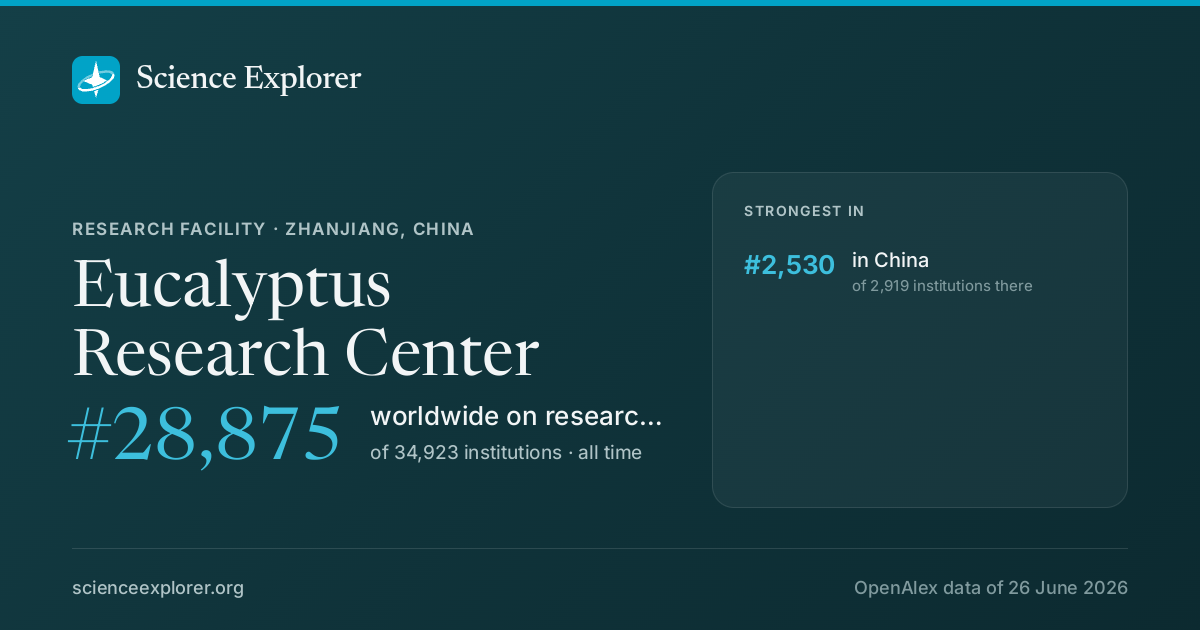
- #28,875 of 34,923
- Rank in China
- #2,530 of 2,919
- Research works
- 224 ◆ 2% vs 2018-21
- Citations
- 864 3.9 per fractional work
- Top-10% rate
- 7.3% all institutions 10.0%
- vs its own fields
- 0.79× 1.00× is exactly expected
- Open access
- 29% world 40%
- International
- 23% world 18%
Which fields of science does Eucalyptus Research Center work in?
In all years, 45% of research at Eucalyptus Research Center is in Physical Sciences, 38% in Life Sciences. Its largest fields are Agricultural and Biological Sciences (29%), Environmental Science (26%), Engineering (10%). It does 2.4× the world's share of Life Sciences.
Each ring splits the one inside it: the four domains of science, their fields, their subfields. Size is fractional works in all years. Every slice is a page; the interactive view zooms down to single topics and colours each by how much more of it this institution does than the world.
Its 4 domains and 23 fields, with their numbers
- Physical Sciences10145.2%
- Environmental Science5826.1%
- Engineering2310.4%
- Computer Science62.5%
- Earth and Planetary Sciences52.1%
- Chemistry41.8%
- Energy20.9%
- Physics and Astronomy20.7%
- Materials Science10.6%
- Mathematics00.1%
- Life Sciences8538.0%
- Social Sciences2611.6%
- Social Sciences2310.2%
- Psychology10.5%
- Business, Management and Accounting10.4%
- Arts and Humanities10.3%
- Decision Sciences00.0%
- Health Sciences125.2%
- Medicine104.3%
- Health Professions20.7%
- Dentistry00.1%
- Nursing00.1%
- Veterinary00.0%
Field profile
Location quotient across every field it publishes in: outside the ring is more than an institution of this size would be expected to publish, inside it is less.
Rings at 0.5×, 1× and 2×. Widest outward: Agricultural and Biological Sciences, 3.8×. Every wedge is a field page.
All 17 fields, with their numbers
- Agricultural and Biological Sciences3.84×3 works
- Health Professions3.51×2 works
- Physics and Astronomy2.98×1 works
- Environmental Science2.52×2 works
- Veterinary2.48×0 works
- Medicine1.58×5 works
- Psychology1.33×1 works
- Business, Management and Accounting1.25×1 works
- Biochemistry, Genetics and Molecular Biology1.04×1 works
- Energy0.44×0 works
- Immunology and Microbiology0.33×0 works
- Engineering0.30×1 works
- Earth and Planetary Sciences0.21×0 works
- Chemistry0.18×0 works
- Arts and Humanities0.17×0 works
- Social Sciences0.16×0 works
- Materials Science0.14×0 works
- Agricultural and Biological Sciences 3.8×
- Health Professions 3.5×
- Physics and Astronomy 3.0×
- Environmental Science 2.5×
- Veterinary 2.5×
- Medicine 1.6×
- Psychology 1.3×
- Business, Management and Accounting 1.2×
- Biochemistry, Genetics and Molecular Biology 1.0×
- Energy 0.4×
- Immunology and Microbiology 0.3×
- Engineering 0.3×
- Earth and Planetary Sciences 0.2×
- Chemistry 0.2×
- Arts and Humanities 0.2×
- Social Sciences 0.2×
- Materials Science 0.1×
Who are the top researchers at Eucalyptus Research Center?
Ranked on the quality score, Xie Yao-jian, Luo Jianzhong and Shaoxiong Chen lead among researchers whose main affiliation is Eucalyptus Research Center.
- 1
Xie Yao-jian
 China · #4,499,990 worldwide
7 citations · 15 works
- 2
Luo Jianzhong
China · #4,588,395 worldwide
18 citations · 16 works
- 3
Shaoxiong Chen
China · #4,821,308 worldwide
406 citations · 52 works
Which keywords describe research at Eucalyptus Research Center?
By fractional works in all years, weighted toward what it does more of than the world: Climate Change, Remote Sensing, Global Change, Allometric Models, Sustainability Indicators, Web-Based Education, Biomass Estimation and Tropical Forests.
- China
- Soil Moisture
- Erosion Control
- Host Specificity
- Ecosystem
- Agrobacterium-Mediated Transformation
- Root Reinforcement
- Phylogenetic Analysis
- Gene Expression
- Water Resources
- Seedling Performance
- Forest Management
- Forest Restoration
- Environmental Impact
- Tree Allometry
- Climate Change Impact
- Tropical Forests
- Web-Based Education
- Allometric Models
- Remote Sensing
- Climate Change
- Global Change
- Sustainability Indicators
- Biomass Estimation
- Aboveground Biomass
- Carbon Stocks
- Soil Properties
- Sustainability
- Invasive Species
- Nursery Cultivation
- Biodiversity
- Crop Yield
- Soil Fertility
- Vegetation
- Slope Stability
- Plant Secondary Metabolites
- Conservation
- Fungal Pathogens
- Medicinal Plants
- Land Use Change
Size is fractional works in all years in the topics tagged with each word; colour is the word's share of this institution's work against its share of the world's. The 40 words are chosen for being large and distinctive. Each links to the topic it comes from most.
All 40 words, with their numbers
- Climate Change51▲ 8.5×25 topics
- Remote Sensing35▲ 14×10 topics
- Global Change24▲ 34×4 topics
- Allometric Models20▲ 186×2 topics
- Sustainability Indicators20▲ 142×1 topic
- Web-Based Education20▲ 541×1 topic
- Biomass Estimation19▲ 77×3 topics
- Tropical Forests19▲ 215×2 topics
- Aboveground Biomass19▲ 119×2 topics
- Climate Change Impact19▲ 44×2 topics
- Carbon Stocks18▲ 262×1 topic
- Tree Allometry18▲ 262×1 topic
- Soil Properties18▲ 50×4 topics
- Environmental Impact15▲ 4.9×9 topics
- Sustainability14▲ 3.6×12 topics
- Forest Restoration13▲ 299×2 topics
- Invasive Species13▲ 9.8×11 topics
- Forest Management13▲ 95×3 topics
- Nursery Cultivation12▲ 517×1 topic
- Seedling Performance12▲ 517×1 topic
- Biodiversity11▲ 6.3×9 topics
- Water Resources10▲ 20×3 topics
- Crop Yield10▲ 70×3 topics
- Gene Expression9▲ 6.3×3 topics
- Soil Fertility9▲ 22×5 topics
- Phylogenetic Analysis8▲ 9.4×5 topics
- Vegetation8▲ 34×2 topics
- Root Reinforcement7▲ 168×1 topic
- Slope Stability7▲ 111×1 topic
- Agrobacterium-Mediated Transformation7▲ 54×1 topic
- Plant Secondary Metabolites7▲ 42×1 topic
- Ecosystem7▲ 21×2 topics
- Conservation7▲ 6.2×5 topics
- Host Specificity7▲ 23×3 topics
- Fungal Pathogens6▲ 16×2 topics
- Erosion Control6▲ 47×2 topics
- Medicinal Plants6▲ 7.2×5 topics
- Soil Moisture6▲ 24×3 topics
- Land Use Change6▲ 8.5×7 topics
- China6▲ 13×2 topics
Which research topics does Eucalyptus Research Center publish most on?
By volume in 2022-now: Mobile Health and mHealth Applications, Agricultural and Food Sciences, Eating Disorders and Behaviors and Diabetes Treatment and Management.
Area is fractional works; colour is the subfield each topic belongs to.
- 1 Mobile Health and mHealth Applications General Health Professions 1 works
- 2 Agricultural and Food Sciences Forestry 1 works
- 3 Eating Disorders and Behaviors Clinical Psychology 1 works
- 4 Diabetes Treatment and Management Endocrinology, Diabetes and Metabolism 1 works
- 5 Shoulder and Clavicle Injuries Epidemiology 1 works
- 6 Nerve Injury and Rehabilitation Surgery 1 works
- 7 Shoulder Injury and Treatment Surgery 1 works
- 8 Pharmacology and Obesity Treatment Pharmacology 1 works
- 9 Soil Management and Crop Yield Soil Science 0 works
- 10 Forest ecology and management Nature and Landscape Conservation 0 works
How open and international is its research?
Against the world's own shares: the tick on each track. Both are shares of its output, so they sit on one scale and can be read against each other as well as against the world.
World: 40% of research is openly available.
World: 18% is written across borders.
How has Eucalyptus Research Center's research output changed?
Output in 2022-2025 was 2% higher than in 2018-2021.
The same series as a ribbon: one cell per year, darker for more. The line above answers how much; this answers when.
Its share of all research
Growing output can still be a shrinking share: all of science grows. This is Eucalyptus Research Center as a percentage of every work published that year, 0.00011% in 2024.
Fractional works of Eucalyptus Research Center over all fractional works that year. How the balance of science has shifted.
Other research institutions in Zhanjiang
- Guangdong Medical College
- Guangdong Ocean University
- Lingnan Normal University
- Guangdong Institute of Arts and Sciences
Share Eucalyptus Research Center's ranking
Badges for a website1Each links back here and updates with every snapshot

Research measures only: rankings here say nothing about teaching, admissions or student experience. Comparable institutions and collaboration partners have tabs of their own, above.
Discussion
Ask a question or share a note about Eucalyptus Research Center. Posts are plain text and can be reported.