Science Explorer Back to mapMap
Discussion
Company · Weinheim · Germany

Freudenberg (Germany)

In research, Freudenberg (Germany) stands highest in Social Sciences (#6,494 of 9,585 worldwide), 2022-now.

World rank, 2022-now
#8,647
of 22,385 · #6,849 all time
Rank in Germany
#285
of 795
Research works
834
▼ 5% vs 2018-21
Citations
6.1k
7.4 per fractional work
Top-10% rate
6.8%
all institutions 10.0%
vs its own fields
0.99×
1.00× is exactly expected
Open access
20%
world 40%
International
14%
world 18%

What is Freudenberg (Germany) known for in research?

The fields where it stands highest, 2022-now, ranked among every institution above the floor in each field.

FieldWorld rankWhere that sitsTop-10% rateWorksAll time
Social SciencesDomain #6,494 of 9,585 7.4%72 #7561

Each strip is that field's whole ranked pool, with the notch where Freudenberg (Germany) sits in it, in the colour of the band that rank falls in. The track under the rate is the rate itself: it carries no average mark, because the average differs by field (from about 6% in Dentistry to 21% in Economics).

Which fields of science does Freudenberg (Germany) work in?

In 2022-now, 43% of research at Freudenberg (Germany) is in Social Sciences, 34% in Physical Sciences. Its largest fields are Engineering (22%), Social Sciences (20%), Medicine (12%). It does 1.7× the world's share of Social Sciences.

Social Sciences: 81 fractional works · 43.4% of its workSocial Sciences: 37 fractional works · 19.7% of its workSociology and Political Science: 19 fractional works · 10.3% of its workPolitical Science and International Relations: 8 fractional works · 4.5% of its workLaw: 2 fractional works · 1.1% of its workEducation: 2 fractional works · 0.9% of its workAnthropology: 2 fractional works · 0.9% of its workCultural Studies: 1 fractional works · 0.4% of its workUrban Studies: 1 fractional works · 0.4% of its workLinguistics and Language: 1 fractional works · 0.4% of its workPublic Administration: 0 fractional works · 0.2% of its workSmaller subfields together: 1 fractional works · 0.6% of its workPsychology: 18 fractional works · 9.9% of its workClinical Psychology: 14 fractional works · 7.4% of its workGeneral Psychology: 2 fractional works · 1.3% of its workSocial Psychology: 2 fractional works · 1.0% of its workSmaller subfields together: 1 fractional works · 0.3% of its workArts and Humanities: 13 fractional works · 7.2% of its workPhilosophy: 5 fractional works · 2.6% of its workHistory: 4 fractional works · 2.1% of its workLiterature and Literary Theory: 2 fractional works · 1.3% of its workLanguage and Linguistics: 1 fractional works · 0.6% of its workArcheology: 1 fractional works · 0.4% of its workSmaller subfields together: 1 fractional works · 0.3% of its workBusiness, Management and Accounting: 10 fractional works · 5.4% of its workAccounting: 4 fractional works · 2.0% of its workOrganizational Behavior and Human Resource Management: 2 fractional works · 1.3% of its workStrategy and Management: 2 fractional works · 1.1% of its workManagement of Technology and Innovation: 1 fractional works · 0.5% of its workManagement Information Systems: 1 fractional works · 0.4% of its workEconomics, Econometrics and Finance: 2 fractional works · 1.0% of its workEconomics and Econometrics: 2 fractional works · 0.9% of its workSmaller subfields together: 0 fractional works · 0.1% of its workDecision Sciences: 0 fractional works · 0.2% of its workPhysical Sciences: 64 fractional works · 34.4% of its workEngineering: 40 fractional works · 21.7% of its workElectrical and Electronic Engineering: 11 fractional works · 6.0% of its workComputational Mechanics: 7 fractional works · 4.0% of its workMechanical Engineering: 6 fractional works · 3.4% of its workAerospace Engineering: 3 fractional works · 1.7% of its workCivil and Structural Engineering: 3 fractional works · 1.6% of its workAutomotive Engineering: 3 fractional works · 1.4% of its workBiomedical Engineering: 2 fractional works · 1.0% of its workMechanics of Materials: 2 fractional works · 1.0% of its workControl and Systems Engineering: 1 fractional works · 0.5% of its workIndustrial and Manufacturing Engineering: 1 fractional works · 0.5% of its workBuilding and Construction: 1 fractional works · 0.4% of its workSmaller subfields together: 1 fractional works · 0.4% of its workEnvironmental Science: 6 fractional works · 3.1% of its workIndustrial and Manufacturing Engineering: 2 fractional works · 1.3% of its workEnvironmental Engineering: 1 fractional works · 0.7% of its workGlobal and Planetary Change: 1 fractional works · 0.4% of its workEcology: 0 fractional works · 0.3% of its workSmaller subfields together: 1 fractional works · 0.5% of its workMaterials Science: 5 fractional works · 2.4% of its workMaterials Chemistry: 3 fractional works · 1.8% of its workPolymers and Plastics: 1 fractional works · 0.6% of its workSmaller subfields together: 0 fractional works · 0.1% of its workPhysics and Astronomy: 4 fractional works · 2.2% of its workAstronomy and Astrophysics: 2 fractional works · 1.3% of its workAtomic and Molecular Physics, and Optics: 1 fractional works · 0.7% of its workSmaller subfields together: 0 fractional works · 0.2% of its workEnergy: 4 fractional works · 1.9% of its workRenewable Energy, Sustainability and the Environment: 3 fractional works · 1.7% of its workSmaller subfields together: 0 fractional works · 0.2% of its workComputer Science: 2 fractional works · 1.3% of its workComputer Networks and Communications: 1 fractional works · 0.7% of its workInformation Systems: 1 fractional works · 0.3% of its workSmaller subfields together: 0 fractional works · 0.3% of its workEarth and Planetary Sciences: 1 fractional works · 0.7% of its workAtmospheric Science: 1 fractional works · 0.4% of its workSmaller subfields together: 1 fractional works · 0.3% of its workChemistry: 1 fractional works · 0.5% of its workPhysical and Theoretical Chemistry: 0 fractional works · 0.2% of its workSmaller subfields together: 1 fractional works · 0.3% of its workChemical Engineering: 1 fractional works · 0.4% of its workFluid Flow and Transfer Processes: 0 fractional works · 0.2% of its workSmaller subfields together: 0 fractional works · 0.2% of its workMathematics: 0 fractional works · 0.1% of its workHealth Sciences: 32 fractional works · 17.0% of its workMedicine: 23 fractional works · 12.4% of its workSurgery: 3 fractional works · 1.7% of its workCardiology and Cardiovascular Medicine: 3 fractional works · 1.4% of its workPublic Health, Environmental and Occupational Health: 2 fractional works · 1.3% of its workEpidemiology: 2 fractional works · 1.3% of its workEmergency Medicine: 2 fractional works · 1.2% of its workRheumatology: 2 fractional works · 0.9% of its workHepatology: 2 fractional works · 0.9% of its workPharmacology: 1 fractional works · 0.7% of its workNeurology: 1 fractional works · 0.6% of its workPulmonary and Respiratory Medicine: 1 fractional works · 0.6% of its workPathology and Forensic Medicine: 1 fractional works · 0.4% of its workPsychiatry and Mental health: 1 fractional works · 0.4% of its workDermatology: 1 fractional works · 0.4% of its workSmaller subfields together: 1 fractional works · 0.7% of its workHealth Professions: 6 fractional works · 3.5% of its workGeneral Health Professions: 5 fractional works · 2.9% of its workOccupational Therapy: 0 fractional works · 0.3% of its workSmaller subfields together: 1 fractional works · 0.3% of its workDentistry: 2 fractional works · 1.1% of its workOrthodontics: 1 fractional works · 0.6% of its workOral Surgery: 0 fractional works · 0.2% of its workSmaller subfields together: 0 fractional works · 0.2% of its workNursing: 0 fractional works · 0.0% of its workLife Sciences: 10 fractional works · 5.1% of its workAgricultural and Biological Sciences: 4 fractional works · 2.3% of its workPlant Science: 3 fractional works · 1.6% of its workInsect Science: 1 fractional works · 0.3% of its workSmaller subfields together: 1 fractional works · 0.3% of its workBiochemistry, Genetics and Molecular Biology: 3 fractional works · 1.5% of its workMolecular Biology: 1 fractional works · 0.5% of its workBiochemistry: 1 fractional works · 0.4% of its workGenetics: 0 fractional works · 0.2% of its workSmaller subfields together: 1 fractional works · 0.3% of its workNeuroscience: 1 fractional works · 0.8% of its workCognitive Neuroscience: 1 fractional works · 0.5% of its workSmaller subfields together: 1 fractional works · 0.3% of its workImmunology and Microbiology: 1 fractional works · 0.4% of its workImmunology: 0 fractional works · 0.3% of its workSmaller subfields together: 0 fractional works · 0.2% of its workPharmacology, Toxicology and Pharmaceutics: 0 fractional works · 0.1% of its workALL ITS WORKFreudenberg(Germany)186fractional works, 2022-now
Life Sciences5%Physical Sciences34%Health Sciences17%Social Sciences43%

Each ring splits the one inside it: the four domains of science, their fields, their subfields. Size is fractional works in 2022-now. Every slice is a page; the interactive view zooms down to single topics and colours each by how much more of it this institution does than the world.

Its 4 domains and 26 fields, with their numbers
    1. Social Sciences3719.7%
    2. Psychology189.9%
    3. Arts and Humanities137.2%
    4. Business, Management and Accounting105.4%
    5. Economics, Econometrics and Finance21.0%
    6. Decision Sciences00.2%
    1. Engineering4021.7%
    2. Environmental Science63.1%
    3. Materials Science52.4%
    4. Physics and Astronomy42.2%
    5. Energy41.9%
    6. Computer Science21.3%
    7. Earth and Planetary Sciences10.7%
    8. Chemistry10.5%
    9. Chemical Engineering10.4%
    10. Mathematics00.1%
    1. Medicine2312.4%
    2. Health Professions63.5%
    3. Dentistry21.1%
    4. Nursing00.0%
    5. Veterinary00.0%
    1. Agricultural and Biological Sciences42.3%
    2. Biochemistry, Genetics and Molecular Biology31.5%
    3. Neuroscience10.8%
    4. Immunology and Microbiology10.4%
    5. Pharmacology, Toxicology and Pharmaceutics00.1%
All of science, and how each field's share has moved since 1950: the Science domain explorer

Field profile

Location quotient across every field it publishes in: outside the ring is more than an institution of this size would be expected to publish, inside it is less.

Agricultural and Biological Sciences: 0.48× its world share, 4 worksAgricultural and Bio…Biochemistry, Genetics and Molecular Biology: 0.28× its world share, 3 worksBiochemistry, Geneti…Immunology and Microbiology: 0.45× its world share, 1 worksImmunology and Micro…Neuroscience: 0.48× its world share, 1 worksNeurosciencePharmacology, Toxicology and Pharmaceutics: 0.32× its world share, 0 worksPharmacology, Toxico…Chemical Engineering: 1.21× its world share, 1 worksChemical EngineeringChemistry: 0.35× its world share, 1 worksChemistryComputer Science: 0.16× its world share, 2 worksComputer ScienceEarth and Planetary Sciences: 0.48× its world share, 1 worksEarth and Planetary …Energy: 2.06× its world share, 4 worksEnergyEngineering: 1.45× its world share, 40 worksEngineeringEnvironmental Science: 0.62× its world share, 6 worksEnvironmental ScienceMaterials Science: 0.69× its world share, 4 worksMaterials ScienceMathematics: 0.11× its world share, 0 worksMathematicsPhysics and Astronomy: 0.99× its world share, 4 worksPhysics and AstronomyDentistry: 2.25× its world share, 2 worksDentistryHealth Professions: 1.32× its world share, 6 worksHealth ProfessionsMedicine: 0.65× its world share, 23 worksMedicineNursing: 0.07× its world share, 0 worksNursingVeterinary: 0.04× its world share, 0 worksVeterinaryArts and Humanities: 2.49× its world share, 13 worksArts and HumanitiesBusiness, Management and Accounting: 1.68× its world share, 10 worksBusiness, Management…Decision Sciences: 0.15× its world share, 0 worksDecision SciencesEconomics, Econometrics and Finance: 0.48× its world share, 2 worksEconomics, Econometr…Psychology: 3.25× its world share, 18 worksPsychologySocial Sciences: 1.56× its world share, 37 worksSocial Sciences1×world share
more than its size predictsabout as predictedless

Rings at 0.5×, 1× and 2×. Widest outward: Psychology, 3.2×. Every wedge is a field page.

All 26 fields, with their numbers
  1. Psychology3.25×18 works
  2. Arts and Humanities2.49×13 works
  3. Dentistry2.25×2 works
  4. Energy2.06×4 works
  5. Business, Management and Accounting1.68×10 works
  6. Social Sciences1.56×37 works
  7. Engineering1.45×40 works
  8. Health Professions1.32×6 works
  9. Chemical Engineering1.21×1 works
  10. Physics and Astronomy0.99×4 works
  11. Materials Science0.69×4 works
  12. Medicine0.65×23 works
  13. Environmental Science0.62×6 works
  14. Agricultural and Biological Sciences0.48×4 works
  15. Neuroscience0.48×1 works
  16. Earth and Planetary Sciences0.48×1 works
  17. Economics, Econometrics and Finance0.48×2 works
  18. Immunology and Microbiology0.45×1 works
  19. Chemistry0.35×1 works
  20. Pharmacology, Toxicology and Pharmaceutics0.32×0 works
  21. Biochemistry, Genetics and Molecular Biology0.28×3 works
  22. Computer Science0.16×2 works
  23. Decision Sciences0.15×0 works
  24. Mathematics0.11×0 works
  25. Nursing0.07×0 works
  26. Veterinary0.04×0 works

Who are the top researchers at Freudenberg (Germany)?

Ranked on the quality score, Peter Kritzer, Henk R. Randau and Holger Preisendanz lead among researchers whose main affiliation is Freudenberg (Germany).

  1. 1 Peter Kritzer Germany · #1,051,122 worldwide 2.1k citations · 39 works
  2. 2 Henk R. Randau Germany · #2,440,342 worldwide 45 citations · 66 works
  3. 3 Holger Preisendanz Germany · #2,684,419 worldwide 1 citations · 49 works
  4. 4 Manfred Schmoch Germany · #2,702,457 worldwide 21 citations · 35 works
  5. 5 Josef von Stackelberg Germany · #2,822,413 worldwide 15 citations · 41 works
  6. 6 Matthias Baldofski Germany · #3,668,969 worldwide 144 citations · 17 works
  7. 7 Klemens Döpp Germany · #4,070,140 worldwide 7 citations · 15 works
  8. 8 Christiane Szliska Germany · #4,124,406 worldwide 1.6k citations · 66 works
  9. 9 Ilona Szabo‐Lin Germany · #4,301,408 worldwide 356 citations · 30 works
  10. 10 Michael Deutsch Germany · #4,363,769 worldwide 78 citations · 43 works
All ranked researchers at Freudenberg (Germany)

What are the most cited papers from Freudenberg (Germany)?

The most cited paper from Freudenberg (Germany) is "Corrosion in high-temperature and supercritical water and aqueous solutions: a review" (Peter Kritzer, 2003), with 657 citations. Next come "Transcutaneous measurement of renal function in conscious mice" (218) and "Pseudoxanthoma Elasticum: Genetics, Clinical Manifestations and Therapeutic Approaches" (211).

Most cited papers
#PaperReleasedCitations
1 Corrosion in high-temperature and supercritical water and aqueous solutions: a review Peter Kritzer · The Journal of Supercritical Fluids 30 Apr 2003 657
2 Transcutaneous measurement of renal function in conscious mice Andrea Schreiber, Yury Shulhevich, Stefania Geraci et al. · American Journal of Physiology-Renal Physiology 13 Jun 2012 218
3 Pseudoxanthoma Elasticum: Genetics, Clinical Manifestations and Therapeutic Approaches Robert Patrick Finger, Peter Charbel Issa, Markus S. Ladewig et al. · Survey of Ophthalmology Mar 2009 211
4 Chemical and electrochemical ageing of carbon materials used in supercapacitor electrodes Min Hua Zhu, Christian Weber, Yongan Andrew Yang et al. · Carbon Aug 2008 208
5 Nonlinearity in cap-and-trade systems: The EUA price and its fundamentals Benjamin Johannes Lutz, Uta Pigorsch, Waldemar Rotfuß · Energy Economics 25 Jun 2013 171
All 61 most cited papers, with filters and sorting

Which keywords describe research at Freudenberg (Germany)?

By fractional works in 2022-now, weighted toward what it does more of than the world: Clinical Practice, Mental Health, Resilience, Childhood Trauma, Developmental Trauma, Psychodynamic Psychotherapy, Thermal Management and Vibration Analysis.

▲ more of its work than of the world's◆ about the world's share▼ less than the world's

Size is fractional works in 2022-now in the topics tagged with each word; colour is the word's share of this institution's work against its share of the world's. The 40 words are chosen for being large and distinctive. Each links to the topic it comes from most.

All 40 words, with their numbers
  1. Mental Health14▲ 5.3×10 topics
  2. Clinical Practice12▲ 43×2 topics
  3. Resilience12▲ 13×4 topics
  4. Childhood Trauma11▲ 99×2 topics
  5. Developmental Trauma11▲ 284×1 topic
  6. Psychodynamic Psychotherapy11▲ 284×1 topic
  7. Sustainability11▲ 2.4×14 topics
  8. Renewable Energy10▲ 3.5×12 topics
  9. Thermal Management8▲ 13×2 topics
  10. Vibration Analysis7▲ 15×3 topics
  11. Gender7▲ 7.3×10 topics
  12. Renewable Energy Integration7▲ 12×3 topics
  13. Engineering7▲ 78×2 topics
  14. Fluid Dynamics7▲ 25×2 topics
  15. Materials Science6▲ 85×2 topics
  16. Mathematical Modeling6▲ 39×1 topic
  17. Turbine Technology6▲ 197×1 topic
  18. Public Policy6▲ 6.5×4 topics
  19. Social Justice5▲ 4.5×5 topics
  20. Ethics5▲ 5.3×6 topics
  21. Polymer Electrolyte Membranes4▲ 33×1 topic
  22. Proton Exchange Membranes4▲ 33×1 topic
  23. Community Engagement4▲ 6.9×2 topics
  24. Sociolinguistics4▲ 12×3 topics
  25. Territorial Governance4▲ 20×2 topics
  26. Chronic Diseases4▲ 8.5×2 topics
  27. Sustainable Energy4▲ 12×3 topics
  28. Epidemiological Study4▲ 31×3 topics
  29. Occupation4▲ 34×2 topics
  30. Sexuality4▲ 29×2 topics
  31. Discourse Analysis4▲ 8.5×2 topics
  32. Financial Reporting4▲ 17×2 topics
  33. Socioeconomic Status4▲ 39×2 topics
  34. Tax Avoidance4▲ 51×2 topics
  35. Citizen Participation4▲ 17×1 topic
  36. Environmental Participation4▲ 28×1 topic
  37. Germany4▲ 106×1 topic
  38. Health Surveys4▲ 106×1 topic
  39. Argumentation4▲ 67×1 topic
  40. Rhetoric4▲ 19×1 topic

Which research topics does Freudenberg (Germany) publish most on?

By volume in 2022-now: Psychoanalysis and Psychopathology Research, Physics and Engineering Research Articles, Fuel Cells and Related Materials and Health and Medical Studies.

  1. 1 Psychoanalysis and Psychopathology Research Clinical Psychology 11 works
  2. 2 Physics and Engineering Research Articles Computational Mechanics 6 works
  3. 3 Fuel Cells and Related Materials Electrical and Electronic Engineering 4 works
  4. 4 Health and Medical Studies General Health Professions 4 works
  5. 5 French Urban and Social Studies Sociology and Political Science 4 works
  6. 6 Linguistics and Discourse Analysis Philosophy 4 works
  7. 7 European history and politics Political Science and International Relations 3 works
  8. 8 Sociology and Education Studies Sociology and Political Science 3 works
  9. 9 Electrocatalysts for Energy Conversion Renewable Energy, Sustainability and the Environment 3 works
  10. 10 Academic and Historical Perspectives in Psychology General Psychology 2 works

How open and international is its research?

Against the world's own shares: the tick on each track. Both are shares of its output, so they sit on one scale and can be read against each other as well as against the world.

openly available19.5%not open80.5%

World: 40% of research is openly available.

with international co-authors13.8%domestic only86.2%

World: 18% is written across borders.

How has Freudenberg (Germany)'s research output changed?

Output in 2022-2025 was 5% lower than in 2018-2021.

still counting1990200020102020
grewheldshrank

The same series as a ribbon: one cell per year, darker for more. The line above answers how much; this answers when.

Its share of all research

Growing output can still be a shrinking share: all of science grows. This is Freudenberg (Germany) as a percentage of every work published that year, 0.00081% in 2024.

still counting0.0010%0.0020%0.0030%Freudenberg (Germany)0.00047% in 202519801990200020102020

Fractional works of Freudenberg (Germany) over all fractional works that year. How the balance of science has shifted.

How much of it reaches the world top 10%

Year by year, against all institutions in the same year.

still counting5%10%15%all institutions10.0% in 2025Freudenberg (Germany)6.2% in 202520102020

Of each year's output, the share that reached the world's 10% most cited for its field and year. Peak 9.6% in 2008.

Other research institutions in Weinheim

All research institutions in Weinheim

Share Freudenberg (Germany)'s ranking
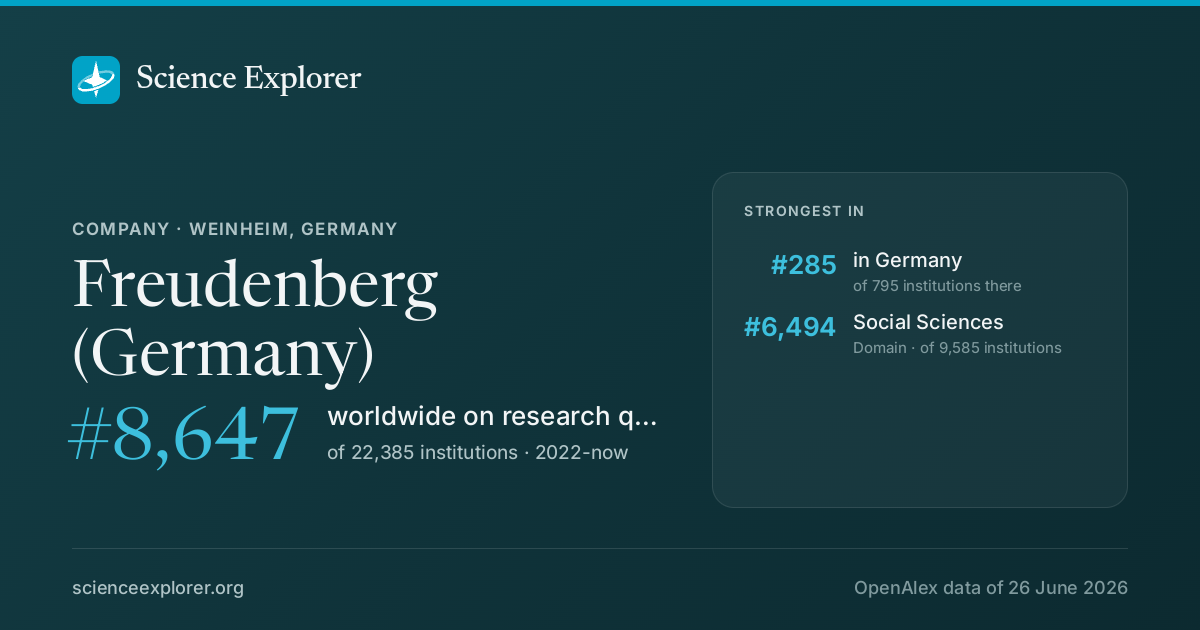
Freudenberg (Germany) on Science Explorer

A card with Freudenberg (Germany)'s standing and the fields it leads in, for a post or a slide. A link to this page previews as the same card.

Download the card

1200 × 630 PNG, sized for social posts, drawn from the latest snapshot.

Badges for a website1Each links back here and updates with every snapshot

Research measures only: rankings here say nothing about teaching, admissions or student experience. Comparable institutions and collaboration partners have tabs of their own, above.

Discussion

Ask a question or share a note about Freudenberg (Germany). Posts are plain text and can be reported.
