- World rank, all time
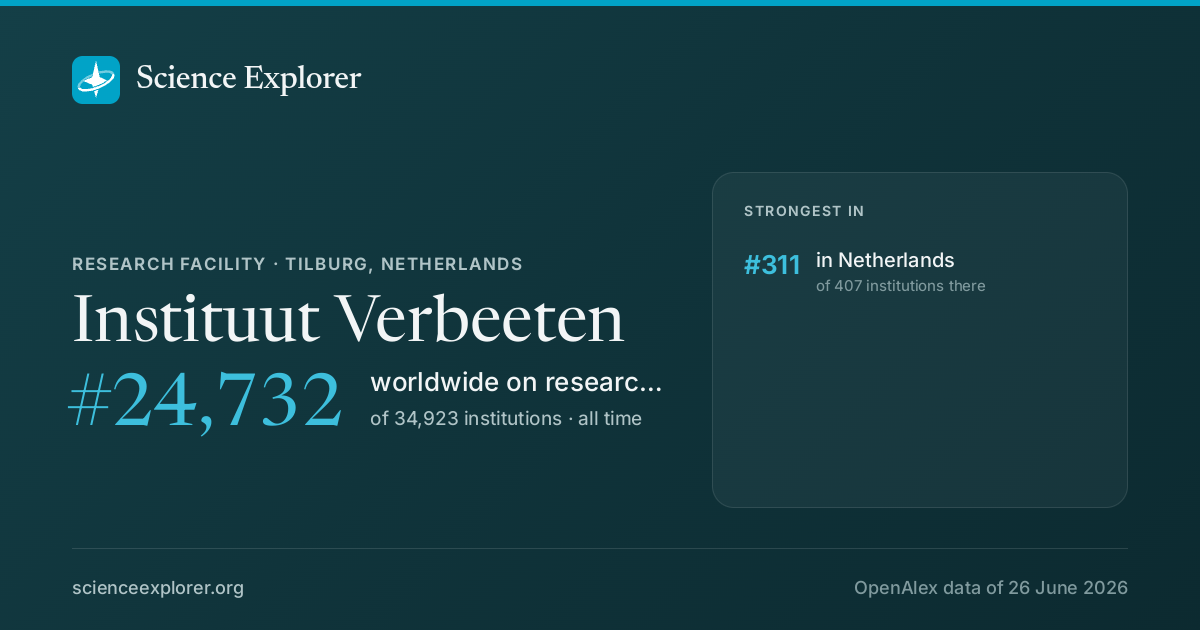
- #24,732 of 34,923
- Rank in Netherlands
- #311 of 407
- Research works
- 180 ▼ 25% vs 2018-21
- Citations
- 6.5k 35.9 per fractional work
- Top-10% rate
- 20.7% all institutions 10.0%
- vs its own fields
- 1.14× 1.00× is exactly expected
- Open access
- 36% world 40%
- International
- 40% world 18%
Which fields of science does Instituut Verbeeten work in?
In all years, 66% of research at Instituut Verbeeten is in Health Sciences, 20% in Physical Sciences. Its largest fields are Medicine (63%), Physics and Astronomy (11%), Biochemistry, Genetics and Molecular Biology (8%). It does 2.7× the world's share of Health Sciences.
Each ring splits the one inside it: the four domains of science, their fields, their subfields. Size is fractional works in all years. Every slice is a page; the interactive view zooms down to single topics and colours each by how much more of it this institution does than the world.
Its 4 domains and 25 fields, with their numbers
- Health Sciences11965.9%
- Medicine11463.2%
- Health Professions42.4%
- Dentistry00.3%
- Nursing00.1%
- Physical Sciences3519.5%
- Physics and Astronomy2011.0%
- Engineering63.1%
- Chemistry53.0%
- Materials Science20.9%
- Computer Science10.7%
- Environmental Science00.3%
- Earth and Planetary Sciences00.2%
- Chemical Engineering00.1%
- Energy00.1%
- Mathematics00.1%
- Life Sciences179.6%
- Social Sciences95.0%
Field profile
Location quotient across every field it publishes in: outside the ring is more than an institution of this size would be expected to publish, inside it is less.
Rings at 0.5×, 1× and 2×. Widest outward: Physics and Astronomy, 4.9×. Every wedge is a field page.
All 10 fields, with their numbers
- Physics and Astronomy4.89×2 works
- Health Professions4.27×2 works
- Medicine3.11×8 works
- Biochemistry, Genetics and Molecular Biology1.07×1 works
- Psychology0.96×0 works
- Social Sciences0.55×1 works
- Arts and Humanities0.41×0 works
- Mathematics0.09×0 works
- Engineering0.07×0 works
- Environmental Science0.02×0 works
Who are the top researchers at Instituut Verbeeten?
Ranked on the quality score, Philip M. Poortmans, Tom Rozema and Patrick T.R. Rodrigus lead among researchers whose main affiliation is Instituut Verbeeten.
- 1
Philip M. Poortmans
 Netherlands · #33,426 worldwide
42k citations · 549 works
- 2
Tom Rozema
Netherlands · #586,127 worldwide
13k citations · 91 works
- 3
Patrick T.R. Rodrigus
Netherlands · #717,131 worldwide
3.8k citations · 40 works
- 4
Ernest J. A. Vonk
Netherlands · #809,291 worldwide
2.8k citations · 30 works
- 5
S. Hol
Netherlands · #853,956 worldwide
1.7k citations · 51 works
- 6
Jack L. M. Venselaar
Netherlands · #906,439 worldwide
2.7k citations · 62 works
- 7
Bing S. Oei
Netherlands · #923,475 worldwide
2.4k citations · 19 works
- 8
Marion Essers
Netherlands · #948,533 worldwide
1.6k citations · 63 works
- 9
Friederike L.A. Koppe
Netherlands · #972,976 worldwide
662 citations · 24 works
- 10
Antoine M. Engelen
Netherlands · #1,086,210 worldwide
673 citations · 21 works
Which keywords describe research at Instituut Verbeeten?
By fractional works in all years, weighted toward what it does more of than the world: Radiotherapy, Dosimetry, Monte Carlo Simulation, Chemotherapy, Image-Guided Radiotherapy, Radiotherapy Physics, Clinical Practice Guidelines and Immunotherapy.
- Tumor Staging
- Medical Education
- Brain Metastases
- Cancer Risk
- Molecular Classification
- Radiation Exposure
- Radiosurgery
- Particle Therapy
- Cognitive Function
- Breast Cancer
- Prostate Cancer
- Biopsy
- Treatment Response
- Breast Tumours
- Prognostic Markers
- Neoadjuvant Therapy
- Immunotherapy
- Radiotherapy Physics
- Chemotherapy
- Dosimetry
- Radiotherapy
- Monte Carlo Simulation
- Image-Guided Radiotherapy
- Clinical Practice Guidelines
- Survival Analysis
- Molecular Subtypes
- Quality of Life
- Gene Expression
- Prognostic Factors
- Radiation Therapy
- Clinical Trials
- Clinical Applications
- Cancer Treatment
- Proton Therapy
- Blood-Brain Barrier
- Adjuvant Therapy
- Clinical Guidelines
- Neurocognitive Function
- Whole-Brain Radiation Therapy
- Screening
Size is fractional works in all years in the topics tagged with each word; colour is the word's share of this institution's work against its share of the world's. The 40 words are chosen for being large and distinctive. Each links to the topic it comes from most.
All 40 words, with their numbers
- Radiotherapy33▲ 49×12 topics
- Dosimetry18▲ 111×2 topics
- Monte Carlo Simulation18▲ 33×3 topics
- Chemotherapy18▲ 14×19 topics
- Image-Guided Radiotherapy18▲ 192×1 topic
- Radiotherapy Physics18▲ 192×1 topic
- Clinical Practice Guidelines16▲ 16×10 topics
- Immunotherapy15▲ 13×14 topics
- Survival Analysis12▲ 25×7 topics
- Neoadjuvant Therapy12▲ 29×5 topics
- Molecular Subtypes9▲ 55×3 topics
- Prognostic Markers9▲ 51×3 topics
- Quality of Life9▲ 3.6×12 topics
- Breast Tumours8▲ 95×1 topic
- Gene Expression8▲ 7.7×2 topics
- Treatment Response8▲ 95×1 topic
- Prognostic Factors8▲ 10×14 topics
- Biopsy8▲ 64×2 topics
- Radiation Therapy8▲ 30×5 topics
- Prostate Cancer8▲ 28×3 topics
- Clinical Trials8▲ 6.7×6 topics
- Breast Cancer7▲ 14×10 topics
- Clinical Applications7▲ 49×2 topics
- Cognitive Function7▲ 18×4 topics
- Cancer Treatment6▲ 14×5 topics
- Particle Therapy6▲ 112×1 topic
- Proton Therapy6▲ 112×1 topic
- Radiosurgery6▲ 38×4 topics
- Blood-Brain Barrier6▲ 53×2 topics
- Radiation Exposure6▲ 27×2 topics
- Adjuvant Therapy6▲ 27×2 topics
- Molecular Classification6▲ 21×3 topics
- Clinical Guidelines6▲ 9.8×4 topics
- Cancer Risk5▲ 11×3 topics
- Neurocognitive Function5▲ 58×2 topics
- Brain Metastases5▲ 123×1 topic
- Whole-Brain Radiation Therapy5▲ 123×1 topic
- Medical Education5▲ 12×2 topics
- Screening5▲ 29×2 topics
- Tumor Staging5▲ 31×2 topics
Which research topics does Instituut Verbeeten publish most on?
By volume in 2022-now: Advanced Radiotherapy Techniques, Health and Medical Studies, Head and Neck Cancer Studies and Breast Cancer Treatment Studies.
Area is fractional works; colour is the subfield each topic belongs to.
- 1 Advanced Radiotherapy Techniques Radiation 2 works
- 2 Health and Medical Studies General Health Professions 1 works
- 3 Head and Neck Cancer Studies Otorhinolaryngology 1 works
- 4 Breast Cancer Treatment Studies Cancer Research 1 works
- 5 Radiation Therapy and Dosimetry Pulmonary and Respiratory Medicine 1 works
- 6 Criminal Law and Policy Sociology and Political Science 0 works
- 7 Oral health in cancer treatment Pulmonary and Respiratory Medicine 0 works
- 8 Breast Lesions and Carcinomas Pathology and Forensic Medicine 0 works
- 9 Advances in Oncology and Radiotherapy Radiology, Nuclear Medicine and Imaging 0 works
- 10 Endometrial and Cervical Cancer Treatments Obstetrics and Gynecology 0 works
How open and international is its research?
Against the world's own shares: the tick on each track. Both are shares of its output, so they sit on one scale and can be read against each other as well as against the world.
World: 40% of research is openly available.
World: 18% is written across borders.
How has Instituut Verbeeten's research output changed?
Output in 2022-2025 was 25% lower than in 2018-2021.
The same series as a ribbon: one cell per year, darker for more. The line above answers how much; this answers when.
Its share of all research
Growing output can still be a shrinking share: all of science grows. This is Instituut Verbeeten as a percentage of every work published that year, 0.000067% in 2024.
Fractional works of Instituut Verbeeten over all fractional works that year. How the balance of science has shifted.
Other research institutions in Tilburg
- Tilburg University
- Elisabeth-TweeSteden Ziekenhuis
- Network for Studies on Pensions, Aging and Retirement
- GGz Breburg
- European Centre for Nature Conservation
- Centraal Ziekenfonds (Netherlands)
- Focal Meditech (Netherlands)
- Van Wees (Netherlands)

Share Instituut Verbeeten's ranking
Badges for a website1Each links back here and updates with every snapshot

Research measures only: rankings here say nothing about teaching, admissions or student experience. Comparable institutions and collaboration partners have tabs of their own, above.
Discussion
Ask a question or share a note about Instituut Verbeeten. Posts are plain text and can be reported.