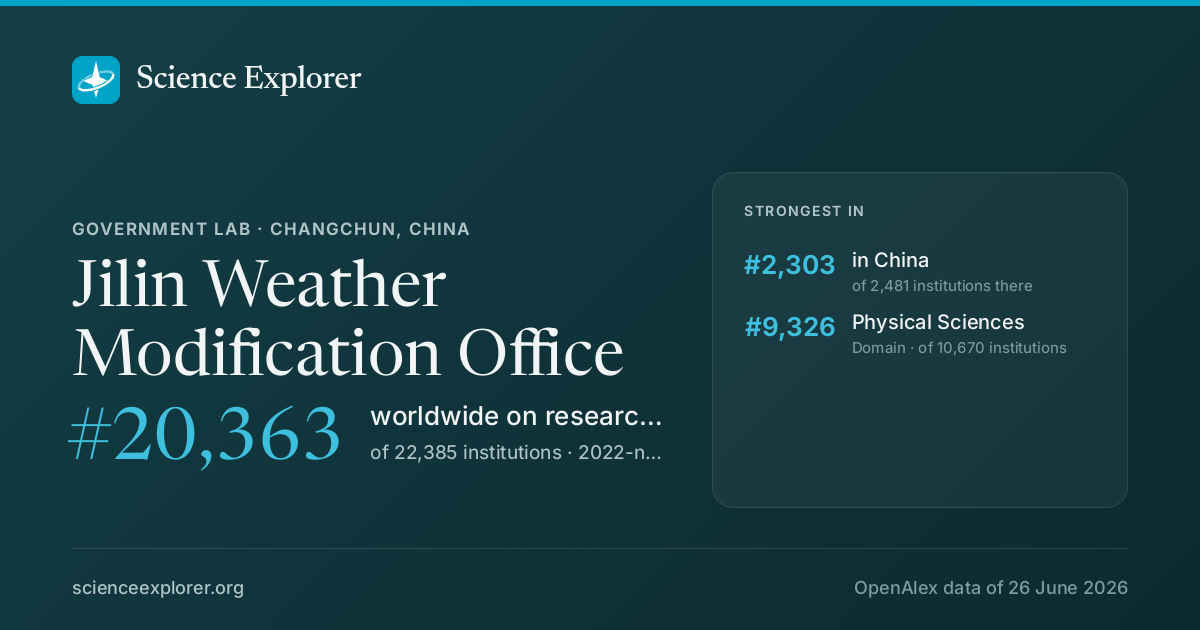
Jilin Weather Modification Office
In research, Jilin Weather Modification Office stands highest in Physical Sciences (#9,326 of 10,670 worldwide), 2022-now. Relative to its size it is most specialised in Atmospheric Science, Global and Planetary Change and Earth and Planetary Sciences (Atmospheric Science is 83.2× its share of world research).
- World rank, 2022-now
- #20,363 of 22,385 · #20,287 all time
- Rank in China
- #2,303 of 2,481
- Research works
- 514 ▲ 51% vs 2018-21
- Citations
- 4.1k 7.9 per fractional work
- Top-10% rate
- 4.2% all institutions 10.0%
- vs its own fields
- 0.87× 1.00× is exactly expected
- Open access
- 31% world 40%
- International
- 12% world 18%
What is Jilin Weather Modification Office known for in research?
The fields where it stands highest, 2022-now, ranked among every institution above the floor in each field.
| Field | World rank | Where that sits | Top-10% rate | Works | All time |
|---|---|---|---|---|---|
| Physical SciencesDomain | #9,326 of 10,670 | 2.9% | 104 | #9047 |
Each strip is that field's whole ranked pool, with the notch where Jilin Weather Modification Office sits in it, in the colour of the band that rank falls in. The track under the rate is the rate itself: it carries no average mark, because the average differs by field (from about 6% in Dentistry to 21% in Economics).
Which fields of science does Jilin Weather Modification Office work in?
In 2022-now, 93% of research at Jilin Weather Modification Office is in Physical Sciences, 5% in Life Sciences. Its largest fields are Earth and Planetary Sciences (41%), Environmental Science (36%), Engineering (9%). It does 2.3× the world's share of Physical Sciences.
Each ring splits the one inside it: the four domains of science, their fields, their subfields. Size is fractional works in 2022-now. Every slice is a page; the interactive view zooms down to single topics and colours each by how much more of it this institution does than the world.
Its 4 domains and 18 fields, with their numbers
- Physical Sciences11793.3%
- Earth and Planetary Sciences5140.5%
- Environmental Science4535.8%
- Engineering118.5%
- Computer Science53.8%
- Materials Science32.4%
- Physics and Astronomy21.4%
- Chemical Engineering00.3%
- Chemistry00.2%
- Energy00.2%
- Mathematics00.1%
- Life Sciences64.6%
- Social Sciences21.4%
- Business, Management and Accounting10.6%
- Social Sciences10.5%
- Psychology00.3%
- Decision Sciences00.0%
- Health Sciences10.7%
- Medicine10.7%
What does Jilin Weather Modification Office specialise in?
Where its research is concentrated relative to its size: Atmospheric Science takes 83.2× the share of its output that it takes of world research.
- Atmospheric ScienceSubfield · 46.2 works83×
- Global and Planetary ChangeSubfield · 28.9 works30×
- Earth and Planetary SciencesField · 50.9 works26×
- Environmental ScienceField · 45.0 works7.2×
Location quotient, a volume reading rather than an impact one. It surfaces small, lopsided specialities.
Field profile
Location quotient across every field it publishes in: outside the ring is more than an institution of this size would be expected to publish, inside it is less.
Rings at 0.5×, 1× and 2×. Widest outward: Earth and Planetary Sciences, 25.8×. Every wedge is a field page.
All 18 fields, with their numbers
- Earth and Planetary Sciences25.83×51 works
- Environmental Science7.21×45 works
- Chemical Engineering0.85×0 works
- Agricultural and Biological Sciences0.71×4 works
- Materials Science0.69×3 works
- Physics and Astronomy0.64×2 works
- Engineering0.57×11 works
- Neuroscience0.49×1 works
- Computer Science0.48×5 works
- Energy0.24×0 works
- Business, Management and Accounting0.18×1 works
- Chemistry0.15×0 works
- Biochemistry, Genetics and Molecular Biology0.09×1 works
- Psychology0.09×0 works
- Mathematics0.06×0 works
- Medicine0.04×1 works
- Decision Sciences0.04×0 works
- Social Sciences0.04×1 works
- Earth and Planetary Sciences 25.8×
- Environmental Science 7.2×
- Chemical Engineering 0.8×
- Agricultural and Biological Sciences 0.7×
- Materials Science 0.7×
- Physics and Astronomy 0.6×
- Engineering 0.6×
- Neuroscience 0.5×
- Computer Science 0.5×
- Energy 0.2×
- Business, Management and Accounting 0.2×
- Chemistry 0.1×
- Biochemistry, Genetics and Molecular Biology 0.1×
- Psychology 0.1×
- Mathematics 0.1×
- Medicine 0.0×
- Decision Sciences 0.0×
- Social Sciences 0.0×
Who are the top researchers at Jilin Weather Modification Office?
Ranked on the quality score, Mengyu Huang, Delong Zhao and Xincheng Ma lead among researchers whose main affiliation is Jilin Weather Modification Office.
- 1
Mengyu Huang
 China · #537,064 worldwide
3.5k citations · 132 works
- 2
Delong Zhao
China · #557,615 worldwide
5.1k citations · 196 works
- 3
Xincheng Ma
China · #1,061,194 worldwide
1k citations · 20 works
- 4
Wei Zhou
China · #1,219,171 worldwide
2.1k citations · 43 works
- 5
Deping Ding
China · #1,407,044 worldwide
2k citations · 111 works
- 6
Xiaobo Dong
China · #1,491,826 worldwide
532 citations · 32 works
- 7
Jiujiang Sheng
China · #1,594,413 worldwide
932 citations · 53 works
- 8
Ping Tian
China · #2,207,491 worldwide
3k citations · 257 works
- 9
Xiao Yang
China · #2,219,566 worldwide
354 citations · 21 works
- 10
Hui He
China · #2,241,750 worldwide
822 citations · 32 works
Which keywords describe research at Jilin Weather Modification Office?
By fractional works in 2022-now, weighted toward what it does more of than the world: Air Quality, Remote Sensing, Hydrological Cycle, Climate Change, Satellite Observations, Climate, Ice Nucleation and Aerosols.
- Wind Erosion
- Sediment Transport
- Global Burden of Disease
- Mortality
- Health Effects
- Forecasting
- Extreme Events
- Greenhouse Gas Emissions
- Satellite
- Spatial Interpolation
- Particulate Matter
- Global Warming
- Black Carbon
- Ensemble Kalman Filter
- Probabilistic Forecasting
- Data Assimilation
- Aerosols
- Climate
- Climate Change
- Remote Sensing
- Air Quality
- Hydrological Cycle
- Satellite Observations
- Ice Nucleation
- Atmospheric Dust
- Boundary Layer
- Convective Parameterization
- Atmospheric Aerosols
- Hydrological Modeling
- Validation
- Precipitation
- Estimation
- Ocean Circulation
- Climate Modeling
- Precipitation Extremes
- Sea Level Rise
- Hydrology
- Air Pollution
- Desertification
- Aeolian Processes
Size is fractional works in 2022-now in the topics tagged with each word; colour is the word's share of this institution's work against its share of the world's. The 40 words are chosen for being large and distinctive. Each links to the topic it comes from most.
All 40 words, with their numbers
- Air Quality33▲ 141×4 topics
- Remote Sensing29▲ 19×18 topics
- Hydrological Cycle23▲ 182×2 topics
- Climate Change23▲ 6.7×35 topics
- Satellite Observations21▲ 165×3 topics
- Climate18▲ 151×2 topics
- Ice Nucleation18▲ 346×2 topics
- Aerosols18▲ 204×1 topic
- Atmospheric Dust18▲ 528×1 topic
- Data Assimilation16▲ 79×3 topics
- Boundary Layer16▲ 101×2 topics
- Probabilistic Forecasting15▲ 63×3 topics
- Convective Parameterization15▲ 209×1 topic
- Ensemble Kalman Filter15▲ 117×1 topic
- Atmospheric Aerosols14▲ 197×1 topic
- Black Carbon14▲ 197×1 topic
- Hydrological Modeling10▲ 33×5 topics
- Global Warming8▲ 15×7 topics
- Validation8▲ 69×2 topics
- Particulate Matter7▲ 38×2 topics
- Precipitation7▲ 112×2 topics
- Spatial Interpolation7▲ 124×2 topics
- Estimation7▲ 128×1 topic
- Satellite7▲ 261×1 topic
- Ocean Circulation6▲ 35×3 topics
- Greenhouse Gas Emissions6▲ 16×2 topics
- Climate Modeling5▲ 57×1 topic
- Extreme Events5▲ 46×2 topics
- Precipitation Extremes5▲ 57×1 topic
- Forecasting5▲ 22×3 topics
- Sea Level Rise5▲ 33×3 topics
- Health Effects5▲ 6.6×4 topics
- Hydrology5▲ 29×4 topics
- Mortality5▲ 6.7×2 topics
- Air Pollution5▲ 30×1 topic
- Global Burden of Disease5▲ 15×1 topic
- Desertification4▲ 95×2 topics
- Sediment Transport4▲ 19×3 topics
- Aeolian Processes4▲ 152×1 topic
- Wind Erosion4▲ 152×1 topic
Which research topics does Jilin Weather Modification Office publish most on?
By volume in 2022-now: Atmospheric aerosols and clouds, Meteorological Phenomena and Simulations, Atmospheric chemistry and aerosols and Precipitation Measurement and Analysis.
Area is fractional works; colour is the subfield each topic belongs to.
- 1 Atmospheric aerosols and clouds Global and Planetary Change 18 works
- 2 Meteorological Phenomena and Simulations Atmospheric Science 15 works
- 3 Atmospheric chemistry and aerosols Atmospheric Science 14 works
- 4 Precipitation Measurement and Analysis Atmospheric Science 7 works
- 5 Climate variability and models Global and Planetary Change 5 works
- 6 Air Quality and Health Impacts Health, Toxicology and Mutagenesis 5 works
- 7 Aeolian processes and effects Earth-Surface Processes 4 works
- 8 Cryospheric studies and observations Atmospheric Science 3 works
- 9 Atmospheric Ozone and Climate Atmospheric Science 3 works
- 10 Air Quality Monitoring and Forecasting Environmental Engineering 2 works
How open and international is its research?
Against the world's own shares: the tick on each track. Both are shares of its output, so they sit on one scale and can be read against each other as well as against the world.
World: 40% of research is openly available.
World: 18% is written across borders.
How has Jilin Weather Modification Office's research output changed?
Output in 2022-2025 was 51% higher than in 2018-2021.
The same series as a ribbon: one cell per year, darker for more. The line above answers how much; this answers when.
Its share of all research
Growing output can still be a shrinking share: all of science grows. This is Jilin Weather Modification Office as a percentage of every work published that year, 0.00039% in 2024.
Fractional works of Jilin Weather Modification Office over all fractional works that year. How the balance of science has shifted.
How much of it reaches the world top 10%
Year by year, against all institutions in the same year.
Of each year's output, the share that reached the world's 10% most cited for its field and year. Peak 9.4% in 2019.
Other research institutions in Changchun
- Jilin University
- Northeast Normal University
- Changchun University of Science and Technology
- Jilin Agricultural University
- Changchun University of Technology
- Changchun University
- Second Affiliated Hospital of Jilin University
- Changchun Institute of Technology
Share Jilin Weather Modification Office's ranking
Badges for a website1Each links back here and updates with every snapshot

Research measures only: rankings here say nothing about teaching, admissions or student experience. Comparable institutions and collaboration partners have tabs of their own, above.
Discussion
Ask a question or share a note about Jilin Weather Modification Office. Posts are plain text and can be reported.