Science Explorer Back to mapMap
Discussion
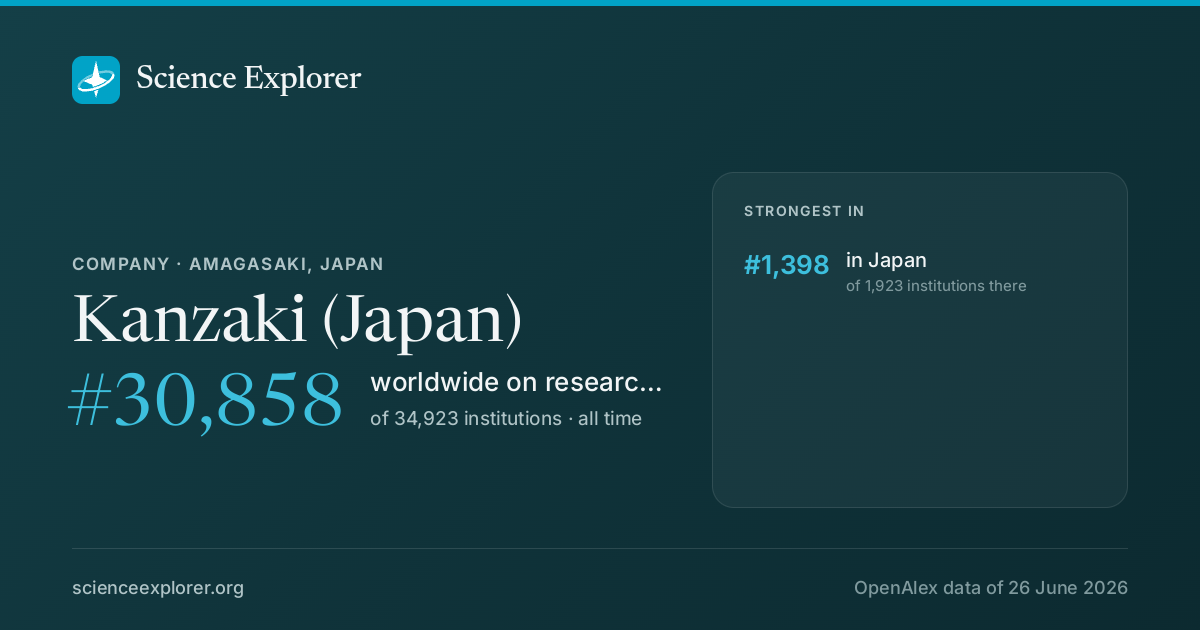
Company · Amagasaki · Japan

Kanzaki (Japan)

World rank, all time
#30,858
of 34,923
Rank in Japan
#1,398
of 1,923
Research works
142
▲ 150% vs 2018-21
Citations
1.6k
11.5 per fractional work
Top-10% rate
12.4%
all institutions 10.0%
vs its own fields
0.90×
1.00× is exactly expected
Open access
48%
world 40%
International
17%
world 18%

Which fields of science does Kanzaki (Japan) work in?

In 2022-now, 71% of research at Kanzaki (Japan) is in Health Sciences, 14% in Life Sciences. Its largest fields are Medicine (63%), Neuroscience (9%), Health Professions (8%). It does 2.4× the world's share of Health Sciences.

Health Sciences: 19 fractional works · 71.3% of its workMedicine: 17 fractional works · 63.3% of its workOrthopedics and Sports Medicine: 6 fractional works · 22.0% of its workPhysiology: 2 fractional works · 7.6% of its workSurgery: 2 fractional works · 6.5% of its workPharmacology: 1 fractional works · 4.8% of its workRehabilitation: 1 fractional works · 4.8% of its workPsychiatry and Mental health: 1 fractional works · 3.6% of its workComplementary and alternative medicine: 1 fractional works · 2.1% of its workCardiology and Cardiovascular Medicine: 0 fractional works · 1.7% of its workPublic Health, Environmental and Occupational Health: 0 fractional works · 1.6% of its workPulmonary and Respiratory Medicine: 0 fractional works · 1.6% of its workOncology: 0 fractional works · 0.9% of its workPathology and Forensic Medicine: 0 fractional works · 0.8% of its workEndocrinology, Diabetes and Metabolism: 0 fractional works · 0.7% of its workGeriatrics and Gerontology: 0 fractional works · 0.7% of its workPediatrics, Perinatology and Child Health: 0 fractional works · 0.7% of its workRadiology, Nuclear Medicine and Imaging: 0 fractional works · 0.6% of its workEpidemiology: 0 fractional works · 0.6% of its workNeurology: 0 fractional works · 0.6% of its workGenetics: 0 fractional works · 0.4% of its workRheumatology: 0 fractional works · 0.4% of its workCritical Care and Intensive Care Medicine: 0 fractional works · 0.3% of its workEmergency Medicine: 0 fractional works · 0.3% of its workHealth Professions: 2 fractional works · 7.6% of its workGeneral Health Professions: 0 fractional works · 1.8% of its workPhysical Therapy, Sports Therapy and Rehabilitation: 0 fractional works · 1.8% of its workSpeech and Hearing: 0 fractional works · 1.5% of its workEmergency Medical Services: 0 fractional works · 0.8% of its workPharmacy: 0 fractional works · 0.8% of its workComplementary and Manual Therapy: 0 fractional works · 0.5% of its workOccupational Therapy: 0 fractional works · 0.3% of its workSmaller subfields together: 0 fractional works · 0.1% of its workDentistry: 0 fractional works · 0.4% of its workPeriodontics: 0 fractional works · 0.4% of its workLife Sciences: 4 fractional works · 13.7% of its workNeuroscience: 2 fractional works · 9.3% of its workCognitive Neuroscience: 2 fractional works · 6.1% of its workSensory Systems: 1 fractional works · 2.0% of its workCellular and Molecular Neuroscience: 0 fractional works · 0.5% of its workEndocrine and Autonomic Systems: 0 fractional works · 0.4% of its workBehavioral Neuroscience: 0 fractional works · 0.3% of its workBiochemistry, Genetics and Molecular Biology: 1 fractional works · 4.4% of its workCell Biology: 1 fractional works · 2.5% of its workMolecular Biology: 1 fractional works · 2.0% of its workPhysical Sciences: 3 fractional works · 10.7% of its workEngineering: 1 fractional works · 4.5% of its workBiomedical Engineering: 1 fractional works · 3.9% of its workAerospace Engineering: 0 fractional works · 0.6% of its workEnvironmental Science: 1 fractional works · 2.0% of its workEcology: 0 fractional works · 1.5% of its workHealth, Toxicology and Mutagenesis: 0 fractional works · 0.4% of its workSmaller subfields together: 0 fractional works · 0.0% of its workPhysics and Astronomy: 0 fractional works · 1.9% of its workAtomic and Molecular Physics, and Optics: 0 fractional works · 1.9% of its workMaterials Science: 0 fractional works · 1.2% of its workElectronic, Optical and Magnetic Materials: 0 fractional works · 0.6% of its workMaterials Chemistry: 0 fractional works · 0.6% of its workEnergy: 0 fractional works · 0.6% of its workRenewable Energy, Sustainability and the Environment: 0 fractional works · 0.6% of its workComputer Science: 0 fractional works · 0.3% of its workArtificial Intelligence: 0 fractional works · 0.3% of its workMathematics: 0 fractional works · 0.2% of its workSocial Sciences: 1 fractional works · 4.3% of its workPsychology: 1 fractional works · 3.4% of its workSocial Psychology: 0 fractional works · 1.6% of its workClinical Psychology: 0 fractional works · 0.7% of its workDevelopmental and Educational Psychology: 0 fractional works · 0.7% of its workApplied Psychology: 0 fractional works · 0.3% of its workSmaller subfields together: 0 fractional works · 0.0% of its workSocial Sciences: 0 fractional works · 0.4% of its workEducation: 0 fractional works · 0.4% of its workArts and Humanities: 0 fractional works · 0.3% of its workConservation: 0 fractional works · 0.3% of its workEconomics, Econometrics and Finance: 0 fractional works · 0.2% of its workALL ITS WORKKanzaki (Japan)27fractional works, 2022-now
Life Sciences14%Physical Sciences11%Health Sciences71%Social Sciences4%

Each ring splits the one inside it: the four domains of science, their fields, their subfields. Size is fractional works in 2022-now. Every slice is a page; the interactive view zooms down to single topics and colours each by how much more of it this institution does than the world.

Its 4 domains and 16 fields, with their numbers
    1. Medicine1763.3%
    2. Health Professions27.6%
    3. Dentistry00.4%
    1. Neuroscience29.3%
    2. Biochemistry, Genetics and Molecular Biology14.4%
    1. Engineering14.5%
    2. Environmental Science12.0%
    3. Physics and Astronomy01.9%
    4. Materials Science01.2%
    5. Energy00.6%
    6. Computer Science00.3%
    7. Mathematics00.2%
    1. Psychology13.4%
    2. Social Sciences00.4%
    3. Arts and Humanities00.3%
    4. Economics, Econometrics and Finance00.2%
All of science, and how each field's share has moved since 1950: the Science domain explorer

Field profile

Location quotient across every field it publishes in: outside the ring is more than an institution of this size would be expected to publish, inside it is less.

Biochemistry, Genetics and Molecular Biology: 0.83× its world share, 1 worksBiochemistry, Geneti…Neuroscience: 5.72× its world share, 2 worksNeuroscienceComputer Science: 0.04× its world share, 0 worksComputer ScienceEnergy: 0.67× its world share, 0 worksEnergyEngineering: 0.30× its world share, 1 worksEngineeringEnvironmental Science: 0.40× its world share, 0 worksEnvironmental ScienceMaterials Science: 0.36× its world share, 0 worksMaterials ScienceMathematics: 0.15× its world share, 0 worksMathematicsPhysics and Astronomy: 0.84× its world share, 0 worksPhysics and AstronomyDentistry: 0.85× its world share, 0 worksDentistryHealth Professions: 2.89× its world share, 2 worksHealth ProfessionsMedicine: 3.29× its world share, 17 worksMedicineArts and Humanities: 0.09× its world share, 0 worksArts and HumanitiesEconomics, Econometrics and Finance: 0.08× its world share, 0 worksEconomics, Econometr…Psychology: 1.13× its world share, 1 worksPsychologySocial Sciences: 0.03× its world share, 0 worksSocial Sciences1×world share
more than its size predictsabout as predictedless

Rings at 0.5×, 1× and 2×. Widest outward: Neuroscience, 5.7×. Every wedge is a field page.

All 16 fields, with their numbers
  1. Neuroscience5.72×2 works
  2. Medicine3.29×17 works
  3. Health Professions2.89×2 works
  4. Psychology1.13×1 works
  5. Dentistry0.85×0 works
  6. Physics and Astronomy0.84×0 works
  7. Biochemistry, Genetics and Molecular Biology0.83×1 works
  8. Energy0.67×0 works
  9. Environmental Science0.40×0 works
  10. Materials Science0.36×0 works
  11. Engineering0.30×1 works
  12. Mathematics0.15×0 works
  13. Arts and Humanities0.09×0 works
  14. Economics, Econometrics and Finance0.08×0 works
  15. Computer Science0.04×0 works
  16. Social Sciences0.03×0 works

Who are the top researchers at Kanzaki (Japan)?

Ranked on the quality score, Yoshihiko Fujii lead among researchers whose main affiliation is Kanzaki (Japan).

  1. 1 Yoshihiko Fujii Japan · #4,830,901 worldwide 13 citations · 16 works
All ranked researchers at Kanzaki (Japan)

What are the most cited papers from Kanzaki (Japan)?

The most cited paper from Kanzaki (Japan) is "Neuropharmacology of second-generation antipsychotic drugs: a validity of the serotonin–dopamine hypothesis" (Tomoyuki Kuroki, Norio Nagao, Tsutomu Nakahara, 2008), with 146 citations. Next come "CHAOTIC PULSATION IN HUMAN CAPILLARY VESSELS AND ITS DEPENDENCE ON MENTAL AND PHYSICAL CONDITIONS" (132) and "Effect of phenycyclidine on dopamine release in the rat prefrontal cortex; an in vivo microdialysis study" (120).

Most cited papers
#PaperReleasedCitations
1 Neuropharmacology of second-generation antipsychotic drugs: a validity of the serotonin–dopamine hypothesis Tomoyuki Kuroki, Norio Nagao, Tsutomu Nakahara · Progress in brain research Book chapter 2008 146
2 CHAOTIC PULSATION IN HUMAN CAPILLARY VESSELS AND ITS DEPENDENCE ON MENTAL AND PHYSICAL CONDITIONS Ichiro Tsuda, Takashi Tahara, Hiroaki Iwanaga · International Journal of Bifurcation and Chaos Jun 1992 132
3 Effect of phenycyclidine on dopamine release in the rat prefrontal cortex; an in vivo microdialysis study Hisao Hondo, Yuji Yonezawa, Tatsuo Nakahara et al. · Brain Research 1994 120
4 Sedimentary features of the seismo-turbidites, Lake Biwa, Japan Tsunemasa Shiki, Fujio Kumon, Yutaka Inouchi et al. · Sedimentary Geology Sep 2000 114
5 Chronic Effects of Static Stretching Exercises on Muscle Strength and Power in Healthy Individuals Across the Lifespan: A Systematic Review with Multi-level Meta-analysis Fabian Arntz, Adrian Markov, David George Behm et al. · Sports Medicine ReviewOpen access 31 Jan 2023 83
All 62 most cited papers, with filters and sorting

Which keywords describe research at Kanzaki (Japan)?

By fractional works in 2022-now, weighted toward what it does more of than the world: Epidemiology, Prevention, Risk Factors, Injury Prevention, Muscle Injuries, Sports Injury, Rehabilitation and High-Intensity Interval Training.

▲ more of its work than of the world's◆ about the world's share▼ less than the world's

Size is fractional works in 2022-now in the topics tagged with each word; colour is the word's share of this institution's work against its share of the world's. The 24 words are chosen for being large and distinctive. Each links to the topic it comes from most.

All 24 words, with their numbers
  1. Epidemiology6▲ 5.7×17 topics
  2. Injury Prevention3▲ 90×3 topics
  3. Prevention3▲ 27×5 topics
  4. Risk Factors3▲ 10×3 topics
  5. Muscle Injuries3▲ 165×1 topic
  6. Sports Injury3▲ 165×1 topic
  7. High-Intensity Interval Training2▲ 62×2 topics
  8. Rehabilitation2▲ 17×7 topics
  9. Clinical Trials2▲ 9.3×4 topics
  10. Resistance Training2▲ 69×2 topics
  11. Performance Analysis2▲ 28×1 topic
  12. Training Load2▲ 91×1 topic
  13. Aging2▲ 10×6 topics
  14. Psychological Factors2▲ 26×3 topics
  15. Chronic Pain1▲ 24×2 topics
  16. Global Burden1▲ 9.2×3 topics
  17. Inflammation1▲ 2.5×9 topics
  18. Quality of Life1▲ 3.5×8 topics
  19. Disability1▲ 45×1 topic
  20. Low Back Pain1▲ 30×2 topics
  21. Measurement Properties1▲ 65×1 topic
  22. Biomechanics1▲ 13×4 topics
  23. Reactive Oxygen Species1▲ 9.9×2 topics
  24. Muscle Mass1▲ 34×2 topics

Which research topics does Kanzaki (Japan) publish most on?

By volume in 2022-now: Sports injuries and prevention, Sports Performance and Training, Musculoskeletal pain and rehabilitation and Exercise and Physiological Responses.

  1. 1 Sports injuries and prevention Orthopedics and Sports Medicine 3 works
  2. 2 Sports Performance and Training Orthopedics and Sports Medicine 2 works
  3. 3 Musculoskeletal pain and rehabilitation Pharmacology 1 works
  4. 4 Exercise and Physiological Responses Rehabilitation 1 works
  5. 5 EEG and Brain-Computer Interfaces Cognitive Neuroscience 1 works
  6. 6 Nutrition and Health in Aging Physiology 1 works
  7. 7 Myofascial pain diagnosis and treatment Cell Biology 1 works
  8. 8 Olfactory and Sensory Function Studies Sensory Systems 1 works
  9. 9 Balance, Gait, and Falls Prevention Physical Therapy, Sports Therapy and Rehabilitation 0 works
  10. 10 Tendon Structure and Treatment Orthopedics and Sports Medicine 0 works

How open and international is its research?

Against the world's own shares: the tick on each track. Both are shares of its output, so they sit on one scale and can be read against each other as well as against the world.

openly available47.8%not open52.2%

World: 40% of research is openly available.

with international co-authors16.9%domestic only83.1%

World: 18% is written across borders.

How has Kanzaki (Japan)'s research output changed?

Output in 2022-2025 was 150% higher than in 2018-2021.

still counting1990200020102020
grewheldshrank

The same series as a ribbon: one cell per year, darker for more. The line above answers how much; this answers when.

Its share of all research

Growing output can still be a shrinking share: all of science grows. This is Kanzaki (Japan) as a percentage of every work published that year, 0.00011% in 2024.

still counting0.00050%0.0010%0.0015%Kanzaki (Japan)0.000075% in 202519801990200020102020

Fractional works of Kanzaki (Japan) over all fractional works that year. How the balance of science has shifted.

Other research institutions in Amagasaki

All research institutions in Amagasaki

Share Kanzaki (Japan)'s ranking

Kanzaki (Japan) on Science Explorer

A card with Kanzaki (Japan)'s standing and the fields it leads in, for a post or a slide. A link to this page previews as the same card.

Download the card

1200 × 630 PNG, sized for social posts, drawn from the latest snapshot.

Badges for a website1Each links back here and updates with every snapshot

Research measures only: rankings here say nothing about teaching, admissions or student experience. Comparable institutions and collaboration partners have tabs of their own, above.

Discussion

Ask a question or share a note about Kanzaki (Japan). Keep it to the research: no personal attacks, advertising or links. Any reader can report a post, which collapses it for everyone until it is opened.