Science Explorer Back to mapMap
Discussion
Company · Baltimore · United States

Levin Group (United States)

In research, Levin Group (United States) stands highest in Health Sciences (#5,295 of 16,688 worldwide), General Health Professions (#1,842 of 1,886 worldwide) and Health Professions (#3,248 of 3,315 worldwide), over all time.

World rank, all time
#12,683
of 34,923
Rank in United States
#2,632
of 7,310
Research works
388
▲ 82% vs 2018-21
Citations
4.3k
11.0 per fractional work
Top-10% rate
8.2%
all institutions 10.0%
vs its own fields
1.13×
1.00× is exactly expected
Open access
18%
world 40%
International
11%
world 18%

What is Levin Group (United States) known for in research?

The fields where it stands highest, over all time, ranked among every institution above the floor in each field.

FieldWorld rankWhere that sitsTop-10% rateWorks
Health SciencesDomain #5,295 of 16,688 6.3%212
General Health ProfessionsSubfield #1,842 of 1,886 0.2%124
Health ProfessionsField #3,248 of 3,315 0.4%144

Each strip is that field's whole ranked pool, with the notch where Levin Group (United States) sits in it, in the colour of the band that rank falls in. The track under the rate is the rate itself: it carries no average mark, because the average differs by field (from about 6% in Dentistry to 21% in Economics).

Which fields of science does Levin Group (United States) work in?

In 2022-now, 46% of research at Levin Group (United States) is in Health Sciences, 29% in Social Sciences. Its largest fields are Medicine (24%), Health Professions (20%), Engineering (12%). It does 1.6× the world's share of Health Sciences.

Health Sciences: 10 fractional works · 46.2% of its workMedicine: 5 fractional works · 24.4% of its workPublic Health, Environmental and Occupational Health: 1 fractional works · 4.2% of its workEpidemiology: 1 fractional works · 3.8% of its workSurgery: 1 fractional works · 3.8% of its workCardiology and Cardiovascular Medicine: 1 fractional works · 2.6% of its workOncology: 0 fractional works · 2.1% of its workRadiology, Nuclear Medicine and Imaging: 0 fractional works · 2.1% of its workDermatology: 0 fractional works · 1.6% of its workPharmacology: 0 fractional works · 1.6% of its workRehabilitation: 0 fractional works · 0.7% of its workPediatrics, Perinatology and Child Health: 0 fractional works · 0.5% of its workOphthalmology: 0 fractional works · 0.4% of its workComplementary and alternative medicine: 0 fractional works · 0.3% of its workGastroenterology: 0 fractional works · 0.3% of its workSmaller subfields together: 0 fractional works · 0.2% of its workHealth Professions: 4 fractional works · 19.6% of its workGeneral Health Professions: 3 fractional works · 16.0% of its workHealth Information Management: 0 fractional works · 1.6% of its workMedical Laboratory Technology: 0 fractional works · 1.6% of its workEmergency Medical Services: 0 fractional works · 0.4% of its workDentistry: 0 fractional works · 1.6% of its workGeneral Dentistry: 0 fractional works · 1.6% of its workNursing: 0 fractional works · 0.5% of its workNutrition and Dietetics: 0 fractional works · 0.5% of its workSocial Sciences: 6 fractional works · 28.5% of its workBusiness, Management and Accounting: 2 fractional works · 10.4% of its workOrganizational Behavior and Human Resource Management: 2 fractional works · 8.0% of its workManagement of Technology and Innovation: 0 fractional works · 1.6% of its workTourism, Leisure and Hospitality Management: 0 fractional works · 0.8% of its workSocial Sciences: 2 fractional works · 8.3% of its workSociology and Political Science: 1 fractional works · 3.5% of its workEducation: 1 fractional works · 3.2% of its workSafety Research: 0 fractional works · 0.9% of its workPolitical Science and International Relations: 0 fractional works · 0.5% of its workSmaller subfields together: 0 fractional works · 0.2% of its workPsychology: 1 fractional works · 4.5% of its workSocial Psychology: 1 fractional works · 4.2% of its workClinical Psychology: 0 fractional works · 0.2% of its workEconomics, Econometrics and Finance: 1 fractional works · 3.2% of its workEconomics and Econometrics: 0 fractional works · 2.4% of its workFinance: 0 fractional works · 0.8% of its workDecision Sciences: 0 fractional works · 1.2% of its workManagement Science and Operations Research: 0 fractional works · 1.2% of its workArts and Humanities: 0 fractional works · 0.8% of its workReligious studies: 0 fractional works · 0.8% of its workPhysical Sciences: 4 fractional works · 18.5% of its workEngineering: 2 fractional works · 11.7% of its workOcean Engineering: 1 fractional works · 3.5% of its workMechanical Engineering: 0 fractional works · 2.4% of its workIndustrial and Manufacturing Engineering: 0 fractional works · 1.8% of its workCivil and Structural Engineering: 0 fractional works · 1.6% of its workElectrical and Electronic Engineering: 0 fractional works · 0.8% of its workAutomotive Engineering: 0 fractional works · 0.5% of its workBiomedical Engineering: 0 fractional works · 0.5% of its workMechanics of Materials: 0 fractional works · 0.5% of its workComputer Science: 1 fractional works · 3.2% of its workArtificial Intelligence: 0 fractional works · 1.6% of its workInformation Systems: 0 fractional works · 1.6% of its workSmaller subfields together: 0 fractional works · 0.0% of its workEnvironmental Science: 0 fractional works · 2.4% of its workEnvironmental Engineering: 0 fractional works · 1.6% of its workEcology: 0 fractional works · 0.8% of its workChemical Engineering: 0 fractional works · 0.8% of its workFluid Flow and Transfer Processes: 0 fractional works · 0.8% of its workPhysics and Astronomy: 0 fractional works · 0.4% of its workAtomic and Molecular Physics, and Optics: 0 fractional works · 0.4% of its workLife Sciences: 1 fractional works · 6.8% of its workAgricultural and Biological Sciences: 0 fractional works · 2.4% of its workAnimal Science and Zoology: 0 fractional works · 0.8% of its workPlant Science: 0 fractional works · 0.8% of its workSoil Science: 0 fractional works · 0.8% of its workNeuroscience: 0 fractional works · 2.1% of its workCellular and Molecular Neuroscience: 0 fractional works · 1.3% of its workCognitive Neuroscience: 0 fractional works · 0.8% of its workPharmacology, Toxicology and Pharmaceutics: 0 fractional works · 1.8% of its workToxicology: 0 fractional works · 1.8% of its workBiochemistry, Genetics and Molecular Biology: 0 fractional works · 0.5% of its workMolecular Biology: 0 fractional works · 0.3% of its workSmaller subfields together: 0 fractional works · 0.1% of its workALL ITS WORKLevin Group(United States)21fractional works, 2022-now
Life Sciences7%Physical Sciences19%Health Sciences46%Social Sciences29%

Each ring splits the one inside it: the four domains of science, their fields, their subfields. Size is fractional works in 2022-now. Every slice is a page; the interactive view zooms down to single topics and colours each by how much more of it this institution does than the world.

Its 4 domains and 19 fields, with their numbers
    1. Medicine524.4%
    2. Health Professions419.6%
    3. Dentistry01.6%
    4. Nursing00.5%
    1. Business, Management and Accounting210.4%
    2. Social Sciences28.3%
    3. Psychology14.5%
    4. Economics, Econometrics and Finance13.2%
    5. Decision Sciences01.2%
    6. Arts and Humanities00.8%
    1. Engineering211.7%
    2. Computer Science13.2%
    3. Environmental Science02.4%
    4. Chemical Engineering00.8%
    5. Physics and Astronomy00.4%
    1. Agricultural and Biological Sciences02.4%
    2. Neuroscience02.1%
    3. Pharmacology, Toxicology and Pharmaceutics01.8%
    4. Biochemistry, Genetics and Molecular Biology00.5%
All of science, and how each field's share has moved since 1950: the Science domain explorer

Field profile

Location quotient across every field it publishes in: outside the ring is more than an institution of this size would be expected to publish, inside it is less.

Agricultural and Biological Sciences: 0.51× its world share, 0 worksAgricultural and Bio…Biochemistry, Genetics and Molecular Biology: 0.09× its world share, 0 worksBiochemistry, Geneti…Neuroscience: 1.32× its world share, 0 worksNeurosciencePharmacology, Toxicology and Pharmaceutics: 5.06× its world share, 0 worksPharmacology, Toxico…Chemical Engineering: 2.30× its world share, 0 worksChemical EngineeringComputer Science: 0.41× its world share, 1 worksComputer ScienceEngineering: 0.78× its world share, 2 worksEngineeringEnvironmental Science: 0.48× its world share, 0 worksEnvironmental SciencePhysics and Astronomy: 0.18× its world share, 0 worksPhysics and AstronomyDentistry: 3.31× its world share, 0 worksDentistryHealth Professions: 7.46× its world share, 4 worksHealth ProfessionsMedicine: 1.27× its world share, 5 worksMedicineNursing: 1.09× its world share, 0 worksNursingArts and Humanities: 0.28× its world share, 0 worksArts and HumanitiesBusiness, Management and Accounting: 3.24× its world share, 2 worksBusiness, Management…Decision Sciences: 1.25× its world share, 0 worksDecision SciencesEconomics, Econometrics and Finance: 1.50× its world share, 1 worksEconomics, Econometr…Psychology: 1.47× its world share, 1 worksPsychologySocial Sciences: 0.66× its world share, 2 worksSocial Sciences1×world share
more than its size predictsabout as predictedless

Rings at 0.5×, 1× and 2×. Widest outward: Health Professions, 7.5×. Every wedge is a field page.

All 19 fields, with their numbers
  1. Health Professions7.46×4 works
  2. Pharmacology, Toxicology and Pharmaceutics5.06×0 works
  3. Dentistry3.31×0 works
  4. Business, Management and Accounting3.24×2 works
  5. Chemical Engineering2.30×0 works
  6. Economics, Econometrics and Finance1.50×1 works
  7. Psychology1.47×1 works
  8. Neuroscience1.32×0 works
  9. Medicine1.27×5 works
  10. Decision Sciences1.25×0 works
  11. Nursing1.09×0 works
  12. Engineering0.78×2 works
  13. Social Sciences0.66×2 works
  14. Agricultural and Biological Sciences0.51×0 works
  15. Environmental Science0.48×0 works
  16. Computer Science0.41×1 works
  17. Arts and Humanities0.28×0 works
  18. Physics and Astronomy0.18×0 works
  19. Biochemistry, Genetics and Molecular Biology0.09×0 works

Who are the top researchers at Levin Group (United States)?

Ranked on the quality score, Robert Levinthal, Roger Levin and Levin Rp lead among researchers whose main affiliation is Levin Group (United States).

  1. 1 Robert Levinthal United States · #4,045,762 worldwide 285 citations · 19 works
  2. 2 Roger Levin United States · #6,079,670 worldwide 124 citations · 50 works
  3. 3 Levin Rp United States · #7,150,396 worldwide 84 citations · 108 works
  4. 4 Michael Levin-Epstein United States · #7,646,870 worldwide 48 citations · 203 works
  5. 5 Roger P. Levin United States · #7,698,312 worldwide 149 citations · 383 works
All ranked researchers at Levin Group (United States)

What are the most cited papers from Levin Group (United States)?

The most cited paper from Levin Group (United States) is "Characteristics, Prevention, and Management of Cardiovascular Disease in People Living With HIV: A Scientific Statement From the American Heart Association" (Matthew J. Feinstein, Priscilla Y. Hsue, Laura A. Benjamin et al., 2019), with 668 citations. Next come "A Prospective Study of Microvascular Free-Flap Surgery and Outcome" (515) and "Hemodynamically significant primary anomalies of the coronary arteries. Angiographic aspects." (502).

Most cited papers
#PaperReleasedCitations
1 Characteristics, Prevention, and Management of Cardiovascular Disease in People Living With HIV: A Scientific Statement From the American Heart Association Matthew J. Feinstein, Priscilla Y. Hsue, Laura A. Benjamin et al. · Circulation Open access 3 Jun 2019 668
2 A Prospective Study of Microvascular Free-Flap Surgery and Outcome Roger K. Khouri, Brian C. Cooley, Allen R. Kunselman et al. · Plastic & Reconstructive Surgery Sep 1998 515
3 Hemodynamically significant primary anomalies of the coronary arteries. Angiographic aspects. David C. Levin, Kenneth E. Fellows, Herbert L. Abrams · Circulation Open access Jul 1978 502
4 Cognitive Outcome Following Traumatic Brain Injury SUREYYA S. DIKMEN, John D. Corrigan, Harvey S. Levin et al. · Journal of Head Trauma Rehabilitation Nov 2009 469
5 Significance of the angiographic morphology of localized coronary stenoses: histopathologic correlations. David C. Levin, John T. Fallon · Circulation Open access Aug 1982 398
All 61 most cited papers, with filters and sorting

Which keywords describe research at Levin Group (United States)?

By fractional works in 2022-now, weighted toward what it does more of than the world: Dental Students, Leadership Development, Career Choice, Motivation, Data Mining, Organizational Performance, COVID-19 and Epidemiology.

▲ more of its work than of the world's◆ about the world's share▼ less than the world's

Size is fractional works in 2022-now in the topics tagged with each word; colour is the word's share of this institution's work against its share of the world's. The 9 words are chosen for being large and distinctive. Each links to the topic it comes from most.

All 9 words, with their numbers
  1. Dental Students3▲ 618×2 topics
  2. Leadership Development3▲ 366×2 topics
  3. Career Choice3▲ 460×1 topic
  4. Motivation3▲ 31×1 topic
  5. Data Mining2▲ 11×4 topics
  6. Epidemiology1▲ 1.56×8 topics
  7. COVID-191▲ 4.6×4 topics
  8. Machine Learning1▲ 1.45×2 topics
  9. Organizational Performance1▲ 18×2 topics

Which research topics does Levin Group (United States) publish most on?

By volume in 2022-now: Dental Education, Practice, Research, Legal, Health, Environmental and COVID-19 Challenges, Facilities and Workplace Management and AI and HR Technologies.

  1. 1 Dental Education, Practice, Research General Health Professions 3 works
  2. 2 Legal, Health, Environmental and COVID-19 Challenges Public Health, Environmental and Occupational Health 1 works
  3. 3 Facilities and Workplace Management Social Psychology 1 works
  4. 4 AI and HR Technologies Organizational Behavior and Human Resource Management 1 works
  5. 5 Hydraulic Fracturing and Reservoir Analysis Mechanical Engineering 0 works
  6. 6 Enhanced Oil Recovery Techniques Ocean Engineering 0 works
  7. 7 Pharmacovigilance and Adverse Drug Reactions Toxicology 0 works
  8. 8 Occupational health in dentistry Medical Laboratory Technology 0 works
  9. 9 Drug-Induced Adverse Reactions Pharmacology 0 works
  10. 10 Data Mining and Machine Learning Applications Information Systems 0 works

How open and international is its research?

Against the world's own shares: the tick on each track. Both are shares of its output, so they sit on one scale and can be read against each other as well as against the world.

openly available17.8%not open82.2%

World: 40% of research is openly available.

with international co-authors10.9%domestic only89.1%

World: 18% is written across borders.

How has Levin Group (United States)'s research output changed?

Output in 2022-2025 was 82% higher than in 2018-2021.

still counting1990200020102020
grewheldshrank

The same series as a ribbon: one cell per year, darker for more. The line above answers how much; this answers when.

Its share of all research

Growing output can still be a shrinking share: all of science grows. This is Levin Group (United States) as a percentage of every work published that year, 0.000061% in 2024.

still counting0.0010%0.0020%Levin Group (United States)0.00012% in 202519801990200020102020

Fractional works of Levin Group (United States) over all fractional works that year. How the balance of science has shifted.

How much of it reaches the world top 10%

Year by year, against all institutions in the same year.

5%10%15%all institutions10.0% in 2011Levin Group (United States)3.9% in 20112010

Of each year's output, the share that reached the world's 10% most cited for its field and year. Peak 5.9% in 2009.

Other research institutions in Baltimore

All research institutions in Baltimore

Share Levin Group (United States)'s ranking
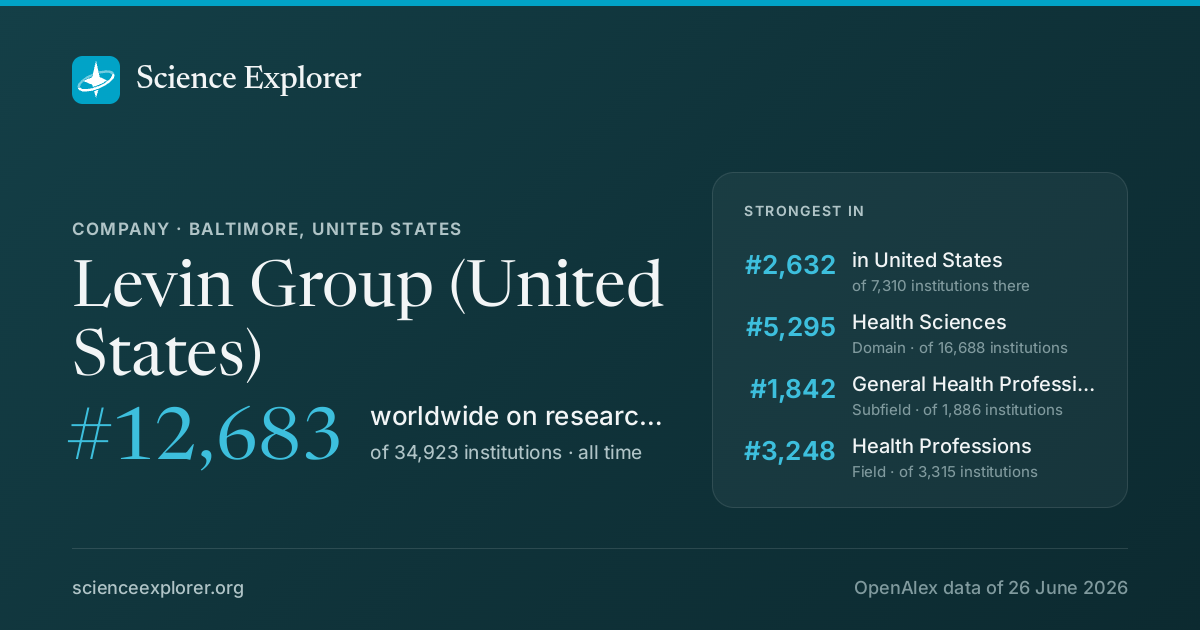
Levin Group (United States) on Science Explorer

A card with Levin Group (United States)'s standing and the fields it leads in, for a post or a slide. A link to this page previews as the same card.

Download the card

1200 × 630 PNG, sized for social posts, drawn from the latest snapshot.

Badges for a website1Each links back here and updates with every snapshot

Research measures only: rankings here say nothing about teaching, admissions or student experience. Comparable institutions and collaboration partners have tabs of their own, above.

Discussion

Ask a question or share a note about Levin Group (United States). Posts are plain text and can be reported.