Liaoning Technical University
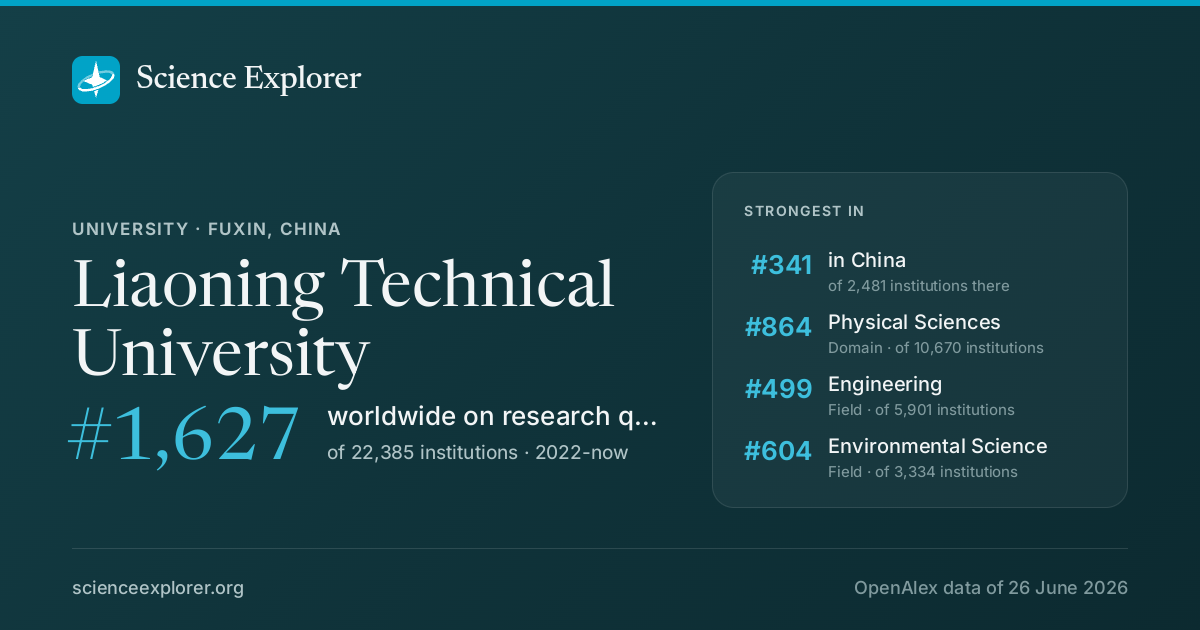
In research, Liaoning Technical University stands highest in Physical Sciences (#864 of 10,670 worldwide), Engineering (#499 of 5,901 worldwide) and Environmental Science (#604 of 3,334 worldwide), 2022-now. Relative to its size it is most specialised in Safety, Risk, Reliability and Quality, Mechanics of Materials and Ocean Engineering (Safety, Risk, Reliability and Quality is 13.1× its share of world research).
- World rank, 2022-now
- #1,627 of 22,385 · #2,485 all time
- Rank in China
- #341 of 2,481
- Research works
- 13k ▲ 280% vs 2018-21
- Citations
- 50k 3.9 per fractional work
- Top-10% rate
- 9.5% all institutions 10.0%
- vs its own fields
- 0.98× 1.00× is exactly expected
- Open access
- 27% world 40%
- International
- 4% world 18%
What is Liaoning Technical University known for in research?
The fields where it stands highest, 2022-now, ranked among every institution above the floor in each field.
| Field | World rank | Where that sits | Top-10% rate | Works | All time |
|---|---|---|---|---|---|
| Physical SciencesDomain | #864 of 10,670 | 9.7% | 3,208 | #1447 | |
| EngineeringField | #499 of 5,901 | 9.5% | 2,040 | #1150 | |
| Environmental ScienceField | #604 of 3,334 | 11.2% | 263 | #1127 | |
| Civil and Structural EngineeringSubfield | #222 of 908 | 11.8% | 273 | #612 | |
| Computer ScienceField | #1,156 of 4,417 | 8.5% | 500 | #1431 | |
| Materials ScienceField | #722 of 2,276 | 11.9% | 139 | #1290 | |
| Mechanics of MaterialsSubfield | #164 of 482 | 10.6% | 277 | #474 | |
| Electrical and Electronic EngineeringSubfield | #805 of 2,176 | 7.6% | 331 | #1744 | |
| Mechanical EngineeringSubfield | #613 of 1,319 | 8.7% | 218 | #1422 | |
| Ocean EngineeringSubfield | #143 of 301 | 12.4% | 170 | #445 |
Each strip is that field's whole ranked pool, with the notch where Liaoning Technical University sits in it, in the colour of the band that rank falls in. The track under the rate is the rate itself: it carries no average mark, because the average differs by field (from about 6% in Dentistry to 21% in Economics).
Which of those standings moved
The same fields on both windows: where it stood over the whole record, and where it stands in 2022-now. The distance is the story, and it is the one thing the two rank columns above cannot show.
- Physical Sciences#1,447 #864
- Engineering#1,150 #499
- Environmental Science#1,127 #604
- Civil and Structural Engineering#612 #222
- Computer Science#1,431 #1,156
- Materials Science#1,290 #722
- Mechanics of Materials#474 #164
- Electrical and Electronic Engineering#1,744 #805
- Mechanical Engineering#1,422 #613
- Ocean Engineering#445 #143
A dot further right is a better standing. Fields it was not ranked in over the whole record are left out.
Which fields of science does Liaoning Technical University work in?
In 2022-now, 90% of research at Liaoning Technical University is in Physical Sciences, 7% in Social Sciences. Its largest fields are Engineering (57%), Computer Science (14%), Environmental Science (7%). It does 2.3× the world's share of Physical Sciences.
Each ring splits the one inside it: the four domains of science, their fields, their subfields. Size is fractional works in 2022-now. Every slice is a page; the interactive view zooms down to single topics and colours each by how much more of it this institution does than the world.
Its 4 domains and 25 fields, with their numbers
- Physical Sciences3,67089.8%
- Engineering2,33257.0%
- Computer Science56713.9%
- Environmental Science3037.4%
- Materials Science1583.9%
- Earth and Planetary Sciences1493.6%
- Energy721.8%
- Physics and Astronomy421.0%
- Chemistry260.6%
- Mathematics140.3%
- Chemical Engineering80.2%
- Social Sciences2937.2%
- Business, Management and Accounting1223.0%
- Decision Sciences551.4%
- Social Sciences541.3%
- Economics, Econometrics and Finance391.0%
- Psychology170.4%
- Arts and Humanities50.1%
- Life Sciences691.7%
- Health Sciences561.4%
- Medicine340.8%
- Health Professions200.5%
- Nursing10.0%
- Dentistry10.0%
What does Liaoning Technical University specialise in?
Where its research is concentrated relative to its size: Safety, Risk, Reliability and Quality takes 13.1× the share of its output that it takes of world research.
- Safety, Risk, Reliability and QualitySubfield · 128.4 works13×
- Mechanics of MaterialsSubfield · 308.8 works11×
- Ocean EngineeringSubfield · 195.0 works9.2×
- Geochemistry and PetrologySubfield · 29.7 works7.1×
- Business and International ManagementSubfield · 30.3 works7.0×
- Civil and Structural EngineeringSubfield · 310.4 works6.4×
Location quotient, a volume reading rather than an impact one. It surfaces small, lopsided specialities.
Field profile
Location quotient across every field it publishes in: outside the ring is more than an institution of this size would be expected to publish, inside it is less.
Rings at 0.5×, 1× and 2×. Widest outward: Engineering, 3.8×. Every wedge is a field page.
All 25 fields, with their numbers
- Engineering3.80×2,332 works
- Earth and Planetary Sciences2.32×148 works
- Energy1.92×72 works
- Computer Science1.78×567 works
- Environmental Science1.49×303 works
- Decision Sciences1.40×56 works
- Materials Science1.11×158 works
- Business, Management and Accounting0.93×122 works
- Chemical Engineering0.54×8 works
- Physics and Astronomy0.47×42 works
- Economics, Econometrics and Finance0.45×39 works
- Chemistry0.40×26 works
- Mathematics0.28×14 works
- Agricultural and Biological Sciences0.20×38 works
- Health Professions0.19×20 works
- Neuroscience0.17×12 works
- Psychology0.14×17 works
- Social Sciences0.10×54 works
- Biochemistry, Genetics and Molecular Biology0.08×18 works
- Pharmacology, Toxicology and Pharmaceutics0.07×1 works
- Nursing0.06×1 works
- Dentistry0.04×1 works
- Medicine0.04×34 works
- Arts and Humanities0.04×5 works
- Immunology and Microbiology0.01×0 works
- Engineering 3.8×
- Earth and Planetary Sciences 2.3×
- Energy 1.9×
- Computer Science 1.8×
- Environmental Science 1.5×
- Decision Sciences 1.4×
- Materials Science 1.1×
- Business, Management and Accounting 0.9×
- Chemical Engineering 0.5×
- Physics and Astronomy 0.5×
- Economics, Econometrics and Finance 0.5×
- Chemistry 0.4×
- Mathematics 0.3×
- Agricultural and Biological Sciences 0.2×
- Health Professions 0.2×
- Neuroscience 0.2×
- Psychology 0.1×
- Social Sciences 0.1×
- Biochemistry, Genetics and Molecular Biology 0.1×
- Pharmacology, Toxicology and Pharmaceutics 0.1×
- Nursing 0.1×
- Dentistry 0.0×
- Medicine 0.0×
- Arts and Humanities 0.0×
- Immunology and Microbiology 0.0×
Who are the top researchers at Liaoning Technical University?
Ranked on the quality score, Chaojun Fan, Shulin Bai and Bing Lü lead among researchers whose main affiliation is Liaoning Technical University.
- 1
Chaojun Fan
 China · #70,995 worldwide
2.8k citations · 89 works
- 2
Shulin Bai
China · #79,643 worldwide
2.9k citations · 136 works
- 3
Bing Lü
China · #222,393 worldwide
5.7k citations · 207 works
- 4
Lijuan Su
China · #298,987 worldwide
1.7k citations · 52 works
- 5
Hemeng Zhang
China · #335,589 worldwide
848 citations · 54 works
- 6
Da Wan
China · #359,591 worldwide
2.3k citations · 106 works
- 7
Fangwei Han
China · #359,949 worldwide
940 citations · 58 works
- 8
Jinzhang Jia
China · #362,499 worldwide
1.2k citations · 114 works
- 9
Mingkun Luo
China · #375,777 worldwide
1.5k citations · 35 works
- 10
Yinghuan Xing
China · #393,117 worldwide
225 citations · 21 works
Which keywords describe research at Liaoning Technical University?
By fractional works in 2022-now, weighted toward what it does more of than the world: Deep Learning, Rock Mechanics, CO2 Sequestration, Pore Structure, Risk Assessment, Dynamic Behavior, Remote Sensing and Neural Networks.
- Support Technology
- Shale Gas
- Sparse Representation
- Liquefaction
- Water Inrush
- Mechanical Behavior
- Wavelet Transform
- Artificial Neural Networks
- Geological Conditions
- Mechanical Properties
- Numerical Simulation
- Convolutional Neural Networks
- Coal Permeability
- Numerical Modelling
- Acoustic Emission
- Fracture
- Pore Structure
- Risk Assessment
- Rock Mechanics
- Machine Learning
- Deep Learning
- Neural Networks
- Remote Sensing
- CO2 Sequestration
- Dynamic Behavior
- Renewable Energy
- Brittle Failure
- Environmental Impact
- Coalbed Methane
- Coal Seam
- Energy Efficiency
- Internet of Things
- Power Electronics
- Renewable Energy Integration
- Support Vector Machines
- Mining Technology
- Supply Chain
- Tunnel
- Fly Ash
- Mining Engineering
Size is fractional works in 2022-now in the topics tagged with each word; colour is the word's share of this institution's work against its share of the world's. The 40 words are chosen for being large and distinctive. Each links to the topic it comes from most.
All 40 words, with their numbers
- Deep Learning448▲ 3.2×78 topics
- Machine Learning248▲ 1.82×79 topics
- Neural Networks214▲ 3.4×36 topics
- Rock Mechanics213▲ 53×4 topics
- Remote Sensing202▲ 4.0×32 topics
- Risk Assessment181▲ 6.7×17 topics
- CO2 Sequestration179▲ 22×4 topics
- Pore Structure174▲ 35×3 topics
- Dynamic Behavior151▲ 32×3 topics
- Fracture135▲ 33×3 topics
- Renewable Energy132▲ 2.2×38 topics
- Acoustic Emission131▲ 51×2 topics
- Brittle Failure130▲ 54×1 topic
- Numerical Modelling130▲ 54×1 topic
- Environmental Impact123▲ 1.77×38 topics
- Coal Permeability122▲ 140×1 topic
- Coalbed Methane122▲ 140×1 topic
- Convolutional Neural Networks115▲ 3.9×14 topics
- Coal Seam107▲ 128×2 topics
- Numerical Simulation102▲ 8.6×12 topics
- Energy Efficiency98▲ 2.6×33 topics
- Mechanical Properties97▲ 2.4×33 topics
- Internet of Things89▲ 2.5×25 topics
- Geological Conditions81▲ 53×2 topics
- Power Electronics72▲ 5.5×8 topics
- Artificial Neural Networks72▲ 3.9×8 topics
- Renewable Energy Integration67▲ 5.0×5 topics
- Wavelet Transform65▲ 6.9×7 topics
- Support Vector Machines63▲ 4.8×8 topics
- Mechanical Behavior61▲ 12×5 topics
- Mining Technology57▲ 130×1 topic
- Water Inrush57▲ 130×1 topic
- Supply Chain56▲ 6.6×10 topics
- Liquefaction55▲ 16×2 topics
- Tunnel55▲ 16×2 topics
- Sparse Representation54▲ 7.1×6 topics
- Fly Ash53▲ 12×2 topics
- Shale Gas53▲ 11×2 topics
- Mining Engineering50▲ 126×1 topic
- Support Technology50▲ 126×1 topic
Which research topics does Liaoning Technical University publish most on?
By volume in 2022-now: Rock Mechanics and Modeling, Coal Properties and Utilization, Geoscience and Mining Technology and Geomechanics and Mining Engineering.
Area is fractional works; colour is the subfield each topic belongs to.
- 1 Rock Mechanics and Modeling Mechanics of Materials 130 works
- 2 Coal Properties and Utilization Ocean Engineering 122 works
- 3 Geoscience and Mining Technology Safety, Risk, Reliability and Quality 57 works
- 4 Geomechanics and Mining Engineering Mechanics of Materials 50 works
- 5 Hydrocarbon exploration and reservoir analysis Mechanics of Materials 46 works
- 6 Landslides and related hazards Management, Monitoring, Policy and Law 43 works
- 7 Advanced Neural Network Applications Computer Vision and Pattern Recognition 40 works
- 8 Grouting, Rheology, and Soil Mechanics Civil and Structural Engineering 36 works
- 9 Concrete and Cement Materials Research Civil and Structural Engineering 34 works
- 10 Geotechnical and Geomechanical Engineering Mechanics of Materials 32 works
How open and international is its research?
Against the world's own shares: the tick on each track. Both are shares of its output, so they sit on one scale and can be read against each other as well as against the world.
World: 40% of research is openly available.
World: 18% is written across borders.
How has Liaoning Technical University's research output changed?
Output in 2022-2025 was 280% higher than in 2018-2021.
The same series as a ribbon: one cell per year, darker for more. The line above answers how much; this answers when.
Its share of all research
Growing output can still be a shrinking share: all of science grows. This is Liaoning Technical University as a percentage of every work published that year, 0.018% in 2024.
Fractional works of Liaoning Technical University over all fractional works that year. How the balance of science has shifted.
How much of it reaches the world top 10%
Year by year, against all institutions in the same year.
Of each year's output, the share that reached the world's 10% most cited for its field and year. Peak 12.0% in 2019.
Share Liaoning Technical University's ranking



Research measures only: rankings here say nothing about teaching, admissions or student experience. Comparable institutions and collaboration partners have tabs of their own, above.
Discussion
Ask a question or share a note about Liaoning Technical University. Posts are plain text and can be reported.