Mannesmann Demag (Germany)
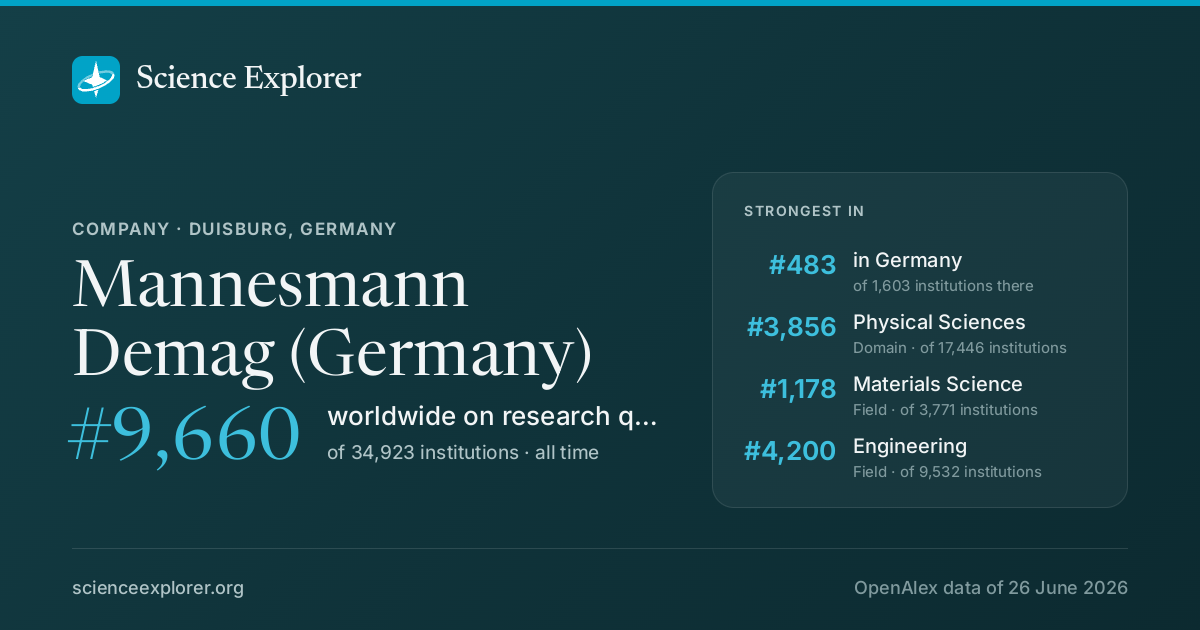
In research, Mannesmann Demag (Germany) stands highest in Physical Sciences (#3,856 of 17,446 worldwide), Materials Science (#1,178 of 3,771 worldwide) and Engineering (#4,200 of 9,532 worldwide), over all time.
- World rank, all time
- #9,660 of 34,923
- Rank in Germany
- #483 of 1,603
- Research works
- 672 ▼ 12% vs 2018-21
- Citations
- 6k 9.0 per fractional work
- Top-10% rate
- 8.4% all institutions 10.0%
- vs its own fields
- 1.05× 1.00× is exactly expected
- Open access
- 4% world 40%
- International
- 6% world 18%
What is Mannesmann Demag (Germany) known for in research?
The fields where it stands highest, over all time, ranked among every institution above the floor in each field.
| Field | World rank | Where that sits | Top-10% rate | Works |
|---|---|---|---|---|
| Physical SciencesDomain | #3,856 of 17,446 | 5.9% | 543 | |
| Materials ScienceField | #1,178 of 3,771 | 4.1% | 152 | |
| EngineeringField | #4,200 of 9,532 | 6.7% | 331 | |
| Mechanical EngineeringSubfield | #1,305 of 2,525 | 5.7% | 145 |
Each strip is that field's whole ranked pool, with the notch where Mannesmann Demag (Germany) sits in it, in the colour of the band that rank falls in. The track under the rate is the rate itself: it carries no average mark, because the average differs by field (from about 6% in Dentistry to 21% in Economics).
Which fields of science does Mannesmann Demag (Germany) work in?
In all years, 81% of research at Mannesmann Demag (Germany) is in Physical Sciences, 14% in Social Sciences. Its largest fields are Engineering (49%), Materials Science (23%), Business, Management and Accounting (5%). It does 2.0× the world's share of Physical Sciences.
Each ring splits the one inside it: the four domains of science, their fields, their subfields. Size is fractional works in all years. Every slice is a page; the interactive view zooms down to single topics and colours each by how much more of it this institution does than the world.
Its 4 domains and 25 fields, with their numbers
- Physical Sciences54380.7%
- Engineering33249.3%
- Materials Science15222.7%
- Computer Science213.2%
- Chemistry91.4%
- Physics and Astronomy91.4%
- Environmental Science91.3%
- Earth and Planetary Sciences40.6%
- Chemical Engineering30.4%
- Energy20.4%
- Mathematics10.2%
- Social Sciences9514.2%
- Business, Management and Accounting355.2%
- Social Sciences233.4%
- Arts and Humanities202.9%
- Psychology101.5%
- Decision Sciences40.6%
- Economics, Econometrics and Finance40.6%
- Health Sciences274.0%
- Medicine213.1%
- Health Professions50.8%
- Nursing00.1%
- Veterinary00.0%
- Dentistry00.0%
- Life Sciences71.1%
Field profile
Location quotient across every field it publishes in: outside the ring is more than an institution of this size would be expected to publish, inside it is less.
Rings at 0.5×, 1× and 2×. Widest outward: Arts and Humanities, 3.0×. Every wedge is a field page.
All 14 fields, with their numbers
- Arts and Humanities3.05×1 works
- Engineering2.88×5 works
- Chemical Engineering2.80×0 works
- Earth and Planetary Sciences2.24×0 works
- Agricultural and Biological Sciences1.85×1 works
- Environmental Science1.47×1 works
- Materials Science1.33×0 works
- Chemistry1.09×0 works
- Economics, Econometrics and Finance0.69×0 works
- Social Sciences0.62×1 works
- Computer Science0.57×0 works
- Business, Management and Accounting0.45×0 works
- Psychology0.32×0 works
- Medicine0.25×1 works
- Arts and Humanities 3.0×
- Engineering 2.9×
- Chemical Engineering 2.8×
- Earth and Planetary Sciences 2.2×
- Agricultural and Biological Sciences 1.9×
- Environmental Science 1.5×
- Materials Science 1.3×
- Chemistry 1.1×
- Economics, Econometrics and Finance 0.7×
- Social Sciences 0.6×
- Computer Science 0.6×
- Business, Management and Accounting 0.5×
- Psychology 0.3×
- Medicine 0.2×
Who are the top researchers at Mannesmann Demag (Germany)?
Ranked on the quality score, W. Bendick, Bernd Wildenmann and Bernd Hahn lead among researchers whose main affiliation is Mannesmann Demag (Germany).
- 1
W. Bendick
 Germany · #1,334,221 worldwide
1.1k citations · 46 works
- 2
Bernd Wildenmann
Germany · #2,207,839 worldwide
15 citations · 59 works
- 3
Bernd Hahn
Germany · #2,355,484 worldwide
378 citations · 15 works
- 4
Karl Wassmann
Germany · #2,607,877 worldwide
358 citations · 30 works
- 5
Friedrich A. K. Lüth
Germany · #2,851,246 worldwide
10 citations · 16 works
- 6
Werner Pepperhoff
Germany · #2,931,694 worldwide
1.3k citations · 110 works
- 7
Winfried Büdenbender
Germany · #2,956,117 worldwide
35 citations · 16 works
- 8
Gerhard Kalwa
Germany · #3,177,783 worldwide
50 citations · 15 works
- 9
Herbert Heuser
Germany · #3,418,677 worldwide
280 citations · 18 works
- 10
Heinz Fabritius
Germany · #3,492,919 worldwide
139 citations · 21 works
Which keywords describe research at Mannesmann Demag (Germany)?
By fractional works in all years, weighted toward what it does more of than the world: Mechanical Properties, Microstructure, Molecular Dynamics Simulation, Corrosion Inhibitors, Metal Corrosion, Hydrogen Embrittlement, Corrosion Behavior and Pitting Corrosion.
- X-ray Photoelectron Spectroscopy
- Engineering
- Sintering
- Martensite Transformation
- Materials Science
- Thermochemical
- Vibration Analysis
- Microstructural Evolution
- Automotive Engineering
- Renewable Resources
- Composite Structures
- Reinforced Concrete
- Wear Resistance
- Additive Manufacturing
- Corrosion
- Passive Films
- Pitting Corrosion
- Hydrogen Embrittlement
- Corrosion Inhibitors
- Microstructure
- Mechanical Properties
- Molecular Dynamics Simulation
- Metal Corrosion
- Corrosion Behavior
- Grain Boundary Engineering
- Stainless Steels
- Structural Analysis
- Cryogenic Treatment
- Grain Refinement
- Metallurgy
- Chloride-induced
- Structural Reliability
- Lightweight Materials
- Renewable Energy
- Databases
- Material Properties
- High-Strength Steels
- Fluid Dynamics
- Thermal Management
- Renewable Energy Integration
Size is fractional works in all years in the topics tagged with each word; colour is the word's share of this institution's work against its share of the world's. The 40 words are chosen for being large and distinctive. Each links to the topic it comes from most.
All 40 words, with their numbers
- Mechanical Properties103▲ 16×18 topics
- Microstructure66▲ 20×14 topics
- Molecular Dynamics Simulation52▲ 50×3 topics
- Corrosion Inhibitors47▲ 127×1 topic
- Metal Corrosion47▲ 127×1 topic
- Hydrogen Embrittlement41▲ 59×3 topics
- Corrosion Behavior40▲ 67×2 topics
- Pitting Corrosion36▲ 105×2 topics
- Grain Boundary Engineering35▲ 67×2 topics
- Passive Films34▲ 143×1 topic
- Stainless Steels34▲ 143×1 topic
- Corrosion34▲ 44×5 topics
- Structural Analysis25▲ 24×5 topics
- Additive Manufacturing24▲ 17×5 topics
- Cryogenic Treatment24▲ 94×1 topic
- Wear Resistance24▲ 77×1 topic
- Grain Refinement24▲ 25×3 topics
- Reinforced Concrete24▲ 52×2 topics
- Metallurgy23▲ 50×2 topics
- Composite Structures23▲ 50×2 topics
- Chloride-induced23▲ 84×1 topic
- Renewable Resources23▲ 26×2 topics
- Structural Reliability23▲ 84×1 topic
- Automotive Engineering22▲ 177×1 topic
- Lightweight Materials22▲ 177×1 topic
- Microstructural Evolution21▲ 18×4 topics
- Renewable Energy20▲ 3.1×13 topics
- Vibration Analysis20▲ 9.7×8 topics
- Databases18▲ 71×1 topic
- Thermochemical18▲ 71×1 topic
- Material Properties18▲ 21×5 topics
- Materials Science18▲ 34×2 topics
- High-Strength Steels17▲ 55×1 topic
- Martensite Transformation17▲ 55×1 topic
- Fluid Dynamics17▲ 17×3 topics
- Sintering17▲ 16×3 topics
- Thermal Management16▲ 8.1×4 topics
- Engineering15▲ 23×1 topic
- Renewable Energy Integration15▲ 8.8×1 topic
- X-ray Photoelectron Spectroscopy15▲ 16×2 topics
Which research topics does Mannesmann Demag (Germany) publish most on?
By volume in 2022-now: Building Energy and Comfort Optimization, Syntax, Semantics, Linguistic Variation, Welding Techniques and Residual Stresses and Extraction and Separation Processes.
Area is fractional works; colour is the subfield each topic belongs to.
- 1 Building Energy and Comfort Optimization Building and Construction 0 works
- 2 Syntax, Semantics, Linguistic Variation Language and Linguistics 0 works
- 3 Welding Techniques and Residual Stresses Mechanical Engineering 0 works
- 4 Extraction and Separation Processes Mechanical Engineering 0 works
- 5 BIM and Construction Integration Building and Construction 0 works
- 6 Agriculture, Land Use, Rural Development General Agricultural and Biological Sciences 0 works
- 7 Civil and Structural Engineering Research Civil and Structural Engineering 0 works
- 8 Engineering and Environmental Studies Ocean Engineering 0 works
- 9 Land Rights and Reforms Soil Science 0 works
- 10 Agricultural Innovations and Practices General Agricultural and Biological Sciences 0 works
How open and international is its research?
Against the world's own shares: the tick on each track. Both are shares of its output, so they sit on one scale and can be read against each other as well as against the world.
World: 40% of research is openly available.
World: 18% is written across borders.
How has Mannesmann Demag (Germany)'s research output changed?
Output in 2022-2025 was 12% lower than in 2018-2021.
The same series as a ribbon: one cell per year, darker for more. The line above answers how much; this answers when.
Its share of all research
Growing output can still be a shrinking share: all of science grows. This is Mannesmann Demag (Germany) as a percentage of every work published that year, 0.000072% in 2024.
Fractional works of Mannesmann Demag (Germany) over all fractional works that year. How the balance of science has shifted.
Other research institutions in Duisburg
- BG Klinikum Duisburg
- Entwicklungszentrum für Schiffstechnik und Transportsysteme
- Sana Kliniken Duisburg
- Klöckner (Germany)
- Evangelisches Krankenhaus Bethesda
- Malteser Krankenhaus St. Anna
- Stryker (Germany)
- DK Recycling und Roheisen (Germany)
Share Mannesmann Demag (Germany)'s ranking
Badges for a website1Each links back here and updates with every snapshot

Research measures only: rankings here say nothing about teaching, admissions or student experience. Comparable institutions and collaboration partners have tabs of their own, above.
Discussion
Ask a question or share a note about Mannesmann Demag (Germany). Keep it to the research: no personal attacks, advertising or links. Any reader can report a post, which collapses it for everyone until it is opened.