Science Explorer Back to mapMap
University · Marietta · United States

Marietta College

In research, Marietta College stands highest in Physical Sciences (#6,423 of 17,446 worldwide), Engineering (#3,823 of 9,532 worldwide) and Social Sciences (#10,511 of 14,833 worldwide), over all time.

World rank, 2022-now
#13,938
of 22,385 · #9,762 all time
Rank in United States
#1,959
of 3,332
Research works
1.2k
▼ 22% vs 2018-21
Citations
13k
10.2 per fractional work
Top-10% rate
4.9%
all institutions 10.0%
vs its own fields
1.03×
1.00× is exactly expected
Open access
25%
world 40%
International
4%
world 18%

What is Marietta College known for in research?

The fields where it stands highest, over all time, ranked among every institution above the floor in each field.

FieldWorld rankWhere that sitsTop-10% rateWorks
Physical SciencesDomain #6,423 of 17,446 7.6%670
EngineeringField #3,823 of 9,532 7.7%357
Social SciencesDomain #10,511 of 14,833 4.4%382
Health SciencesDomain #15,081 of 16,688 4.1%140
Social SciencesField #8,525 of 9,330 3.7%181

Each strip is that field's whole ranked pool, with the notch where Marietta College sits in it, in the colour of the band that rank falls in. The track under the rate is the rate itself: it carries no average mark, because the average differs by field (from about 6% in Dentistry to 21% in Economics).

Which fields of science does Marietta College work in?

In 2022-now, 48% of research at Marietta College is in Physical Sciences, 26% in Health Sciences. Its largest fields are Engineering (23%), Medicine (21%), Social Sciences (11%).

Physical Sciences: 46 fractional works · 47.9% of its workEngineering: 22 fractional works · 22.6% of its workMechanical Engineering: 5 fractional works · 5.0% of its workMechanics of Materials: 4 fractional works · 4.1% of its workOcean Engineering: 3 fractional works · 3.1% of its workElectrical and Electronic Engineering: 3 fractional works · 2.8% of its workBiomedical Engineering: 2 fractional works · 2.5% of its workIndustrial and Manufacturing Engineering: 2 fractional works · 1.6% of its workControl and Systems Engineering: 1 fractional works · 1.5% of its workAutomotive Engineering: 1 fractional works · 0.7% of its workAerospace Engineering: 1 fractional works · 0.6% of its workComputational Mechanics: 0 fractional works · 0.5% of its workSmaller subfields together: 0 fractional works · 0.2% of its workPhysics and Astronomy: 9 fractional works · 9.2% of its workAstronomy and Astrophysics: 4 fractional works · 4.5% of its workAtomic and Molecular Physics, and Optics: 2 fractional works · 2.0% of its workStatistical and Nonlinear Physics: 1 fractional works · 1.4% of its workNuclear and High Energy Physics: 1 fractional works · 1.0% of its workSmaller subfields together: 0 fractional works · 0.2% of its workComputer Science: 8 fractional works · 8.1% of its workArtificial Intelligence: 5 fractional works · 5.2% of its workInformation Systems: 1 fractional works · 1.1% of its workComputer Networks and Communications: 1 fractional works · 0.7% of its workSignal Processing: 0 fractional works · 0.5% of its workComputational Theory and Mathematics: 0 fractional works · 0.3% of its workHuman-Computer Interaction: 0 fractional works · 0.3% of its workMaterials Science: 4 fractional works · 4.6% of its workElectronic, Optical and Magnetic Materials: 1 fractional works · 1.4% of its workGeneral Materials Science: 1 fractional works · 1.4% of its workMaterials Chemistry: 1 fractional works · 0.6% of its workSurfaces, Coatings and Films: 0 fractional works · 0.5% of its workPolymers and Plastics: 0 fractional works · 0.5% of its workMetals and Alloys: 0 fractional works · 0.3% of its workEarth and Planetary Sciences: 2 fractional works · 2.3% of its workOceanography: 1 fractional works · 1.1% of its workPaleontology: 0 fractional works · 0.3% of its workSpace and Planetary Science: 0 fractional works · 0.3% of its workGeophysics: 0 fractional works · 0.2% of its workSmaller subfields together: 0 fractional works · 0.3% of its workEnvironmental Science: 1 fractional works · 0.8% of its workWater Science and Technology: 0 fractional works · 0.3% of its workSmaller subfields together: 1 fractional works · 0.6% of its workEnergy: 0 fractional works · 0.3% of its workRenewable Energy, Sustainability and the Environment: 0 fractional works · 0.3% of its workHealth Sciences: 24 fractional works · 25.6% of its workMedicine: 20 fractional works · 21.0% of its workSurgery: 4 fractional works · 4.1% of its workPublic Health, Environmental and Occupational Health: 3 fractional works · 2.7% of its workDermatology: 3 fractional works · 2.7% of its workNeurology: 1 fractional works · 1.5% of its workPulmonary and Respiratory Medicine: 1 fractional works · 1.2% of its workImmunology and Allergy: 1 fractional works · 1.0% of its workRadiology, Nuclear Medicine and Imaging: 1 fractional works · 0.8% of its workPhysiology: 1 fractional works · 0.7% of its workCardiology and Cardiovascular Medicine: 1 fractional works · 0.7% of its workEmergency Medicine: 1 fractional works · 0.7% of its workReproductive Medicine: 1 fractional works · 0.7% of its workEpidemiology: 1 fractional works · 0.6% of its workAnesthesiology and Pain Medicine: 0 fractional works · 0.5% of its workRehabilitation: 0 fractional works · 0.4% of its workPsychiatry and Mental health: 0 fractional works · 0.4% of its workEndocrinology, Diabetes and Metabolism: 0 fractional works · 0.3% of its workGastroenterology: 0 fractional works · 0.3% of its workPediatrics, Perinatology and Child Health: 0 fractional works · 0.3% of its workSmaller subfields together: 1 fractional works · 1.2% of its workHealth Professions: 4 fractional works · 3.8% of its workGeneral Health Professions: 2 fractional works · 1.7% of its workPhysical Therapy, Sports Therapy and Rehabilitation: 1 fractional works · 1.0% of its workOccupational Therapy: 0 fractional works · 0.4% of its workMedical Laboratory Technology: 0 fractional works · 0.3% of its workSmaller subfields together: 0 fractional works · 0.3% of its workDentistry: 0 fractional works · 0.4% of its workNursing: 0 fractional works · 0.4% of its workNutrition and Dietetics: 0 fractional works · 0.2% of its workSmaller subfields together: 0 fractional works · 0.2% of its workSocial Sciences: 22 fractional works · 23.3% of its workSocial Sciences: 11 fractional works · 11.0% of its workEducation: 3 fractional works · 3.4% of its workPolitical Science and International Relations: 3 fractional works · 3.1% of its workSociology and Political Science: 2 fractional works · 2.0% of its workAnthropology: 1 fractional works · 1.0% of its workLinguistics and Language: 0 fractional works · 0.5% of its workSafety Research: 0 fractional works · 0.4% of its workCultural Studies: 0 fractional works · 0.3% of its workGeneral Social Sciences: 0 fractional works · 0.3% of its workSmaller subfields together: 0 fractional works · 0.1% of its workPsychology: 5 fractional works · 5.3% of its workSocial Psychology: 2 fractional works · 1.6% of its workDevelopmental and Educational Psychology: 1 fractional works · 1.3% of its workClinical Psychology: 1 fractional works · 1.0% of its workExperimental and Cognitive Psychology: 1 fractional works · 0.7% of its workApplied Psychology: 0 fractional works · 0.4% of its workGeneral Psychology: 0 fractional works · 0.3% of its workArts and Humanities: 2 fractional works · 2.4% of its workLiterature and Literary Theory: 1 fractional works · 0.7% of its workArcheology: 0 fractional works · 0.4% of its workHistory: 0 fractional works · 0.3% of its workPhilosophy: 0 fractional works · 0.3% of its workVisual Arts and Performing Arts: 0 fractional works · 0.3% of its workHistory and Philosophy of Science: 0 fractional works · 0.3% of its workDecision Sciences: 2 fractional works · 2.0% of its workManagement Science and Operations Research: 2 fractional works · 1.7% of its workSmaller subfields together: 0 fractional works · 0.3% of its workEconomics, Econometrics and Finance: 1 fractional works · 1.3% of its workEconomics and Econometrics: 1 fractional works · 1.3% of its workBusiness, Management and Accounting: 1 fractional works · 1.2% of its workOrganizational Behavior and Human Resource Management: 1 fractional works · 0.6% of its workStrategy and Management: 0 fractional works · 0.5% of its workSmaller subfields together: 0 fractional works · 0.1% of its workLife Sciences: 3 fractional works · 3.2% of its workNeuroscience: 1 fractional works · 1.3% of its workCognitive Neuroscience: 1 fractional works · 1.1% of its workSmaller subfields together: 0 fractional works · 0.2% of its workBiochemistry, Genetics and Molecular Biology: 1 fractional works · 0.9% of its workGenetics: 0 fractional works · 0.4% of its workMolecular Biology: 0 fractional works · 0.3% of its workSmaller subfields together: 0 fractional works · 0.2% of its workAgricultural and Biological Sciences: 1 fractional works · 0.6% of its workEcology, Evolution, Behavior and Systematics: 0 fractional works · 0.4% of its workSmaller subfields together: 0 fractional works · 0.2% of its workPharmacology, Toxicology and Pharmaceutics: 0 fractional works · 0.4% of its workPharmacology: 0 fractional works · 0.4% of its workImmunology and Microbiology: 0 fractional works · 0.1% of its workALL ITS WORKMarietta College96fractional works, 2022-now
Life Sciences3%Physical Sciences48%Health Sciences26%Social Sciences23%

Each ring splits the one inside it: the four domains of science, their fields, their subfields. Size is fractional works in 2022-now. Every slice is a page; the interactive view zooms down to single topics and colours each by how much more of it this institution does than the world.

Its 4 domains and 22 fields, with their numbers
    1. Engineering2222.6%
    2. Physics and Astronomy99.2%
    3. Computer Science88.1%
    4. Materials Science44.6%
    5. Earth and Planetary Sciences22.3%
    6. Environmental Science10.8%
    7. Energy00.3%
    1. Medicine2021.0%
    2. Health Professions43.8%
    3. Dentistry00.4%
    4. Nursing00.4%
    1. Social Sciences1111.0%
    2. Psychology55.3%
    3. Arts and Humanities22.4%
    4. Decision Sciences22.0%
    5. Economics, Econometrics and Finance11.3%
    6. Business, Management and Accounting11.2%
    1. Neuroscience11.3%
    2. Biochemistry, Genetics and Molecular Biology10.9%
    3. Agricultural and Biological Sciences10.6%
    4. Pharmacology, Toxicology and Pharmaceutics00.4%
    5. Immunology and Microbiology00.1%
All of science, and how each field's share has moved since 1950: the Science domain explorer

Field profile

Location quotient across every field it publishes in: outside the ring is more than an institution of this size would be expected to publish, inside it is less.

Agricultural and Biological Sciences: 0.12× its world share, 1 worksAgricultural and Bio…Biochemistry, Genetics and Molecular Biology: 0.17× its world share, 1 worksBiochemistry, Geneti…Immunology and Microbiology: 0.09× its world share, 0 worksImmunology and Micro…Neuroscience: 0.79× its world share, 1 worksNeurosciencePharmacology, Toxicology and Pharmaceutics: 1.19× its world share, 0 worksPharmacology, Toxico…Computer Science: 1.05× its world share, 8 worksComputer ScienceEarth and Planetary Sciences: 1.44× its world share, 2 worksEarth and Planetary …Energy: 0.38× its world share, 0 worksEnergyEngineering: 1.51× its world share, 22 worksEngineeringEnvironmental Science: 0.16× its world share, 1 worksEnvironmental ScienceMaterials Science: 1.31× its world share, 4 worksMaterials SciencePhysics and Astronomy: 4.12× its world share, 9 worksPhysics and AstronomyDentistry: 0.83× its world share, 0 worksDentistryHealth Professions: 1.42× its world share, 4 worksHealth ProfessionsMedicine: 1.09× its world share, 20 worksMedicineNursing: 0.81× its world share, 0 worksNursingArts and Humanities: 0.84× its world share, 2 worksArts and HumanitiesBusiness, Management and Accounting: 0.38× its world share, 1 worksBusiness, Management…Decision Sciences: 2.04× its world share, 2 worksDecision SciencesEconomics, Econometrics and Finance: 0.62× its world share, 1 worksEconomics, Econometr…Psychology: 1.73× its world share, 5 worksPsychologySocial Sciences: 0.87× its world share, 11 worksSocial Sciences1×world share
more than its size predictsabout as predictedless

Rings at 0.5×, 1× and 2×. Widest outward: Physics and Astronomy, 4.1×. Every wedge is a field page.

All 22 fields, with their numbers
  1. Physics and Astronomy4.12×9 works
  2. Decision Sciences2.04×2 works
  3. Psychology1.73×5 works
  4. Engineering1.51×22 works
  5. Earth and Planetary Sciences1.44×2 works
  6. Health Professions1.42×4 works
  7. Materials Science1.31×4 works
  8. Pharmacology, Toxicology and Pharmaceutics1.19×0 works
  9. Medicine1.09×20 works
  10. Computer Science1.05×8 works
  11. Social Sciences0.87×11 works
  12. Arts and Humanities0.84×2 works
  13. Dentistry0.83×0 works
  14. Nursing0.81×0 works
  15. Neuroscience0.79×1 works
  16. Economics, Econometrics and Finance0.62×1 works
  17. Energy0.38×0 works
  18. Business, Management and Accounting0.38×1 works
  19. Biochemistry, Genetics and Molecular Biology0.17×1 works
  20. Environmental Science0.16×1 works
  21. Agricultural and Biological Sciences0.12×1 works
  22. Immunology and Microbiology0.09×0 works

Who are the top researchers at Marietta College?

Ranked on the quality score, J. Daniel Bryant, Leo Christodoulou and CLAUDE C. FRAZIER lead among researchers whose main affiliation is Marietta College.

  1. 1 J. Daniel Bryant United States · #631,320 worldwide 2.5k citations · 49 works
  2. 2 Leo Christodoulou United States · #1,328,765 worldwide 1.6k citations · 44 works
  3. 3 CLAUDE C. FRAZIER United States · #1,712,560 worldwide 899 citations · 38 works
  4. 4 Jan P. Skalny United States · #1,841,161 worldwide 3.7k citations · 120 works
  5. 5 R. K. Viswanadham United States · #1,922,285 worldwide 995 citations · 47 works
  6. 6 R. G. Lye United States · #2,606,009 worldwide 539 citations · 26 works
  7. 7 Inam Jawed United States · #2,798,553 worldwide 910 citations · 32 works
  8. 8 John J. Mills United States · #2,854,888 worldwide 457 citations · 25 works
  9. 9 Peter Van Dyke United States · #2,908,629 worldwide 677 citations · 23 works
  10. 10 Archer Butler Hulbert United States · #3,059,036 worldwide 95 citations · 69 works
All ranked researchers at Marietta College

What are the most cited papers from Marietta College?

The most cited paper from Marietta College is "Surgical Modifications of the Upper Airway for Obstructive Sleep Apnea in Adults: A Systematic Review and Meta-Analysis" (Sean M. Caples, James A. Rowley, Jeffrey R. Prinsell et al., 2010), with 545 citations. Next come "CfA3: 185 TYPE Ia SUPERNOVA LIGHT CURVES FROM THE CfA" (521) and "Local Stress Concentrations in Imperfect Filamentary Composite Materials" (482).

Most cited papers
#PaperReleasedCitations
1 Surgical Modifications of the Upper Airway for Obstructive Sleep Apnea in Adults: A Systematic Review and Meta-Analysis Sean M. Caples, James A. Rowley, Jeffrey R. Prinsell et al. · SLEEP ReviewOpen access Oct 2010 545
2 CfA3: 185 TYPE Ia SUPERNOVA LIGHT CURVES FROM THE CfA M. Hicken et al. · The Astrophysical Journal Open access Jul 2009 521
3 Local Stress Concentrations in Imperfect Filamentary Composite Materials J. M. Hedgepeth, Peter Van Dyke · Journal of Composite Materials Jul 1967 482
4 Diffuseness as a Useful Parameter for Relaxor Ceramics Steven M. Pilgrim, Audrey E. Sutherland, Stephen R. Winzer · Journal of the American Ceramic Society Oct 1990 403
5 Adhesion and durability of metal-polymer bonds John D. Venables · Journal of Materials Science Aug 1984 396
All 61 most cited papers, with filters and sorting

Which keywords describe research at Marietta College?

By fractional works in 2022-now, weighted toward what it does more of than the world: Complications, Quality of Life, Ontology, Quantum Gravity, Optimization, Linked Data, Semantic Web and Dark Energy.

▲ more of its work than of the world's◆ about the world's share▼ less than the world's

Size is fractional works in 2022-now in the topics tagged with each word; colour is the word's share of this institution's work against its share of the world's. The 40 words are chosen for being large and distinctive. Each links to the topic it comes from most.

All 40 words, with their numbers
  1. Quality of Life5▲ 3.7×16 topics
  2. Machine Learning4▲ 1.24×13 topics
  3. Complications4▲ 7.8×6 topics
  4. Optimization3▲ 7.2×4 topics
  5. Ontology3▲ 41×2 topics
  6. Quantum Gravity3▲ 37×4 topics
  7. Linked Data3▲ 73×1 topic
  8. Semantic Web3▲ 30×1 topic
  9. Energy Efficiency2▲ 2.7×7 topics
  10. Dark Energy2▲ 32×2 topics
  11. Patient Satisfaction2▲ 6.8×4 topics
  12. Leadership2▲ 3.9×4 topics
  13. Anatomy2▲ 23×2 topics
  14. Data Assimilation2▲ 10×2 topics
  15. Decision Making2▲ 5.8×3 topics
  16. Dermal Fillers2▲ 70×1 topic
  17. Ensemble Kalman Filter2▲ 17×2 topics
  18. Hyaluronic Acid2▲ 70×1 topic
  19. Primary Care2▲ 4.7×6 topics
  20. Uncertainty Quantification2▲ 21×1 topic
  21. Well Placement2▲ 38×1 topic
  22. Pain Management2▲ 6.6×5 topics
  23. Rehabilitation2▲ 3.8×6 topics
  24. Holocene1▲ 13×3 topics
  25. Predictive Maintenance1▲ 19×3 topics
  26. Simulation1▲ 5.7×4 topics
  27. Supernovae1▲ 18×2 topics
  28. Archaeology1▲ 11×2 topics
  29. Biomimetic1▲ 22×2 topics
  30. Carbon Fiber Reinforced Plastics1▲ 44×1 topic
  31. Cosmic Microwave Background1▲ 25×1 topic
  32. Cosmological Parameters1▲ 25×1 topic
  33. Mediterranean1▲ 16×2 topics
  34. Polymer Composite Materials1▲ 44×1 topic
  35. Relativity1▲ 49×1 topic
  36. Student Retention1▲ 35×2 topics
  37. Unified Field Theories1▲ 110×1 topic
  38. Vibration Analysis1▲ 5.2×2 topics
  39. Actuators1▲ 7.6×2 topics
  40. Performance Improvement1▲ 47×3 topics

Which research topics does Marietta College publish most on?

By volume in 2022-now: Semantic Web and Ontologies, Reservoir Engineering and Simulation Methods, Facial Rejuvenation and Surgery Techniques and Relativity and Gravitational Theory.

  1. 1 Semantic Web and Ontologies Artificial Intelligence 3 works
  2. 2 Reservoir Engineering and Simulation Methods Ocean Engineering 2 works
  3. 3 Facial Rejuvenation and Surgery Techniques Dermatology 2 works
  4. 4 Relativity and Gravitational Theory Astronomy and Astrophysics 1 works
  5. 5 Cosmology and Gravitation Theories Astronomy and Astrophysics 1 works
  6. 6 Material Properties and Applications General Materials Science 1 works
  7. 7 Complex Systems and Decision Making Management Science and Operations Research 1 works
  8. 8 Historical and Literary Studies Anthropology 1 works
  9. 9 Copper Interconnects and Reliability Electronic, Optical and Magnetic Materials 1 works
  10. 10 Advanced Sensor and Energy Harvesting Materials Biomedical Engineering 1 works

How open and international is its research?

Against the world's own shares: the tick on each track. Both are shares of its output, so they sit on one scale and can be read against each other as well as against the world.

openly available25.0%not open75.0%

World: 40% of research is openly available.

with international co-authors3.6%domestic only96.4%

World: 18% is written across borders.

How has Marietta College's research output changed?

Output in 2022-2025 was 22% lower than in 2018-2021.

still counting1990200020102020
grewheldshrank

The same series as a ribbon: one cell per year, darker for more. The line above answers how much; this answers when.

Its share of all research

Growing output can still be a shrinking share: all of science grows. This is Marietta College as a percentage of every work published that year, 0.00042% in 2024.

still counting0.0050%0.010%0.015%Marietta College0.00034% in 202519801990200020102020

Fractional works of Marietta College over all fractional works that year. How the balance of science has shifted.

How much of it reaches the world top 10%

Year by year, against all institutions in the same year.

still counting10%20%all institutions10.0% in 2025Marietta College4.9% in 2025200020102020

Of each year's output, the share that reached the world's 10% most cited for its field and year. Peak 15.6% in 1994.

Other research institutions in Marietta

All research institutions in Marietta

Share Marietta College's ranking
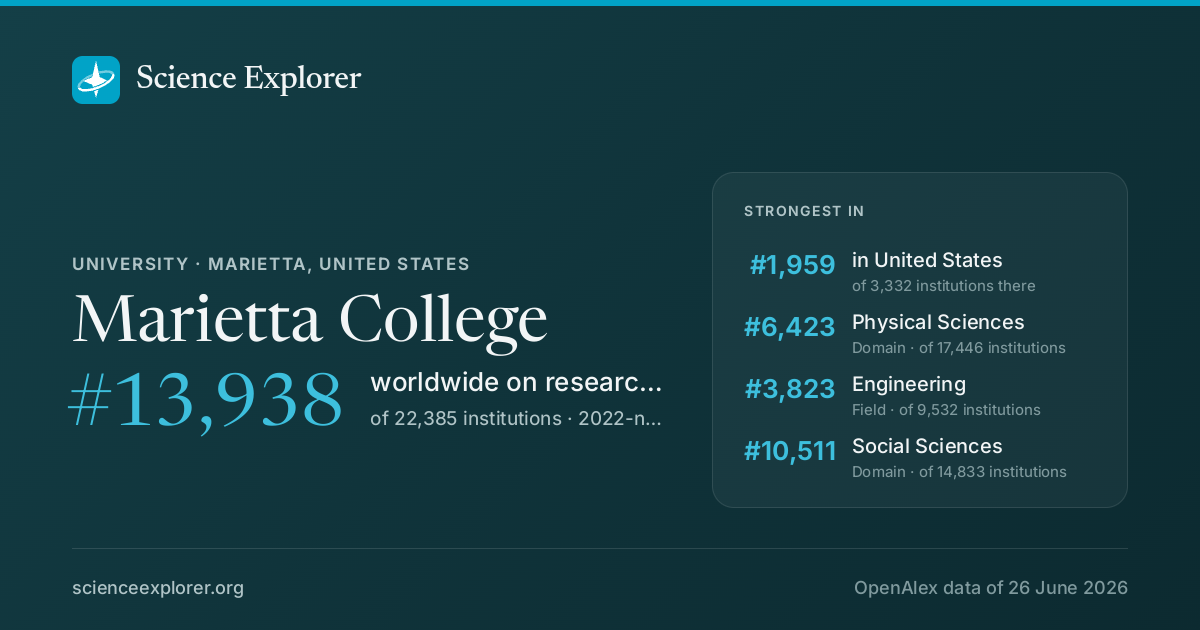
Marietta College on Science Explorer

A card with Marietta College's standing and the fields it leads in, for a post or a slide. A link to this page previews as the same card.

Download the card

1200 × 630 PNG, sized for social posts, drawn from the latest snapshot.

Badges for a website1Each links back here and updates with every snapshot

Research measures only: rankings here say nothing about teaching, admissions or student experience. Comparable institutions and collaboration partners have tabs of their own, above.

Discussion

Ask a question or share a note about Marietta College. Keep it to the research: no personal attacks, advertising or links. Any reader can report a post, which collapses it for everyone until it is opened.
