Mitsui Memorial Hospital
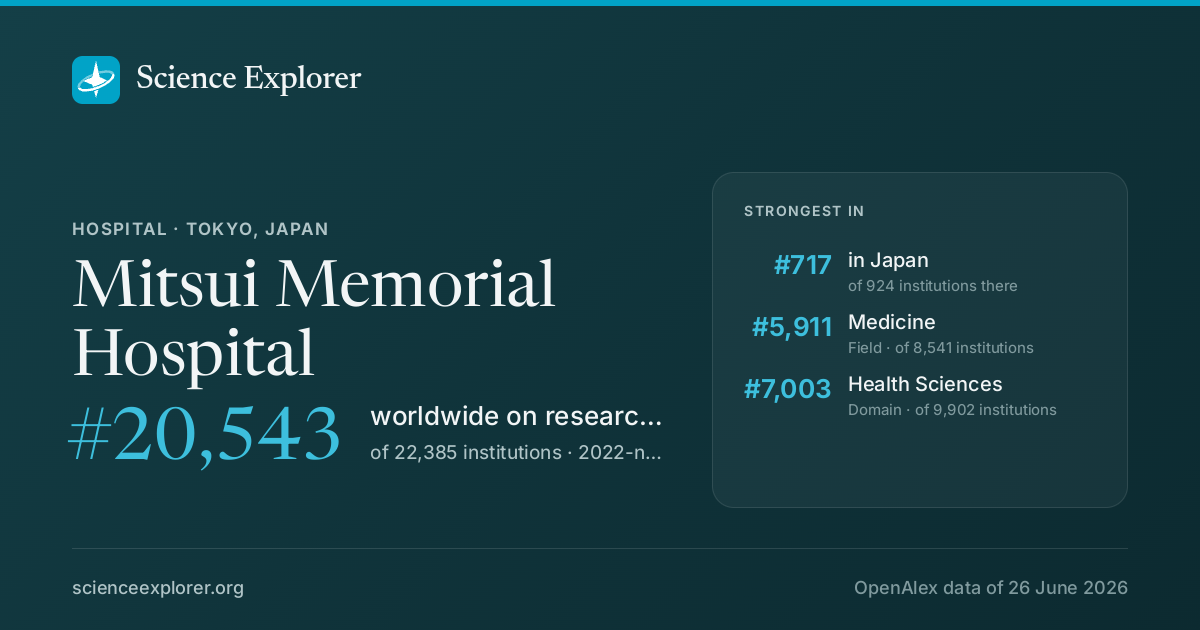
In research, Mitsui Memorial Hospital stands highest in Medicine (#5,911 of 8,541 worldwide) and Health Sciences (#7,003 of 9,902 worldwide), 2022-now. Relative to its size it is most specialised in Cardiology and Cardiovascular Medicine and Surgery (Cardiology and Cardiovascular Medicine is 17.3× its share of world research).
- World rank, 2022-now
- #20,543 of 22,385 · #23,434 all time
- Rank in Japan
- #717 of 924
- Research works
- 1.2k ▼ 11% vs 2018-21
- Citations
- 20k 17.3 per fractional work
- Top-10% rate
- 7.0% all institutions 10.0%
- vs its own fields
- 0.87× 1.00× is exactly expected
- Open access
- 47% world 40%
- International
- 7% world 18%
What is Mitsui Memorial Hospital known for in research?
The fields where it stands highest, 2022-now, ranked among every institution above the floor in each field.
| Field | World rank | Where that sits | Top-10% rate | Works | All time |
|---|---|---|---|---|---|
| MedicineField | #5,911 of 8,541 | 6.3% | 110 | #7638 | |
| Health SciencesDomain | #7,003 of 9,902 | 6.3% | 113 | #9006 |
Each strip is that field's whole ranked pool, with the notch where Mitsui Memorial Hospital sits in it, in the colour of the band that rank falls in. The track under the rate is the rate itself: it carries no average mark, because the average differs by field (from about 6% in Dentistry to 21% in Economics).
Which fields of science does Mitsui Memorial Hospital work in?
In 2022-now, 87% of research at Mitsui Memorial Hospital is in Health Sciences, 8% in Life Sciences. Its largest fields are Medicine (85%), Neuroscience (4%), Biochemistry, Genetics and Molecular Biology (3%). It does 3.5× the world's share of Health Sciences.
Each ring splits the one inside it: the four domains of science, their fields, their subfields. Size is fractional works in 2022-now. Every slice is a page; the interactive view zooms down to single topics and colours each by how much more of it this institution does than the world.
Its 4 domains and 20 fields, with their numbers
- Health Sciences12586.9%
- Medicine12285.0%
- Health Professions21.3%
- Dentistry10.4%
- Nursing00.2%
- Life Sciences128.0%
- Physical Sciences53.2%
- Engineering32.0%
- Computer Science10.4%
- Mathematics00.3%
- Materials Science00.2%
- Physics and Astronomy00.1%
- Environmental Science00.1%
- Earth and Planetary Sciences00.0%
- Social Sciences31.9%
What does Mitsui Memorial Hospital specialise in?
Where its research is concentrated relative to its size: Cardiology and Cardiovascular Medicine takes 17.3× the share of its output that it takes of world research.
- Cardiology and Cardiovascular MedicineSubfield · 26.0 works17×
- SurgerySubfield · 25.4 works7.6×
Location quotient, a volume reading rather than an impact one. It surfaces small, lopsided specialities.
Field profile
Location quotient across every field it publishes in: outside the ring is more than an institution of this size would be expected to publish, inside it is less.
Rings at 0.5×, 1× and 2×. Widest outward: Medicine, 4.4×. Every wedge is a field page.
All 20 fields, with their numbers
- Medicine4.42×122 works
- Neuroscience2.16×5 works
- Dentistry0.93×1 works
- Immunology and Microbiology0.85×1 works
- Pharmacology, Toxicology and Pharmaceutics0.66×0 works
- Biochemistry, Genetics and Molecular Biology0.60×5 works
- Health Professions0.49×2 works
- Psychology0.45×2 works
- Nursing0.38×0 works
- Mathematics0.26×0 works
- Engineering0.13×3 works
- Materials Science0.07×0 works
- Physics and Astronomy0.06×0 works
- Agricultural and Biological Sciences0.05×0 works
- Computer Science0.05×0 works
- Economics, Econometrics and Finance0.04×0 works
- Social Sciences0.03×1 works
- Environmental Science0.02×0 works
- Business, Management and Accounting0.02×0 works
- Earth and Planetary Sciences0.01×0 works
- Medicine 4.4×
- Neuroscience 2.2×
- Dentistry 0.9×
- Immunology and Microbiology 0.8×
- Pharmacology, Toxicology and Pharmaceutics 0.7×
- Biochemistry, Genetics and Molecular Biology 0.6×
- Health Professions 0.5×
- Psychology 0.5×
- Nursing 0.4×
- Mathematics 0.3×
- Engineering 0.1×
- Materials Science 0.1×
- Physics and Astronomy 0.1×
- Agricultural and Biological Sciences 0.1×
- Computer Science 0.1×
- Economics, Econometrics and Finance 0.0×
- Social Sciences 0.0×
- Environmental Science 0.0×
- Business, Management and Accounting 0.0×
- Earth and Planetary Sciences 0.0×
Who are the top researchers at Mitsui Memorial Hospital?
Ranked on the quality score, Kengo Tanabe, Masahiko Asami and Jiro Aoki lead among researchers whose main affiliation is Mitsui Memorial Hospital.
- 1
Kengo Tanabe
 Japan · #199,935 worldwide
11k citations · 258 works
- 2
Masahiko Asami
Japan · #455,960 worldwide
4.2k citations · 211 works
- 3
Jiro Aoki
Japan · #572,041 worldwide
10k citations · 237 works
- 4
Nobuo Toda
Japan · #938,812 worldwide
5.8k citations · 180 works
- 5
Takamasa Ohki
Japan · #1,173,391 worldwide
4.6k citations · 89 works
- 6
Akihiro Isogawa
Japan · #1,196,709 worldwide
1.5k citations · 43 works
- 7
Yu Horiuchi
Japan · #1,363,475 worldwide
1.4k citations · 106 works
- 8
Yoshiaki SHIMOYAMA
Japan · #1,744,840 worldwide
2.9k citations · 57 works
- 9
Kazumi Tagawa
Japan · #2,033,469 worldwide
3.1k citations · 118 works
- 10
Kazuhisa Kodama
Japan · #2,064,613 worldwide
253 citations · 28 works
Which keywords describe research at Mitsui Memorial Hospital?
By fractional works in 2022-now, weighted toward what it does more of than the world: Heart Failure, Treatment, Diagnosis, Echocardiography, Epidemiology, Guidelines, Myocardial Infarction and Cardiovascular Disease.
- Fibrosis
- Aortic Dissection
- Type 2 Diabetes
- Myocardial Perfusion
- Chronic Kidney Disease
- Cardiovascular Risk Assessment
- Surgery
- Atherosclerosis
- Radiotherapy
- Percutaneous Coronary Intervention
- Coronary Artery Disease
- Chemotherapy
- Transcatheter Aortic-Valve Replacement
- Magnetic Resonance Imaging
- Complications
- Quality of Life
- Cardiovascular Disease
- Guidelines
- Diagnosis
- Heart Failure
- Epidemiology
- Treatment
- Echocardiography
- Inflammation
- Myocardial Infarction
- Obesity
- Endovascular Repair
- Surgical Aortic-Valve Replacement
- Catheter Ablation
- Cardiac Imaging
- Cardiovascular Risk
- Neurological Disorders
- Surgical Management
- Radiation Exposure
- Clinical Guidelines
- Dilated Cardiomyopathy
- Computed Tomography Angiography
- Stroke Prevention
- Anticoagulant Therapy
- Bicuspid Aortic Valve
Size is fractional works in 2022-now in the topics tagged with each word; colour is the word's share of this institution's work against its share of the world's. The 40 words are chosen for being large and distinctive. Each links to the topic it comes from most.
All 40 words, with their numbers
- Epidemiology16▲ 2.7×43 topics
- Heart Failure14▲ 22×12 topics
- Treatment14▲ 8.1×23 topics
- Diagnosis10▲ 7.7×17 topics
- Echocardiography10▲ 25×7 topics
- Guidelines9▲ 13×7 topics
- Inflammation8▲ 2.8×31 topics
- Cardiovascular Disease8▲ 5.1×21 topics
- Myocardial Infarction8▲ 24×4 topics
- Quality of Life7▲ 3.2×19 topics
- Obesity6▲ 5.6×8 topics
- Complications6▲ 8.6×12 topics
- Endovascular Repair6▲ 47×3 topics
- Magnetic Resonance Imaging5▲ 15×4 topics
- Surgical Aortic-Valve Replacement5▲ 52×1 topic
- Transcatheter Aortic-Valve Replacement5▲ 52×1 topic
- Catheter Ablation5▲ 29×2 topics
- Chemotherapy5▲ 4.9×13 topics
- Cardiac Imaging5▲ 27×3 topics
- Coronary Artery Disease5▲ 28×2 topics
- Cardiovascular Risk5▲ 10×4 topics
- Percutaneous Coronary Intervention5▲ 24×4 topics
- Neurological Disorders4▲ 5.5×13 topics
- Radiotherapy4▲ 8.0×10 topics
- Surgical Management4▲ 7.8×11 topics
- Atherosclerosis4▲ 10×5 topics
- Radiation Exposure4▲ 29×2 topics
- Surgery4▲ 8.0×4 topics
- Clinical Guidelines4▲ 9.2×6 topics
- Cardiovascular Risk Assessment4▲ 33×2 topics
- Dilated Cardiomyopathy4▲ 38×2 topics
- Chronic Kidney Disease4▲ 10×7 topics
- Computed Tomography Angiography4▲ 40×1 topic
- Myocardial Perfusion4▲ 40×1 topic
- Stroke Prevention4▲ 21×2 topics
- Type 2 Diabetes4▲ 11×4 topics
- Anticoagulant Therapy3▲ 19×3 topics
- Aortic Dissection3▲ 56×1 topic
- Bicuspid Aortic Valve3▲ 56×1 topic
- Fibrosis3▲ 12×6 topics
Which research topics does Mitsui Memorial Hospital publish most on?
By volume in 2022-now: Cardiac Valve Diseases and Treatments, Cardiac Imaging and Diagnostics, Cardiac Structural Anomalies and Repair and Aortic Disease and Treatment Approaches.
Area is fractional works; colour is the subfield each topic belongs to.
- 1 Cardiac Valve Diseases and Treatments Cardiology and Cardiovascular Medicine 5 works
- 2 Cardiac Imaging and Diagnostics Radiology, Nuclear Medicine and Imaging 4 works
- 3 Cardiac Structural Anomalies and Repair Surgery 3 works
- 4 Aortic Disease and Treatment Approaches Pulmonary and Respiratory Medicine 3 works
- 5 Cardiovascular Function and Risk Factors Cardiology and Cardiovascular Medicine 3 works
- 6 Atrial Fibrillation Management and Outcomes Cardiology and Cardiovascular Medicine 3 works
- 7 Heart Failure Treatment and Management Cardiology and Cardiovascular Medicine 3 works
- 8 Diabetes Treatment and Management Endocrinology, Diabetes and Metabolism 2 works
- 9 Infective Endocarditis Diagnosis and Management Epidemiology 2 works
- 10 Coronary Interventions and Diagnostics Surgery 2 works
How open and international is its research?
Against the world's own shares: the tick on each track. Both are shares of its output, so they sit on one scale and can be read against each other as well as against the world.
World: 40% of research is openly available.
World: 18% is written across borders.
How has Mitsui Memorial Hospital's research output changed?
Output in 2022-2025 was 11% lower than in 2018-2021.
The same series as a ribbon: one cell per year, darker for more. The line above answers how much; this answers when.
Its share of all research
Growing output can still be a shrinking share: all of science grows. This is Mitsui Memorial Hospital as a percentage of every work published that year, 0.00060% in 2024.
Fractional works of Mitsui Memorial Hospital over all fractional works that year. How the balance of science has shifted.
How much of it reaches the world top 10%
Year by year, against all institutions in the same year.
Of each year's output, the share that reached the world's 10% most cited for its field and year. Peak 20.1% in 2012.
Other research institutions in Tokyo
- The University of Tokyo
- Tokyo Institute of Technology
- Keio University
- Waseda University
- Tokyo University of Science
- Nihon University
- Hitachi (Japan)
- NTT (Japan)


Share Mitsui Memorial Hospital's ranking
Badges for a website1Each links back here and updates with every snapshot

Research measures only: rankings here say nothing about teaching, admissions or student experience. Comparable institutions and collaboration partners have tabs of their own, above.
Discussion
Ask a question or share a note about Mitsui Memorial Hospital. Keep it to the research: no personal attacks, advertising or links. Any reader can report a post, which collapses it for everyone until it is opened.